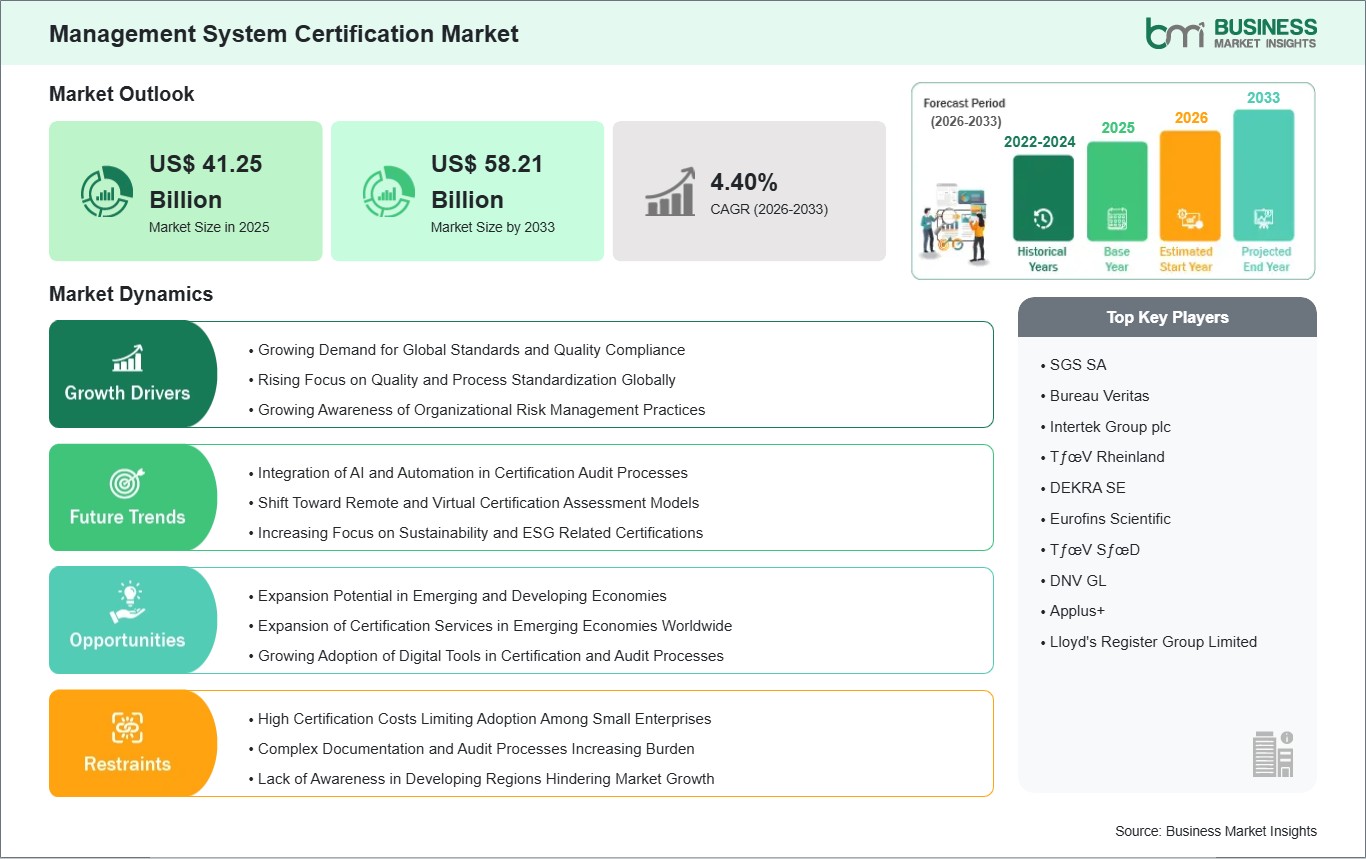
The Management System Certification Market size is expected to reach US$ 58.21 Billion by 2033 from US$ 41.25 Billion in 2025. The market is estimated to record a CAGR of 4.40% from 2026 to 2033.
The Management System Certification market is showing a consistent growth pattern, with increasing recognition of the importance of quality, efficiency, and compliance with various rules and regulations across the world. Organizations are using these certifications to ensure their business processes comply with global standards such as ISO, which reflects their commitment to quality management, environmental protection, information security, and workplace safety, among others. In today’s complex global business environment, where companies have to deal with various stakeholders, management system certification is a strategic imperative. Certifications not only help companies manage their business processes effectively, but they have also become essential tools to establish their credibility in the market, where competition is high.
Digital transformation and technological innovation have played a pivotal role in propelling the Management System Certification market. Organizations have adopted various digital tools to make certification processes more convenient, efficient, and effective. Sustainability and corporate social responsibility initiatives are also major motivating factors, where companies strive to prove their environmental and social accountability, while at the same time minimizing their business risks.
Globalization is yet another factor that has increased demand even further, where companies across North America, Europe, Asia Pacific, the Middle East, Africa, and South and Central America strive to attain internationally recognized certifications to ensure consistency, reliability, and trust. However, there are certain challenges associated with this market. The process is not only time-consuming, resource-intensive, and expensive, which is creating challenges, especially for small and medium-sized enterprises. In addition, changes to standards and legislative requirements require constant changes, which is adding pressure to organizational resources. However, the global Management System Certification market is still growing as more and more businesses are realizing the importance of such certifications not merely as a regulatory requirement but also as a business tool for success in the modern global economy.

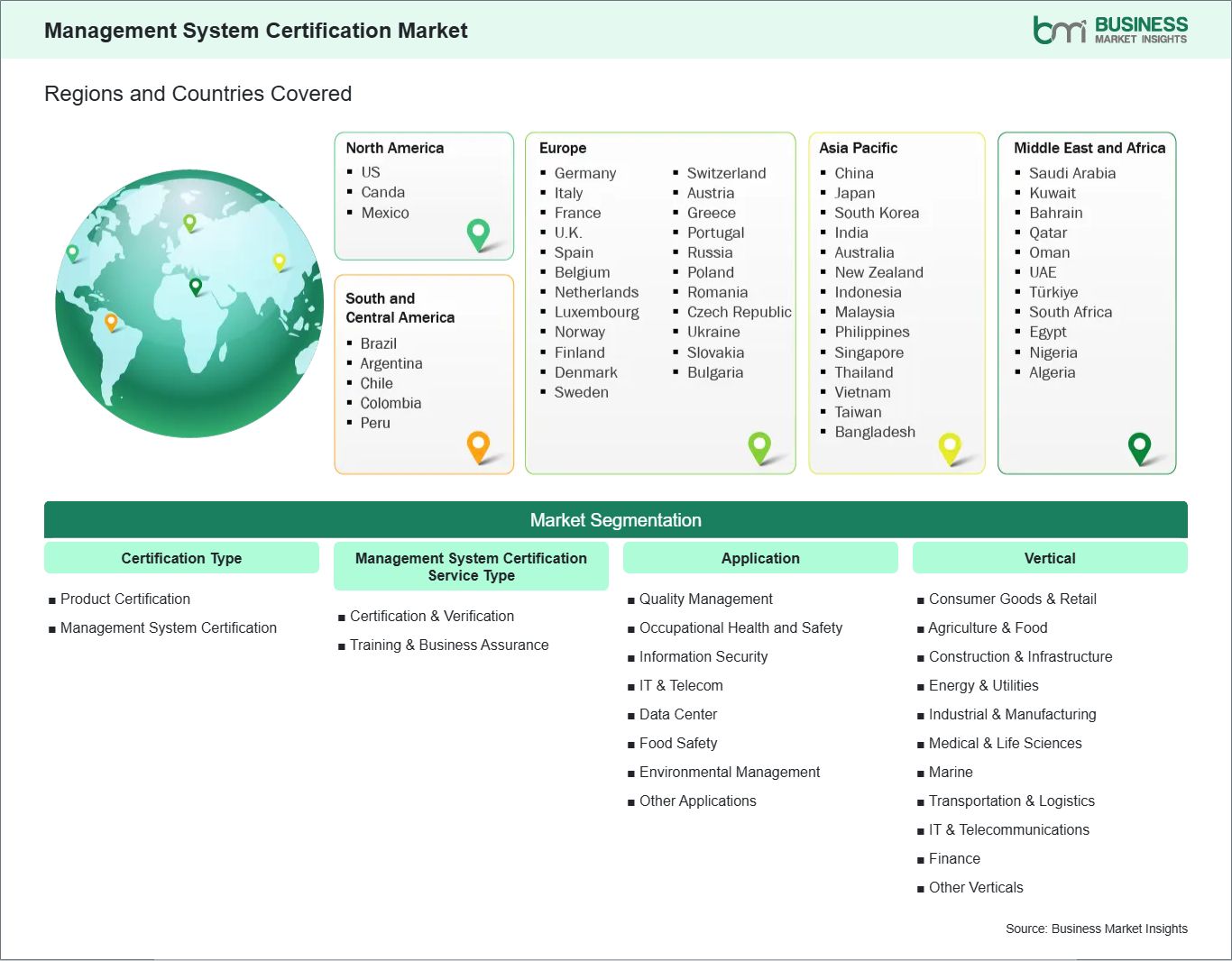
Key segments that contributed to the derivation of the management system certification market analysis are certification type, management system certification service type, application and vertical.
With the growth of global business networks, organizations are increasingly relying on internationally recognized management system certifications as a way of ensuring quality and operational efficiency. For organizations operating in multiple countries around the world, internationally recognized management system certifications are a vital tool for streamlining internal processes and ensuring the smooth delivery of products and services. For instance, the automobile industry, the manufacturing industry, and the consumer goods industry are some of the sectors that are using internationally recognized management system certifications as a way of reinforcing credibility with customers and other stakeholders. Another factor that has contributed to the growth of internationally recognized management system certifications is the alignment of regulations in different countries.
For instance, the pharmaceutical industry, the aerospace industry, and the food industry are some of the sectors that are heavily regulated and are required to comply with global regulations. For these organizations, internationally recognized management system certifications are a vital tool for ensuring that they are in compliance with global regulations and are meeting their regulatory requirements. Apart from regulatory compliance, internationally recognized management system certifications are also a vital tool for organizations seeking to boost their brand reputation.
Emerging and developing regions have become important growth drivers in the management system certification market. Companies in Southeast Asia, Latin America, and some African nations are increasingly seeking management system certifications to participate in international trade and collaborate with multinational corporations. In some cases, it serves as a gateway for these organizations to participate in international business and collaborate with multinational corporations on a level playing field with other international companies. Other factors include rapid industrialization and development in sectors such as technology services, infrastructure development, and manufacturing in developing and emerging nations. Companies in developing and emerging nations are increasingly seeking management system certifications to collaborate with international companies in investment opportunities and joint ventures. In some cases, service-oriented sectors are seeking quality and data security certifications to meet international client demands and explore international business opportunities in a global marketplace.
The management system certification market demonstrates steady growth, with size and share analysis highlighting evolving trends and competitive dynamics among key players. The report examines subsegments categorized within certification type, management system certification service type, application and vertical, offering insights into their contribution to overall market performance.
By certification type, the product certification subsegment dominated the market in 2025, driven by stringent regulatory requirements and increasing emphasis on verified product quality and compliance across industries.
Based on management system certification service type, the certification & verification subsegment dominated the market in 2025, driven by growing demand for independent third-party validation of management systems to ensure transparency and adherence to standards.
On the basis of application, the quality management subsegment dominated the market in 2025, driven by widespread adoption of ISO 9001 standards to enhance operational efficiency and meet customer and regulatory requirements.
In terms of vertical, the consumer goods & retail subsegment dominated the market in 2025, driven by high demand for quality, safety, traceability, and sustainability certifications in products for end consumers.
| Report Attribute | Details |
|---|---|
| Market size in 2025 | US$ 41.25 Billion |
| Market Size by 2033 | US$ 58.21 Billion |
| Global CAGR (2026 - 2033) | 4.40% |
| Historical Data | 2022-2024 |
| Forecast period | 2026-2033 |
| Segments Covered | By Certification Type
|
|
Regions and Countries Covered
| |
| North America | US, Canada, Mexico |
| Europe | Belgium, Austria, Finland, Denmark, Greece, Poland, Romania, Russia, Ukraine, Czech Republic, Slovakia, Bulgaria, Italy, Luxembourg, Germany, Switzerland, France, Netherlands, Norway, Portugal, Spain, Sweden, United Kingdom |
| Asia-Pacific | Australia, China, India, Japan, South Korea, Indonesia, Malaysia, Philippines, Singapore, Thailand, Vietnam, Bangladesh, New Zealand, Taiwan |
| South and Central America | Brazil, Argentina, Peru, Chile, Colombia |
| Middle East and Africa | Bahrain, Kuwait, Oman, Qatar, Saudi Arabia, United Arab Emirates, Turkiye, South Africa, Egypt, Algeria, Nigeria |
| Market leaders and key company profiles |
|
The "Management System Certification Market Size and Forecast (2022 - 2033)" report provides a detailed analysis of the market covering below areas:
The geographical scope of the Management System Certification Market report is divided into North America, Asia Pacific, Europe, Middle East & Africa, and South & Central America. North America held the largest share in 2025.
The global Management System Certification market is characterized by various regional factors, with North America maintaining its position of dominance due to well-established regulatory environments, high levels of compliance with international standards, and strong infrastructural support for quality, environmental, and safety management system certifications. Organizations here view management system certifications as essential tools for achieving business benefits, such as improved business efficiency, compliance, and trust-building with global business partners, especially through technological solutions to streamline audit processes and ensure compliance.
The European region is characterized by a mature market with high levels of regulation, sustainability, and quality management, where businesses view management system certifications as essential tools to ensure competitiveness in global supply chains while adhering to environmental and social governance requirements. In the Asia Pacific region, there is a high growth rate of management system certification, driven by increasing industrial activities, growth of IT and services, and emphasis on business excellence and safety management.
The emerging economies are increasingly adopting international standards in their local business practices, which is providing a boost to their credibility. The Middle East and African economies are growing, with industrial modernization, infrastructure development, and an increased focus on occupational health, safety, and environment regulations. However, the lack of a coherent regulatory system and awareness is an area of concern.
South and Central America are steadily moving forward with an increased adoption of certifications, driven by industrialization, integration into the global supply chain, and the need to comply with international quality and safety standards, despite cost constraints. Management system certifications are being recognized across the regions as a strategic tool for business success, as opposed to mere compliance, with a lead by the North American region, followed by others.

The Management System Certification Market is evaluated by gathering qualitative and quantitative data post primary and secondary research, which includes important corporate publications, association data, and databases. A few of the key developments in the management system certification market are:
The Management System Certification Market is valued at US$ 41.25 Billion in 2025, it is projected to reach US$ 58.21 Billion by 2033.
As per our report Management System Certification Market, the market size is valued at US$ 41.25 Billion in 2025, projecting it to reach US$ 58.21 Billion by 2033. This translates to a CAGR of approximately 4.40% during the forecast period.
The Management System Certification Market report typically cover these key segments-
The historic period, base year, and forecast period can vary slightly depending on the specific market research report. However, for the Management System Certification Market report:
The Management System Certification Market is populated by several key players, each contributing to its growth and innovation. Some of the major players include:
The Management System Certification Market report is valuable for diverse stakeholders, including:
Essentially, anyone involved in or considering involvement in the Management System Certification Market value chain can benefit from the information contained in a comprehensive market report.
Please tell us your area of interest
(Market Segments/ Regions and Countries/ Companies)