Market Summary
Executive Summary and Global Market Analysis
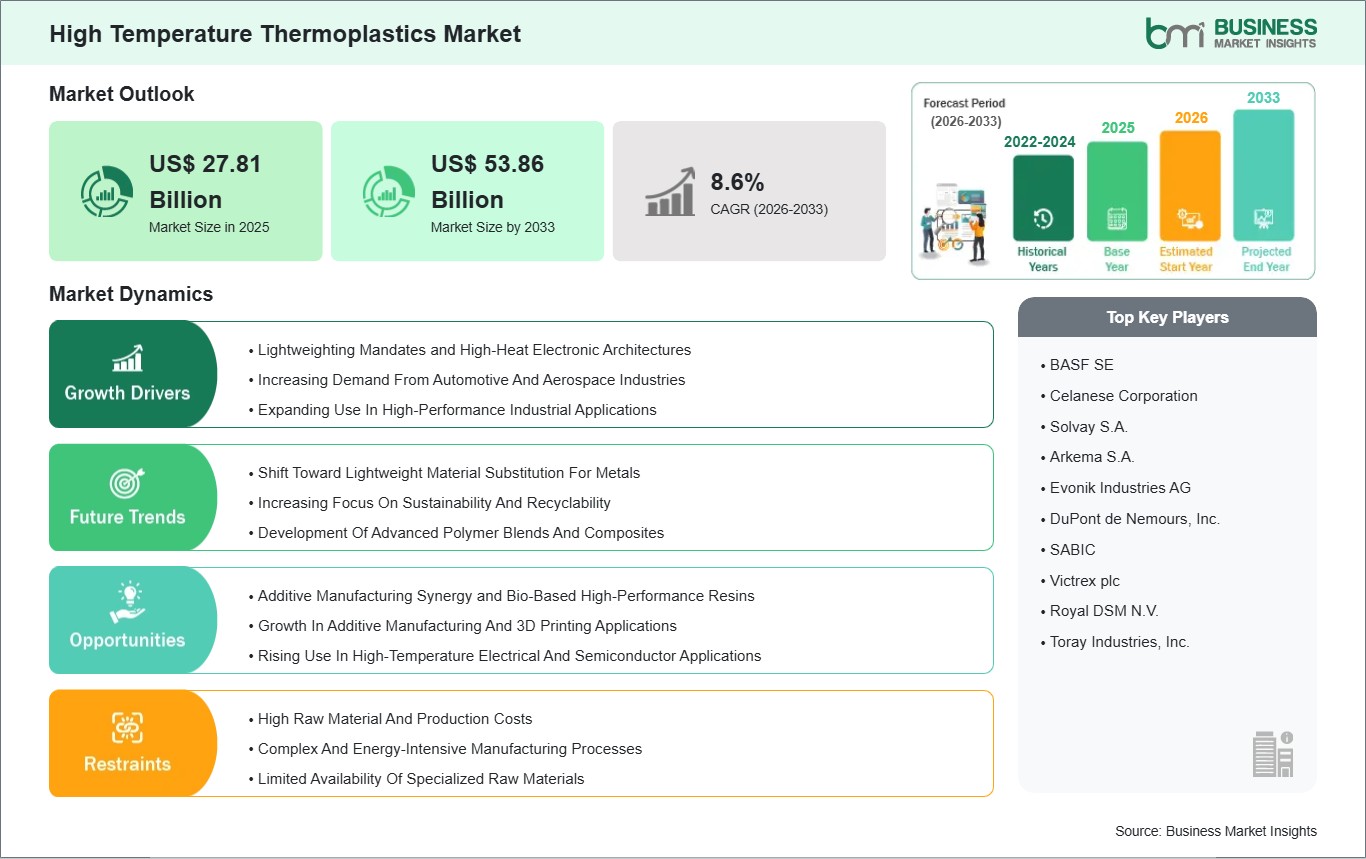
High-temperature thermoplastics (HTTs) refer to a specialized class of advanced polymers engineered to maintain their mechanical integrity, chemical resistance, and dimensional stability while operating at continuous temperatures exceeding 150°C or 160°C. These materials are characterized by high glass transition temperatures and melting points, allowing them to replace metals in extreme environments. Market progression is fundamentally propelled by the escalating demand for lightweighting in the transportation and aerospace sectors to enhance fuel efficiency and reduce carbon emissions. Furthermore, the rapid global transition toward electrification, specifically the requirement for heat-stable battery enclosures and high-voltage connectors, serves as a primary catalyst for sustained demand.
However, several factors may restrain market development. The immense raw material and compounding costs associated with these high-performance resins can be prohibitive compared to standard engineering plastics. Stringent processing requirements, necessitating specialized high-temperature injection molding and extrusion equipment, involve significant capital expenditure for manufacturers. Additionally, the industry faces challenges related to recycling and circular economy initiatives, as the complex molecular structures and fiber reinforcements of HTTs complicate traditional reprocessing methods.
Despite these hurdles, the market holds significant opportunities in the expansion of 3D printing and additive manufacturing, which allow for the production of complex, high-heat geometries without expensive tooling. The rise of 5G infrastructure and electronics miniaturization, requiring materials that can withstand high-heat PCB assembly reflow, is expected to support long-term development. Manufacturers are also finding growth potential in the medical sector, where the demand for biocompatible, radiolucent, and autoclavable implants continues to rise.
Segment Analysis
High Temperature Thermoplastics Market Segmentation
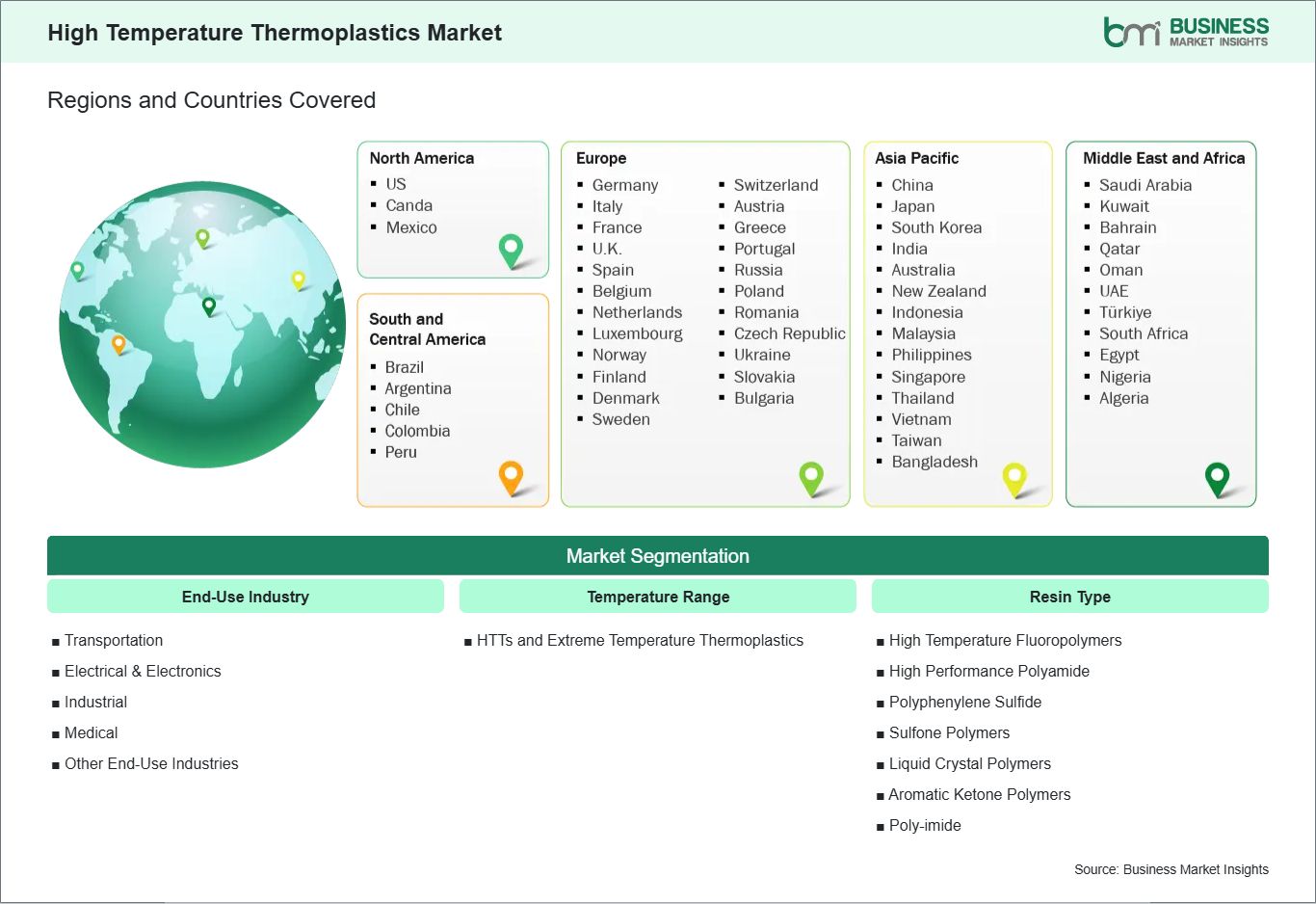
Key segments that contributed to the derivation of the High Temperature Thermoplastics market analysis are end-use industry, temperature range, and resin type.
- By End-Use Industry, the market is segmented into Transportation, Electrical & Electronics, Industrial, Medical, and Others.
- By Temperature Range, the market is divided into HTTs (Range 302˚F-449.6˚F) and Extreme Temperature Thermoplastics (Range >449.6˚F).
- By Resin Type, the market is categorized into High Temperature Fluoropolymers (High Temperature FPs), High Performance Polyamide (HPPA), Polyphenylene Sulfide (PPS), Sulfone Polymers (SP), Liquid Crystal Polymers (LCP), Aromatic Ketone Polymers (AKP), and Poly-imide (PI).
Market Forces
High Temperature Thermoplastics Market Drivers and Opportunities
Lightweighting Mandates and High-Heat Electronic Architectures
The primary driver for the High Temperature Thermoplastics Market is the systemic global requirement for lightweight materials to enhance energy efficiency across the transportation and industrial sectors. The Mandatory Reduction of Vehicle Emissions and the Transition to Electric Mobility acts as a foundational catalyst, as HTTs enable the replacement of heavier aluminum and steel parts, directly extending the range of electric vehicles (EVs). This momentum is further propelled by Stringent Aerospace Performance Standards; the imperative to reduce aircraft fuel consumption drives the continuous integration of PEEK and PEKK in structural and interior components that must withstand extreme thermal cycling. In the technological sphere, the Miniaturization of Electronics and the Advent of 5G/6G Infrastructure serves as a vital driver, as high-frequency communication modules generate significant heat, necessitating substrates with exceptional thermal stability and dielectric properties. Furthermore, the Documented Longevity and Chemical Inertness of HTTs in Oil and Gas Exploration encourage their use in deep-sea and high-pressure-high-temperature (HPHT) environments, where material failure results in catastrophic operational costs. Together, these factors, energy efficiency, high-heat electronics, and extreme-environment durability, ensure a robust and essential growth path for the global High Temperature Thermoplastics Market.
Additive Manufacturing Synergy and Bio-Based High-Performance Resins
A significant high-value opportunity lies in the convergence of High Temperature Thermoplastics with Industrial Additive Manufacturing (3D Printing). Next-generation PEEK and PEKK filaments are being developed to allow for the rapid prototyping and low-volume production of complex, functional aerospace and medical parts, significantly reducing lead times and material waste compared to traditional subtractive machining. There is also a major growth frontier in the development of Advanced Biocompatible Thermoplastics for Medical Implants and Surgical Instrumentation; as the demand for minimally invasive surgery grows, HTTs provide the necessary radiolucency and sterilization resistance (via autoclave) required for modern orthopedic and spinal applications. Furthermore, the expansion of Sustainable and Bio-Based High-Performance Formulations presents a lucrative opportunity, as manufacturers seek to align with global circular economy goals by introducing recyclable or renewably sourced high-temp resins. Beyond the hardware, the rise of Integrated Smart Thermoplastics with Conductive Fillers offers a unique frontier, enabling the creation of components with built-in electromagnetic interference (EMI) shielding or structural health monitoring capabilities. Manufacturers who focus on Customizable Polymer Blends for Specific Thermal Profiles and those pioneering Advanced Recycling Technologies for HTT Scrap are positioned to lead the global High Temperature Thermoplastics Market.
Size and Share Analysis
High Temperature Thermoplastics Market Size and Share Analysis
Based on the resin type, the Polyphenylene Sulfide (PPS) and High-Performance Polyamide (HPPA) subsegments hold the primary market presence, functioning as the foundational resins for high-volume industrial and automotive parts due to their excellent chemical resistance and mechanical strength. Sulfone Polymers (SP) and High Temperature Fluoropolymers provide critical support in filtration and electrical insulation. A notable trend is the surge in the Aromatic Ketone Polymers (AKP, including PEEK) and Liquid Crystal Polymers (LCP) subsegments, which are registering a higher pace of adoption. These resins are becoming essential for Precision Miniaturization and High-End Performance, where the strategic shift toward compact 5G hardware and advanced medical devices drives the demand for materials with exceptional dimensional stability and fine-feature moldability.
Report Coverage
High Temperature Thermoplastics Market Report Coverage and Deliverables
The "High Temperature Thermoplastics Market Size and Forecast (2022 - 2033)" report provides a detailed analysis of the market covering below areas:
- Market size and forecast at global, regional, and country levels for all market segments covered under the scope
- Market trends, as well as drivers, restraints, and opportunities
- Market analysis covering key trends, global and regional framework, major players, and recent developments
- Market concentration, heat map analysis, prominent players, and recent developments
- Detailed company profiles, including SWOT analysis
Geographic Insights
High Temperature Thermoplastics Market Geographic Insights
The geographical scope of the High Temperature Thermoplastics market report is divided into five regions: North America, Asia Pacific, Europe, Middle East & Africa, and South & Central America.
The Asia-Pacific High Temperature Thermoplastics Market is a central hub for global production and consumption. China serves as a primary engine for regional expansion, supported by large-scale government initiatives to modernize industrial manufacturing and a significant volume of domestic production for high-heat circuit boards and connectors. India and Japan continue to lead in the development of sophisticated polymer applications, prioritizing thermal stability for medical sterilization and advanced semiconductor processing equipment.
Market progression is further supported by a transition toward bio-based high-performance polymers and additive manufacturing (3D printing), which facilitate the production of complex, functional parts with minimal material wastage. The increasing adoption of electric vehicle (EV) battery components and miniaturized electronic devices, alongside strategic investments in aerospace lightweighting, solidifies Asia Pacific as a vital region for the evolution and future scaling of the High Temperature Thermoplastics market.
Industry Activity
Recent Developments
The High Temperature Thermoplastics market is evaluated by gathering qualitative and quantitative data post primary and secondary research, which includes important corporate publications, association data, and databases. A few of the key developments in the High Temperature Thermoplastics market are:
- In May 2024, APS Elastomers launched a high-temperature TPU product line with improved melting temperature, enhanced modulus stability, and superior resilience for extreme conditions. This launch expands high-temperature thermoplastic applications and reinforces innovation in the high-performance polymer market.
- In September 2024, Toray Advanced Composites launched Toray Cetex® TC1130 PESU, a high-performance thermoplastic composite for aerospace interiors. The material offers lightweight, recyclable, and high-temperature performance, supporting sustainability and innovation in the high-temperature thermoplastic market.
Trust & Transparency
Research Methodology
The market analysis combines proprietary research with secondary data from government agencies, company disclosures, regulatory filings, industry databases and expert interviews. Market estimates are validated through data triangulation, cross-market benchmarking and analyst
review.
View Full Research Methodology
Key Sources Referred:
World Bank & Global Trade Indicators World Trade Organization (WTO) (International Monetary Fund )IMF International Trade Administration (ITA) Company website Company annual reports Company investor presentations