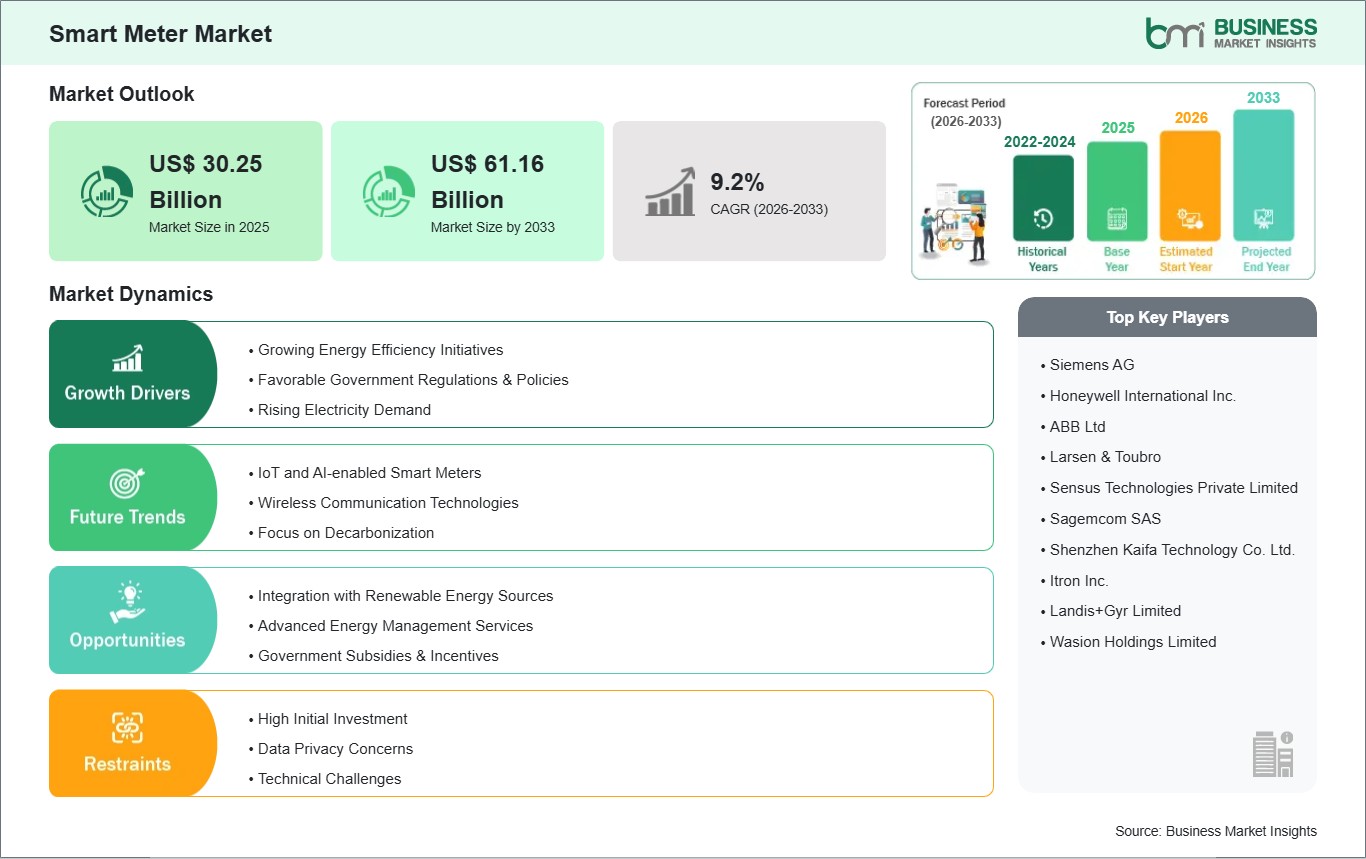
The smart meter market size is expected to reach US$ 61.16 billion by 2033 from US$ 30.25 billion in 2025. The market is estimated to record a CAGR of 9.2% from 2026 to 2033.
A smart meter is an advanced electronic device that records electricity, gas, or water consumption in real time and communicates this data directly to utility providers, enabling more efficient energy management and billing. Unlike traditional meters, smart meters offer accurate readings, automated billing, and the ability to monitor usage patterns, helping consumers optimize energy consumption. The benefits of smart meters include reduced energy costs, improved grid reliability, faster outage detection, and support for renewable energy integration. They also empower consumers with detailed insights into their usage, promoting energy conservation and sustainability. Smart meters find applications in residential, commercial, and industrial sectors, enhancing utility operations, demand-side management, and facilitating dynamic pricing models.
The demand factors driving the smart meter market are diverse. Key drivers include rising energy consumption, the need for efficient grid management, government initiatives promoting energy efficiency, and advancements in IoT and communication technologies. Restraints involve high installation costs, data privacy concerns, and lack of awareness among consumers. Opportunities exist in emerging economies, renewable energy integration, and smart city initiatives, while trends include the adoption of advanced metering infrastructure (AMI), digital twin technologies, and AI-driven energy analytics. Collectively, these factors are propelling the global growth of the smart meter market.

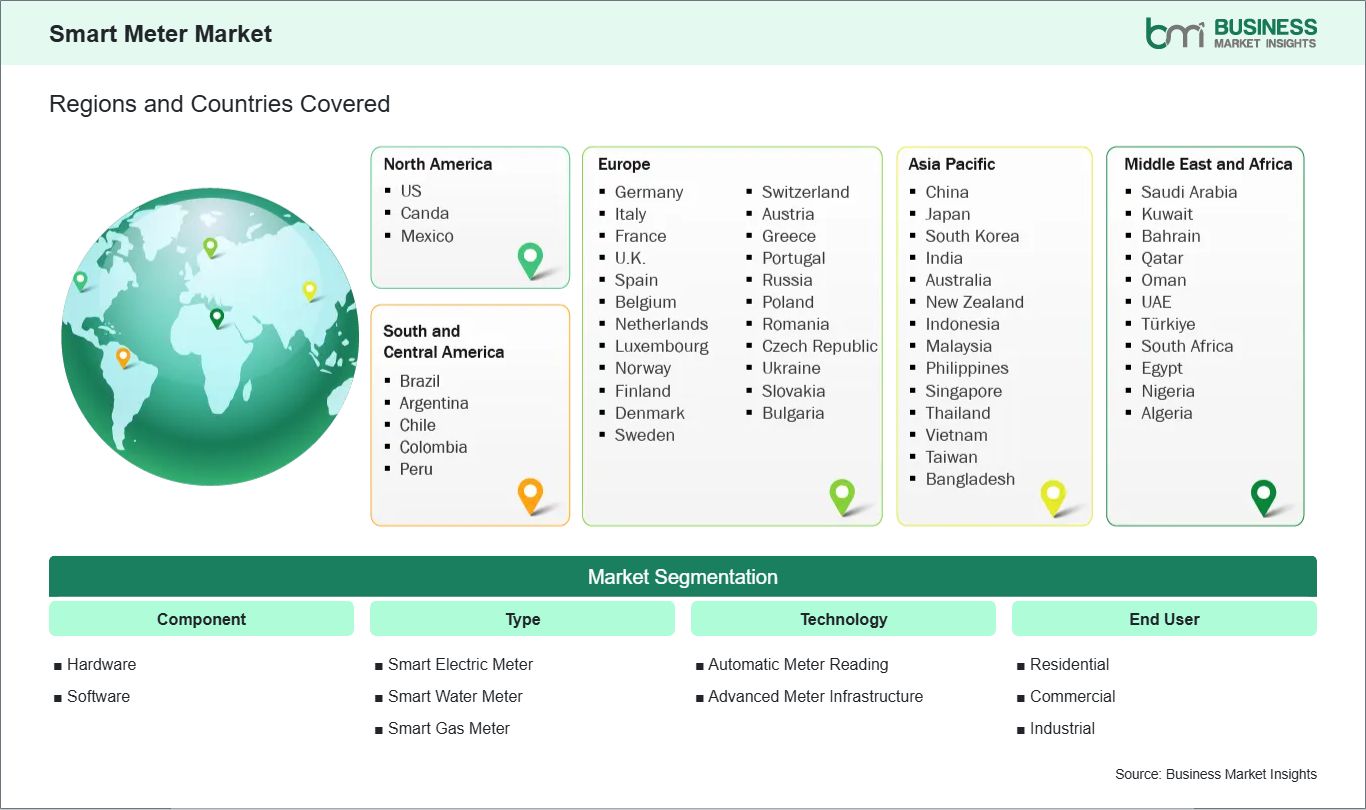
Key segments that contributed to the derivation of the smart meter market analysis are component, type, technology, and end user.
The rising electricity demand is a key driver of the smart meter market, primarily due to rapid urbanization, industrialization, and the increasing adoption of electronic devices in both residential and commercial sectors. As populations grow and economies expand, the consumption of electricity escalates, putting pressure on utilities to manage energy supply efficiently. Traditional meters, which provide only periodic readings, are inadequate for handling such dynamic demand patterns, leading to inefficiencies, higher operational costs, and increased energy losses. Smart meters address these challenges by enabling real-time monitoring, two-way communication, and precise measurement of electricity consumption. This allows utility companies to optimize load management, detect outages promptly, and implement demand response strategies. Additionally, as renewable energy sources and decentralized power generation become more prevalent, smart meters help integrate these variable sources into the grid, ensuring stability and reliability.
Furthermore, consumers are becoming more energy-conscious, seeking detailed insights into their usage patterns to reduce costs and environmental impact. Smart meters provide this granular data, empowering informed decision-making. Overall, the surge in electricity demand necessitates advanced metering infrastructure, positioning smart meters as an essential solution for efficient energy management, grid modernization, and sustainable growth in power systems.
The global shift toward renewable energy sources, such as solar, wind, and hydropower, is transforming the energy landscape, creating a significant opportunity for smart meters. Renewable energy systems are inherently variable and decentralized, with energy generation fluctuating based on weather conditions and time of day. Traditional energy grids, designed for consistent, centralized power supply, struggle to accommodate these fluctuations efficiently. Smart meters address this challenge by providing real-time monitoring and data analytics, enabling utilities and consumers to track energy consumption patterns and generation in a highly granular manner.
By integrating with renewable energy sources, smart meters facilitate bidirectional energy flow, allowing households and businesses with solar panels or other distributed energy resources to feed surplus energy back into the grid. This enhances grid stability and ensures optimal energy utilization. Moreover, smart meters support dynamic pricing models and demand response programs, incentivizing users to consume energy during off-peak periods or when renewable generation is high.
The rising adoption of green energy policies and carbon reduction initiatives globally further fuels the demand for smart metering solutions. Utilities increasingly rely on smart meters to manage decentralized energy resources efficiently, reduce energy losses, and improve operational reliability. Consequently, the integration of renewable energy sources acts as a key driver of smart meter market growth, as it not only enables efficient energy management but also aligns with global sustainability goals, accelerating the transition to a cleaner, smarter, and more resilient energy ecosystem.

By component, the smart meter market is divided into hardware and software. The hardware segment dominated the market in 2025. The hardware segment in the smart meter market is driven by factors such as hardware advancements, including sensors, communication modules, and metering devices, enhance smart meter accuracy, reliability, and integration with IoT networks. Improved hardware efficiency reduces costs and deployment complexity, directly driving adoption and accelerating smart meter market growth globally.
By type, the market is segmented into smart electric meter, smart water meter, and smart gas meter. The smart electric meter segment held the largest share of the market in 2025. A smart electric meter is an advanced device that digitally records electricity usage in real time, enabling remote monitoring, accurate billing, and energy management. Rising demand stems from energy efficiency goals, government initiatives, and the shift toward smart grids.
By technology, the market is segmented into automatic meter reading (AMR) and advanced meter infrastructure (AMI). The grid-connected segment held the largest share of the market in 2025. AMR is a technology that remotely collects consumption data from utilities like electricity, gas, or water meters. Growing demand in the smart meter market is driven by efficiency, real-time monitoring, reduced operational costs, and enhanced energy management.
By end user, the market is segmented into residential, commercial, and industrial. The residential segment held the largest share of the market in 2025. The increasing demand for smart meters in residential areas is driven by energy efficiency, real-time usage monitoring, accurate billing, and integration with renewable energy sources, allowing homeowners to reduce costs, manage consumption, and support sustainable energy initiatives effectively.
| Report Attribute | Details |
|---|---|
| Market size in 2025 | US$ 30.25 Billion |
| Market Size by 2033 | US$ 61.16 Billion |
| Global CAGR (2026 - 2033) | 9.2% |
| Historical Data | 2022-2024 |
| Forecast period | 2026-2033 |
| Segments Covered | By Component
|
| Regions and Countries Covered | North America
|
| Market leaders and key company profiles |
|
The "Smart Meter Market Size and Forecast (2022–2033)" report provides a detailed analysis of the market covering below areas:
The geographical scope of the smart meter market report is divided into five regions: North America, Asia Pacific, Europe, Middle East & Africa, and South & Central America. The smart meter market in Asia Pacific is expected to grow significantly during the forecast period.
The Asia-Pacific smart meter market is segmented into China, Japan, South Korea, India, Australia, New Zealand, Indonesia, Malaysia, the Philippines, Singapore, Thailand, Vietnam, Taiwan, Bangladesh, and the Rest of Asia. The growth of the smart meter market in the Asia Pacific region is being strongly driven by increasing demand factors that reflect both technological advancement and evolving energy consumption patterns. One of the primary demand factors is the rising need for efficient energy management and accurate billing systems. As urbanization accelerates across countries like China, India, and Japan, electricity consumption is growing rapidly, creating pressure on utilities to monitor usage in real-time and reduce energy losses. Smart meters enable utilities to collect precise data, detect theft, and improve load management, directly addressing these challenges.
Additionally, government initiatives and regulatory frameworks aimed at promoting renewable energy integration and reducing carbon emissions are fueling market demand. Policies that encourage energy conservation, such as subsidies for smart grid implementation or mandatory smart meter rollouts, are compelling both residential and commercial consumers to adopt smart metering solutions. Another significant factor is the rising awareness among consumers about energy efficiency and cost savings. With advanced features such as remote monitoring, usage analytics, and time-of-use billing, smart meters allow consumers to optimize their energy consumption, thereby generating greater demand. Furthermore, the growth of IoT infrastructure and advancements in wireless communication technologies facilitate the deployment and connectivity of smart meters, making them more accessible and reliable. Rapid industrialization, coupled with the expansion of smart city projects in the region, is also contributing to a surge in demand, as urban planners and energy providers seek modern, scalable solutions to manage complex energy networks efficiently. Collectively, these factors create a strong demand-driven momentum for the smart meter market across Asia Pacific.

The smart meter market is evaluated by gathering qualitative and quantitative data post primary and secondary research, which includes important corporate publications, association data, and databases. A few of the key developments in the smart meter market are:
The Smart Meter Market is valued at US$ 30.25 Billion in 2025, it is projected to reach US$ 61.16 Billion by 2033.
As per our report Smart Meter Market, the market size is valued at US$ 30.25 Billion in 2025, projecting it to reach US$ 61.16 Billion by 2033. This translates to a CAGR of approximately 9.2% during the forecast period.
The Smart Meter Market report typically cover these key segments-
The historic period, base year, and forecast period can vary slightly depending on the specific market research report. However, for the Smart Meter Market report:
The Smart Meter Market is populated by several key players, each contributing to its growth and innovation. Some of the major players include:
The Smart Meter Market report is valuable for diverse stakeholders, including:
Essentially, anyone involved in or considering involvement in the Smart Meter Market value chain can benefit from the information contained in a comprehensive market report.
Please tell us your area of interest
(Market Segments/ Regions and Countries/ Companies)