Market Summary
Executive Summary and Global Market Analysis
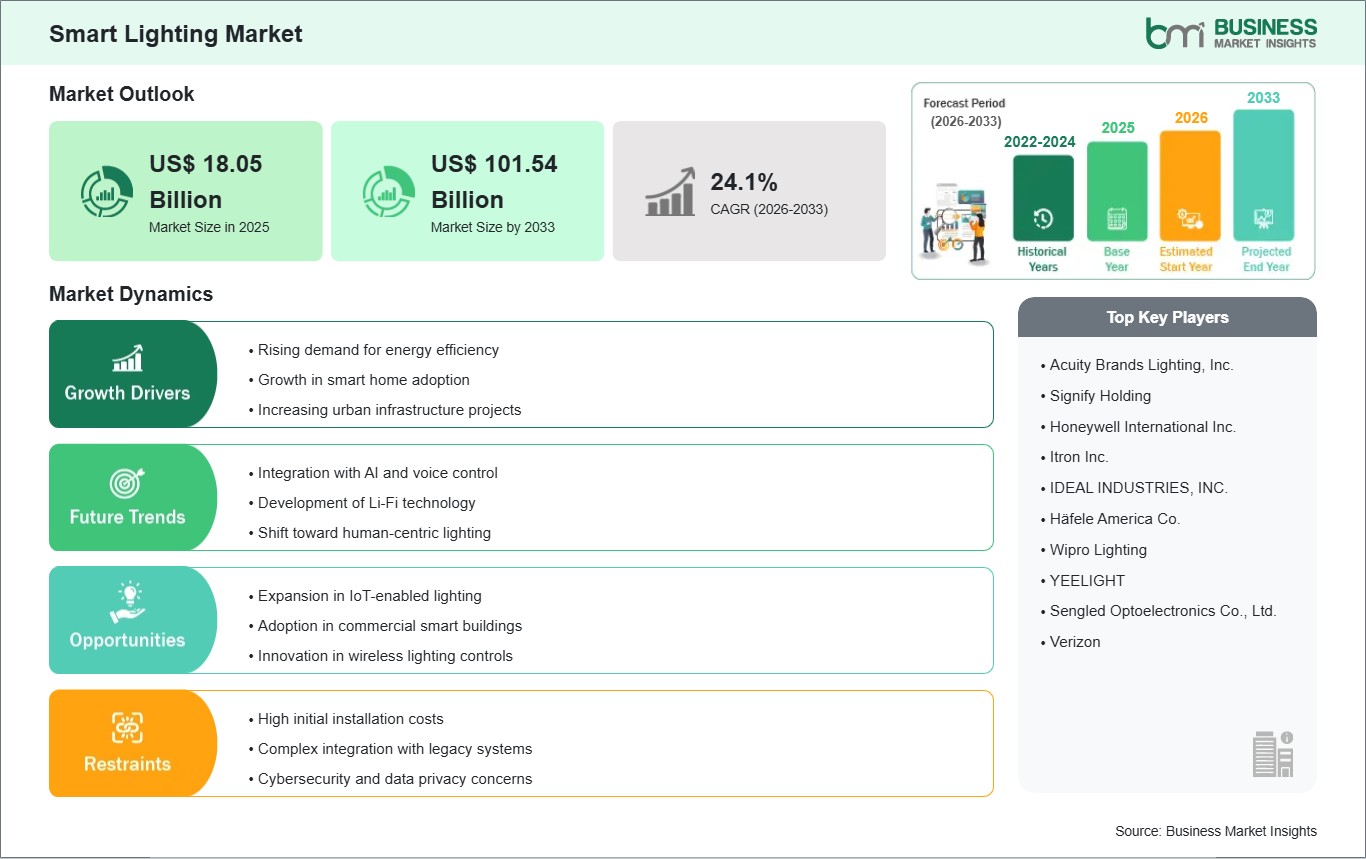
Smart Lighting systems use advanced lighting technologies, primarily LEDs, combined with embedded sensors, controllers, and network connectivity (IoT) to enable features like remote control, automated dimming, color customization, and adaptive illumination based on occupancy and ambient light levels. These systems are key components of smart homes, smart commercial buildings, and smart city infrastructure.
The Smart Lighting Market is undergoing robust expansion, driven by the global focus on energy efficiency and sustainability and the rapid adoption of IoT-enabled smart home and commercial automation systems. Smart lighting solutions significantly reduce energy consumption, lower maintenance costs, and provide enhanced user convenience and aesthetic control, making them a preferred choice across residential, commercial, and municipal applications worldwide.
Segment Analysis
Smart Lighting Market Segmentation
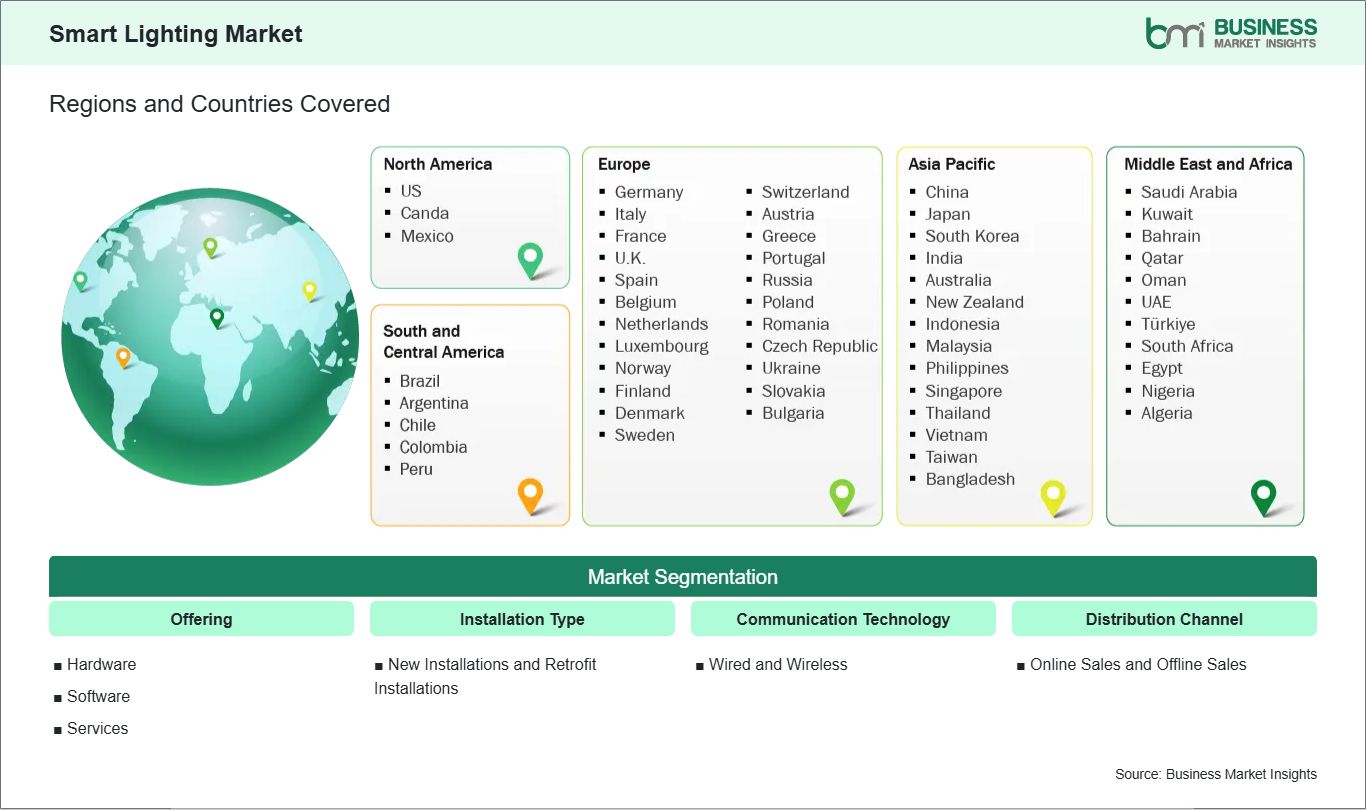
Key segments that contributed to the derivation of the Smart Lighting Market analysis are offering, installation type, communication technology, and distribution channel.
- By Offering, the market is segmented into Hardware, Software, and Services.
- By Installation Type, the market is bifurcated into New Installations and Retrofit Installations.
- By Communication Technology, the market is segmented into Wired and Wireless.
- By Distribution Channel, the market is bifurcated into Online Sales and Offline Sales.
Market Forces
Smart Lighting Market Drivers and Opportunities
Growing Global Emphasis on Energy Efficiency and Regulatory Support
The most significant driver is the global transition toward energy-efficient practices supported by stringent governmental mandates and rising energy costs. Traditional lighting consumes a substantial portion of a building's electricity. Smart LED lighting offers an immediate and significant reduction in energy consumption through automation features like occupancy sensing and daylight harvesting.
Governments in regions like Europe and North America are actively promoting the adoption of smart lighting through incentives, rebates, and energy efficiency standards. This regulatory push accelerates the replacement of conventional lighting with smart LED-based systems in both new construction and retrofit projects, forcing commercial and industrial sectors, in particular, to adopt connected lighting to comply with environmental and sustainability goals.
Massive Upscaling of Smart City Projects in Emerging Economies
The Smart City projects, particularly within the Asia Pacific region (such as China, India, and South Korea), provide an enormous structural opportunity for the Smart Lighting Market growth, with smart city infrastructure becoming a prominent platform to support overall IoT implementations.
Smart street lights are not merely energy-efficient lighting solutions. They are networked, integrated nodes comprising sensors for air quality index, public Wi-Fi connectivity, surveillance cameras, as well as traffic control. The intersection of these functionalities turns an entire lighting solution into a vital component of smart infrastructural development. The sheer scale of municipal and public infrastructure upgrades required for these projects, combined with substantial government financial investments, guarantees large, sustained contract opportunities for smart lighting solution providers for the next decade.
Size and Share Analysis
Smart Lighting Market Size and Share Analysis
The Smart Lighting Market demonstrates consistent growth, with size and share analysis revealing strong positioning for material and product leaders amid customization trends. The report examines subsegments within offering, installation type, communication technology, and distribution channel, providing insights into their contribution to overall market performance.
For instance, Hardware subsegment holds a significant share, driven by the widespread deployment of smart luminaires and sensors, though the software subsegment is expanding at the fastest pace due to AI-driven management needs. Wireless communication (Zigbee, Wi-Fi, Bluetooth) is a leading subsegment in the market by communication technology, owing to its ease of use in residential spaces, whereas wired technology remains a staple in mission-critical industrial infrastructures. Furthermore, retrofit installations currently command a majority share of the market by installation type.
Report Coverage
Smart Lighting Market Report Coverage and Deliverables
The "Smart Lighting Market Size and Forecast (2022 - 2033)" report provides a detailed analysis of the market covering below areas:
- Smart Lighting Market size and forecast at global, regional, and country levels for all the key market segments covered under the scope
- Smart Lighting Market trends, as well as market dynamics such as drivers, restraints, and key opportunities
- Smart Lighting Market analysis covering key market trends, global and regional framework, major players, regulations, and recent market developments
- Industry landscape and competition analysis covering market concentration, heat map analysis, prominent players, and recent developments for the Smart Lighting Market
- Detailed company profiles, including SWOT analysis
Geographic Insights
Smart Lighting Market Geographic Insights
The geographical scope of the Smart Lighting Market report is divided into five regions: North America, Asia Pacific, Europe, Middle East & Africa, and South & Central America.
Europe holds a significant share, driven by stringent EU energy efficiency regulations and the early adoption of smart home technology in countries like Germany and the UK. This regulatory environment accelerates commercial and public sector retrofits.
However, Asia Pacific is consistently projected as the fastest-growing regional market. This surge is attributed to rapid urbanization and massive Smart City initiatives in countries like China and India, where governments are making substantial investments to deploy connected lighting as a foundation for urban infrastructure.
North America holds a significant market share, characterized by high consumer awareness, widespread adoption of IoT-enabled smart homes, and strong commercial sector demand for integrated building management systems that prioritize energy savings and advanced control. Emerging regions in the Middle East are also contributing through large-scale, high-value infrastructure projects.
Industry Activity
Recent Developments
The Smart Lighting Market is evaluated by gathering qualitative and quantitative data post-primary and secondary research, which includes important corporate publications, association data, and databases. A few of the key developments in the Smart Lighting Market are:
- In November 2025, Yeelight, a leading global provider of smart lighting solutions, announced the launch of its latest innovation, 11W RGBCW smart bulb, which delivers an impressive 1300 lumens. This marks Yeelight's first smart lighting product to support Matter over Thread, representing a major milestone in the company's technological roadmap and commitment to the future of smart home connectivity.
- In September 2025, Itron, Inc., in collaboration with Current Lighting Solutions, a provider of sustainable, advanced lighting, announced to deliver a combined smart lighting solution designed to maximize the safety, energy efficiency, and operational benefits of enhanced luminaire technology. The combined offering brings together Itron’s best-in-class management and control technologies, as part of its CityEdge portfolio, with Current’s industry-leading LED fixtures and luminaries, including its Evolve® Roadway product line.
Trust & Transparency
Research Methodology
The market analysis combines proprietary research with secondary data from government agencies, company disclosures, regulatory filings, industry databases and expert interviews. Market estimates are validated through data triangulation, cross-market benchmarking and analyst
review.
View Full Research Methodology
Key Sources Referred:
World Bank - Global Trade IndicatorsWorld Trade Organization (WTO)International Monetary Fund (IMF)International Trade Administration (ITA)Company WebsitesCompany Annual ReportsCompany Investor Presentations