Smart Sensors Market Regional Highlights
North America Smart Sensors Market
North America generated revenue between 34% and 37% in 2025 and is expected to grow at a CAGR of 15.2% and 16.4% until 2033. The region dominates due to high levels of semiconductor innovation, investment in industrial automation, and implementation of connected devices. North America has been boosted by its advanced healthcare facilities, defense modernization projects, and growing adoption of intelligent transport systems. Smart sensors market share growth will be fueled by large R&D budgets and a favorable business environment.
- Industrial IoT deployment across manufacturing facilities continues driving demand for advanced sensing platforms capable of supporting predictive maintenance, operational efficiency improvements, and real-time asset monitoring.
- Healthcare providers increasingly deploy intelligent monitoring devices that improve patient outcomes through continuous data collection, remote diagnostics, and advanced clinical analytics capabilities.
- Automotive manufacturers are integrating higher sensor content into electric vehicles and advanced driver assistance systems to enhance safety, efficiency, and autonomous functionality.
- Semiconductor investments supported by reshoring initiatives strengthen regional supply-chain resilience while improving access to advanced sensing technologies for domestic industries.
- Defense and aerospace modernization programs continue creating demand for ruggedized sensing systems designed for mission-critical operational environments.
US Smart Sensors Market
The United States represents 72%–76% of North American revenue and is expected to grow at a CAGR of 15.5%–16.5% through 2033. The country benefits from leadership in semiconductor design, AI development, industrial automation, and connected healthcare technologies. Strong venture capital activity and government-supported technology initiatives continue fostering commercialization opportunities. Smart Sensors Market growth remains closely linked to digital transformation investments across manufacturing, logistics, transportation, healthcare, and defense sectors.
- AI-enabled sensor development is accelerating due to increasing enterprise demand for real-time analytics and intelligent decision-support capabilities.
- Large-scale investments in semiconductor manufacturing capacity improve domestic production capabilities and support technology leadership across sensing applications.
- Connected healthcare ecosystems are driving adoption of wearable monitoring devices, remote diagnostics platforms, and smart clinical infrastructure.
- Automotive electrification programs continue increasing sensor integration requirements across vehicle safety, battery management, and autonomous driving systems.
Europe Smart Sensors Market
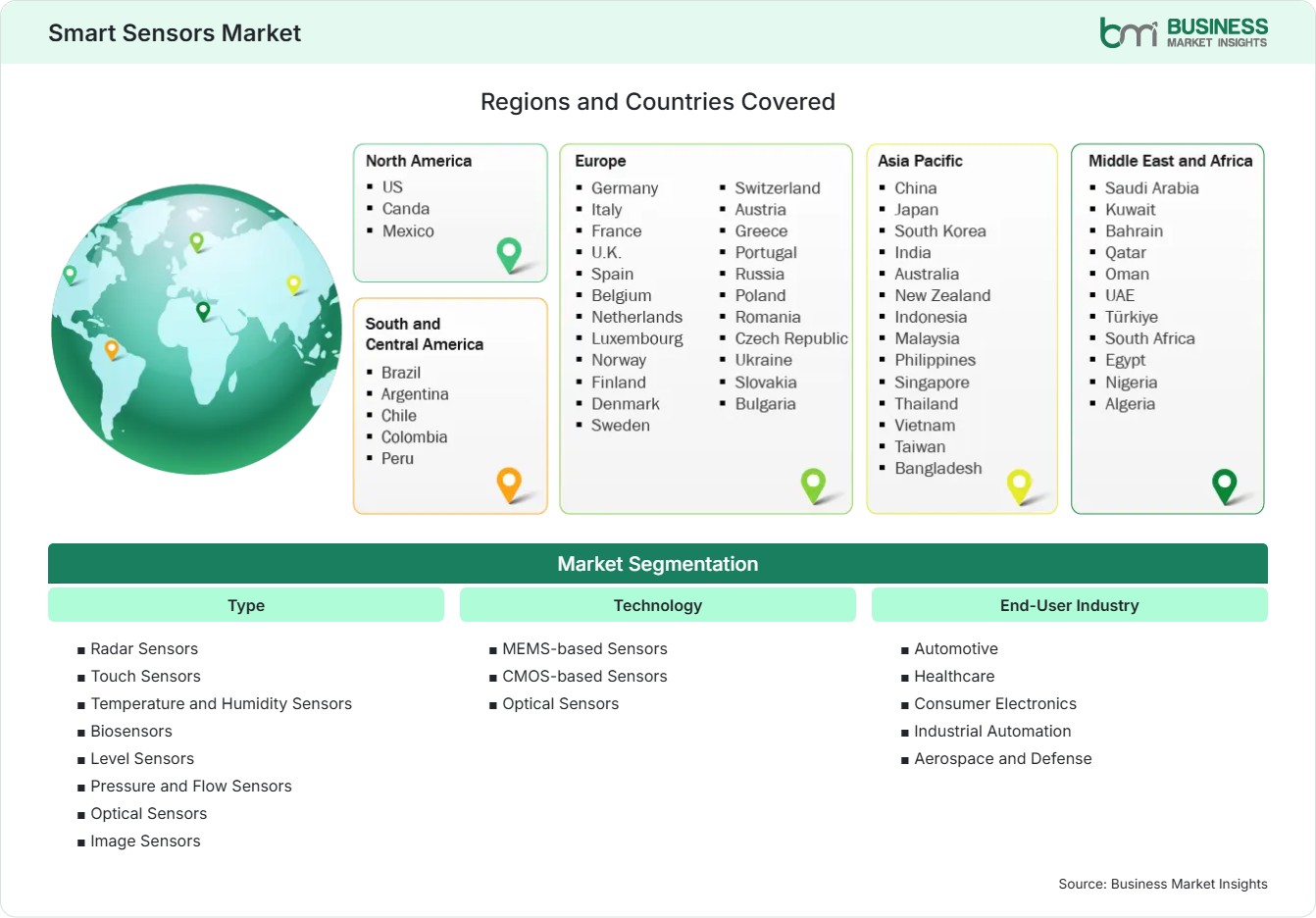
Europe secured a 24%-27% market share in 2025 and is expected to experience a compound annual growth rate of 15.8%-17.0% from 2025 to 2033. Germany continues to lead the region in terms of the number of countries, while Eastern European manufacturing centers offer good growth prospects. The region’s growing focus on industrial automation, energy efficiency, and automotive technologies drives up demand.
- Germany leads regional adoption through advanced manufacturing capabilities, Industry 4.0 implementation, and strong automotive production ecosystems.
- Industrial automation projects across Europe increasingly rely on intelligent sensing networks to improve productivity and resource utilization.
- Sustainability-focused regulations encourage deployment of environmental monitoring systems and energy-efficient operational technologies.
- Medical technology innovation supports increasing use of precision sensing solutions across diagnostics, monitoring, and treatment applications.
- Semiconductor collaboration initiatives strengthen regional technology development and supply-chain resilience.
Asia Pacific Smart Sensors Market
The Asia Pacific region contributed 28%-31% in 2025 and is expected to show a higher CAGR of 18.2%-19.6% between 2026 and 2033. In the region, China is the leading contributor in terms of revenue generation, and India is emerging as the fastest-growing national market. The factors contributing to demand include growth in electronics manufacturing, consumer device manufacturing, smart factories, and electric vehicles.
- Consumer electronics production remains a major demand generator for image, motion, environmental, and biometric sensing technologies.
- Smart factory deployment programs accelerate integration of intelligent monitoring systems across manufacturing environments.
- Rapid electric vehicle production growth creates significant opportunities for automotive sensing technologies and battery management applications.
- India benefits from industrial digitization initiatives, electronics manufacturing investments, and expanding healthcare technology adoption.
- Regional semiconductor investments strengthen local supply chains and enhance technology accessibility across emerging industries.
Rest of World Smart Sensors Market
The Rest of World region held an 8%–11% share in 2025 and is expected to expand at a CAGR of 16.0%–17.2% through 2033. South and Central America are benefiting from industrial modernization investments, while Middle East and Africa markets are supported by smart infrastructure development. Digital transformation programs and increasing industrial automation adoption continue improving long-term demand prospects.
Brazil leads adoption across South and Central America, while the United Arab Emirates demonstrates strong growth potential through smart city investments and industrial diversification initiatives.
- Smart city developments increase deployment of environmental monitoring, traffic management, and infrastructure sensing systems.
- Oil and gas operators utilize advanced sensing technologies for predictive maintenance, safety monitoring, and operational optimization.
- Industrial modernization initiatives create opportunities for intelligent process-control and asset-monitoring solutions.
- Healthcare infrastructure expansion supports growing demand for connected monitoring and diagnostic devices.
- Government-led digital transformation programs encourage broader adoption of IoT-enabled sensing technologies across public and private sectors.