
Industrial Sensors Market Outlook: Size, Share, Trends, Growth Analysis, Competitive Landscape & Forecast, 2026-2033

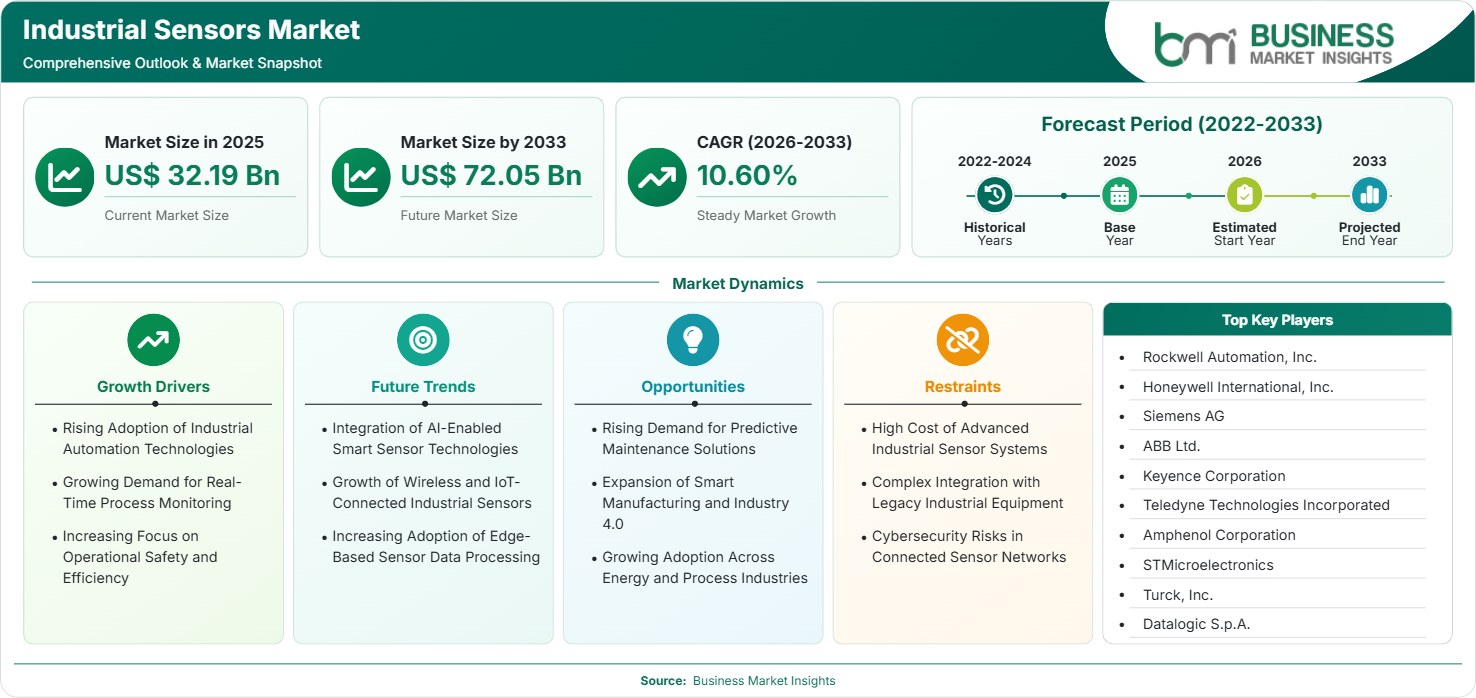
The Industrial Sensors Market size was valued at US$ 32.19 Billion in 2025 and is projected to reach US$ 72.05 Billion by 2033, growing at a CAGR of 10.60% during 2026–2033. Growing industrial automation, increasing adoption of Industry 4.0 technologies, and rising investments in smart manufacturing are supporting market growth globally. The increasing need for real-time monitoring, process optimization, and predictive maintenance is further driving demand for advanced industrial sensing technologies across manufacturing and process industries.

Report Coverage
  • Type: Temperature Sensor, Proximity Sensor, Pressure Sensor, Position Sensor, Motion Sensor, Level Sensor, Gas and Chemical Sensor, Humidity Sensor, Flow Sensor, Others
  • End Use Industry: Discrete, Process
US$ 32.19 Bn Market size in 2025
US$ 72.05 Bn Market Size by 2033
10.60% CAGR, 2026 - 2033
2026-2033 Forecast Period

01 AI Overview

Industrial Sensors Market Summary

  • North America Region: North America holds a market share of 31%–34% in 2025, growing with a CAGR of 10.1%–10.8% during 2026–2033. Strong industrial automation adoption, advanced manufacturing infrastructure, and increasing deployment of connected industrial systems continue supporting regional leadership. The U.S. industrial sensors market is expected to register a CAGR of 10.3%–11.0%.
  • Fastest Growing Region: Asia Pacific accounts for 35%–38% share in 2025 and is projected to grow at a CAGR of 11.0%–11.7% through 2033. Rapid industrialization, expanding manufacturing activities, and increasing investments in factory automation continue driving regional growth.
  • Leading Segment: Temperature Sensor represents 16%–19% share in 2025 and is expected to grow at a CAGR of 10.5%–11.2% through 2033. Extensive deployment across industrial monitoring and process control applications continues supporting segment dominance.
  • High Growth Segment: Process Industry accounts for 56%–59% share in 2025 and is forecast to grow at a CAGR of 10.9%–11.6% during 2026–2033. Increasing demand for process optimization, safety monitoring, and operational efficiency continues accelerating segment growth.
  • Key Market Opportunity: Expansion of smart factories, industrial IoT integration, predictive maintenance platforms, and advanced automation systems is creating substantial growth opportunities.
  • Major Market Players: Rockwell Automation, Inc., Honeywell International, Inc., Siemens AG, ABB Ltd., Keyence Corporation, Teledyne Technologies Incorporated, Amphenol Corporation, STMicroelectronics, Turck, Inc., and Datalogic S.p.A.
02 Strategic Insights

Industrial Sensors Market: Strategic Insights

Industrial Sensors Market Strategic Framework
FREE PDF
Request your free sample
Request free sample
03 Stakeholder View

Key Takeaways

  • Industrial sensors remain essential components for automation, process monitoring, equipment control, and industrial safety applications.
  • Temperature sensors continue leading the product segment due to widespread use across industrial processes.
  • Process industries remain the largest end-use category, supported by extensive monitoring and control requirements.
  • Industrial IoT adoption is increasing demand for connected sensors with real-time data collection and remote monitoring capabilities.
  • Predictive maintenance initiatives are supporting deployment of advanced sensors for early fault detection and equipment optimization.
  • North America remains a leading market, driven by automation investments and increasing adoption of smart manufacturing technologies.
  • Asia Pacific is projected to witness the fastest growth, supported by expanding manufacturing activity and industrial modernization.
  • Smart factories, digital transformation, and connected production systems are expected to create significant future opportunities.
04 Geographic Outlook

Industrial Sensors Market Regional Highlights

North America Industrial Sensors Market

North America accounts for 31%–34% Industrial Sensors Market share in 2025 and is projected to grow at a CAGR of 10.1%–10.8% through 2033. The region benefits from advanced manufacturing capabilities, widespread automation adoption, and growing implementation of Industry 4.0 technologies.

  • Manufacturers continue deploying sensor-based monitoring systems to improve operational visibility, productivity, and process efficiency.
  • Industrial facilities are investing in predictive maintenance programs supported by advanced sensing and monitoring technologies.
  • Smart factory initiatives remain a major demand driver as industries modernize production and automation infrastructure.
  • Process industries are adopting automated monitoring systems to strengthen safety, reliability, and operational performance.
  • Industrial IoT integration continues expanding the role of connected sensors across industrial monitoring and control applications.
  • Ongoing technology innovation supports the development of smarter, more accurate, and highly connected industrial sensing solutions.

US Industrial Sensors Market

The United States contributes approximately 89%–93% of North American revenue and is expected to register a CAGR of 10.3%–11.0% through 2033. The country remains the largest market due to strong industrial automation and digital manufacturing investments.

  • Manufacturing companies are increasingly implementing intelligent sensing solutions across production lines to enhance automation and productivity.
  • Industrial operators continue utilizing sensors to strengthen equipment monitoring, fault detection, and operational visibility.
  • Growing demand for connected factory environments is supporting broader adoption of networked and smart sensing technologies.
  • Predictive analytics initiatives are driving deployment of advanced monitoring solutions for early issue detection and maintenance planning.
  • Industrial modernization projects continue supporting sensor adoption across manufacturing, process, and other end-user industries.
  • Investments in operational efficiency remain an important market driver as industries seek to reduce downtime and optimize processes.

Europe Industrial Sensors Market

Europe represents 24%–27% of global revenue in 2025 and is anticipated to expand at a CAGR of 10.4%–11.1% through 2033. Strong industrial automation capabilities and increasing digital manufacturing initiatives continue supporting regional growth.

  • Germany continues leading regional demand through extensive implementation of Industry 4.0 technologies.
  • Poland is among the fastest-growing markets and is estimated to register a CAGR of 11.3%–12.0% during the forecast period.
  • Industrial operators are increasingly adopting intelligent monitoring systems.
  • Smart manufacturing programs continue encouraging sensor deployment.
  • Process optimization initiatives remain supportive of industry demand.
  • Industrial digital transformation efforts continue creating growth opportunities.

Asia Pacific Industrial Sensors Market

Asia Pacific accounts for 35%–38% of global revenue in 2025 and is expected to achieve the fastest CAGR of 11.0%–11.7% through 2033. Rapid industrialization, manufacturing expansion, and growing automation investments continue supporting strong regional growth.

  • China remains the largest regional market, supported by extensive manufacturing activities and automation adoption.
  • India is projected to record strong growth through 2033, supported by industrial modernization and smart manufacturing initiatives.
  • Factory automation projects continue increasing demand for advanced sensing technologies across manufacturing facilities.
  • Smart manufacturing adoption is expanding across automotive, electronics, food processing, and other industrial sectors.
  • Industrial IoT deployments are creating new opportunities for sensor manufacturers through connected monitoring and data-driven operations.
  • Government support for manufacturing development remains favorable for industrial automation and sensor market expansion.

Rest of World Industrial Sensors Market

Rest of World accounts for 8%–11% of global revenue in 2025 and is projected to expand at a CAGR of 9.2%–9.9% through 2033. Increasing industrial development and growing automation adoption continue supporting market expansion across Latin America, the Middle East, and Africa.

  • Brazil continues generating demand through industrial modernization and manufacturing development activities.
  • The UAE is witnessing increased implementation of industrial automation solutions.
  • Saudi Arabia is expected to achieve approximately 10.1%–10.8% CAGR through 2033, supported by industrial diversification initiatives.
  • Process industries continue investing in operational monitoring technologies.
  • Infrastructure development projects are supporting demand for industrial automation systems.
  • Growing awareness regarding efficiency improvements remains favorable for market growth.
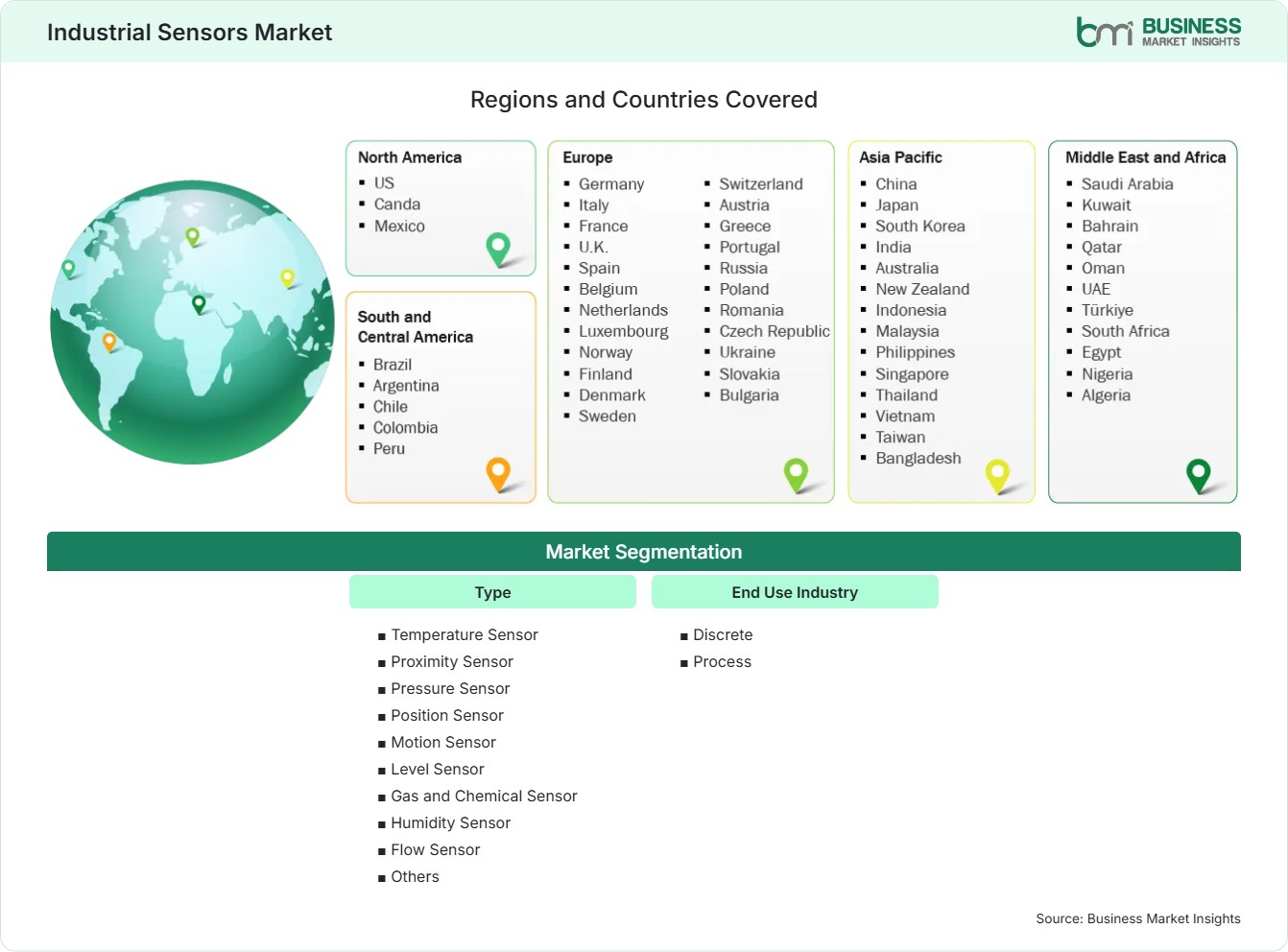
Global Market Geography
FREE PDF
Request your free sample
Request free sample
05 Segment Analysis

Industrial Sensors Market Segmentation

Type

The type segment represents the broad range of sensing technologies used to monitor, measure, and control industrial processes. This segment accounts for approximately 16%–19% share in 2025 and is projected to grow at a CAGR of 10.5%–11.2% through 2033. The expanding Industrial Sensors Market Scope is supported by increasing factory automation, growing deployment of industrial IoT networks, and rising demand for real-time operational visibility across manufacturing and process industries.

  • Temperature Sensor: Temperature sensors dominate the market due to their extensive use in process control, equipment monitoring, and industrial safety applications.
  • Proximity Sensor: Proximity sensors continue witnessing strong adoption in automated production lines and material handling systems.
  • Pressure Sensor: Pressure sensors are widely utilized in industrial equipment, fluid systems, and process monitoring applications.
  • Position Sensor: Position sensors help improve precision and control across robotics, automation systems, and manufacturing equipment.
  • Motion Sensor: Motion sensors play an important role in machine automation, security systems, and equipment performance monitoring.
  • Level Sensor: Level sensors are increasingly deployed in storage tanks, process industries, and inventory management applications.
  • Gas and Chemical Sensor: Gas and chemical sensors support workplace safety, environmental monitoring, and industrial process control.
  • Humidity Sensor: Humidity sensors help maintain environmental conditions across manufacturing and storage facilities.
  • Flow Sensor: Flow sensors remain essential for monitoring liquids and gases across industrial operations.
  • Others: Other sensor types include vibration sensors, optical sensors, image sensors, and specialized industrial monitoring devices.

End Use Industry

The end use industry segment highlights the primary industrial sectors utilizing sensing technologies to improve performance, safety, and operational efficiency. This segment accounts for approximately 56%–59% share in 2025 and is expected to register a CAGR of 10.9%–11.6% through 2033. Current Industrial Sensors Market Trends indicate increasing deployment of intelligent sensing solutions across discrete and process industries as organizations prioritize automation and digital transformation.

  • Discrete: Discrete industries utilize sensors extensively in assembly lines, robotics, packaging systems, and manufacturing automation environments where precision and efficiency are critical.
  • Process: Process industries dominate the market due to widespread sensor deployment across oil & gas, chemicals, power generation, food processing, pharmaceuticals, and water treatment operations.
06 Market Forces

Industrial Sensors Market Dynamics

Key Market Drivers

Rising Adoption of Industrial Automation Technologies

Industrial automation continues to expand across manufacturing and processing environments as organizations seek greater efficiency, consistency, and productivity. Sensors serve as foundational components within automated systems by providing the real-time information required for machine control and operational decision-making. Automated production lines rely on sensing technologies to monitor conditions, improve accuracy, and support continuous operations. Manufacturers are increasingly investing in robotics, smart equipment, and connected production environments that depend heavily on advanced sensors. As automation adoption continues accelerating globally, demand for industrial sensing technologies is expected to experience sustained growth.

Growing Demand for Real-Time Process Monitoring

Industrial operators are placing greater emphasis on real-time visibility into production processes, equipment conditions, and environmental parameters. Sensors enable continuous monitoring that helps organizations identify inefficiencies, maintain product quality, and improve operational performance. Real-time data collection supports faster response to changing process conditions while reducing the likelihood of production disruptions. Industries such as chemicals, food processing, pharmaceuticals, and energy increasingly depend on accurate monitoring systems. As organizations continue pursuing data-driven operations and enhanced process control, demand for industrial sensors is expected to remain a significant market driver.

Increasing Focus on Operational Safety and Efficiency

Safety and efficiency remain key priorities across industrial environments. Sensors help organizations monitor equipment performance, detect hazardous conditions, and maintain compliance with operational standards. They provide critical information that supports preventive actions and reduces the risk of accidents or equipment failures. Industrial facilities are increasingly deploying advanced sensing technologies to strengthen workplace safety while improving productivity. Growing awareness regarding risk management and operational optimization continues encouraging broader sensor adoption. As industries strive to achieve higher safety standards and more efficient operations, industrial sensor demand is expected to continue increasing.

Key Market Opportunities

Rising Demand for Predictive Maintenance Solutions

Predictive maintenance is creating significant opportunities for industrial sensor manufacturers. Organizations are increasingly utilizing sensor-generated data to monitor equipment health and identify potential failures before they occur. This approach helps reduce downtime, optimize maintenance schedules, and improve asset reliability. Industrial operators are seeking technologies that support proactive maintenance strategies rather than reactive repairs. Sensors play a critical role by continuously collecting operational information needed for predictive analysis. As industries continue focusing on reliability and cost reduction, demand for sensing technologies supporting predictive maintenance programs is expected to expand substantially.

Expansion of Smart Manufacturing and Industry 4.0

The ongoing transition toward smart manufacturing is creating attractive growth opportunities across the industrial sensors market. Industry 4.0 environments rely on connected devices, intelligent machines, and real-time data exchange to improve operational efficiency. Sensors are central to these digital ecosystems because they provide the information required for automation, analytics, and process optimization. Manufacturers continue investing in connected production facilities that support greater flexibility and productivity. As smart factory adoption expands globally, industrial sensor suppliers are expected to benefit from increasing demand for advanced monitoring and control technologies.

Growing Adoption Across Energy and Process Industries

Energy and process industries continue increasing investments in monitoring technologies designed to improve operational reliability and process efficiency. Facilities operating in sectors such as oil & gas, chemicals, utilities, and water treatment depend on accurate sensing solutions to manage complex operations. Sensors help improve visibility into production systems while supporting compliance, safety, and performance objectives. Growing modernization initiatives across these industries are creating new deployment opportunities. Long-term Industrial Sensors Market Forecast projections remain favorable as energy and process operators continue investing in digital transformation and intelligent monitoring solutions.

Market Restraints and Challenges

High Cost of Advanced Industrial Sensor Systems

Factor: Advanced industrial sensor deployments often require investments in intelligent sensing devices, communication systems, integration software, analytics platforms, and supporting infrastructure. High-performance sensors frequently incorporate sophisticated technologies that increase acquisition costs.

Impact: Elevated implementation expenses may limit adoption among smaller organizations and facilities operating under budget constraints. Businesses may delay modernization projects until clear financial returns can be demonstrated, potentially slowing market penetration in certain industry segments.

Complex Integration with Legacy Industrial Equipment

Factor: Many industrial facilities continue operating older equipment that was not originally designed to support modern sensing technologies or connected digital environments. Integrating new sensor systems with existing infrastructure can be technically challenging.

Impact: Integration complexity may increase deployment timelines, implementation costs, and operational disruption risks. Organizations often require additional engineering resources and system customization efforts, which can influence adoption decisions and project execution strategies.

07 Company Analysis

Competitive Landscape

The Industrial Sensors Market Analysis is characterized by competition among industrial automation companies, sensing technology providers, semiconductor manufacturers, process control specialists, and factory automation solution providers. Market participants are focusing on smart sensing technologies, industrial IoT integration, wireless monitoring solutions, and advanced automation systems to strengthen their market positions. Growing adoption of Industry 4.0, increasing demand for predictive maintenance, and rising implementation of connected manufacturing environments continue driving product innovation. Companies are investing in sensor miniaturization, improved measurement accuracy, real-time monitoring capabilities, and enhanced connectivity features to support industrial digitalization initiatives. Strategic partnerships, product development programs, and expansion of industrial automation portfolios remain key competitive approaches across the market as manufacturers seek higher operational efficiency, reliability, and process optimization.

Company Name

Overview

Products and Services Relevant to this Market

Rockwell Automation, Inc.

Industrial automation company providing smart manufacturing and control solutions.

Industrial sensors, condition monitoring systems, automation platforms, process control technologies, and predictive maintenance solutions.

Honeywell International, Inc.

Technology company serving industrial, process, and automation sectors globally.

Pressure sensors, temperature sensors, gas detection systems, industrial monitoring solutions, and process automation technologies.

Siemens AG

Global industrial technology company focused on automation and digital industries.

Industrial sensing devices, automation systems, process monitoring technologies, and smart manufacturing solutions.

ABB Ltd.

Industrial automation and electrification company serving manufacturing and process industries.

Process sensors, measurement devices, industrial monitoring systems, and automation solutions.

Keyence Corporation

Manufacturer of sensing, automation, and industrial inspection technologies.

Proximity sensors, vision systems, laser measurement sensors, motion detection devices, and automation components.

Teledyne Technologies Incorporated

Technology company specializing in instrumentation and industrial sensing solutions.

Industrial sensors, monitoring equipment, measurement technologies, and process control systems.

Amphenol Corporation

Electronics and connectivity solutions provider serving industrial markets.

Industrial sensing components, connectivity systems, monitoring devices, and automation solutions.

STMicroelectronics

Semiconductor company supporting industrial and smart device applications.

MEMS sensors, motion sensors, environmental sensors, industrial sensing technologies, and embedded electronics.

Turck, Inc.

Industrial automation company specializing in sensor and connectivity technologies.

Proximity sensors, flow sensors, position sensors, industrial networking systems, and automation products.

Datalogic S.p.A.

Industrial automation and data capture technology provider.

Optical sensors, industrial detection systems, automation technologies, and machine vision solutions.

10 Trust & Transparency

Research Methodology

The market analysis combines proprietary research with secondary data from government agencies, company disclosures, regulatory filings, industry databases and expert interviews. Market estimates are validated through data triangulation, cross-market benchmarking and analyst review.

View Full Research Methodology

11 Questions Answered

Frequently Asked Questions

How is Industry 4.0 influencing the industrial sensors industry?

Industry 4.0 is accelerating adoption of connected sensors that enable real-time data collection, predictive maintenance, factory automation, and intelligent decision-making. These technologies help manufacturers improve productivity, reduce downtime, and enhance operational efficiency.

What does this Industrial Sensors Market Report cover?

This report covers type analysis, end-use industry evaluation, regional trends, competitive landscape analysis, market drivers, opportunities, restraints, challenges, and future growth prospects through 2033.

Why does the Process Industry represent the high-growth end-use segment?

The process industry remains the largest and fastest-growing segment because industries such as oil & gas, chemicals, pharmaceuticals, food processing, power generation, and water treatment require continuous monitoring of operational parameters. Industrial sensors are essential for maintaining safety, efficiency, and process reliability.

Which type segment dominates the market?

Temperature Sensors dominate the market due to their extensive usage in manufacturing operations, process industries, equipment monitoring, energy systems, and industrial safety applications. Their importance across a wide range of operational environments continues supporting strong demand.

What is driving growth in the Industrial Sensors market?

Rising adoption of industrial automation technologies, growing demand for real-time process monitoring, and increasing focus on operational safety and efficiency are major factors driving market growth. The expansion of smart factories and connected industrial environments is further supporting sensor deployment across industries.

Access the Full Industrial Sensors Market Report

Get segment-level forecasts, regional estimates, competitive benchmarking, company profiles and downloadable Excel datasets.

Access the full Industrial Sensors Market Report
350 pages PDF & Excel | 2026-08-20