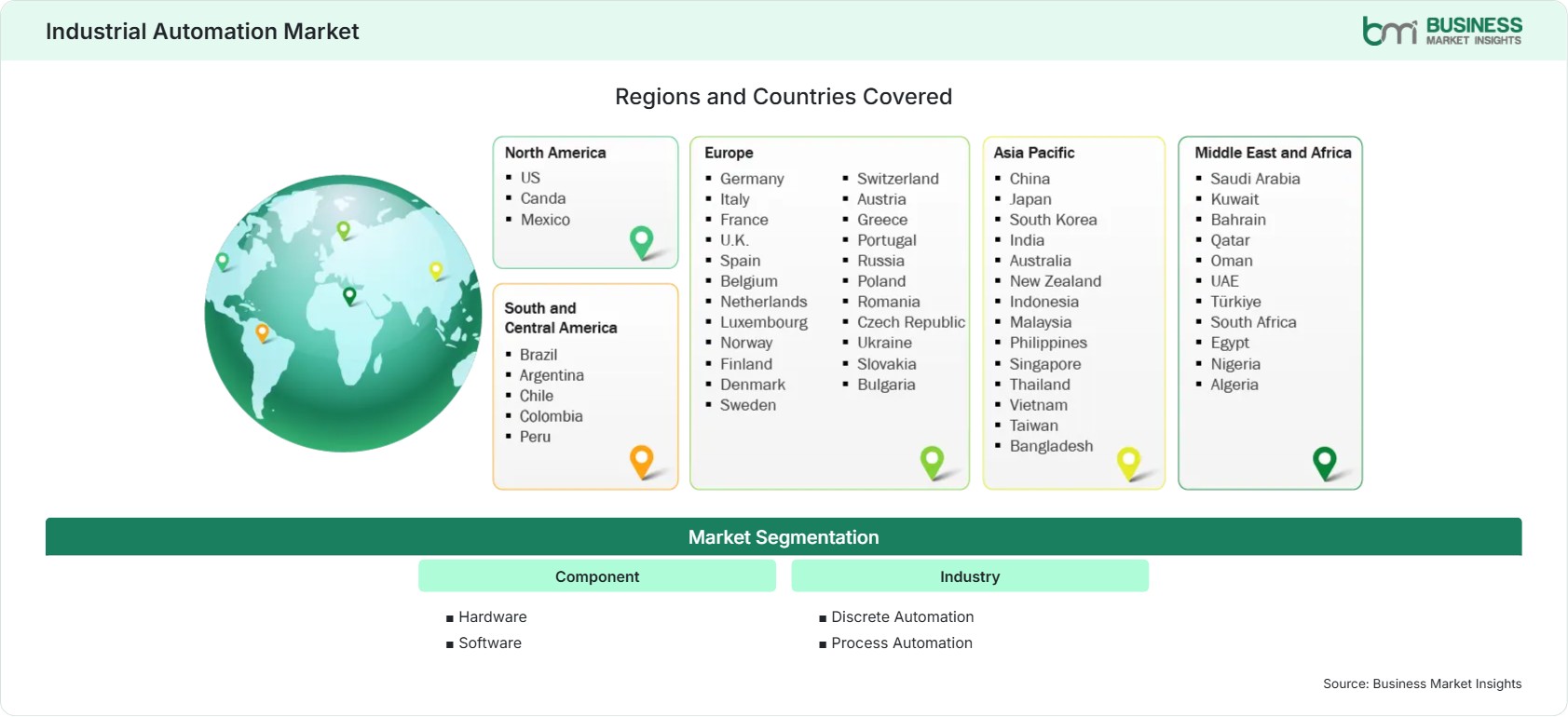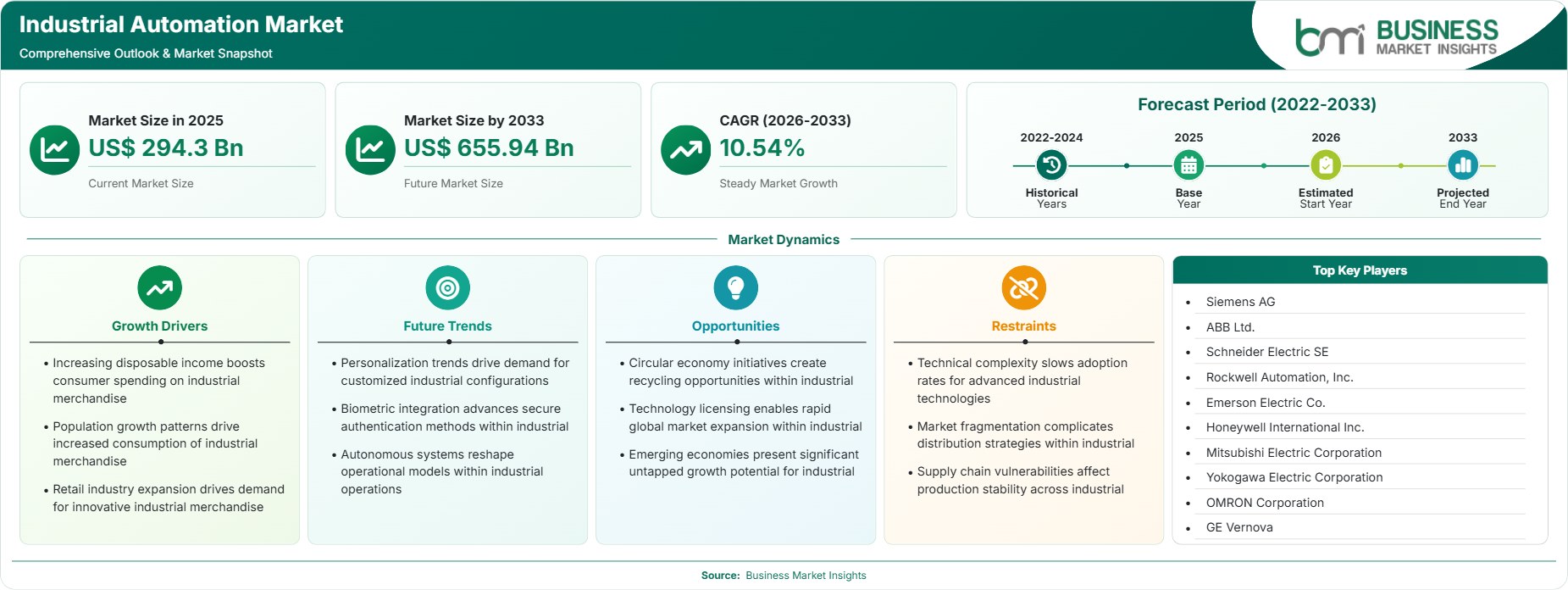
Industrial Automation Market Regional Highlights
North America Industrial Automation Market
North America represents 32%–35% of global demand in 2025 and advances at a CAGR of 8.8%–9.6% through 2033. The region benefits from manufacturing reshoring, advanced robotics adoption, and strong industrial software spending. Industrial Automation Market share remains supported by automotive, aerospace, food processing, and pharmaceutical facilities. Industrial cybersecurity investment and AI-driven asset management continue expanding. Large enterprises increasingly connect operational technology environments with enterprise analytics platforms to improve productivity, reliability, sustainability performance, and workforce efficiency.
- U.S. manufacturers increasingly deploy AI-enabled predictive maintenance platforms to improve equipment utilization and reduce unplanned downtime across automotive, aerospace, and industrial machinery operations.
- Demand for collaborative robotics continues rising as labor shortages challenge production consistency and operational scalability across manufacturing facilities.
- Energy management solutions gain traction as companies pursue emissions reduction targets while maintaining production efficiency and reliability.
- Industrial cybersecurity spending rises as connected operational technology infrastructures expand across critical manufacturing environments.
US Industrial Automation Market
The United States accounts for 74%–78% of regional demand and experiences a CAGR of 9.0%–9.8%. Government manufacturing incentives, semiconductor investments, and digital factory implementations have driven market penetration. There is robust demand for the solution in the automotive, electronics, logistics, and life sciences segments. Advanced analytics, cloud-enabled infrastructure, and robotics play important roles in strategy implementation. More firms are now looking for automation ecosystems that include production intelligence, workforce enablement, and cybersecurity.
- Semiconductor manufacturing investments are driving demand for advanced control systems, robotics, machine vision, and cleanroom automation technologies.
- Warehouse automation and intelligent material handling solutions continue expanding alongside e-commerce and logistics infrastructure development.
- Process industries increasingly adopt digital twins and asset performance platforms to improve operational reliability and planning efficiency.
Europe Industrial Automation Market
Europe holds its position in the Industrial Automation market, with a market share of 25%-28 % in 2025, and is projected to grow at a 9.4%-10.2% CAGR till 2033. Germany is the market leader, whereas Eastern European countries have a higher growth rate. The concepts of smart factories, sustainability, and the digitization of industry are becoming increasingly relevant for manufacturers. The European Union's environmental goals require manufacturers to use energy-efficient technologies and control systems in their production. Investments in automobile electrification, pharmaceuticals, and the manufacturing of advanced machinery contribute to regional demand and help upgrade industrial infrastructure.
- Germany leads regional adoption through strong engineering capabilities and advanced manufacturing ecosystems with CAGR near 9.5%–10.0%.
- Poland emerges as a high-growth market, supported by manufacturing expansion and foreign direct investment, growing around 10.8%–11.5%.
- Sustainability regulations encourage deployment of monitoring, optimization, and energy management technologies across production sites.
- Industrial connectivity and interoperability initiatives support broader implementation of intelligent manufacturing environments.
Asia Pacific Industrial Automation Market
Asia-Pacific accounts for 29%-32% and enjoys the highest CAGR of 12.4%-13.2%. China has the largest share of the region's technology, but both India and Southeast Asia are significant growth markets. Increased investments in factories, electronics manufacturing, semiconductors, and industrial digitalization initiatives increase implementation. The use of robotics continues to grow in the manufacturing industry. Regional governments are highly active in modernizing technologies, improving export performance, and boosting productivity.
- China remains the largest regional market due to extensive manufacturing capacity and significant robotics deployment initiatives.
- India demonstrates high-growth characteristics with a CAGR of approximately 13.0%–14.0%, supported by manufacturing and infrastructure development.
- Electronics and semiconductor investments drive demand for precision automation and quality assurance systems.
- Smart factory initiatives are accelerating adoption of industrial software and connected control architectures.
Rest of World Industrial Automation Market
Rest of World has a market share of 10%- 13% in the Industrial Automation Market in 2025 and is projected to exhibit a CAGR of 10.6%- 11.4%. South & Central America will take advantage of the mining, food processing, and manufacturing upgrades being done in the region. Brazil takes the lead for regional implementation while Mexico is experiencing strong growth. In the Middle East & Africa region, energy diversification, infrastructure development, and digitalization of the process industry will drive implementation. Organizations increasingly implement automation technologies to enhance productivity, reliability, safety, and resource management outcomes.
- Brazil remains the largest South American market, supported by processing industries and industrial modernization programs.
- Mexico benefits from nearshoring activities and growing manufacturing integration with global supply chains.
- Saudi Arabia advances adoption through industrial diversification and smart manufacturing initiatives.
- Mining operations increasingly deploy autonomous and remote monitoring technologies to enhance safety and efficiency.