
Packaging Automation Market Outlook: Size, Share, Trends, Growth Analysis, Competitive Landscape & Forecast, 2026-2033

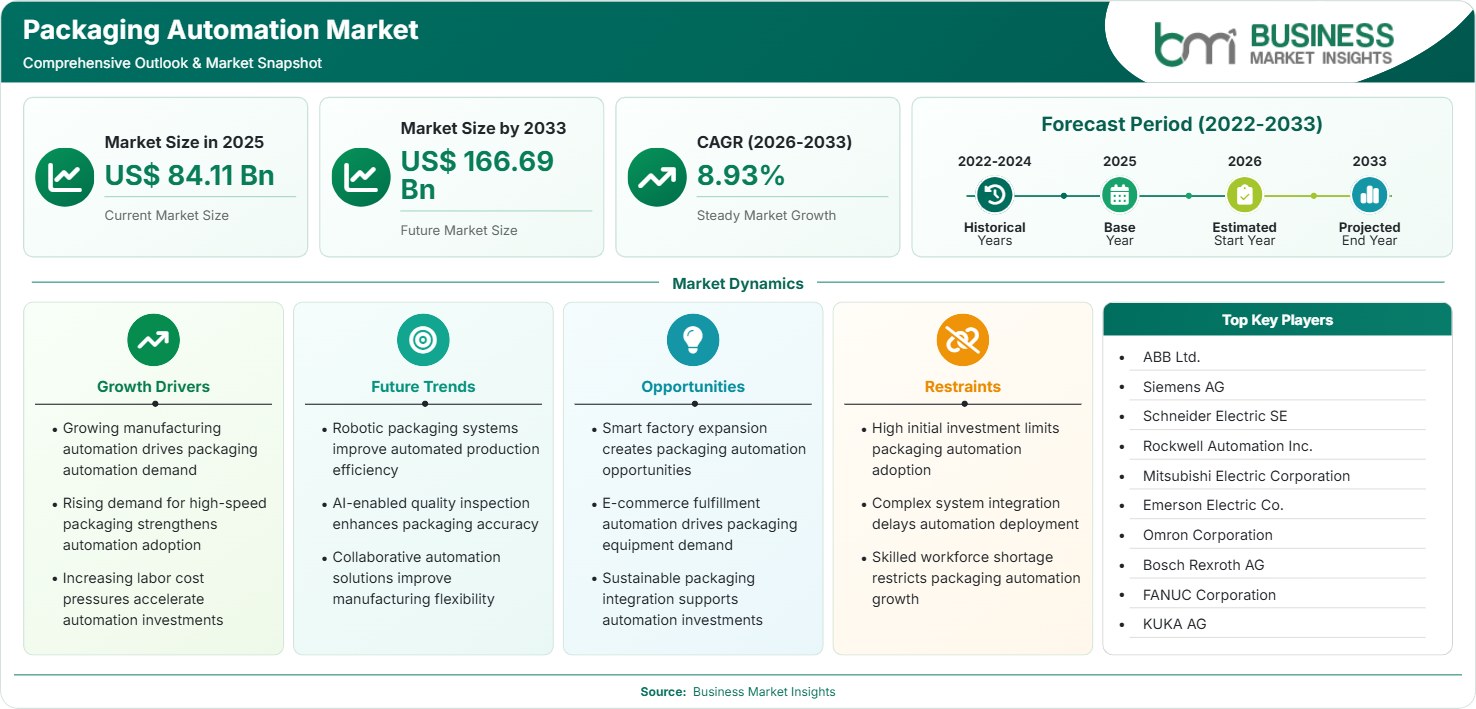
The Packaging Automation Market size was valued at US$ 84.11 billion in 2025 and is projected to reach US$ 166.69 billion by 2033, registering a CAGR of 8.93% during 2026–2033. There is rapid growth being experienced in the market because of the increase in the levels of manufacturing automation, the growing need for fast packaging processes, and the increased investment in advanced industrial automation systems. Packaging automation systems make production more efficient, reduce operational errors, reduce dependency on manual labor, increase product quality, and optimize the process of packaging.

Report Coverage
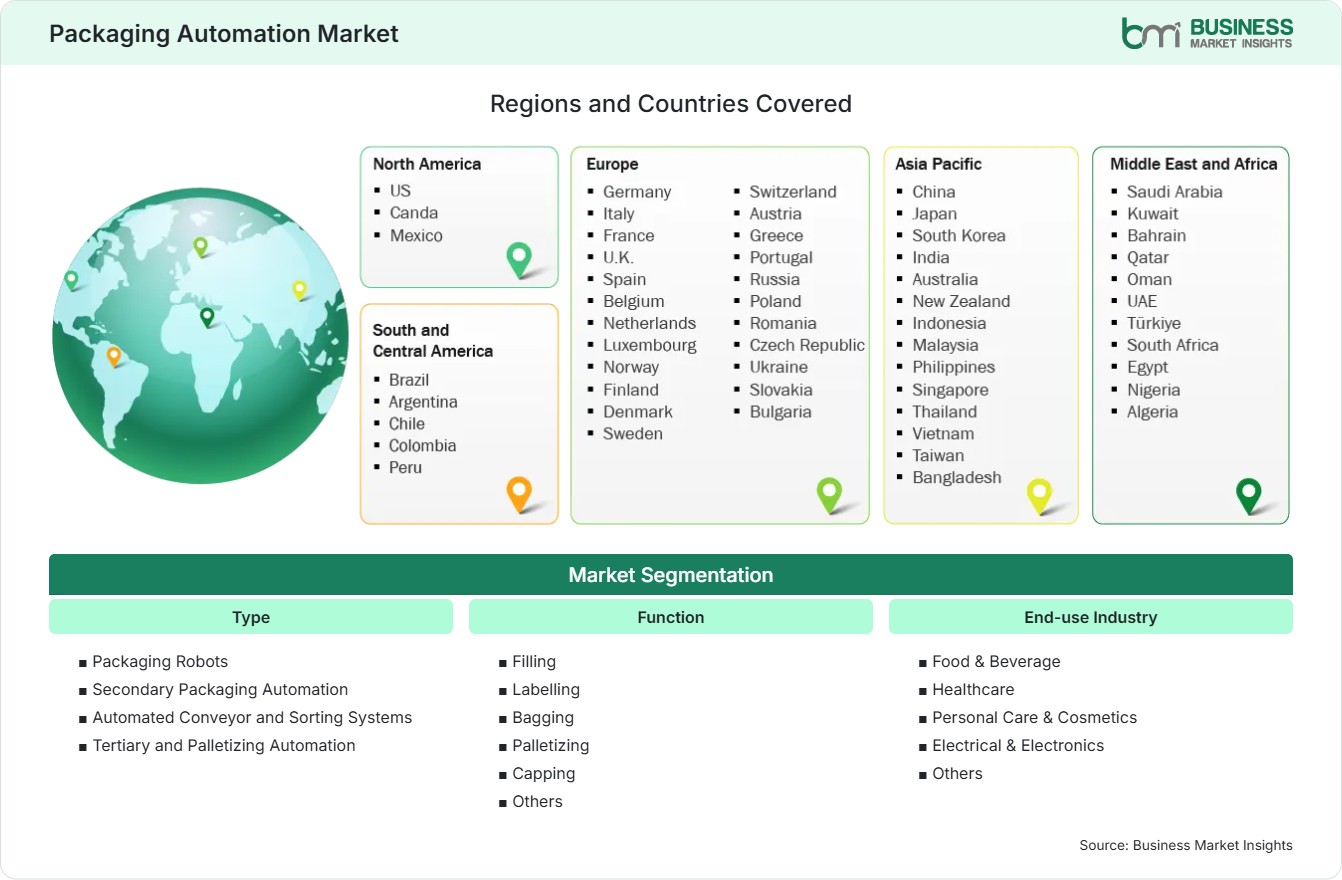
  • Type: Packaging Robots, Secondary Packaging Automation, Automated Conveyor and Sorting Systems, Tertiary and Palletizing Automation
  • Function: Filling, Labelling, Bagging, Palletizing, Capping, Others
  • End-use Industry: Food & Beverage, Healthcare, Personal Care & Cosmetics, Electrical & Electronics, Others
US$ 84.11 Bn Market size in 2025
US$ 166.69 Bn Market Size by 2033
8.93% CAGR, 2026 - 2033
2026-2033 Forecast Period

AI Overview

Packaging Automation Market Summary

  • North America Region: North America accounted for 29%–32% of global revenue in 2025 and is projected to register a CAGR of 8.4%–8.9% during 2026–2033. Strong industrial automation adoption, advanced manufacturing infrastructure, increasing labor shortages, and growing investments in smart factories continue supporting regional growth. The United States contributes approximately 85%–88% of regional revenue and is expected to register a CAGR of 8.5%–9.0% owing to increasing deployment of robotic packaging systems and intelligent manufacturing technologies.
  • Fastest Growing Region: Asia Pacific represented 37%–40% of global revenue in 2025 and is projected to register the highest CAGR of 9.6%–10.1% during the forecast period. Expanding manufacturing activities, rapid industrialization, growing food processing industries, and increasing factory automation investments continue accelerating regional market expansion.
  • Leading Segment: Packaging Robots accounted for 33%–36% of market revenue in 2025 and are projected to register a CAGR of 9.1%–9.6% during the assessment period owing to increasing demand for high-speed, accurate, and flexible packaging operations.
  • High Growth Segment: Healthcare represented 18%–21% of total market revenue in 2025 and is projected to expand at a CAGR of 9.8%–10.3% driven by increasing pharmaceutical production, stringent packaging quality requirements, and growing adoption of automated packaging systems.
  • Key Market Opportunity: Smart factory development, e-commerce fulfillment automation, sustainable packaging technologies, and intelligent robotics continue creating significant opportunities for packaging automation providers.
  • Major Market Players: ABB Ltd., Siemens AG, Schneider Electric SE, Rockwell Automation Inc., Mitsubishi Electric Corporation, Emerson Electric Co., Omron Corporation, Bosch Rexroth AG, FANUC Corporation, KUKA AG
Strategic Insights

Packaging Automation Market: Strategic Insights

Packaging Automation Market Strategic Framework
FREE PDF
Request your free sample
Request free sample
Stakeholder View

Key Takeaways

  •  The market continues benefiting from expanding manufacturing automation, high-speed packaging requirements, labor cost optimization, and increasing industrial digitalization.
  •  The strongest Packaging Automation Market Growth opportunities continue emerging from smart factories, e-commerce fulfillment centers, sustainable packaging initiatives, and intelligent robotics.
  •  Packaging robots remain the leading technology segment due to increasing adoption across food processing, healthcare, consumer goods, and industrial manufacturing facilities.
  •  Asia Pacific continues recording the fastest growth owing to rapid industrialization, manufacturing expansion, and increasing automation investments.
  •  Manufacturers are focusing on robotics, AI-enabled packaging systems, machine vision, and predictive maintenance technologies to improve productivity and operational efficiency.
  •  Companies investing in intelligent automation platforms, flexible packaging systems, and advanced industrial software are expected to strengthen their competitive positioning.
Geographic Outlook

Packaging Automation Market Regional Highlights

North America Packaging Automation Market

North America accounted for 29%–32% of global revenue in 2025 and is projected to register a CAGR of 8.4%–8.9% during 2026–2033. The region continues witnessing strong adoption of automated packaging technologies owing to advanced manufacturing infrastructure, increasing labor shortages, stringent quality requirements, and growing investments in smart factories. The Packaging Automation Market Share remains significant as manufacturers across food & beverage, healthcare, personal care, and electronics industries increasingly deploy robotic packaging systems and intelligent production lines.

  • The United States remains the largest regional market owing to widespread adoption of industrial robotics, automated packaging equipment, and advanced manufacturing technologies.
  • Canada continues supporting regional growth through increasing investments in food processing automation, pharmaceutical manufacturing, and warehouse modernization.
  • Growing adoption of Industry 4.0 technologies and industrial IoT platforms continues accelerating deployment of intelligent packaging automation systems.
  • Manufacturers are increasingly investing in collaborative robots, machine vision systems, and AI-enabled packaging solutions to improve production efficiency and operational flexibility.

US Packaging Automation Market

The United States accounted for approximately 85%–88% of North American revenue in 2025 and is projected to register a CAGR of 8.5%–9.0% during the forecast period. Strong manufacturing capabilities, increasing automation investments, expanding e-commerce activities, and rising demand for high-speed packaging solutions continue supporting market growth.

  • Food and beverage manufacturers continue expanding automated packaging operations to improve productivity and product consistency.
  • Pharmaceutical companies are increasingly deploying automated filling, labeling, inspection, and packaging systems to meet stringent regulatory requirements.
  • Growing investments in warehouse automation and fulfillment centers continue strengthening demand for integrated packaging equipment.
  • Industrial manufacturers continue adopting intelligent robotics and digital production systems to reduce labor dependency and improve operational performance.

Europe Packaging Automation Market

Europe represented 26%–29% of global revenue in 2025 and is expected to expand at a CAGR of 8.2%–8.7% during 2026–2033. Strong industrial automation capabilities, advanced manufacturing technologies, and increasing focus on sustainable production continue driving regional market expansion. Germany remains the largest regional market, while the United Kingdom is projected to register the fastest growth with a CAGR of 8.8%–9.3% due to increasing factory modernization and digital manufacturing initiatives.

  • Germany continues leading regional demand through strong robotics adoption, advanced industrial manufacturing, and highly automated production facilities.
  • The United Kingdom supports market expansion through increasing investments in smart factories, food processing automation, and pharmaceutical manufacturing.
  • France continues contributing through expanding consumer goods production, industrial modernization, and packaging technology adoption.
  • European manufacturers are increasingly integrating energy-efficient packaging systems and sustainable automation technologies into production facilities.
  • Growing demand for recyclable packaging materials continues encouraging adoption of flexible automated packaging solutions.

Asia Pacific Packaging Automation Market

Asia Pacific accounted for 37%–40% of global revenue in 2025 and is projected to register the highest CAGR of 9.6%–10.1% during the forecast period. Rapid industrialization, expanding manufacturing capacity, increasing labor costs, and growing food processing industries continue positioning the region as the fastest-growing market. China remains the leading regional market, while India is projected to register the fastest growth with a CAGR of 10.2%–10.7% due to increasing industrial automation and manufacturing investments.

  • China continues dominating regional demand through extensive manufacturing activities, large-scale electronics production, and widespread industrial automation adoption.
  • India continues witnessing strong growth through expanding food processing, pharmaceutical manufacturing, consumer goods production, and smart factory development.
  • Japan maintains a significant market position through advanced robotics technologies, precision manufacturing, and intelligent factory automation.
  • South Korea continues supporting market growth through electronics manufacturing, automation technologies, and smart production systems.
  • Southeast Asian countries are increasingly adopting automated packaging systems to improve manufacturing competitiveness and export capabilities.

Rest of World Packaging Automation Market

The Rest of World accounted for 7%–9% of global revenue in 2025 and is projected to register a CAGR of 8.5%–9.0% during 2026–2033. Latin America, the Middle East, and Africa continue witnessing increasing investments in industrial automation, food processing, logistics modernization, and manufacturing efficiency improvements.

Growing industrial development, expanding consumer goods production, and increasing demand for automated packaging technologies continue creating new opportunities for equipment manufacturers across emerging economies.

  • Brazil remains the leading Latin American market through increasing food and beverage manufacturing, industrial automation, and consumer goods production.
  • The United Arab Emirates continues strengthening demand through industrial diversification, logistics modernization, and advanced manufacturing investments.
  • Saudi Arabia supports market expansion through industrial development initiatives, food processing investments, and smart manufacturing projects.
  • South Africa continues adopting packaging automation technologies across food processing, pharmaceuticals, and consumer product manufacturing.
  • Global automation providers continue expanding regional partnerships and service networks to address increasing demand for integrated packaging solutions.
Global Market Geography
FREE PDF
Request your free sample
Request free sample
Segment Analysis

Packaging Automation Market Segmentation

Type

The Type segment accounted for 33%–36% of market revenue in 2025 and is projected to register a CAGR of 9.1%–9.6% during the forecast period. Increasing demand for intelligent production systems, higher packaging throughput, and improved operational efficiency continues driving adoption across various automation technologies. The Packaging Automation Market Trends indicate growing investments in robotics, automated material handling, and integrated packaging systems that improve production flexibility while reducing manual intervention.

  • Packaging Robots: Packaging robots remain the leading segment due to increasing deployment for pick-and-place operations, case packing, palletizing, inspection, and packaging line automation. Their ability to improve productivity, maintain precision, and operate continuously supports widespread adoption across manufacturing industries.
  • Secondary Packaging Automation: Secondary packaging automation continues expanding through increasing demand for automated case packing, carton forming, wrapping, and labeling solutions that improve packaging efficiency and product consistency.
  • Automated Conveyor and Sorting Systems: Conveyor and sorting systems continue gaining importance by enabling efficient product movement, automated sorting, and streamlined material handling across manufacturing and distribution facilities.
  • Tertiary and Palletizing Automation: Tertiary packaging and palletizing systems continue witnessing increasing adoption due to rising warehouse automation, logistics optimization, and demand for efficient end-of-line packaging operations.

Function

The Function segment represented 27%–30% of total market revenue in 2025 and is expected to expand at a CAGR of 8.8%–9.3% throughout the assessment period. Growing demand for automated production processes, improved product quality, and higher packaging accuracy continues supporting automation across various packaging functions. The Packaging Automation Market Scope continues expanding as manufacturers integrate multiple automated functions into unified production lines.

  • Filling: Automated filling systems continue leading functional applications due to extensive use across food & beverage, pharmaceutical, and personal care manufacturing where precision, hygiene, and production speed are critical.
  • Labelling: Automated labeling systems continue supporting accurate product identification, regulatory compliance, and high-speed production across multiple industries.
  • Bagging: Automated bagging equipment continues gaining adoption for flexible packaging applications requiring high production efficiency and reduced manual handling.
  • Palletizing: Automated palletizing solutions continue improving warehouse productivity by enabling faster and more accurate product stacking and material handling.
  • Capping: Automated capping systems remain essential for beverage, pharmaceutical, and cosmetic production by ensuring consistent sealing quality and production efficiency.
  • Others: Additional functions including inspection, wrapping, sealing, coding, and quality verification continue contributing to overall packaging automation demand.

End-use Industry

The End-use Industry segment accounted for 31%–34% of market revenue in 2025 and is projected to register a CAGR of 9.3%–9.8% during 2026–2033. Increasing production volumes, stringent quality requirements, and growing demand for operational efficiency continue expanding packaging automation adoption across multiple industries.

  • Food & Beverage: Food & beverage remains the largest end-use industry owing to high production volumes, increasing packaged food consumption, hygiene requirements, and continuous investments in automated production facilities.
  • Healthcare: Healthcare continues registering strong growth through increasing pharmaceutical manufacturing, medical device production, and regulatory requirements for accurate and sterile packaging processes.
  • Personal Care & Cosmetics: Personal care and cosmetics manufacturers continue adopting packaging automation to improve production efficiency, product consistency, and packaging customization.
  • Electrical & Electronics: Electronics manufacturers increasingly deploy automated packaging systems to improve product protection, precision handling, and manufacturing efficiency.
  • Others: Consumer goods, industrial products, chemicals, and logistics applications continue contributing to market expansion through increasing investments in automated packaging technologies.
Market Forces

Packaging Automation Market Dynamics

Key Market Drivers

Growing manufacturing automation drives packaging automation demand

The growth in the use of automation technologies in different manufacturing industries keeps boosting the need for packaging automation systems that can perform efficiently. Many organizations are integrating robotics, intelligent production systems, and manufacturing systems into their operations to ensure that they maximize their productivity, eliminate any errors in the production process, and make sure that they have consistent packaging. There is more focus on making smart manufacturing environments, thus boosting the use of automated packaging systems.

Rising demand for high-speed packaging strengthens automation adoption

The increased production levels and the rising consumer demand for packaged products have led many manufacturers to install high-speed packaging machinery that can help enhance their performance and efficiency. High-speed packaging machines can help improve production speeds, product quality, and flexibility as well as enabling continuous production processes. There is a growing trend within industries such as foods and beverages, pharmaceuticals, personal care products, consumer goods, and e-commerce to use high-speed packaging machinery.

Increasing labor cost pressures accelerate automation investments

The increased cost of labor and shortages of labor in various industries have driven companies to embrace automated packaging. Automation helps in cutting down the reliance on labor, increasing efficiency, decreasing production downtime, and ensuring quality packaging all the time while optimizing the cost of operations. Automation increases workplace safety as it reduces repetitive actions performed manually and ensures that employees are not exposed to dangerous production processes. Robotic intelligence and collaborative automation systems allow manufacturers to sustain their production during labor shortages.

Key Market Opportunities

Smart factory expansion creates packaging automation opportunities

Increasing implementation of smart factory initiatives is creating significant opportunities for packaging automation providers. Integration of robotics, industrial IoT, artificial intelligence, and real-time production monitoring is enabling manufacturers to develop highly efficient, connected, and flexible packaging operations capable of supporting modern manufacturing requirements.

E-commerce fulfillment automation drives packaging equipment demand

Rapid expansion of e-commerce and omnichannel retail operations is increasing demand for automated packaging equipment capable of handling high order volumes, customized packaging, and fast fulfillment processes. Distribution centers and fulfillment facilities continue investing in advanced automation technologies to improve operational efficiency and customer service.

Sustainable packaging integration supports automation investments

Growing adoption of sustainable packaging materials and environmentally responsible manufacturing practices is encouraging investments in advanced packaging automation systems. Manufacturers are implementing flexible automation solutions capable of handling recyclable, lightweight, and eco-friendly packaging materials while maintaining production efficiency and product quality.

Market Restraints and Challenges

High initial investment limits packaging automation adoption

Factor: The implementation of packaging automation systems demands significant initial investments in robotics, conveyors, advanced control systems, sensing devices, machine vision systems, and system integration. Small and medium-sized companies encounter limited budgets when they try to convert their existing packaging systems into fully automated systems.

Impact: High capital costs can cause delays and hinder automation project implementation among manufacturers with strict financial considerations. Many companies are now providing their customers with modular automation, leasing, and scalable systems.

Complex system integration delays automation deployment

Factor: Incorporation of packaging automation systems with existing production machinery, enterprise software, warehouse management systems, and quality control systems requires proper planning and technical expertise. Incompatibility between existing infrastructure and automation technology could result in more complicated installation procedures.

Impact: The complications involved in integration might delay the installation process, increase installation costs, and lead to production disruptions during the transition process. The manufacturing companies have been making investments in digital twin technology and automation systems.

Company Analysis

Competitive Landscape

Competition within the packaging automation industry is driven by robotics innovation, intelligent control systems, software integration, production flexibility, and end-to-end automation capabilities. The Packaging Automation Market Analysis indicates that leading companies continue investing in artificial intelligence, industrial IoT, machine vision, collaborative robotics, and smart manufacturing technologies to strengthen their market positions across food & beverage, healthcare, personal care, electronics, and industrial manufacturing sectors.

Company Name

Overview

Products and Services relevant to this market

ABB Ltd.

Global industrial automation and robotics company serving multiple manufacturing industries.

Packaging robots, robotic automation systems, motion control solutions, industrial software, and digital manufacturing technologies.

Siemens AG

Global technology company providing industrial automation and digitalization solutions.

Packaging automation systems, PLCs, industrial software, motion control, factory automation, and digital twin solutions.

Schneider Electric SE

Provider of industrial automation and energy management technologies.

Packaging automation platforms, industrial control systems, machine automation, digital manufacturing software, and smart factory solutions.

Rockwell Automation Inc.

Global provider of industrial automation and digital transformation solutions.

Packaging automation software, control systems, industrial robotics integration, machine vision, and manufacturing execution systems.

Mitsubishi Electric Corporation

Manufacturer of factory automation and industrial control technologies.

Packaging automation equipment, PLCs, servo systems, robotics, industrial drives, and automation software.

Emerson Electric Co.

Global automation technology provider for industrial manufacturing.

Industrial automation systems, process control technologies, packaging automation software, sensors, and monitoring solutions.

Omron Corporation

Provider of industrial automation, sensing, and robotics technologies.

Packaging automation controllers, machine vision systems, industrial robots, sensors, and inspection solutions.

Bosch Rexroth AG

Industrial automation company specializing in motion control and factory automation.

Packaging automation systems, conveyor technologies, linear motion solutions, control systems, and factory automation equipment.

FANUC Corporation

Global leader in factory automation and industrial robotics.

Packaging robots, robotic arms, CNC systems, machine automation, and intelligent manufacturing solutions.

KUKA AG

Industrial robotics and intelligent automation company.

Packaging robots, automated production systems, palletizing solutions, industrial robotics, and smart manufacturing technologies.

Trust & Transparency

Research Methodology

The market analysis combines proprietary research with secondary data from government agencies, company disclosures, regulatory filings, industry databases and expert interviews. Market estimates are validated through data triangulation, cross-market benchmarking and analyst review.

View Full Research Methodology

Questions Answered

Frequently Asked Questions

How do market forecasts support strategic planning?

Packaging Automation Market Forecasts help manufacturers, automation providers, investors, and industrial enterprises evaluate future demand, identify emerging opportunities, optimize production strategies, and support long-term investment decisions.

What does market report include?

The Packaging Automation Market Report provides comprehensive insights covering market size, competitive landscape, segmentation analysis, regional outlook, technology trends, investment opportunities, competitive benchmarking, and future market prospects.

What factors are driving packaging automation market expansion?

Growing manufacturing automation, rising demand for high-speed packaging, increasing labor cost pressures, smart factory adoption, and expanding industrial digitalization continue driving market growth.

Which end-use industry is expected to witness significant growth?

Healthcare is expected to register strong growth due to increasing pharmaceutical production, stringent packaging quality requirements, medical device manufacturing, and rising investments in automated packaging technologies.

Which type dominates the Packaging Automation Market?

Packaging Robots represent the leading type segment due to their extensive adoption for pick-and-place operations, palletizing, packaging line automation, and high-speed manufacturing applications.

Access the Full Packaging Automation Market Report

Get segment-level forecasts, regional estimates, competitive benchmarking, company profiles and downloadable Excel datasets.

Access the full Packaging Automation Market Report
350 pages PDF & Excel | 2026-08-07
Similar Research

Related Market Reports