Market Summary
Executive Summary and Global Market Analysis
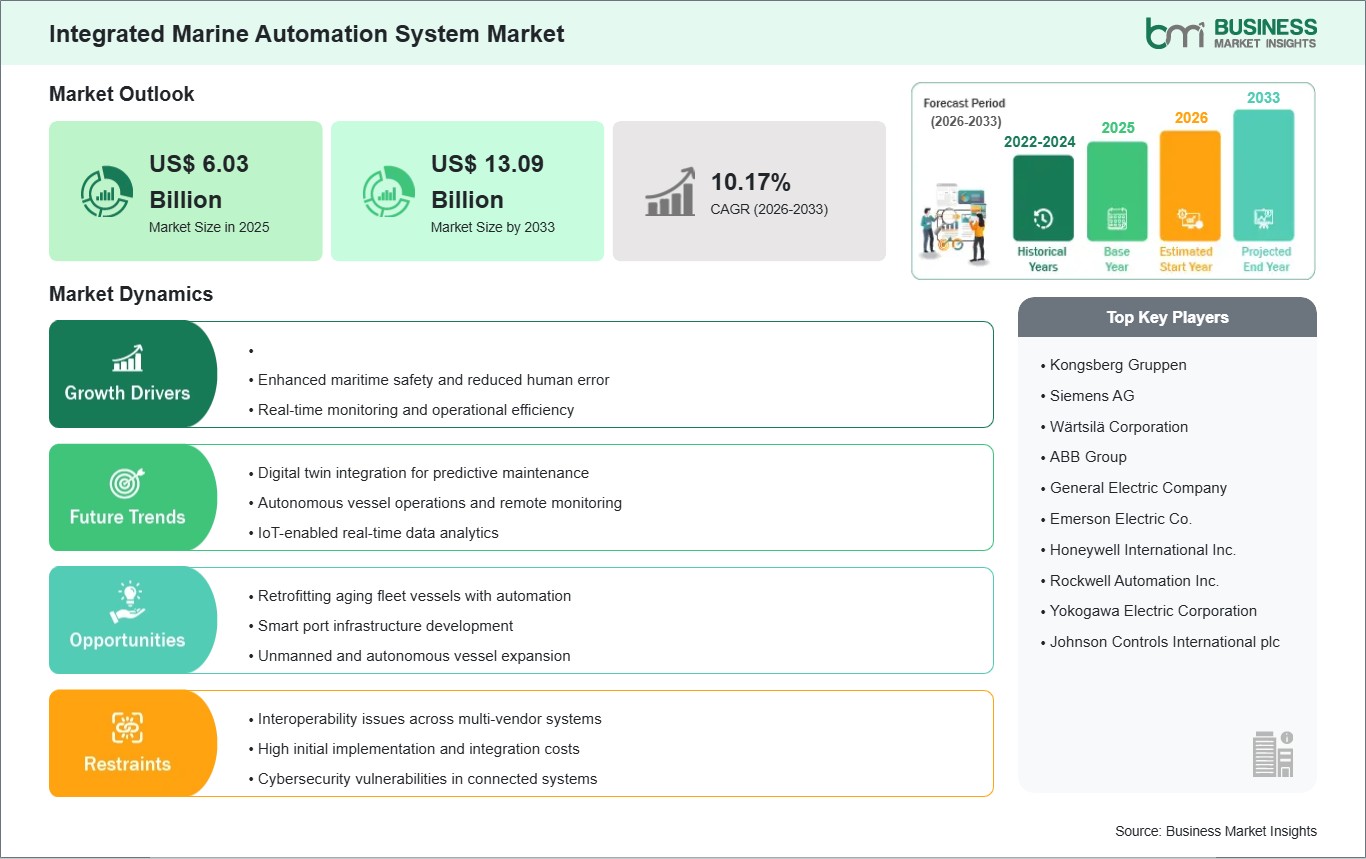
Integrated marine automation systems combine onboard monitoring, control, alarm handling, and decision support within a unified vessel architecture. These platforms connect propulsion, electrical distribution, machinery supervision, safety controls, and operator interfaces to sustain reliable ship operations. Their functional value lies in reducing manual intervention while maintaining continuity across mission-critical marine processes.
Fleet operators are prioritizing integrated control environments as vessels become more software-defined and operational transparency gains importance. Automation consolidation supports tighter equipment coordination, improves fault visibility, and simplifies response workflows for engine room and bridge personnel. Retrofit programs also reinforce demand as owners modernize aging assets to improve reliability, energy oversight, and compliance readiness.
Segment positioning reflects distinct operational priorities across system design and vessel deployment. Power management remains central where electrical stability, load balancing, and fuel efficiency shape automation investments. Commercial vessels represent a broad implementation base, while defense platforms emphasize resilience, redundancy, and mission assurance. OEM demand stays prominent because automation architecture is increasingly specified early in ship design.
Technology development is shifting the industry toward interoperable platforms with stronger analytics, remote diagnostics, and distributed control intelligence. System suppliers are improving data fusion across subsystems so crews can manage vessel health through fewer interfaces and clearer exception alerts. This evolution supports more adaptive maintenance planning and sharper operational awareness during complex voyages.
Competitive conditions are shaped by platform breadth, service capability, integration expertise, and lifecycle support rather than isolated hardware supply. Buyers assess vendors on system reliability, commissioning experience, cybersecurity preparedness, and long-term upgrade pathways. As procurement shifts toward connected ship ecosystems, solution depth and installed-base familiarity remain decisive differentiators.
Segment Analysis
Integrated Marine Automation System Market Segmentation
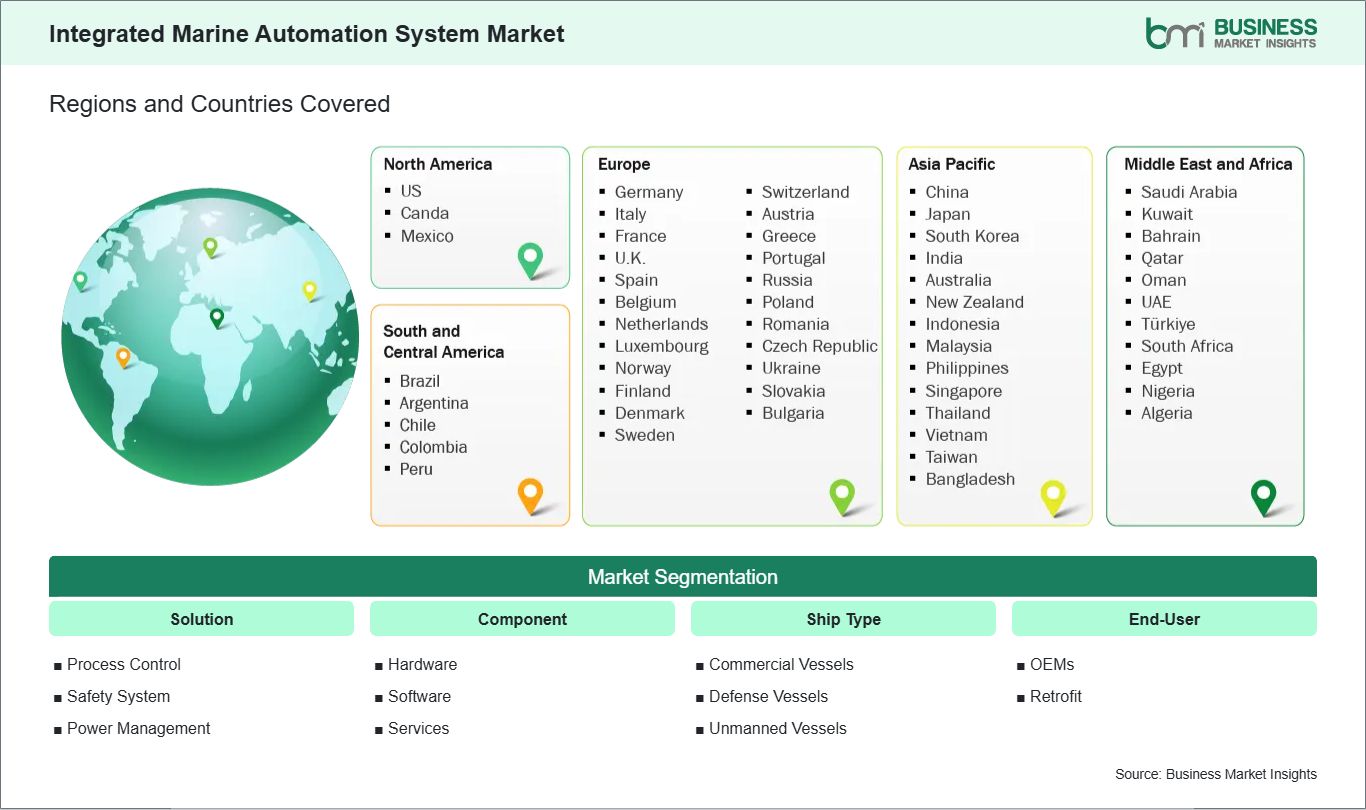
The market is segmented by solution, component, ship type, and end-user to reflect deployment priorities across vessel programs.
By Solution
- Process Control: Coordinates machinery functions through centralized monitoring and command logic.
- Safety System: Maintains alarm visibility and protective response during abnormal vessel conditions.
- Power Management: Optimizes electrical distribution, load sharing, and onboard energy stability.
By Component
- Hardware: Provides controllers, sensors, interfaces, and communication infrastructure for vessel automation.
- Software: Enables supervisory control, analytics, visualization, and system coordination functions.
- Services: Covers integration, commissioning, maintenance, and lifecycle support activities.
By Ship Type
- Commercial Vessels: Account for wide-scale deployment across cargo, passenger, and offshore operations.
- Defense Vessels: Require resilient automation for mission continuity and system redundancy.
- Unmanned Vessels: Depend on integrated control layers for remote supervision and autonomous functions.
- OEMs: Specify automation architecture during shipbuilding and original platform integration.
By End-User
- OEMs: Shape early-stage design choices and platform-level automation configuration.
- Retrofit: Extends automation functionality across existing fleets through modernization projects.
Market Forces
Integrated Marine Automation System Market Drivers and Opportunities
Rising Digital Control Requirements Across Modern Vessel Operations
Marine operators are handling more interconnected onboard systems, which raises the need for unified control environments. Separate monitoring layers create fragmented visibility, slower fault diagnosis, and higher crew workload during demanding operating conditions. Integrated automation addresses this gap by centralizing alarms, control actions, and equipment feedback into a coordinated operating framework suited to complex vessel routines.
The effect is stronger operational consistency across propulsion, power, machinery, and safety domains. This matters in commercial and defense programs where downtime, manual dependency, and delayed response can disrupt voyage performance. As shipowners place greater emphasis on controllability and lifecycle efficiency, integrated marine automation systems become more relevant to both newbuild and upgrade decisions.
Expansion of Smart Vessel Modernization and Remote Operations
A broader shift toward intelligent shipping is opening room for advanced automation upgrades across fleet categories. Vendors are introducing platforms with stronger analytics, remote diagnostics, and modular integration, allowing owners to extend functionality without redesigning entire control environments. These capabilities are particularly useful where operators seek cleaner workflows, better situational visibility, and smoother coordination across onboard subsystems.
Future scope is notable in retrofit programs, unmanned vessel development, and digitally managed commercial fleets. Expansion in these areas can strengthen recurring service demand while widening software-led differentiation across suppliers. The market stands to benefit as ship operators pursue flexible automation layers that support scalable upgrades, operational continuity, and sharper control over distributed marine assets.
Size and Share Analysis
Integrated Marine Automation System Market Size and Share Analysis
The Integrated Marine Automation System market size is expected to reach US$ 13.09 Billion by 2033 from US$ 6.03 Billion in 2025. The market is estimated to record a CAGR of 10.17% from 2026 to 2033. This trajectory indicates sustained expansion as vessel operators prioritize integrated control visibility, equipment coordination, and lifecycle modernization across increasingly digital marine environments.
By solution, power management holds a leading position because energy stability, load control, and electrical efficiency remain central to ship performance. Within components, hardware forms the operational backbone through controllers, interfaces, and communication modules, while software deepens system intelligence and service layers strengthen long-term platform continuity.
Commercial vessels represent the principal application base as operators seek broad automation coverage across cargo movement, propulsion management, and onboard safety supervision. OEM engagement remains prominent because automation design is increasingly embedded during vessel construction, while retrofit activity continues to expand through fleet renewal initiatives.
Report Coverage
Integrated Marine Automation System Market Report Coverage and Deliverables
The "Integrated Marine Automation System Market Size and Forecast (2022-2033)" report provides a detailed analysis of the market covering the areas below:
- Market size and forecast at global, regional, and country levels for all the key market segments covered under the scope
- Market trends, as well as market dynamics such as drivers, restraints, and key opportunities
- Market analysis covering key market trends, global and regional framework, major players, regulations, and recent market developments
- Industry landscape and competition analysis covering market concentration, heat map analysis, prominent players, and recent developments for the market
- Detailed company profiles, including SWOT analysis
Geographic Insights
Integrated Marine Automation System Market Geographic Insights
The Integrated Marine Automation System market shows diverse regional adoption patterns influenced by shipbuilding priorities, fleet modernization cycles, digital control maturity, and operational safety expectations. Across the broader market, automation demand reflects how shipowners balance efficiency, reliability, and centralized oversight in increasingly connected marine environments.
North America maintains a steady role through defense modernization, offshore support requirements, and demand for resilient vessel control platforms. Buyers in this region often emphasize integration quality, redundancy, and supportability, which favors established automation architectures suited to complex operating conditions and extended service obligations.
Asia Pacific remains a strong center for implementation because commercial shipbuilding scale, port-linked trade activity, and industrial supply depth support automation deployment. Regional demand is reinforced by shipyard integration programs and the need for efficient control systems across newbuild commercial fleets, specialized vessels, and emerging autonomous platforms.
Europe retains strategic influence through advanced maritime engineering, decarbonization-focused modernization, and early movement toward intelligent ship operations, while emerging markets in the Middle East, Africa, and South and Central America present selective expansion potential tied to fleet renewal and infrastructure-linked marine investment. Together, these regions broaden the industry’s installation base and service opportunities.
Industry Activity
Recent Developments
The market assessment incorporates recent industry actions that reflect product development and regulatory movement.
Below are two notable updates arranged from latest to earlier developments.
- In May 2026, ABB has secured a contract with Sri Lankan shipbuilder Colombo Dockyard PLC to supply a fully integrated electrical power, propulsion and automation system for two newbuild cable repair vessels for shipowner Orange Marine, a wholly owned subsidiary of the Orange Group specializing in submarine cable work. Scheduled for delivery in 2028 and 2029, the hybrid-electric ships will be responsible for maintaining cables in the Atlantic and Indian oceans as well as the Mediterranean, Black and Red seas. This order follows the previous successful collaboration with both Orange Marine and Colombo Dockyard PLC.
- In June 2025, Valmet, a major supplier of ship automation, introduces the Valmet DNAe Integrated Automation System for the marine industry. Valmet DNAe is a fully web-based marine control system that integrates seamlessly with all onboard equipment, providing ship owners with a unified platform for efficient operations. It is the first web-based automation system to receive the ISASecure SSA Level 1 certification for its built-in cybersecurity approach.
Trust & Transparency
Research Methodology
The market analysis combines proprietary research with secondary data from government agencies, company disclosures, regulatory filings, industry databases and expert interviews. Market estimates are validated through data triangulation, cross-market benchmarking and analyst
review.
View Full Research Methodology
Key Sources Referred:
International Maritime Organization publications and regulatory updates Government maritime transport and trade data repositories Peer-reviewed maritime engineering journals Company annual reports and investor presentations Shipbuilding and marine technology industry reports Academic studies on vessel automation and control systems Corporate product releases and technical disclosures