
B2B Payments Market Outlook: Size, Share, Trends, Growth Analysis, Competitive Landscape & Forecast, 2026-2033

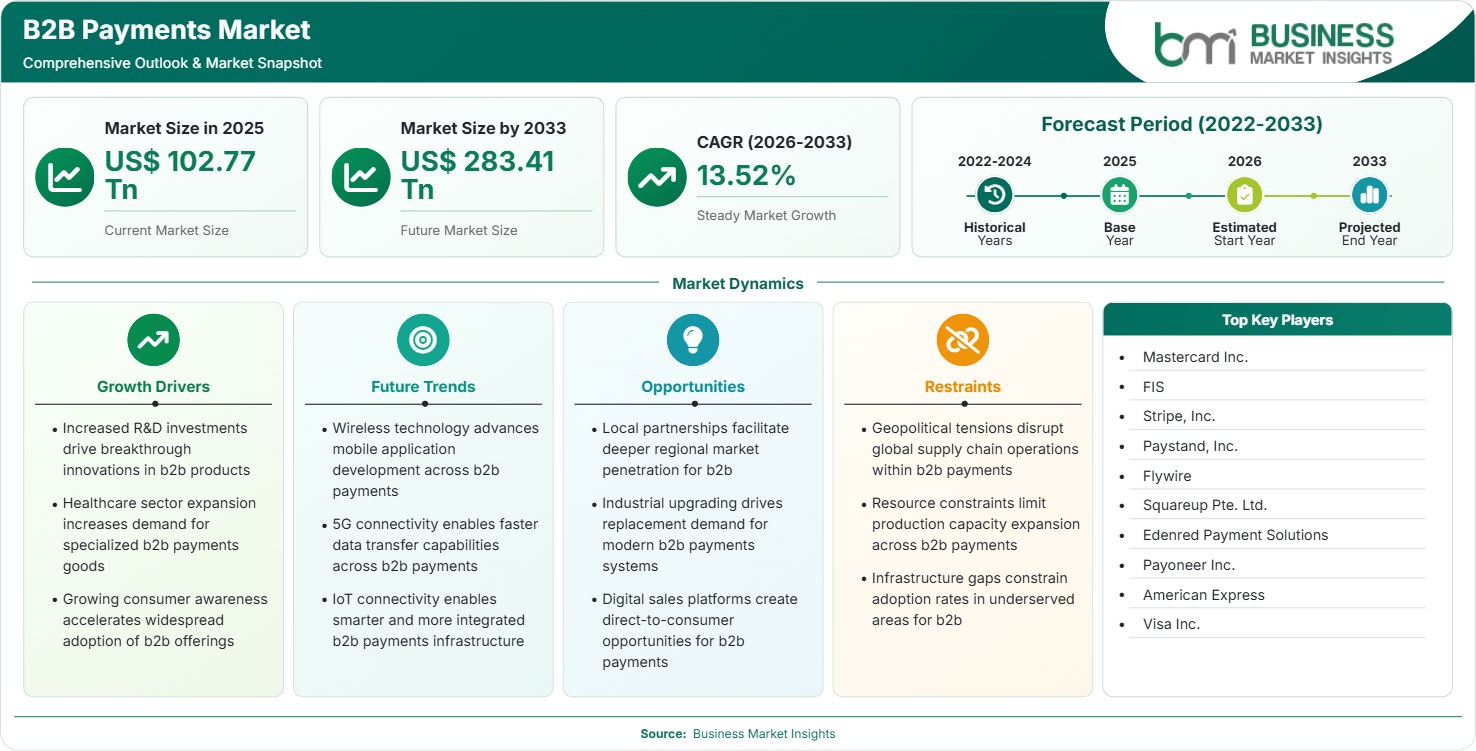
The B2B Payments Market size was valued at US$ 102.77 Trillion in 2025 and is projected to reach US$ 283.41 Trillion by 2033, growing at a CAGR of 13.52% during 2026–2033. Key growth drivers include accelerating digital payment adoption, real-time payment infrastructure expansion, embedded finance integration, and increasing cross-border commercial transactions. Opportunities are emerging from AI-enabled payment automation, SME digitization, and blockchain-based settlement innovations.

Report Coverage
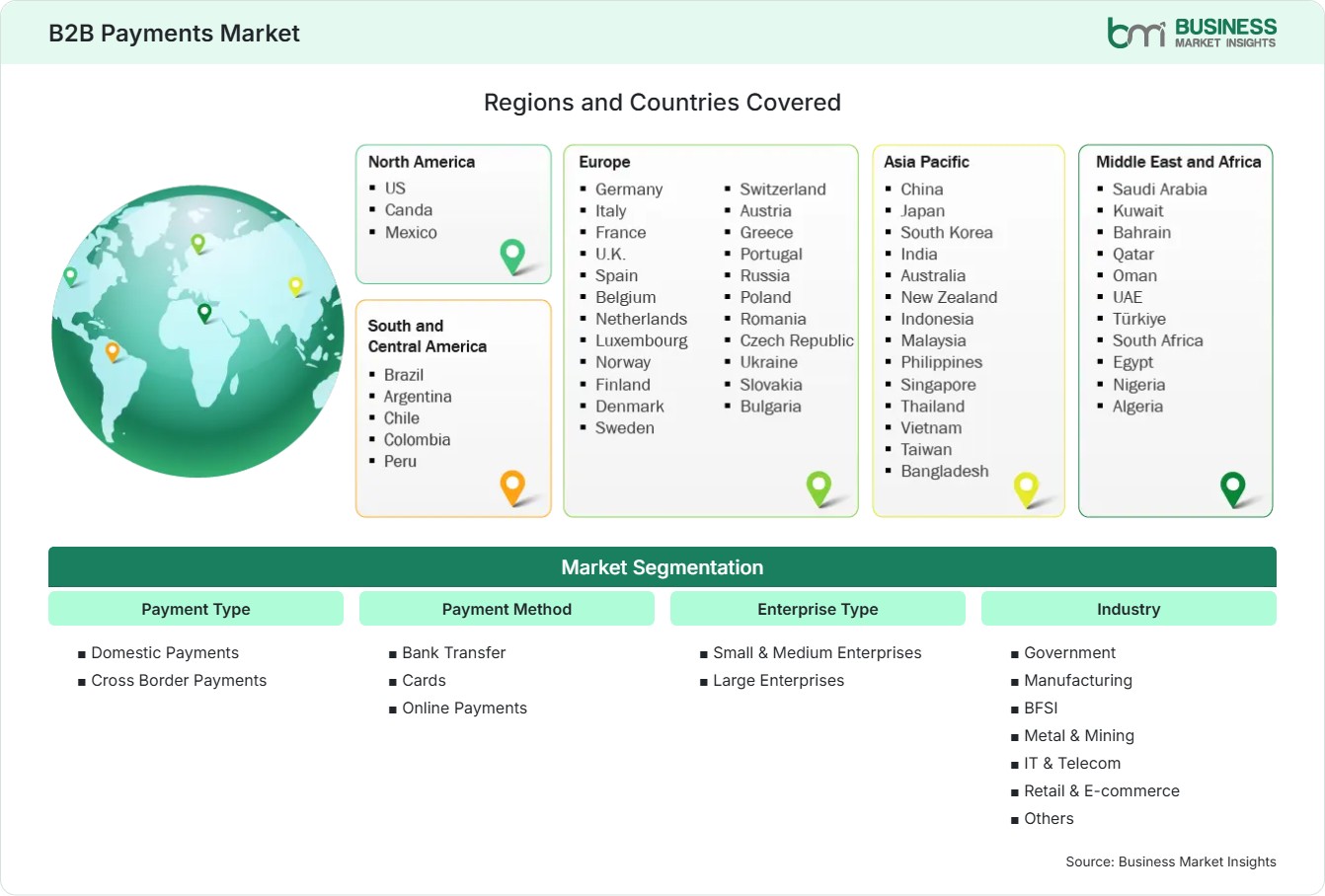
  • Payment Type: Domestic Payments, Cross Border Payments
  • Payment Method: Bank Transfer, Cards, Online Payments
  • Enterprise Type: Small & Medium Enterprises, Large Enterprises
  • Industry: Government, Manufacturing, BFSI, Metal & Mining, IT & Telecom, Retail & E-commerce, Others
US$ 102.77 Tn Market size in 2025
US$ 283.41 Tn Market Size by 2033
13.52% CAGR, 2026 - 2033
2026-2033 Forecast Period

01 AI Overview

B2B Payments Market Summary

  • North America Region: North America holds a market share of 34%–37% in 2025, growing with a CAGR of 12.0%–13.0% during 2026–2033. Growth is supported by widespread digital invoicing adoption, mature banking infrastructure, real-time payment networks, integrated treasury platforms, and increasing enterprise demand for automated reconciliation and payment visibility solutions. The U.S. market benefits from enterprise digitization, RTP adoption, and treasury modernization, expanding at approximately 12.5%–13.5% CAGR through 2033.
  • Fastest Growing Region: Asia Pacific holds a market share of 26%–29% in 2025, growing with a CAGR of 15.5%–16.5% during 2026–2033. Growth is driven by expanding digital commerce ecosystems, government-backed payment modernization programs, rising SME formalization, cross-border trade growth, and rapid adoption of mobile-first commercial payment technologies.
  • Leading Segment: Domestic Payments account for 61%–64% share in 2025 and are expected to expand at a CAGR of 12.5%–13.5% through 2033. Growth stems from increasing automation of supplier payments, real-time transaction processing, digital invoicing penetration, and stronger enterprise demand for efficient working-capital management.
  • High Growth Segment: Online Payments represent 23%–26% share in 2025 and are forecast to grow at a CAGR of 16.5%–17.5% during 2026–2033. Expansion is supported by API-driven payment platforms, embedded finance capabilities, digital procurement systems, and increasing preference for cloud-based transaction management.
  • Key Market Opportunity: Commercial payment ecosystems are increasingly integrating AI, embedded finance, and real-time settlement capabilities, enabling enterprises to optimize liquidity, reduce operational costs, enhance compliance monitoring, and improve supplier payment experiences globally.
  • Major Market Players: Mastercard Incorporated, Fidelity National Information Services, Inc. (FIS), Stripe, Inc., Paystand, Inc., Flywire Corporation, Block, Inc., Edenred Payment Solutions, Payoneer Global Inc., American Express Company, Visa Inc., JPMorgan Chase & Co.
02 Strategic Insights

B2B Payments Market: Strategic Insights

B2B Payments Market Strategic Framework
FREE PDF
Request your free sample
Request free sample
03 Stakeholder View

Key Takeaways

  • The commercial payments ecosystem is increasingly interconnected, with banks, fintech firms, ERP providers, and payment processors collaborating to create seamless transaction environments and stronger value-chain visibility.
  • Cross-border transaction platforms and digital payment solutions targeting SMEs present significant upside due to rising international trade participation and increasing demand for cost-efficient payment processing.
  • AI-powered payment orchestration, predictive cash-flow management, and automated reconciliation technologies are becoming critical innovation areas for solution providers seeking differentiation.
  • Asia Pacific presents a compelling investment case due to rapid enterprise digitization, supportive government policies, and expanding adoption of electronic payment infrastructures across major economies.
  • Strategic acquisitions and partnerships between financial institutions and fintech companies continue to accelerate platform modernization, payment automation capabilities, and embedded finance deployment.
  • Growing demand for transparent transaction tracking and compliance management is encouraging enterprises to invest in integrated payment and treasury management platforms.
04 Geographic Outlook

B2B Payments Market Regional Highlights

North America B2B Payments Market

North America accounted for approximately 34%–37% of global B2B Payments Market revenue in 2025 and is projected to expand at a CAGR of 12.0%–13.0% through 2033. The region benefits from advanced banking infrastructure, widespread enterprise digitization, mature treasury management systems, and significant adoption of real-time payment technologies. Large corporations continue investing in payment automation to improve working-capital efficiency and supplier engagement. Strong fintech innovation and open-banking initiatives are further enhancing commercial transaction capabilities while supporting broader adoption of digital payment ecosystems across industries.

  • Enterprises increasingly deploy AI-driven reconciliation platforms to reduce processing costs, improve transaction accuracy, strengthen financial visibility, and accelerate settlement cycles across complex commercial payment environments.
  • Financial institutions continue expanding real-time payment connectivity, enabling faster commercial transactions, enhanced liquidity management, and improved customer experiences for corporate clients.
  • Embedded finance solutions are gaining traction among procurement and ERP software providers, simplifying payment execution while strengthening operational efficiency throughout business ecosystems.
  • Growing cybersecurity investments are helping enterprises mitigate fraud risks, comply with evolving regulations, and strengthen trust in digital commercial payment channels.
  • Increasing demand for integrated treasury solutions supports greater automation, improved forecasting accuracy, and more efficient management of working capital requirements.

US B2B Payments Market

The United States represents roughly 77%–80% of North American B2B Payments Market revenue and is projected to grow at a CAGR of 12.5%–13.5% during 2026–2033. Strong adoption of RTP networks, widespread ERP implementation, and significant fintech investment continue supporting digital payment transformation. Enterprises are increasingly prioritizing automated invoicing, supplier payment optimization, and integrated treasury systems to improve operational efficiency. Regulatory support for payment modernization and continued innovation among financial institutions further strengthen the country's position as a global commercial payment technology leader.

  • Large enterprises are accelerating adoption of payment orchestration platforms that consolidate multiple payment channels and improve transaction management efficiency.
  • Treasury modernization programs continue driving demand for integrated liquidity management and automated reconciliation technologies across diverse industry sectors.
  • Fintech collaboration with traditional banking institutions is expanding access to innovative payment solutions and advanced transaction analytics capabilities.
  • Cross-border payment optimization remains a priority as businesses seek lower costs, faster settlements, and improved transaction transparency.

Europe B2B Payments Market

Europe held approximately 24%–27% of B2B Payments Market revenue in 2025 and is anticipated to register a CAGR of 12.5%–13.5% through 2033. Strong regulatory support for open banking, digital invoicing frameworks, and payment standardization initiatives continues driving adoption. Large enterprises are increasingly investing in automated payment systems to streamline supplier relationships and enhance financial control. Germany remains the leading regional market, while Eastern European economies demonstrate higher growth rates due to ongoing digital transformation and modernization of commercial banking infrastructure.

  • Open banking initiatives continue fostering innovation by enabling secure data sharing, improved payment experiences, and greater competition among payment providers.
  • Digital invoicing mandates are encouraging enterprises to adopt automated transaction processing and stronger compliance management systems.
  • Germany maintains leadership through advanced industrial ecosystems, extensive enterprise technology adoption, and strong commercial banking capabilities.
  • Poland and other emerging European economies exhibit accelerated adoption driven by digital transformation initiatives and growing fintech ecosystems.
  • Cross-border commerce within the region supports continued demand for efficient, standardized, and transparent payment processing solutions.

Asia Pacific B2B Payments Market

Asia Pacific accounted for approximately 26%–29% of global B2B Payments Market revenue in 2025 and is forecast to grow at a CAGR of 15.5%–16.5% through 2033, making it the fastest-growing region. Rapid digitalization, increasing government support for electronic payments, and expanding regional trade networks continue driving adoption. China represents the largest regional market, while India demonstrates the strongest growth trajectory. Rising SME digitization, mobile-first financial solutions, and growing participation in international trade further accelerate commercial payment modernization throughout the region.

  • Government-backed payment modernization programs are accelerating digital transaction adoption and expanding financial inclusion across business communities.
  • China continues leading regional revenue generation through large-scale enterprise digitization and extensive digital payment infrastructure deployment.
  • India records among the highest growth rates as businesses increasingly adopt electronic invoicing, digital procurement, and automated payment solutions.
  • Expanding regional trade corridors create demand for faster cross-border payment capabilities and improved settlement transparency.
  • Cloud-based financial platforms are enabling SMEs to access sophisticated payment management tools previously limited to large enterprises.

Rest of World B2B Payments Market

Rest of World accounted for approximately 10%–13% of global B2B Payments Market revenue in 2025 and is projected to expand at a CAGR of 13.0%–14.0% through 2033. South & Central America is benefiting from growing digital banking adoption and fintech investment. Meanwhile, Middle East & Africa markets are advancing through national digital transformation strategies and payment infrastructure modernization programs.

Brazil remains the leading market in South & Central America, while the United Arab Emirates demonstrates the strongest growth across the Middle East & Africa region. Continued financial digitization and regulatory modernization support broader commercial payment adoption.

  • Fintech innovation is expanding access to digital commercial payment solutions for businesses across emerging economies.
  • Brazil benefits from strong digital banking penetration and increasing enterprise adoption of electronic payment systems.
  • Gulf countries continue investing in digital economy initiatives that strengthen commercial transaction infrastructure and financial innovation.
  • Growing international trade participation supports demand for efficient cross-border payment and settlement capabilities.
  • Regulatory modernization efforts are helping create more transparent, secure, and interoperable payment ecosystems.
Global Market Geography
FREE PDF
Request your free sample
Request free sample
05 Segment Analysis

B2B Payments Market Segmentation

Payment Type

The Payment Type segment accounted for the largest B2B Payments Market share of transaction volume within the market ecosystem. This segment represented approximately 61%–64% market share in 2025 and is projected to expand at a CAGR of 12.5%–13.5% through 2033. Growing enterprise requirements for payment automation, supplier relationship management, and transaction visibility continue driving adoption. The increasing complexity of commercial supply chains and digitized procurement systems supports broader deployment of advanced payment solutions across domestic and international business environments.

  • Domestic Payments: Domestic transactions remain the dominant payment category, supported by real-time settlement infrastructure, ERP integration, automated invoicing systems, and growing enterprise emphasis on operational efficiency and liquidity optimization.
  • Cross Border Payments: Cross-border transactions benefit from expanding international trade networks, enhanced payment transparency, fintech innovation, and increasing demand for lower-cost settlement mechanisms across global supply chains.

Payment Method

Payment Method solutions represented a highly competitive area of innovation, with increasing enterprise preference for digitized transaction processing. This segment accounted for approximately 32%–35% market share in 2025 and is expected to register a CAGR of 14.5%–15.5% through 2033. Growing adoption of API-enabled platforms, treasury modernization initiatives, and integrated commercial payment workflows continue strengthening demand. The B2B Payments Market scope continues expanding as enterprises prioritize efficiency, transparency, and security across payment operations.

  • Bank Transfer: Bank transfers remain essential for high-value commercial transactions due to strong regulatory acceptance, extensive banking network coverage, reliable settlement mechanisms, and treasury integration capabilities.
  • Cards: Commercial card usage continues increasing as enterprises seek enhanced expense control, transaction visibility, rebate opportunities, and simplified payment processes across procurement activities.
  • Online Payments: Online payment platforms benefit from cloud-based architectures, embedded finance functionality, automated workflows, and growing demand for seamless transaction execution across digital procurement ecosystems.

Enterprise Type

Enterprise Type segmentation highlights distinct adoption patterns between organizational sizes. This segment maintained approximately 28%–31% B2B Payments Market share in 2025 and is projected to grow at a CAGR of 13.5%–14.5% during the forecast period. Increasing availability of cloud-based payment platforms and subscription-based deployment models is enabling broader accessibility. Enhanced compliance capabilities and lower implementation complexity continue encouraging adoption among organizations seeking scalable financial management solutions.

  • Small & Medium Enterprises: SMEs increasingly adopt digital payment platforms to improve cash-flow visibility, reduce administrative burdens, strengthen supplier relationships, and access advanced financial management capabilities.
  • Large Enterprises: Large organizations prioritize sophisticated treasury management, payment orchestration, fraud mitigation, and multi-country transaction management capabilities to support complex operational requirements.

Industry

Industry-specific adoption continues shaping investment priorities across commercial payment ecosystems. This segment accounted for approximately 34%–37% market share in 2025 and is forecast to expand at a CAGR of 14.0%–15.0% through 2033. Growing digital transformation initiatives, supply-chain optimization efforts, and regulatory compliance requirements are accelerating implementation. The evolving B2B Payments Market trends demonstrate increasing demand for industry-tailored transaction management solutions that support operational efficiency and business scalability.

  • Government: Government agencies increasingly implement electronic payment systems to improve transparency, streamline procurement processes, enhance accountability, and strengthen public-sector financial management capabilities.
  • Manufacturing: Manufacturing organizations utilize digital payment solutions to support supplier ecosystems, optimize inventory financing, and improve working-capital management across global operations.
  • BFSI: Financial institutions continue investing in payment modernization technologies to enhance transaction processing efficiency, customer experiences, and regulatory compliance management capabilities.
  • Metal & Mining: Companies operating within metal and mining sectors leverage automated payment solutions to manage complex supplier networks and strengthen financial visibility.
  • IT & Telecom: Technology and telecommunications organizations increasingly adopt digital payment infrastructure to support subscription models, partner ecosystems, and global service delivery operations.
  • Retail & E-commerce: Retail and e-commerce enterprises benefit from automated transaction management, marketplace settlement capabilities, and integrated payment processing systems that improve operational agility.
06 Market Forces

B2B Payments Market Dynamics

Key Market Drivers

Rapid Expansion of Real-Time Payment Infrastructure

Real-time payment adoption is accelerating across developed and emerging economies as businesses demand faster transaction processing and improved liquidity management. Financial institutions continue investing heavily in instant payment frameworks, enabling enterprises to optimize working capital and reduce settlement delays. The U.S. Federal Reserve's FedNow Service expansion and increasing RTP network utilization illustrate the broader modernization trend. B2B Payments Market growth is increasingly linked to enterprise demand for immediate transaction visibility and cash-flow optimization. Organizations implementing real-time payment capabilities report improved supplier relationships, reduced reconciliation complexities, and stronger operational efficiency. As transaction volumes continue increasing, real-time infrastructure is expected to remain a critical foundation supporting commercial payment modernization globally.

Digital Transformation Across Enterprise Finance Functions

Enterprise finance departments are accelerating digital transformation initiatives to improve operational efficiency and reduce administrative costs. According to various industry surveys, finance leaders increasingly prioritize automation, electronic invoicing, and integrated treasury platforms. The adoption of cloud-based ERP systems has significantly expanded the need for seamless payment connectivity. Organizations are replacing manual payment processes with automated workflows that improve transaction accuracy and compliance monitoring. The growing complexity of multinational operations further increases demand for centralized payment management capabilities. Integrated payment ecosystems allow businesses to streamline procurement, treasury, and accounting functions while improving financial visibility. These developments continue supporting sustainable long-term market expansion.

Growing Cross-Border Trade and Supply Chain Complexity

Global trade activity continues generating demand for sophisticated commercial payment solutions capable of supporting multinational transactions. IMF trade data and international commerce indicators demonstrate continued growth in cross-border business activity despite geopolitical uncertainties. Enterprises increasingly require payment platforms that provide transparency, compliance management, foreign exchange optimization, and efficient settlement capabilities. B2B Payments Market trends indicate stronger demand for solutions that simplify international supplier payments and improve transaction tracking. The expansion of global sourcing strategies and digital trade ecosystems further increases transaction volumes. Payment providers offering streamlined cross-border capabilities, automated compliance tools, and enhanced visibility are well positioned to benefit from evolving commercial trade requirements.

Key Market Opportunities

AI-Driven Payment Intelligence and Automation

Artificial intelligence is creating significant opportunities for payment providers seeking to improve transaction efficiency and customer value. AI-powered reconciliation, anomaly detection, predictive cash-flow analysis, and automated dispute management solutions are becoming increasingly attractive to enterprises. Incorporating machine learning is helping businesses spot areas of payment delays, improve liquidity management, and manage operational risks. Amidst increasing complexities in the field of finance, the demand for intelligent automation will continue to grow. Technology companies incorporating artificial intelligence in their payment systems will be able to offer significant efficiencies along with increased customer retention. With increasing corporate spending on digital finance, AI-driven business payments platforms will have significant growth potential.

Embedded Finance Within Enterprise Software Platforms

Embedded finance is transforming how businesses access payment services by integrating financial capabilities directly into enterprise software environments. Procurement systems, ERP platforms, accounting solutions, and supply-chain management applications increasingly incorporate payment functionality. This B2B Payments Market trend provides an opportunity for payment platforms to increase transaction volume along with increased customer interaction. For businesses, it is an advantage through simplification of their workflows, decreased operational complexity, and increased visibility of transactions. Expansion of financial services through APIs increases the scope of integration. With software providers trying to distinguish themselves, embedded payments are likely to drive innovation and revenue generation.

SME Digitization and Emerging Market Expansion

Millions of SMEs continue transitioning from manual financial processes to digital platforms, creating substantial growth potential. Governments and financial institutions across emerging markets are promoting digital business ecosystems through regulatory modernization, electronic invoicing initiatives, and payment infrastructure investment. B2B Payments Market Forecasts now place a significant emphasis on SME digitalization as a source of income. Firms that implement digital payments are able to access finance more easily, increase efficiency, and become more financially transparent. Payment services that provide cost-effective, scalable, and easily implemented solutions stand to gain from this trend as it continues worldwide.

Market Restraints and Challenges

Cybersecurity Risks and Increasing Fraud Sophistication

Factor: The growing digitization of commercial payment ecosystems expands exposure to cyberattacks, business email compromise schemes, and payment fraud attempts.

Impact: Enterprises face increasing compliance costs, operational risks, and reputational concerns. As payment volumes rise and transaction channels diversify, organizations must invest heavily in cybersecurity infrastructure, monitoring capabilities, and employee training programs. Sophisticated threat actors continue targeting high-value business transactions, creating additional risk management requirements. Smaller organizations often lack the resources necessary to implement advanced security controls. These challenges can delay digital transformation initiatives and increase implementation costs, potentially limiting adoption rates among certain enterprise segments despite the broader benefits of payment modernization.

Fragmented Regulatory Requirements Across Jurisdictions

Factor: Commercial payment providers operating internationally must navigate diverse regulatory frameworks governing data privacy, financial reporting, anti-money laundering controls, and payment processing standards.

Impact: The complexity of regulations leads to higher costs and longer times of implementation. Enterprises that perform transactions on an international level usually have to develop special compliance systems that meet the demands of the local regulations. The constant updates of regulations lead to increased administrative difficulties and expenses on technology. Payment service providers have to constantly update their systems in order to remain compliant in different jurisdictions.

07 Company Analysis

Competitive Landscape

The competitive environment is characterized by increasing convergence between traditional financial institutions, payment processors, fintech innovators, and embedded finance providers. B2B Payments Market analysis indicates that vendors are prioritizing payment automation, real-time settlement capabilities, cross-border transaction optimization, API-driven integrations, and AI-powered treasury solutions to strengthen their market positions.

Company Name

Overview

Products and Services Relevant to this Market

Mastercard Incorporated

Global payments technology company enabling commercial transaction processing, payment security, and digital financial connectivity across enterprise ecosystems.

Commercial cards, virtual cards, cross-border payment services, payment gateways, supplier payment solutions, and payment analytics platforms.

Fidelity National Information Services, Inc. (FIS)

Major financial technology provider serving banks, corporations, and financial institutions with payment modernization capabilities.

Treasury management solutions, payment processing platforms, commercial banking technology, real-time payments, and financial software services.

Stripe, Inc.

Technology-focused payments provider supporting digital commerce, embedded finance, and enterprise payment infrastructure.

Payment APIs, treasury solutions, invoicing platforms, cross-border payments, payment orchestration, and business financial services.

Paystand, Inc.

Fintech company focused on digitizing commercial payments through automated and cloud-based payment networks.

Accounts receivable automation, digital invoicing, payment acceptance, B2B transaction networks, and payment reconciliation tools.

Flywire Corporation

Specialized payments company supporting complex domestic and international payment workflows across industries.

Cross-border payment solutions, payment processing, receivables management, global settlement services, and transaction tracking capabilities.

Block, Inc.

Financial technology company providing digital payment infrastructure and commercial transaction management capabilities.

Payment acceptance platforms, merchant services, business financial tools, transaction management, and integrated payment systems.

Edenred Payment Solutions

Corporate payment specialist supporting business spending management and payment optimization programs.

Corporate payment platforms, virtual payment solutions, expense management tools, and supplier payment services.

Payoneer Global Inc.

Global financial services provider enabling international business payments and commercial transactions.

Cross-border payment services, business accounts, supplier payments, currency management, and commercial transaction solutions.

American Express Company

Financial services leader with extensive commercial payment and corporate expense management capabilities.

Corporate cards, supplier payment programs, commercial financing solutions, expense management, and transaction analytics.

Visa Inc.

Global payment technology provider supporting enterprise payment modernization and transaction connectivity.

Commercial payment networks, virtual cards, cross-border payment solutions, real-time payments, and treasury integration services.

JPMorgan Chase & Co.

Global banking institution offering comprehensive treasury and commercial payment services.

Treasury services, liquidity management, payment processing, cross-border settlements, and working-capital optimization solutions.

10 Trust & Transparency

Research Methodology

The market analysis combines proprietary research with secondary data from government agencies, company disclosures, regulatory filings, industry databases and expert interviews. Market estimates are validated through data triangulation, cross-market benchmarking and analyst review.

View Full Research Methodology

11 Questions Answered

Frequently Asked Questions

What industries are generating the highest demand?

The B2B Payments Market Report highlights that BFSI, manufacturing, retail & e-commerce, government, and IT & telecom sectors are among the largest adopters due to high transaction volumes, complex supplier ecosystems, and ongoing digital transformation initiatives.

How is artificial intelligence influencing commercial payments?

Artificial intelligence improves payment automation through predictive cash-flow analysis, fraud detection, reconciliation automation, anomaly identification, and transaction optimization. These capabilities help enterprises improve efficiency while reducing financial and operational risks.

Why are cross-border payment solutions becoming important?

Businesses increasingly operate across multiple markets and require payment systems that provide transparency, compliance support, foreign exchange management, and efficient settlement capabilities. Cross-border solutions help reduce operational complexity and transaction costs.

Which region represents the strongest growth opportunity?

Asia Pacific presents the strongest growth opportunity due to rapid digital transformation, increasing SME digitization, supportive government initiatives, expanding regional trade activity, and rising adoption of electronic payment infrastructure across major economies.

What is driving the adoption of the B2B Payments Market?

Enterprises are increasingly adopting digital payment platforms to improve transaction speed, reduce manual processing costs, strengthen cash-flow visibility, enhance supplier relationships, and automate reconciliation activities. Real-time payment infrastructure and integrated ERP connectivity are accelerating adoption.

Access the Full B2B Payments Market Report

Get segment-level forecasts, regional estimates, competitive benchmarking, company profiles and downloadable Excel datasets.

Access the full B2B Payments Market Report
350 pages PDF & Excel | 2026-08-18