
Compressor Control Systems Market Outlook: Size, Share, Trends, Growth Analysis, Competitive Landscape & Forecast, 2026-2033

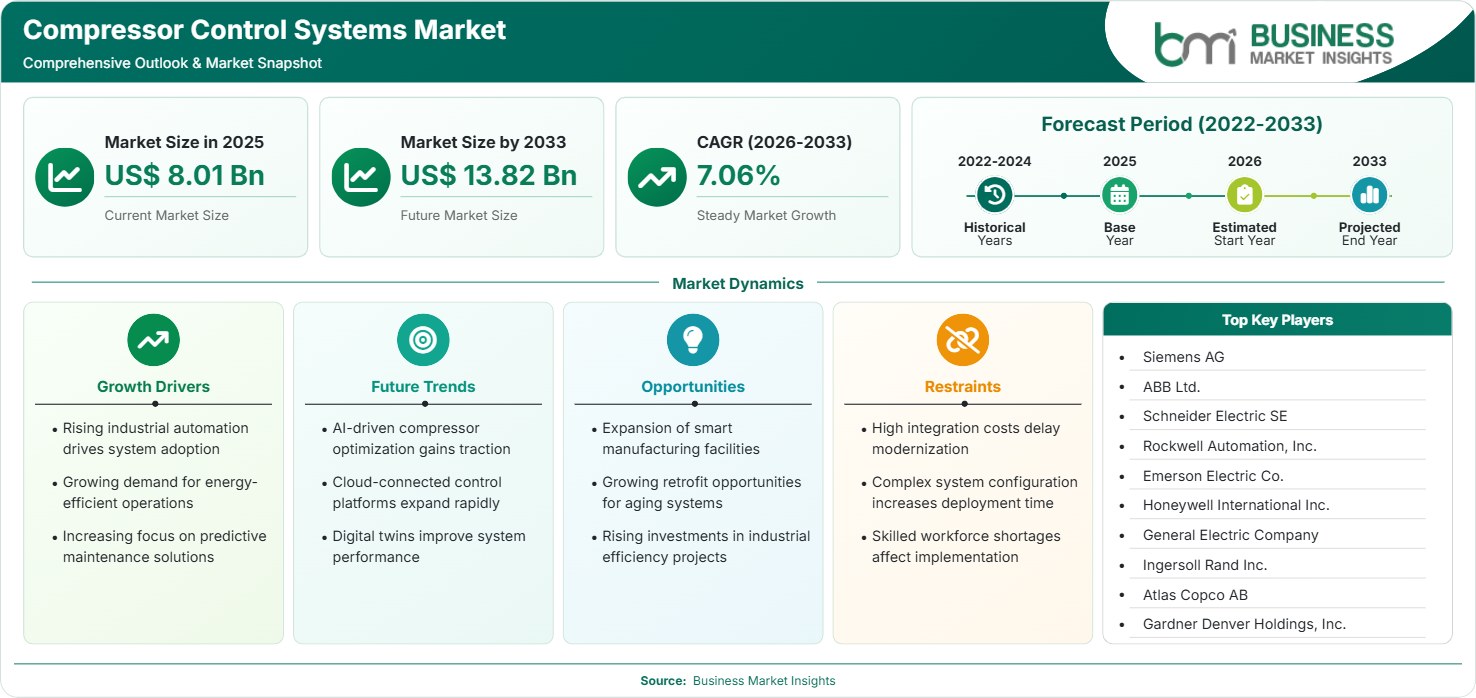
The Compressor Control Systems Market size was valued at US$ 8.01 billion in 2025 and is projected to reach US$ 13.82 billion by 2033, growing at a CAGR of 7.06% during 2026–2033. Rising industrial automation, growing demand for energy-efficient operations, and increasing adoption of predictive maintenance solutions continue supporting market expansion, while smart manufacturing facilities and industrial modernization projects create significant long-term opportunities.

Report Coverage
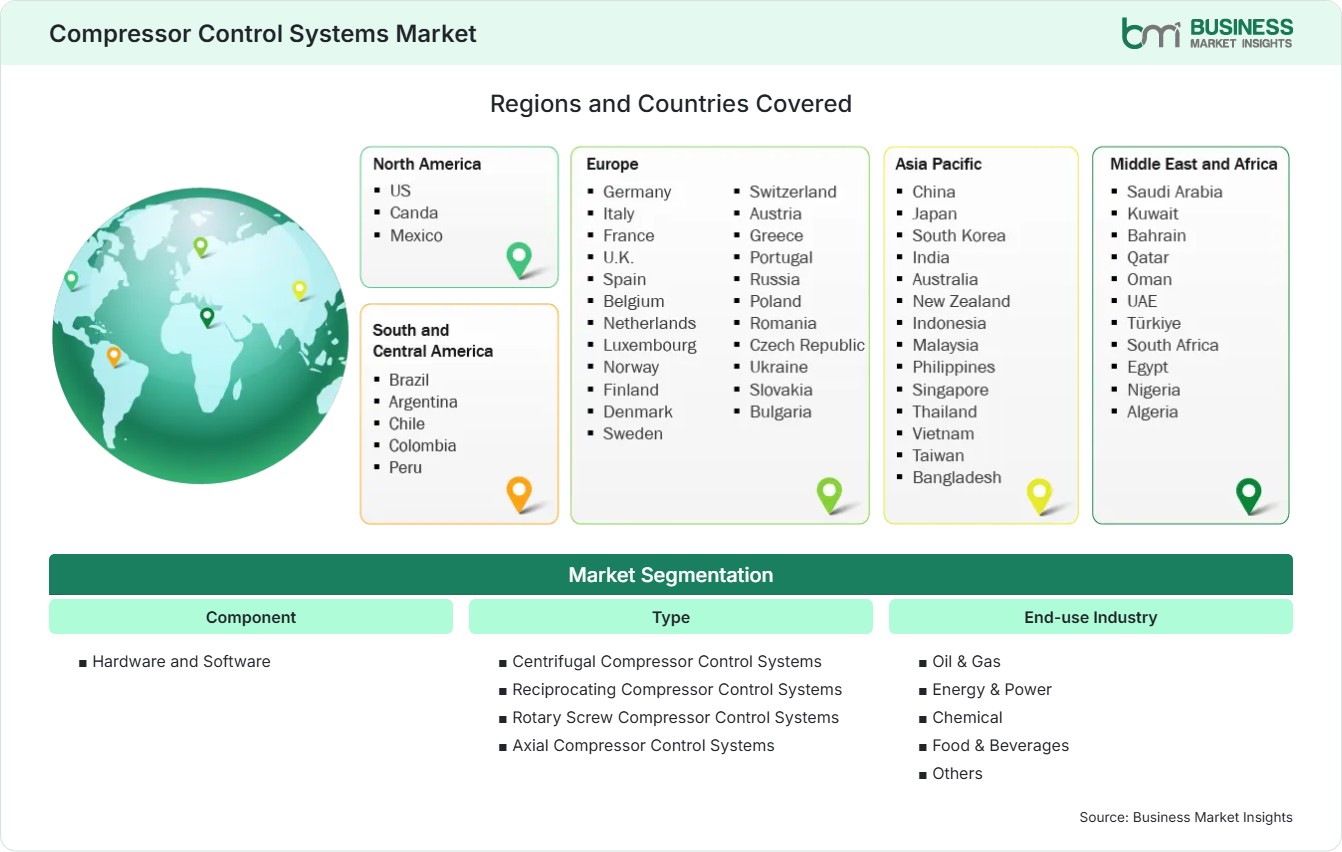
  • Component: Hardware and Software
  • Type: Centrifugal Compressor Control Systems, Reciprocating Compressor Control Systems, Rotary Screw Compressor Control Systems, Axial Compressor Control Systems
  • End-use Industry: Oil & Gas, Energy & Power, Chemical, Food & Beverages, Others
US$ 8.01 Bn Market size in 2025
US$ 13.82 Bn Market Size by 2033
7.06% CAGR, 2026 - 2033
2026-2033 Forecast Period

AI Overview

Compressor Control Systems Market Summary

  • North America Region: North America holds 34%–37% market share in 2025 and is projected to expand at a CAGR of 6.8%–7.3% during 2026–2033. Industrial automation, digital asset management, and modernization of oil & gas and power facilities continue driving market expansion. The U.S. leads regional demand through extensive deployment of industrial automation platforms, digital process control systems, and predictive maintenance technologies, advancing at an estimated CAGR of 6.9%–7.4% during 2026–2033.
  • Fastest Growing Region: Asia Pacific accounts for 30%–33% market share in 2025 and is expected to register a CAGR of 7.8%–8.4% during 2026–2033. Expanding manufacturing capacity, industrial automation, energy infrastructure development, and increasing investments in smart factories continue accelerating regional growth.
  • Leading Segment: Hardware represents 61%–64% market share in 2025 and is anticipated to grow at a CAGR of 6.9%–7.4% owing to increasing installation of controllers, sensors, programmable logic controllers, and industrial monitoring devices.
  • High Growth Segment: Oil & Gas accounts for 31%–34% market share in 2025 and is forecast to expand at a CAGR of 7.5%–8.1% as upstream, midstream, and downstream facilities continue investing in compressor efficiency, operational reliability, and digital automation.
  • Key Market Opportunity: Expansion of smart manufacturing facilities, retrofit projects for aging compressor systems, and increasing investments in industrial efficiency are creating attractive growth opportunities for automation solution providers.
  • Major Market Players: Siemens AG, ABB Ltd., Schneider Electric SE, Rockwell Automation, Inc., Emerson Electric Co., Honeywell International Inc., General Electric Company, Ingersoll Rand Inc., Atlas Copco AB, and Gardner Denver Holdings, Inc.
Strategic Insights

Compressor Control Systems Market: Strategic Insights

Compressor Control Systems Market Strategic Framework
FREE PDF
Request your free sample
Request free sample
Stakeholder View

Key Takeaways

  • Industrial digitalization is reshaping compressor operations as manufacturers increasingly integrate intelligent controllers, advanced sensors, and predictive analytics into plant-wide automation strategies to improve operational efficiency and equipment reliability.
  • Oil & gas facilities, power generation plants, and chemical processing industries present the strongest commercial opportunities because they require continuous compressor monitoring, high system availability, and optimized energy consumption.
  • Artificial intelligence, Industrial Internet of Things (IIoT), cloud-based monitoring platforms, and predictive maintenance technologies are accelerating product innovation while enabling real-time diagnostics and automated operational decision-making.
  • Asia Pacific offers the most attractive long-term investment opportunity because of expanding industrial production, increasing factory automation, strong infrastructure development, and growing adoption of smart manufacturing technologies.
  • Strategic acquisitions, industrial automation partnerships, and investments in software-driven compressor optimization solutions continue strengthening competition while helping vendors expand their digital service capabilities and global customer reach.
Geographic Outlook

Compressor Control Systems Market Regional Highlights

North America Compressor Control Systems Market

North America accounted for 34%–37% of the Compressor Control Systems Market Share in 2025 and is projected to expand at a CAGR of 6.8%–7.3% during 2026–2033. Strong adoption of industrial automation, predictive maintenance platforms, and digital asset management solutions continues supporting market growth across oil & gas, power generation, and manufacturing industries.

  • Oil & gas companies continue modernizing compressor stations with intelligent automation and advanced process control technologies.
  • Increasing deployment of Industrial Internet of Things platforms strengthens predictive maintenance and operational efficiency.
  • Industrial energy optimization initiatives encourage investment in intelligent compressor monitoring systems.
  • Expansion of digital manufacturing facilities supports greater demand for integrated compressor control technologies.

US Compressor Control Systems Market

The U.S. represented 76%–79% of the North American market in 2025 and is projected to grow at a CAGR of 6.9%–7.4% through 2033. Ongoing investments in industrial modernization, process automation, and intelligent manufacturing continue supporting widespread deployment across major industrial sectors.

  • Large-scale manufacturing facilities increasingly deploy automated compressor control systems to improve productivity.
  • Energy companies continue investing in predictive maintenance and digital monitoring technologies.
  • Industrial software integration enhances operational visibility and equipment reliability.
  • Smart factory development accelerates adoption of connected compressor control platforms.

Europe Compressor Control Systems Market

Europe held 25%–28% market share in 2025 and is expected to expand at a CAGR of 6.6%–7.1% through 2026–2033. Germany leads regional adoption, while the United Kingdom records the fastest growth because of increasing industrial automation investments and energy efficiency initiatives.

  • Industrial decarbonization strategies encourage adoption of energy-efficient compressor management technologies.
  • Process industries continue upgrading aging automation infrastructure across production facilities.
  • Digital manufacturing initiatives support wider implementation of intelligent control systems.
  • Chemical and food processing industries increasingly deploy predictive maintenance solutions.

Asia Pacific Compressor Control Systems Market

Asia Pacific accounted for 30%–33% market share in 2025 and is projected to register the strongest Compressor Control Systems Market Forecasts, expanding at a CAGR of 7.8%–8.4% during 2026–2033. China leads regional revenue, while India demonstrates the fastest growth through expanding industrial automation and manufacturing investments.

  • Rapid industrialization continues increasing demand for intelligent compressor automation technologies.
  • Smart factory projects accelerate deployment of connected industrial control systems.
  • Expanding energy and power infrastructure supports long-term equipment modernization.
  • Manufacturing digitalization encourages adoption of advanced monitoring and predictive maintenance solutions.
  • Government support for industrial modernization strengthens future market expansion.

Rest of World Compressor Control Systems Market

The Rest of World region represented 9%–11% market share in 2025 and is expected to grow at a CAGR of 6.9%–7.5% during 2026–2033. Brazil leads South American adoption, while Saudi Arabia demonstrates the highest growth across the Middle East and Africa owing to industrial diversification and energy infrastructure investments.

  • Oil refining and petrochemical expansion continue increasing demand for compressor automation technologies.
  • Industrial diversification initiatives encourage modernization of manufacturing facilities.
  • Investments in power generation strengthen demand for advanced compressor control solutions.
  • Mining and processing industries increasingly adopt intelligent equipment monitoring systems.
Global Market Geography
FREE PDF
Request your free sample
Request free sample
Segment Analysis

Compressor Control Systems Market Segmentation

Component

The Component segment represents the largest, with Hardware accounting for 61%–64% market share in 2025 and expanding at a CAGR of 6.9%–7.4%. The Compressor Control Systems Market Trends indicate sustained investments in programmable logic controllers, sensors, human-machine interfaces, and industrial communication devices that improve compressor efficiency, operational safety, and process reliability.

  • Hardware: Includes controllers, sensors, programmable logic controllers, communication modules, and monitoring devices that enable accurate compressor operation, real-time diagnostics, and reliable industrial automation.
  • Software: Supports visualization, predictive maintenance, data analytics, remote monitoring, alarm management, and process optimization for intelligent compressor control environments.

Type

The Type segment continues expanding as industries deploy specialized compressor control systems tailored to different operational requirements, pressure ranges, and industrial processes. Growing automation investments continue supporting adoption across multiple compressor technologies.

  • Centrifugal Compressor Control Systems: Widely adopted in oil & gas, petrochemical, and power generation industries requiring continuous high-capacity compression and efficient process control.
  • Reciprocating Compressor Control Systems: Preferred for applications requiring high-pressure performance, reliable operation, and precise process monitoring across industrial facilities.
  • Rotary Screw Compressor Control Systems: Increasingly deployed across manufacturing plants because of energy efficiency, operational reliability, and simplified maintenance requirements.
  • Axial Compressor Control Systems: Utilized in large-scale power generation, aviation, and industrial processing applications requiring continuous high-volume airflow management.

End-use Industry

The End-use Industry segment reflects broad deployment of compressor control technologies across process industries seeking higher operational efficiency, equipment reliability, and reduced energy consumption. Oil & gas remains the leading end-use industry, while modernization initiatives continue expanding adoption across additional industrial sectors.

  • Oil & Gas: Largest end-use segment driven by continuous compressor monitoring, process optimization, asset reliability, and stringent operational safety requirements.
  • Energy & Power: Increasing investments in power generation efficiency encourage deployment of intelligent compressor monitoring and automated process control systems.
  • Chemical: Chemical processing facilities adopt advanced compressor control technologies to improve production stability, safety, and energy efficiency.
  • Food & Beverages: Manufacturers utilize compressor automation to improve production consistency, operational efficiency, and compliance with quality standards.
Market Forces

Compressor Control Systems Market Dynamics

Key Market Drivers

Rising Industrial Automation Drives System Adoption

The increasing adoption of industrial automation is a major factor supporting the Compressor Control Systems Market Growth. Manufacturers across oil & gas, chemicals, power generation, and food processing are integrating intelligent compressor control systems to improve operational efficiency, reduce manual intervention, and enhance equipment reliability. The use of industrial automation tools along with PLCs, DCS, and IIOT helps in optimizing the processes and continuous monitoring of performance. In addition to this, increased spending on smart factories and digital manufacturing plants creates greater need for the automated compressor management system. With productivity, safety, and asset efficiency being priority considerations, intelligent control technologies for compressors will continue their commercial adoption.

Growing Demand for Energy-Efficient Operations

Industrial facilities are increasingly investing in energy-efficient equipment to reduce operating expenses and meet sustainability objectives. Compressor systems account for a significant portion of industrial electricity consumption, encouraging operators to deploy advanced control technologies that optimize compressor loading, pressure regulation, and energy utilization. Intelligent control systems constantly observe the operational conditions and automatically adjust the performance of the compressors based on the production needs, thus preventing wastage of power. The growing trend of environmental laws, corporate policies on de-carbonization, and the rising cost of electricity is further fueling the modernization process.

Increasing Focus on Predictive Maintenance Solutions

Predictive maintenance is becoming an essential strategy for industrial asset management as manufacturers seek to reduce unplanned downtime and maintenance expenses. The compressor control system that utilizes sensors along with artificial intelligence and machine learning technologies keeps track of vibration, temperature, pressure, and performance to detect any equipment failure even before it occurs. Such a maintenance strategy not only makes sure of the proper functioning of the machinery but also increases its life span and reduces maintenance costs. The adoption of IIoT platform and cloud-based asset management solutions has boosted the demand for smart compressor control systems.

Key Market Opportunities

Expansion of Smart Manufacturing Facilities

The expansion of smart manufacturing facilities is creating substantial growth opportunities for compressor control system providers. Manufacturers are increasingly integrating automation platforms, connected sensors, cloud analytics, and digital twins to optimize production efficiency and improve operational visibility. The Compressor Control Systems Market Forecasts indicate continued investment in intelligent factory infrastructure as industries accelerate digital transformation initiatives. Modern compressor control systems aid in the creation of an autonomous production system through real-time monitoring and predictive diagnosis. This makes energy efficiency, equipment reliability, and flexibility of production possible, which makes smart manufacturing one of the main opportunities for the industry.

Growing Retrofit Opportunities for Aging Systems

Many industrial facilities continue operating aging compressor infrastructure that lacks modern monitoring, automation, and predictive maintenance capabilities. Rather than replacing complete compressor installations, operators increasingly prefer retrofit solutions that integrate advanced controllers, communication modules, sensors, and software with existing equipment. Retrofit activities decrease capital costs and increase efficiency of operations as well as improve equipment efficiency and compliance. Increased focus on longevity of assets, digital transformation, and energy optimization drives continued demand for compressor control systems upgrades in the oil & gas industry, power generation, manufacturing, and chemical processing sectors.

Rising Investments in Industrial Efficiency Projects

Governments and industrial organizations continue investing in energy optimization and operational efficiency projects to improve productivity while reducing environmental impact. Compressor control systems play an important role by optimizing compressor sequencing, minimizing energy losses, and improving equipment utilization across industrial facilities. Growth in the use of industrial digitization, artificial intelligence, and process analytics adds to the prospects for intelligent compressor management systems. The companies that provide hardware, software, remote diagnostics, and lifecycle services will reap rewards from the increasing investment in modernization and sustainability in industry.

Market Restraints and Challenges

High Integration Costs Delay Modernization

Implementing advanced compressor control systems often requires significant investment in hardware, software, communication infrastructure, engineering services, and operator training, increasing overall project costs.

Factor: High capital expenditure associated with modernization projects.

Impact: Industrial companies delay upgrading systems due to budget constraints and lengthy payback periods. Companies of smaller sizes may choose to invest in production before automation, thus making it harder to implement automated technology even though it provides numerous benefits.

Complex System Configuration Increases Deployment Time

Modern compressor control systems require extensive configuration, calibration, integration, and testing to ensure compatibility with existing industrial equipment, automation platforms, and plant operating conditions.

Factor: Complex engineering and system integration requirements.

Impact: Longer implementation timelines can increase project costs, disrupt plant operations, and delay return on investment. Facilities operating multiple compressor technologies often require customized engineering solutions and specialized technical expertise, creating additional challenges for organizations seeking rapid deployment of intelligent compressor control systems.

Company Analysis

Competitive Landscape

The competitive landscape of the Market is highly competitive, with global automation companies focusing on digital control platforms, Industrial Internet of Things (IIoT) integration, predictive maintenance software, and intelligent compressor optimization technologies. The Compressor Control Systems Market Analysis indicates that leading companies are strengthening their positions through strategic acquisitions, software innovation, cloud-enabled monitoring solutions, and expansion of industrial automation portfolios. Vendors are increasingly investing in artificial intelligence, edge computing, cybersecurity, and remote asset management capabilities to improve compressor efficiency, minimize operational downtime, and support digital transformation initiatives across process industries.

Company Name

Overview

Products and Services Relevant to this Market

Siemens AG

Global industrial technology leader delivering automation, digitalization, and smart infrastructure solutions for manufacturing and process industries.

Compressor control systems, PLCs, distributed control systems, industrial software, SCADA platforms, digital twin solutions, and predictive maintenance technologies.

ABB Ltd.

Multinational automation company providing electrification, industrial automation, robotics, and digital technologies for industrial facilities worldwide.

Compressor automation systems, control platforms, variable speed drives, industrial software, asset monitoring, and process optimization solutions.

Schneider Electric SE

Global specialist in energy management and industrial automation technologies supporting sustainable industrial operations.

EcoStruxure automation platform, compressor monitoring systems, PLCs, industrial controllers, energy management software, and predictive analytics solutions.

Rockwell Automation, Inc.

Industrial automation company offering intelligent manufacturing technologies for discrete and process industries globally.

FactoryTalk software, Allen-Bradley controllers, industrial automation platforms, compressor control applications, and remote monitoring solutions.

Emerson Electric Co.

Engineering technology company providing advanced automation and measurement solutions across industrial sectors.

DeltaV distributed control systems, compressor performance monitoring, process automation software, valves, instrumentation, and predictive maintenance technologies.

Honeywell International Inc.

Global technology company delivering industrial automation, process control, and digital transformation solutions.

Experion process control systems, industrial cybersecurity, compressor optimization software, automation platforms, and asset performance management solutions.

General Electric Company

Diversified industrial technology company supplying digital energy and industrial equipment solutions.

Compressor control technologies, industrial monitoring platforms, digital asset management, and process optimization software.

Ingersoll Rand Inc.

Global manufacturer of industrial equipment specializing in compressed air and industrial flow technologies.

Compressor controllers, compressed air management systems, monitoring software, industrial compressors, and energy optimization solutions.

Atlas Copco AB

Industrial technology company providing compressor systems, vacuum solutions, and industrial productivity equipment.

Smart compressor controllers, remote monitoring software, air management systems, predictive maintenance tools, and compressor optimization technologies.

Gardner Denver Holdings, Inc.

Industrial equipment manufacturer offering compressor technologies and engineered industrial solutions for diverse end-use industries.

Compressor control systems, air compression equipment, industrial monitoring technologies, maintenance solutions, and digital compressor management platforms.

Trust & Transparency

Research Methodology

The market analysis combines proprietary research with secondary data from government agencies, company disclosures, regulatory filings, industry databases and expert interviews. Market estimates are validated through data triangulation, cross-market benchmarking and analyst review.

View Full Research Methodology

Questions Answered

Frequently Asked Questions

What does the Compressor Control Systems Market Report include?

The Market Report provides comprehensive insights into market size, segmentation, competitive landscape, regional outlook, technology trends, company profiles, growth drivers, investment opportunities, recent developments, and long-term industry forecasts.

What are the major growth opportunities for market participants?

Key opportunities include expansion of smart manufacturing facilities, modernization of aging industrial compressor infrastructure through retrofit projects, increasing investments in industrial energy efficiency, and growing adoption of artificial intelligence-enabled automation platforms.

Which component accounts for the largest market share?

Hardware represents the largest component segment owing to widespread deployment of programmable logic controllers, sensors, industrial communication devices, controllers, and monitoring equipment required for compressor automation and performance optimization.

Which end-use industry dominates the Market?

The oil & gas industry remains the leading end-use segment because compressor systems are essential for upstream production, gas processing, refining operations, pipeline transportation, and petrochemical manufacturing where operational reliability is critical.

What factors are driving the Compressor Control Systems Market?

The market is primarily driven by increasing industrial automation, rising demand for energy-efficient manufacturing, expanding adoption of predictive maintenance technologies, and growing investments in smart factories that require intelligent compressor monitoring and automated process control.

Access the Full Compressor Control Systems Market Report

Get segment-level forecasts, regional estimates, competitive benchmarking, company profiles and downloadable Excel datasets.

Access the full Compressor Control Systems Market Report
350 pages PDF & Excel | 2026-08-05