
Distributed Control System Market Outlook: Size, Share, Trends, Growth Analysis, Competitive Landscape & Forecast, 2026-2033

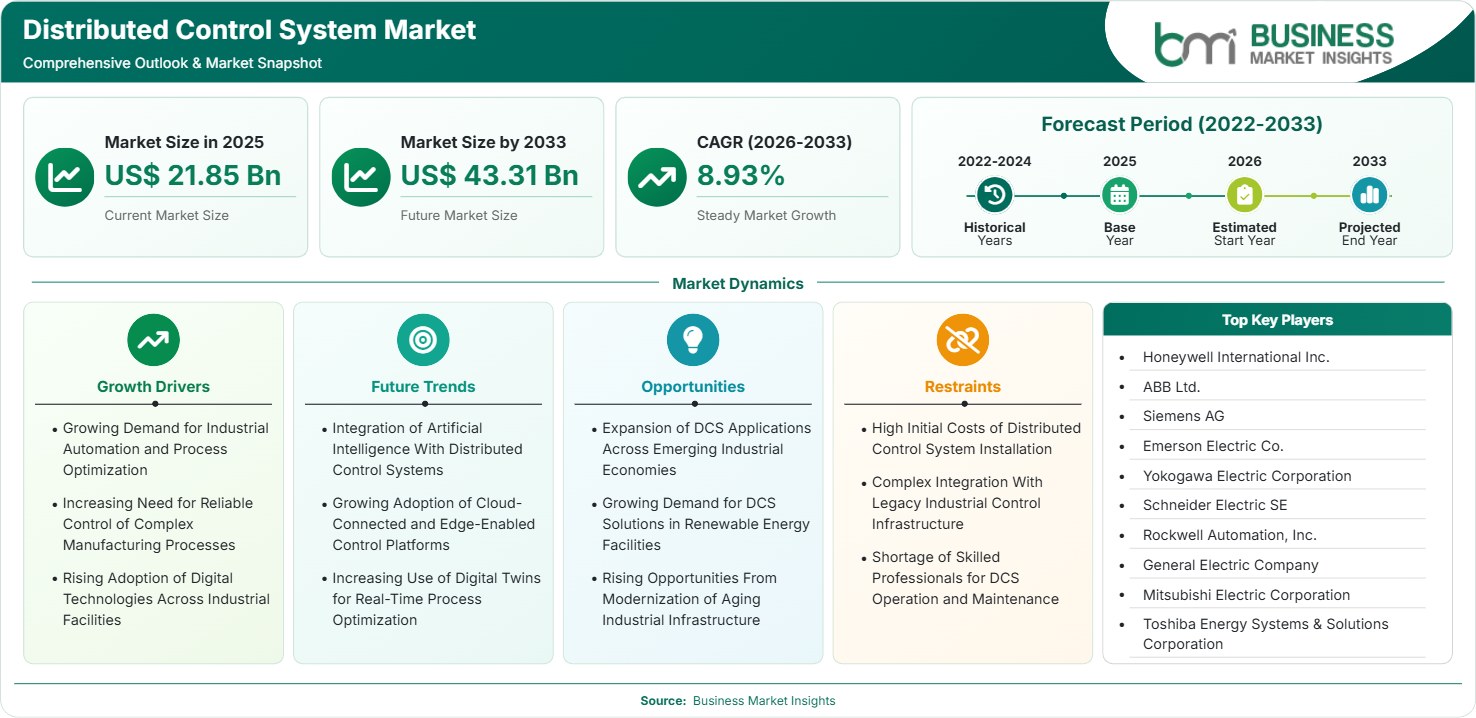
The Distributed Control System Market size was valued at US$ 21.85 Billion in 2025 and is projected to reach US$ 43.31 Billion by 2033, growing at a CAGR of 8.93% during 2026–2033, driven by industrial automation, process optimization, digitalization, infrastructure modernization, renewable energy investments, and complex manufacturing requirements.

Report Coverage
  • Component: Hardware, Software, Services
  • End-User: Oil & Gas, Chemicals, Power Generation, Pharmaceutical, Food & Beverage, Others
US$ 21.85 Bn Market size in 2025
US$ 43.31 Bn Market Size by 2033
8.93% CAGR, 2026 - 2033
2026-2033 Forecast Period

AI Overview

Distributed Control System Market Summary

  • North America Region: North America holds a 29%–33% share in 2025 and is projected to grow at a 7.8%–9.2% CAGR during 2026–2033, supported by process automation, energy infrastructure modernization, industrial digitalization, cybersecurity investments, and replacement of aging control systems. The US market holds a dominant regional position and is projected to grow at a 7.5%–9.0% CAGR through 2033, supported by automation investments across power, chemicals, oil and gas, pharmaceuticals, and advanced manufacturing.
  • Fastest Growing Region: Asia Pacific accounts for a 31%–35% share in 2025 and is projected to expand at a 10.0%–11.5% CAGR through 2033, driven by industrialization, new manufacturing capacity, expanding power infrastructure, chemical production, pharmaceutical investments, and modernization of process industries across China, India, Southeast Asia, and other emerging economies.
  • Leading Segment: Component, Hardware represents a 42%–47% share in 2025 and is projected to grow at a 8.2%–9.4% CAGR through 2033, supported by controller upgrades, distributed I/O expansion, industrial networking, operator stations, redundancy requirements, and modernization of installed automation infrastructure.
  • High Growth Segment: End-User, Power Generation represents a 23%–28% share in 2025 and is projected to grow at a 9.5%–11.0% CAGR through 2033, supported by grid modernization, renewable integration, thermal plant upgrades, distributed generation, operational efficiency requirements, and increasingly complex energy management.
  • Key Market Opportunity: Modernization of aging process infrastructure creates demand for scalable control platforms, digital engineering, remote monitoring, cybersecurity, predictive maintenance, and hybrid architectures that integrate legacy assets with newer automation technologies.
  • Major Market Players: Honeywell International Inc., ABB Ltd., Siemens AG, Emerson Electric Co., Yokogawa Electric Corporation, Schneider Electric SE, Rockwell Automation, Inc., General Electric Company, Mitsubishi Electric Corporation, and Toshiba Energy Systems & Solutions Corporation.
Strategic Insights

Distributed Control System Market: Strategic Insights

Distributed Control System Market Strategic Framework
FREE PDF
Request your free sample
Request free sample
Stakeholder View

Key Takeaways

  • The ecosystem increasingly combines DCS vendors, industrial software providers, instrumentation manufacturers, automation integrators, cybersecurity specialists, and engineering companies. Competitive positioning is therefore shifting toward integrated automation portfolios rather than standalone control hardware.
  • Power generation and emerging industrial economies offer strong growth potential as new capacity, renewable integration, and industrial expansion increase demand for scalable process control and operational visibility.
  • The technology roadmap is moving toward open architectures, edge computing, industrial Internet of Things connectivity, cloud-linked analytics, digital twins, and AI-supported optimization while maintaining deterministic control and high availability.
  • India, Southeast Asia, and the Middle East provide compelling investment opportunities because industrial expansion, energy infrastructure development, and new process facilities are creating demand for modern control systems.
  • Modernization projects are becoming strategically important as industrial operators seek to extend asset lifecycles while replacing obsolete control platforms. Vendors that provide migration tools, engineering support, and phased upgrades can capture recurring service revenue.
  • Cybersecurity is becoming a core procurement criterion as connectivity increases. DCS suppliers that combine robust control functionality with secure architecture, continuous monitoring, and lifecycle support can strengthen their position in critical industries.
Geographic Outlook

Distributed Control System Market Regional Highlights

North America Distributed Control System Market

North America held a 29%–33% distributed control system market share in 2025 and is projected to grow at a 7.8%–9.2% CAGR through 2033. The US represents the dominant regional market, supported by established process industries, power infrastructure, chemicals, pharmaceuticals, and advanced manufacturing. Canada contributes through oil and gas, mining, chemicals, and power applications.

  • The US remains the regional leader as industrial operators invest in automation modernization, cybersecurity, predictive maintenance, and digital integration across energy, chemicals, pharmaceuticals, and advanced manufacturing facilities.
  • Canada provides opportunities through oil and gas processing, mining, chemicals, and power infrastructure, where reliable process control supports operational efficiency and safety requirements.
  • Industrial operators increasingly prioritize phased DCS migrations that reduce production disruption while allowing legacy control infrastructure to transition toward modern automation architectures.

US Distributed Control System Market

The US represented approximately 23%–27% of global demand in 2025 and US distributed control system market forecast to grow at a 7.5%–9.0% CAGR through 2033. The market benefits from extensive installed industrial infrastructure and significant demand for modernization. Industrial operators are increasingly combining DCS upgrades with cybersecurity improvements, data analytics, remote monitoring, and predictive maintenance. This creates opportunities for suppliers that can deliver integrated modernization programs.

  • Aging control infrastructure creates replacement demand as operators seek to improve system reliability, cybersecurity, interoperability, and operational visibility without completely rebuilding established production facilities.
  • Pharmaceutical and specialty chemical production requires precise process control, traceability, and regulatory compliance, supporting demand for sophisticated automation platforms and validated control architectures.
  • Power operators are modernizing control systems to manage changing generation portfolios, improve plant efficiency, and support increasingly complex electricity infrastructure.
  • Industrial cybersecurity requirements are increasing as connectivity expands, creating demand for secure-by-design DCS platforms and continuous lifecycle monitoring.

Europe Distributed Control System Market

Europe distributed control system market accounted for a 25%–29% share in 2025 and is projected to grow at a 7.0%–8.5% CAGR through 2033. Germany, the United Kingdom, France, and Italy represent leading markets supported by chemicals, pharmaceuticals, manufacturing, and power generation. Germany is projected to grow at 7.5%–9.0% CAGR, while Poland represents a high-growth market at 9.0%–10.5%.

  • Germany benefits from its large industrial base, supporting DCS demand across chemicals, manufacturing, pharmaceuticals, and energy-intensive industries undergoing automation and efficiency upgrades.
  • The United Kingdom is investing in industrial digitalization, energy infrastructure, and process modernization, creating opportunities for control systems supporting operational flexibility and remote monitoring.
  • France provides opportunities across nuclear and conventional power, chemicals, pharmaceuticals, and industrial manufacturing, where reliable automation supports complex operational requirements.
  • Poland is emerging as a high-growth market as manufacturing investment and industrial modernization increase demand for modern process automation and control infrastructure.

Asia Pacific Distributed Control System Market

Asia Pacific distributed control system market held a 31%–35% share in 2025 and is projected to achieve a 10.0%–11.5% CAGR through 2033, making it the fastest-growing region. China, Japan, South Korea, and India represent leading markets, while India is projected to grow at 11.0%–12.5% CAGR. Rapid industrialization, new manufacturing capacity, chemicals, pharmaceuticals, and power infrastructure are supporting demand.

  • China remains a major market because of its extensive chemicals, power, manufacturing, and industrial infrastructure, with modernization and new capacity supporting automation investment.
  • Japan benefits from advanced manufacturing, chemicals, pharmaceuticals, and energy industries, where aging infrastructure and efficiency requirements encourage upgrades to sophisticated control platforms.
  • South Korea provides opportunities through chemicals, electronics, refining, power, and advanced manufacturing, where precise process management and production reliability remain important.
  • India represents a high-growth market as industrial expansion, power infrastructure investment, pharmaceutical production, and manufacturing development increase demand for integrated process control systems.

Rest of World Distributed Control System Market

South and Central America distributed control system market accounted for approximately 7%–10% of global demand in 2025 and are projected to grow at a 8.0%–10.0% CAGR through 2033. Brazil and Mexico lead regional adoption, supported by energy, chemicals, food processing, and manufacturing investments. Industrial modernization and infrastructure development create additional demand for reliable automation systems.

  • Brazil offers opportunities through oil and gas, chemicals, food processing, and power generation, with modernization programs supporting demand for integrated process automation.
  • Mexico is benefiting from manufacturing expansion and industrial investment, creating opportunities for DCS deployment across automotive-related processes, chemicals, food production, and energy facilities.
  • Saudi Arabia and the UAE are developing large industrial and energy projects that require sophisticated automation, process optimization, and centralized operational control.
  • South Africa provides demand across mining, power, chemicals, and industrial processing, where control system modernization can improve operational reliability and asset performance.
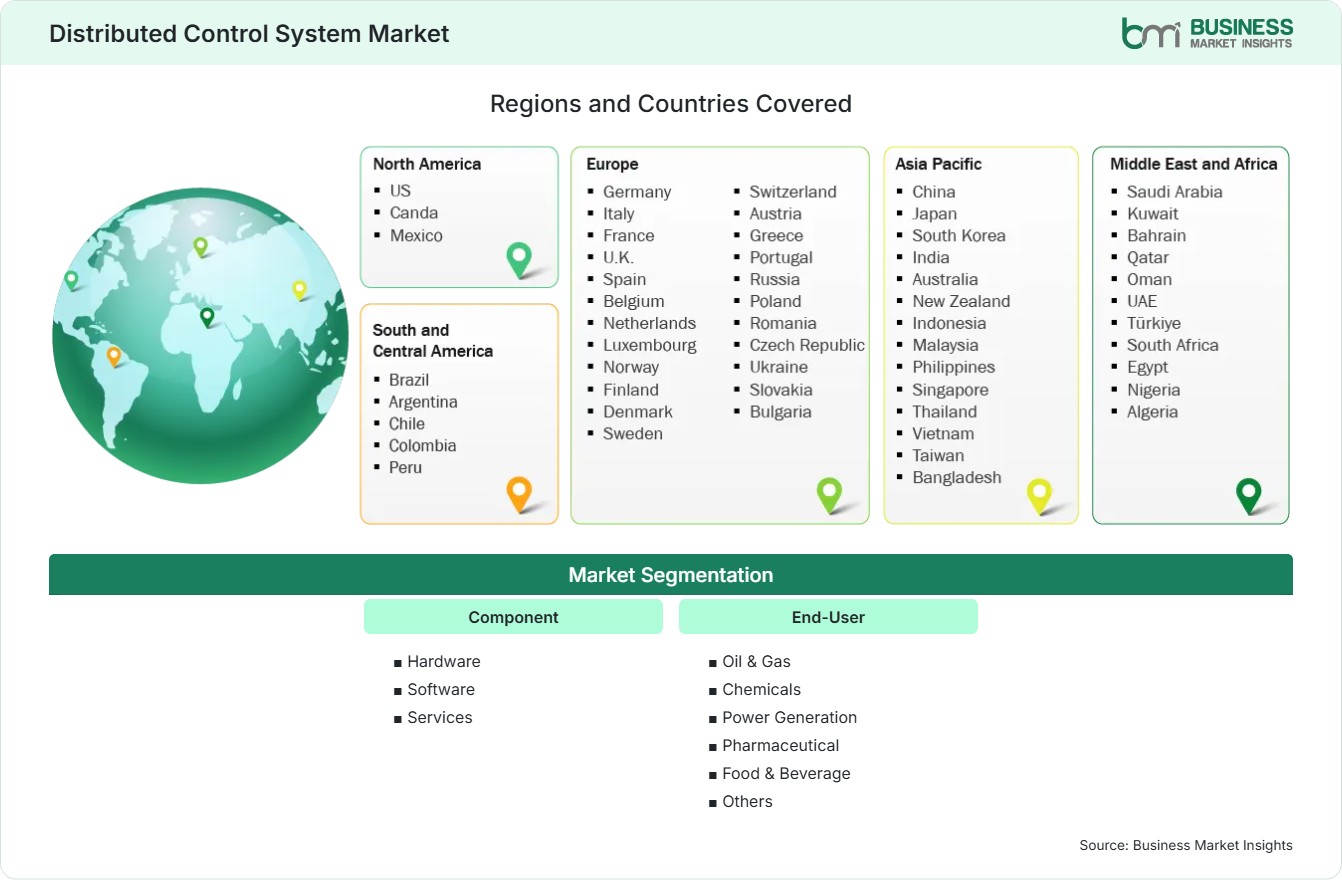
Global Market Geography
FREE PDF
Request your free sample
Request free sample
Segment Analysis

Distributed Control System Market Segmentation

Component

Hardware represented a 42%–47% share in 2025 and is projected to grow at a 8.2%–9.4% CAGR during 2026–2033. Hardware remains fundamental to DCS architecture because controllers, I/O systems, operator stations, networking equipment, and redundancy components directly determine system availability.

  • Hardware: Controllers, I/O modules, operator stations, networking equipment, and redundant components enable continuous process control. Replacement cycles and greenfield industrial projects support hardware demand.
  • Software: Engineering tools, supervisory applications, analytics, visualization, and optimization software improve operational visibility. Digitalization is increasing demand for integrated software capabilities across industrial facilities.
  • Services: Consulting, engineering, installation, integration, maintenance, migration, and lifecycle support help operators deploy and modernize DCS platforms while reducing operational disruption.

End-User

Power Generation represented a 23%–28% of distributed control system market share in 2025 and is projected to grow at a 9.5%–11.0% CAGR during 2026–2033. Oil and gas, chemicals, pharmaceuticals, and food processing remain important users, while modernization and digitalization are expanding demand for integrated automation across industrial facilities.

  • Oil & Gas: Refineries, processing facilities, and upstream operations require reliable process control for complex assets, supporting demand for automation, monitoring, safety integration, and modernization.
  • Chemicals: Chemical production requires precise control of temperature, pressure, flow, and composition. DCS platforms support continuous processes, operational safety, quality management, and efficiency optimization.
  • Power Generation: Power facilities use DCS platforms to monitor and control generation processes, improve operational efficiency, support reliability, and manage increasingly complex generation portfolios.
  • Pharmaceutical: Pharmaceutical facilities require precise, traceable, and validated process control. Automation supports batch consistency, quality requirements, regulatory compliance, and efficient production workflows.
  • Food & Beverage: Food processing plants use automation to improve production consistency, quality, hygiene, and energy efficiency while supporting continuous monitoring across complex processing operations.
Market Forces

Distributed Control System Market Dynamics

Key Market Drivers

Growing Demand for Industrial Automation and Process Optimization

Industrial firms have been increasing their investment in automation to improve production efficiency, eliminate process variation, and ensure consistent product quality. DCS systems offer many benefits for continuous and batch industries, where multiple process variables are synchronized simultaneously. The increasing cost of labor, the increasing complexity of operations, and the need to maximize asset utilization have led companies to automate their control processes.

Increasing Need for Reliable Control of Complex Manufacturing Processes

Industries are becoming more complex as manufacturing processes involve many stages, advanced technology, and rising quality standards. The DCS system offers the ability to monitor and control the entire system from a central point while maintaining reliability and redundancy. Industries like chemicals, pharmaceuticals, refineries, and power generation stand to lose a lot financially and face hazards when their processes are interrupted. This makes it essential for them to choose control systems that are able to monitor, detect, and respond automatically and also remain highly available. Modern DCS architectures also support modular expansion, allowing facilities to add production capacity without completely redesigning existing control infrastructure.

Rising Adoption of Digital Technologies Across Industrial Facilities

Industrial digitalization is expanding the role of DCS platforms from basic process control toward connected operational intelligence. Industrial Internet of Things technologies, edge computing, advanced analytics, digital twins, artificial intelligence, and cloud connectivity are increasingly being integrated with control environments. As plants become more connected, DCS platforms are increasingly expected to exchange data with manufacturing execution systems and enterprise applications while maintaining operational reliability and cybersecurity. This shift is increasing investment in modern control architectures that can support both deterministic process control and data-driven decision-making.

Key Market Opportunities

Expansion of DCS Applications Across Emerging Industrial Economies

The growth of industry in developing countries is providing an opportunity for Market providers because new plants need automation starting from the design phase. Countries like India, Southeast Asia, Middle East, and some Latin America regions are constructing manufacturing industries, chemical industries, pharmaceutical industries, energy sector, and food processing plants. Green field projects give the users the flexibility to apply latest control systems without limitations of old systems. Providers can generate extra revenue through engineering, integration, commissioning, training, and lifecycle services. Local partnerships and regional support networks can further strengthen market access and considered to be a major distributed control system market trend.

Growing Demand for DCS Solutions in Renewable Energy Facilities

The expansion of renewable energy infrastructure is creating new applications for advanced control and monitoring technologies. Large solar, wind, hybrid, and energy storage projects require coordinated monitoring of generation assets, grid interfaces, and supporting infrastructure. DCS capabilities can contribute to centralized operational visibility and automated management, particularly in complex hybrid facilities that combine multiple energy sources. Opportunities are also emerging as conventional power plants integrate renewable generation and require more flexible operational strategies.

Rising Opportunities from Modernization of Aging Industrial Infrastructure

Modernization of the control systems infrastructure offers a substantial opportunity because many of these facilities still operate on outdated technologies that are difficult to sustain, integrate, and protect. Operators have a growing need for migration plans that allow them to maintain existing production assets while incorporating state-of-the-art control and security technologies. Modernization initiatives can yield revenue through engineering services, integration work, equipment upgrades, software updates, education, and support. However, the opportunity is not limited to a total system overhaul, as various layers of control can be upgraded separately.

Market Restraints and Challenges

High Initial Costs of Distributed Control System Installation

Factor: The implementation of the DCS will involve significant cost for purchasing the necessary controllers, input/output system, network, operator interface, engineering, software, installation, training, and security. Large-scale process plants may also incur considerable changes to infrastructure prior to installation. Impact: Significant costs involved in the process could lead to delays in making investments, especially by smaller industrial companies or plants operating on tight financial budgets. Modernization is likely to be delayed where the current systems continue to function despite technical problems.

Complex Integration with Legacy Industrial Control Infrastructure

Factor: Many industrial facilities operate legacy control systems, proprietary protocols, aging instrumentation, and fragmented automation architectures that were not designed for modern digital integration. Impact: Integrating new DCS platforms with existing infrastructure can require specialized engineering, customized interfaces, extensive testing, and planned production shutdowns. These requirements increase project duration and create operational risks during migration. Operators may therefore delay upgrades when the expected benefits do not clearly outweigh transition costs and disruption. Successful modernization increasingly depends on interoperability, migration tools, simulation environments, and phased implementation strategies.

Company Analysis

Competitive Landscape

The Distributed Control System Market analysis is shaped by global automation companies with capabilities spanning control hardware, industrial software, instrumentation, cybersecurity, engineering, and lifecycle services. Competition increasingly centers on integrated digital ecosystems, migration capabilities, open architectures, industrial cybersecurity, and the ability to support customers across long asset lifecycles.

Company Name

Overview

Products and Services relevant to this market

Honeywell International Inc.

Global technology and automation company with extensive expertise in process control, industrial software, and connected operations.

Experion Process Knowledge System, process automation, industrial software, cybersecurity, optimization, engineering, and lifecycle services.

ABB Ltd.

Global electrification and automation company serving process industries, power, manufacturing, and infrastructure markets.

ABB Ability System 800xA, distributed control, industrial automation, process electrification, digital solutions, and lifecycle services.

Siemens AG

Major industrial technology company providing integrated automation, digitalization, electrification, and industrial software capabilities.

SIMATIC PCS 7, process control, industrial automation, digital twins, engineering software, industrial networking, and services.

Emerson Electric Co.

Process automation specialist providing control systems, instrumentation, software, engineering, and operational optimization solutions.

DeltaV DCS, Plantweb digital ecosystem, process instrumentation, asset management, optimization software, and lifecycle services.

Yokogawa Electric Corporation

Industrial automation company specializing in process control, measurement, operational technology, and industrial digital transformation.

CENTUM VP, process control, instrumentation, industrial software, safety systems, analytics, engineering, and lifecycle support.

Schneider Electric SE

Energy management and industrial automation company offering integrated control, digitalization, and energy optimization solutions.

EcoStruxure Foxboro DCS, process automation, industrial software, cybersecurity, energy management, and lifecycle services.

Rockwell Automation, Inc.

Industrial automation provider focused on control systems, information solutions, manufacturing software, and connected operations.

PlantPAx process automation system, controllers, industrial networking, software, digital transformation, cybersecurity, and services.

General Electric Company

Industrial technology company with expertise in power generation, energy systems, automation, and digital industrial solutions.

Industrial control technologies, power automation, digital solutions, asset performance management, monitoring, and energy applications.

Mitsubishi Electric Corporation

Global electronics and automation company serving manufacturing, process industries, energy, and infrastructure markets.

MELSEC automation platforms, process control, industrial networking, monitoring, control software, drives, and engineering services.

Toshiba Energy Systems & Solutions Corporation

Energy technology provider supporting power generation, transmission, energy management, and industrial control applications.

Power plant control systems, automation, monitoring, energy management, digital solutions, and engineering and maintenance services.

Trust & Transparency

Research Methodology

The market analysis combines proprietary research with secondary data from government agencies, company disclosures, regulatory filings, industry databases and expert interviews. Market estimates are validated through data triangulation, cross-market benchmarking and analyst review.

View Full Research Methodology

Questions Answered

Frequently Asked Questions

How are renewable energy projects creating DCS opportunities?

Renewable and hybrid energy facilities increasingly require centralized monitoring and coordinated control across generation assets, storage systems, and grid interfaces.

What is driving DCS modernization projects in distributed control system market report?

Legacy systems may become difficult to maintain because of obsolete components, limited integration capabilities, insufficient cybersecurity, and unavailable technical expertise.

Why is cybersecurity becoming important for DCS systems?

Industrial facilities are increasingly connecting control environments with enterprise networks, remote monitoring platforms, and cloud-based applications.

How does DCS differ from PLC-based control systems?

DCS platforms are traditionally optimized for continuous and complex process control with distributed architecture, centralized operator interfaces, and integrated engineering capabilities.

What industries rely most heavily on DCS technology?

Oil and gas, chemicals, power generation, pharmaceuticals, and food and beverage are major DCS users.

Access the Full Distributed Control System Market Report

Get segment-level forecasts, regional estimates, competitive benchmarking, company profiles and downloadable Excel datasets.

Access the full Distributed Control System Market Report
350 pages PDF & Excel | 2026-08-06
Similar Research

Related Market Reports