
Air Quality Monitoring Equipment Market Outlook (2022-2033)

Historic Data: 2022-2024   |   Base Year: 2025   |   Forecast Period: 2026-2033
Report Content: Market Scope, Market Segmentation, Market Dynamics, and Competitive Analysis

Report Coverage:
  • Equipment Type (Gas Analyzers, Particulate Matter Monitors, Meteorological Monitoring, Air Samplers, Other Equipment)
  • End Use (Commercial, Residential, Industrial, Government)
  • Application (Indoor, Outdoor)
  • Type (Fixed, Portable)

No. of Pages: 400
Report Code: BMIPUB00033271
Category: Electronics and Semiconductor
Air Quality Monitoring Equipment Market

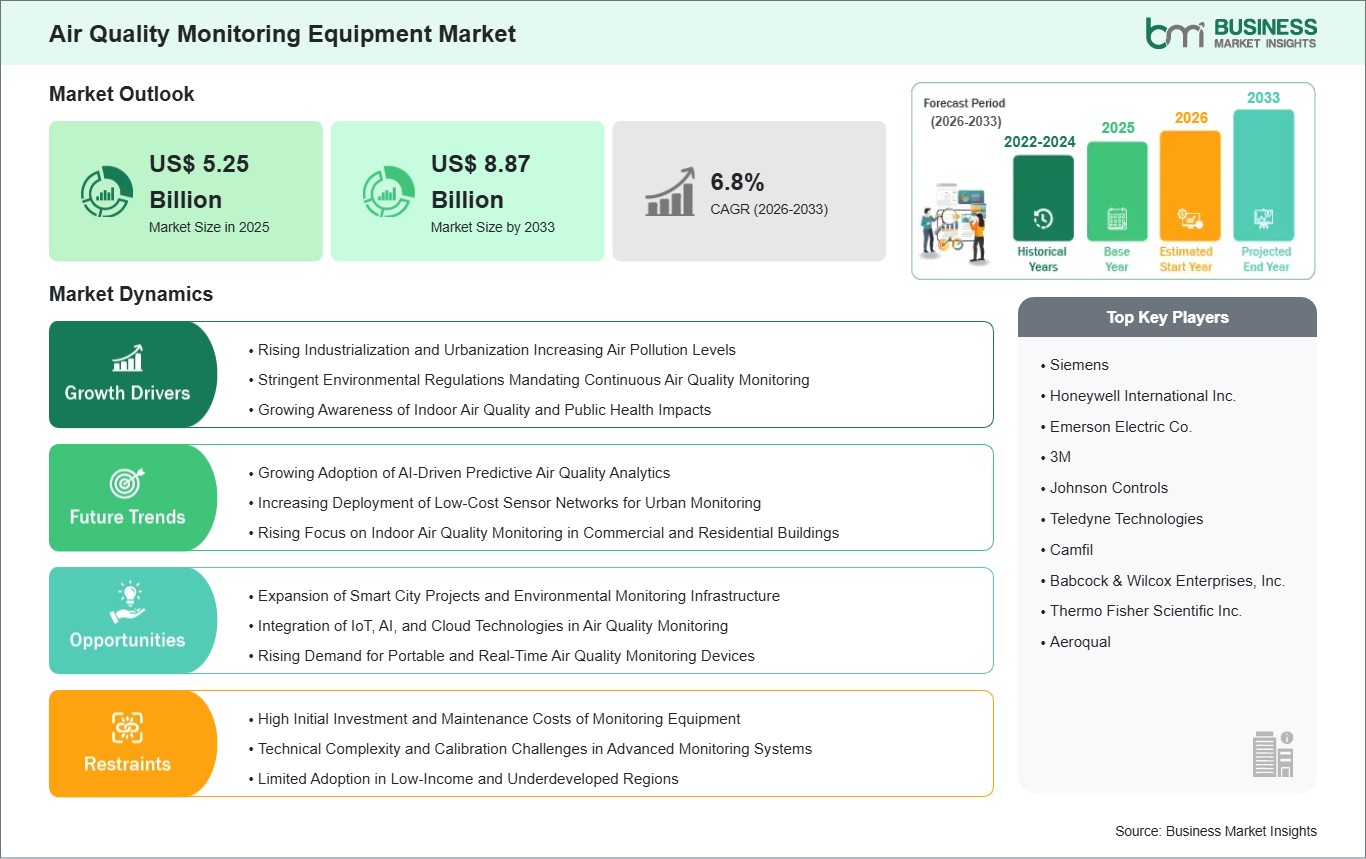
The air quality monitoring equipment market size is expected to reach US$ 8.87 billion by 2033 from US$ 5.25 billion in 2025. The market is estimated to record a CAGR of 6.8% from 2025 to 2033.

Executive Summary and Global Market Analysis:

Air quality monitoring equipment has become a critical component in ensuring environmental safety and compliance across industrial, commercial, and urban settings worldwide. Solutions such as particulate matter (PM) sensors, gas analyzers, continuous ambient air quality monitors, indoor air quality (IAQ) systems, and real-time air monitoring platforms are increasingly deployed across industrial plants, smart cities, commercial buildings, and residential complexes. These solutions enable organizations to gain several advantages, including real-time detection of pollutants, regulatory compliance, protection of human health, and actionable insights for environmental management. Increasing industrialization, urbanization, rising environmental awareness, and stringent government regulations have significantly driven the adoption of air quality monitoring solutions.

However, the air quality monitoring equipment market faces challenges that could affect its growth. These include the high cost of advanced monitoring systems, technical complexity, maintenance requirements, and integration difficulties with existing infrastructure or smart city networks. Capital expenditure constraints, data management challenges, and evolving regulatory standards also influence market dynamics. Despite these challenges, the market presents substantial growth opportunities, driven by the deployment of IoT-enabled air monitoring devices, the integration of AI and cloud-based analytics for predictive air quality management, expanding smart city initiatives, and increasing public and corporate focus on environmental sustainability.

Air Quality Monitoring Equipment Market - Strategic Insights:

global-market-strategic-framework
Get more information on this report

Air Quality Monitoring Equipment Market Segmentation Analysis:

Key segments that contributed to the derivation of the air quality monitoring equipment market analysis are equipment type, end use, application, type, and pollutants.

  • By equipment type, the air quality monitoring equipment market is bifurcated into gas analyzers, particulate matter monitors, meteorological monitoring, air samplers, and others. The gas analyzers segment dominated the market in 2025.
  • By end use, the market is bifurcated into commercial, residential, industrial, and government. The industrial segment dominated the market in 2025.
  • By application, the market is bifurcated into indoor and outdoor. The outdoor segment dominated the market in 2025.
  • By type, the market is bifurcated into fixed and portable. The fixed segment dominated the market in 2025.
  • By pollutants, the market is bifurcated into chemical pollutants and physical pollutants. The chemical pollutants segment dominated the market in 2025.
Air Quality Monitoring Equipment Market Drivers and Opportunities:

Stringent Environmental Regulations

Stringent environmental regulations are a key driver of the air quality monitoring equipment market. Governments and regulatory bodies across the globe are enforcing stricter air pollution control standards to protect public health and the environment. Policies mandating continuous monitoring of ambient and industrial emissions have increased the adoption of advanced air quality monitoring systems. Industries such as manufacturing, energy, and construction are required to install monitoring equipment to ensure compliance with emission norms. Additionally, urban air quality mandates and real-time public reporting requirements are further accelerating demand for reliable and accurate air quality monitoring equipment.

Growth of Smart Cities and IoT Integration

The rapid development of smart cities presents a significant opportunity for the air quality monitoring equipment market. Smart city initiatives increasingly rely on IoT-enabled sensors and real-time data platforms to monitor and manage urban air quality. Integration of air quality monitoring equipment with cloud-based analytics, artificial intelligence, and city management systems enables predictive pollution control and informed policymaking. Rising investments in smart infrastructure, especially in emerging economies, along with growing public awareness of air pollution, are expected to create strong growth opportunities for advanced, connected air quality monitoring solutions.

Air Quality Monitoring Equipment Market Size and Share Analysis:

By equipment type, the air quality monitoring equipment market is segmented into gas analyzers, particulate matter monitors, meteorological monitoring, air samplers, and others. Gas analyzers held a significant share in 2025 due to their widespread deployment across industrial facilities, power plants, urban monitoring stations, and environmental agencies, driven by strong demand for continuous measurement of gaseous pollutants such as NOx, SO₂, CO, and VOCs.

By end use, the market is segmented into commercial, residential, industrial, and government. The industrial segment held a significant share in 2025 due to extensive adoption of air quality monitoring systems across manufacturing plants, refineries, mining operations, and energy facilities to comply with emission regulations and ensure workplace safety.

By application, the market is segmented into indoor and outdoor. The outdoor segment held a significant share in 2025 due to increasing deployment of ambient air quality monitoring stations by governments and municipalities for pollution control, public health monitoring, and smart city initiatives.

By type, the market is segmented into fixed and portable. Fixed monitoring systems held a significant share in 2025 due to their long-term installation across industrial sites, urban monitoring networks, and regulatory stations requiring continuous and high-accuracy air quality data.

By pollutants, the market is segmented into chemical pollutants and physical pollutants. Chemical pollutants held a significant share in 2025 due to rising concerns over toxic gas emissions from industrial activities, vehicular exhaust, and power generation, increasing demand for reliable chemical pollutant detection systems.

Air Quality Monitoring Equipment Market Report Highlights:

Report Attribute Details
Market size in 2025 US$ 5.25 Billion
Market Size by 2033 US$ 8.87 Billion
Global CAGR (2026 - 2033)6.8%
Historical Data 2022-2024
Forecast period 2026-2033
Segments Covered By Equipment Type
  • Gas Analyzers
  • Particulate Matter Monitors
  • Meteorological Monitoring
  • Air Samplers
  • Other Equipment
By End Use
  • Commercial
  • Residential
  • Industrial
  • Government
By Application
  • Indoor
  • Outdoor
By Type
  • Fixed
  • Portable
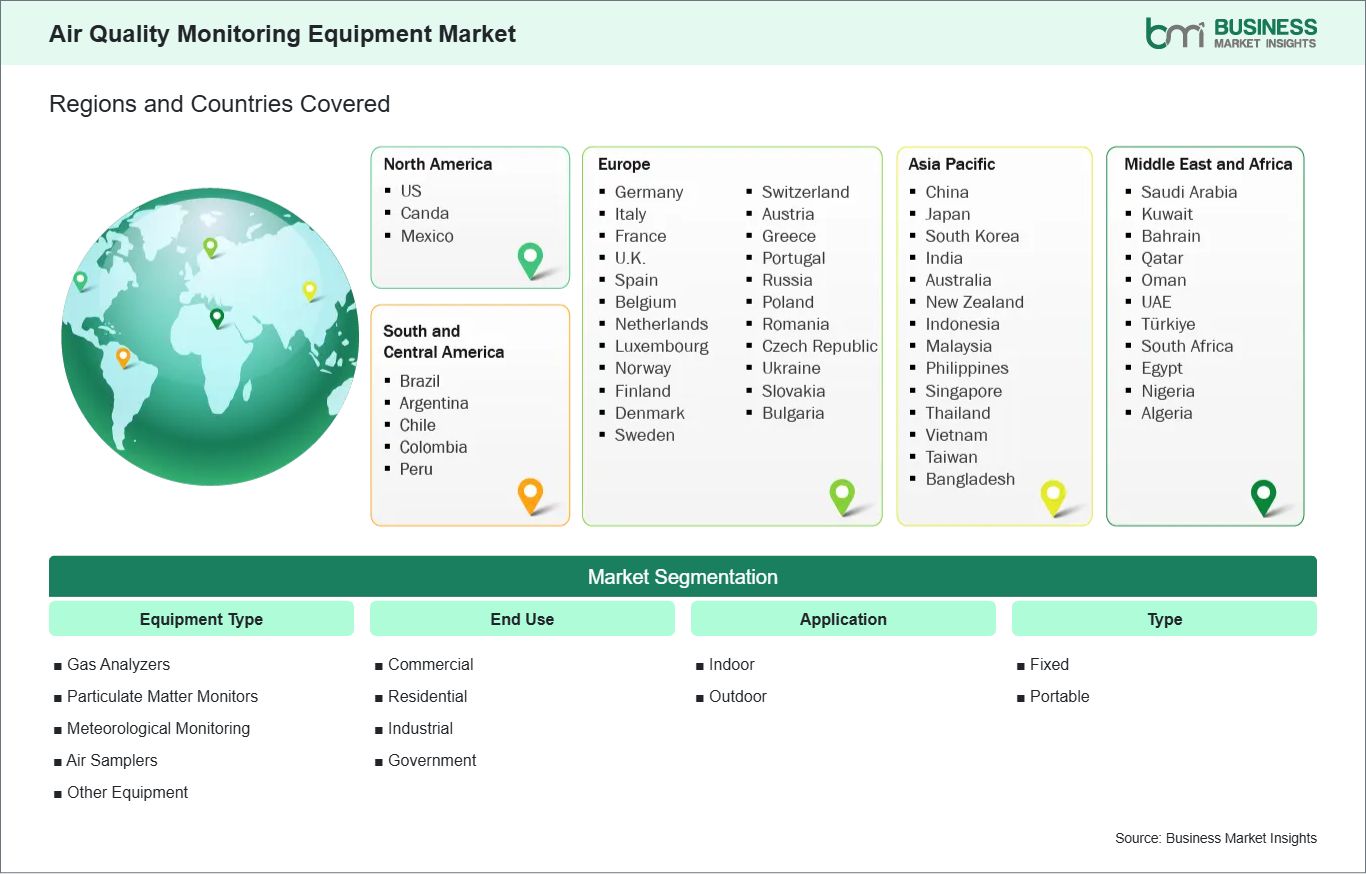
Regions and Countries Covered
North America US, Canada, Mexico
Europe Belgium, Austria, Finland, Denmark, Greece, Poland, Romania, Russia, Ukraine, Czech Republic, Slovakia, Bulgaria, Italy, Luxembourg, Germany, Switzerland, France, Netherlands, Norway, Portugal, Spain, Sweden, United Kingdom
Asia-Pacific Australia, China, India, Japan, South Korea, Indonesia, Malaysia, Philippines, Singapore, Thailand, Vietnam, Bangladesh, New Zealand, Taiwan
South and Central America Brazil, Argentina, Peru, Chile, Colombia
Middle East and Africa Bahrain, Kuwait, Oman, Qatar, Saudi Arabia, United Arab Emirates, Turkiye, South Africa, Egypt, Algeria, Nigeria
Market leaders and key company profiles
  • Siemens
  • Honeywell International Inc.
  • Emerson Electric Co.
  • 3M
  • Johnson Controls
  • Teledyne Technologies
  • Camfil
  • Babcock & Wilcox Enterprises, Inc.
  • Thermo Fisher Scientific Inc.
  • Aeroqual
Get more information on this report

Air Quality Monitoring Equipment Market Report Coverage and Deliverables:

The "Air Quality Monitoring Equipment Market Size and Forecast (2022–2033)" report provides a detailed analysis of the market covering below areas:

  • Air quality monitoring equipment market size and forecast at global, regional, and country levels for all the key market segments covered under the scope
  • Air quality monitoring equipment market trends, as well as market dynamics such as drivers, restraints, and key opportunities
  • Air quality monitoring equipment market analysis covering key market trends, global and regional framework, major players, regulations, and recent market developments
  • Industry landscape and competition analysis covering market concentration, heat map analysis, prominent players, and recent developments for the air quality monitoring equipment market
  • Detailed company profiles, including SWOT analysis

Air Quality Monitoring Equipment Market Geographic Insights:

The geographical scope of the air quality monitoring equipment market report is divided into five regions: North America, Asia Pacific, Europe, Middle East & Africa, and South & Central America. The air quality monitoring equipment market in Asia Pacific is expected to grow significantly during the forecast period.

The Asia-Pacific air quality monitoring equipment market is segmented into China, Japan, South Korea, India, Australia, New Zealand, Indonesia, Malaysia, the Philippines, Singapore, Thailand, Vietnam, Taiwan, Bangladesh, and the Rest of Asia. The region is witnessing strong growth, driven by rapid urbanization, increasing industrialization, and rising concerns over air pollution and public health. Major economies such as China, India, and Japan are leading market growth due to stringent environmental regulations, expanding industrial activity, and large-scale deployment of ambient air quality monitoring networks across urban and industrial areas.

The region is also experiencing growing adoption of advanced air quality monitoring technologies, including IoT-enabled sensors, real-time data analytics, and cloud-based monitoring platforms. Increasing government initiatives focused on pollution control, smart city development, and environmental sustainability are further boosting market demand. Additionally, rising investments in environmental monitoring infrastructure, increased public awareness of air quality issues, and continuous technological advancements are positioning Asia-Pacific as a key growth region in the global air quality monitoring equipment market.

global-market-geography
Get more information on this report

Air Quality Monitoring Equipment Market Research Report Guidance:

  • The report includes qualitative and quantitative data in the air quality monitoring equipment market across equipment type, end use, application, type, pollutants, and geography.
  • The report starts with the key takeaways (chapter 2), highlighting the key trends and outlook of the air quality monitoring equipment market.
  • Chapter 3 includes the research methodology of the study.
  • Chapter 4 further includes ecosystem analysis.
  • Chapter 5 highlights the major industry dynamics in the air quality monitoring equipment market, including factors that are driving the market, prevailing deterrents, potential opportunities, as well as future trends. Impact analysis of these drivers and restraints is also covered in this section.
  • Chapter 6 discusses the air quality monitoring equipment market scenario, in terms of historical market revenues, and forecast till the year 2031.
  • Chapters 7 to 10 cover air quality monitoring equipment market segments by equipment type, end use, application, type, pollutants, and geography across North America, Europe, Asia Pacific, Middle East and Africa, and South and Central America. They cover the market volume revenue forecast and factors driving the market.
  • Chapter 11 describes the competitive analysis along with the heat map analysis for the key players operating in the market.
  • Chapter 12 describes the industry landscape analysis. It provides detailed descriptions of business activities such as market initiatives, new developments, mergers, and joint ventures globally, along with a competitive landscape.
  • Chapter 13 provides detailed profiles of the major companies operating in the air quality monitoring equipment market. Companies have been profiled on the basis of their key facts, business descriptions, products and services, financial overview, SWOT analysis, and key developments.
  • Chapter 14, i.e., the appendix is inclusive of a brief overview of the company, list of abbreviations, and disclaimer.

Air Quality Monitoring Equipment Market News and Key Development:

The air quality monitoring equipment market is evaluated by gathering qualitative and quantitative data post primary and secondary research, which includes important corporate publications, association data, and databases. A few of the key developments in the air quality monitoring equipment market are:

  • In May 2024, Thermo Fisher Scientific has announced the commencement of manufacturing of Air Quality Monitoring System (AQMS) analyzers in India. The analyzers will be engineered, manufactured and validated at Thermo Fisher’s facility at Nasik, Maharashtra.
  • In January 2023, The Secretary, MeitY, Shri Alkesh Kumar Sharma has launched the Technology for Air Quality Monitoring System (AI-AQMS v1.0) developed under MeitY supported projects.The Centre for Development of Advanced Computing (C-DAC), Kolkata in collaboration with TeXMIN, ISM, Dhanbad under the ‘National programme on Electronics and ICT applications in Agriculture and Environment (AgriEnIcs)’ has developed a outdoor air quality monitoring station to monitor environmental pollutants which includes parameters like PM 1.0, PM 2.5, PM 10.0, SO2, NO2, CO, O2, ambient temperature, relative humidity etc., for continuous air quality analysis of the environment.

Key Sources Referred:

  • World Bank – Global Trade Indicators
  • World Trade Organization (WTO)
  • International Monetary Fund (IMF)
  • International Trade Administration (ITA)
  • Company website
  • Company annual reports
  • Company investor presentations
The List of Companies - Air Quality Monitoring Equipment Market
  • Siemens
  • Honeywell International Inc.
  • Emerson Electric Co.
  • 3M
  • Johnson Controls
  • Teledyne Technologies
  • Camfil
  • Babcock & Wilcox Enterprises, Inc.
  • Thermo Fisher Scientific Inc.
  • Aeroqual
Frequently Asked Questions
How big is the Air Quality Monitoring Equipment Market?

The Air Quality Monitoring Equipment Market is valued at US$ 5.25 Billion in 2025, it is projected to reach US$ 8.87 Billion by 2033.

What is the CAGR for Air Quality Monitoring Equipment Market by (2026 - 2033)?

As per our report Air Quality Monitoring Equipment Market, the market size is valued at US$ 5.25 Billion in 2025, projecting it to reach US$ 8.87 Billion by 2033. This translates to a CAGR of approximately 6.8% during the forecast period.

What segments are covered in this report?

The Air Quality Monitoring Equipment Market report typically cover these key segments-

  • Equipment Type (Gas Analyzers, Particulate Matter Monitors, Meteorological Monitoring, Air Samplers, Other Equipment)
  • End Use (Commercial, Residential, Industrial, Government)
  • Application (Indoor, Outdoor)
  • Type (Fixed, Portable)

What is the historic period, base year, and forecast period taken for Air Quality Monitoring Equipment Market?

The historic period, base year, and forecast period can vary slightly depending on the specific market research report. However, for the Air Quality Monitoring Equipment Market report:

  • Historic Period : 2022-2024
  • Base Year : 2025
  • Forecast Period : 2026-2033
  • Who are the major players in Air Quality Monitoring Equipment Market?

    The Air Quality Monitoring Equipment Market is populated by several key players, each contributing to its growth and innovation. Some of the major players include:

  • Siemens
  • Honeywell International Inc.
  • Emerson Electric Co.
  • 3M
  • Johnson Controls
  • Teledyne Technologies
  • Camfil
  • Babcock & Wilcox Enterprises, Inc.
  • Thermo Fisher Scientific Inc.
  • Aeroqual
  • Who should buy this report?

    The Air Quality Monitoring Equipment Market report is valuable for diverse stakeholders, including:

    • Investors: Provides insights for investment decisions pertaining to market growth, companies, or industry insights. Helps assess market attractiveness and potential returns.
    • Industry Players: Offers competitive intelligence, market sizing, and trend analysis to inform strategic planning, product development, and sales strategies.
    • Suppliers and Manufacturers: Helps understand market demand for components, materials, and services related to concerned industry.
    • Researchers and Consultants: Provides data and analysis for academic research, consulting projects, and market studies.
    • Financial Institutions: Helps assess risks and opportunities associated with financing or investing in the concerned market.

    Essentially, anyone involved in or considering involvement in the Air Quality Monitoring Equipment Market value chain can benefit from the information contained in a comprehensive market report.

    Available Report Formats

    pdf-format excel-format pptx-format
    Buy Now
    Sales Assistance
    +1 646 791 7070 (US & UK)
    Customization Form

    Please tell us your area of interest
    (Market Segments/ Regions and Countries/ Companies)