Market Summary
Executive Summary and Global Market Analysis
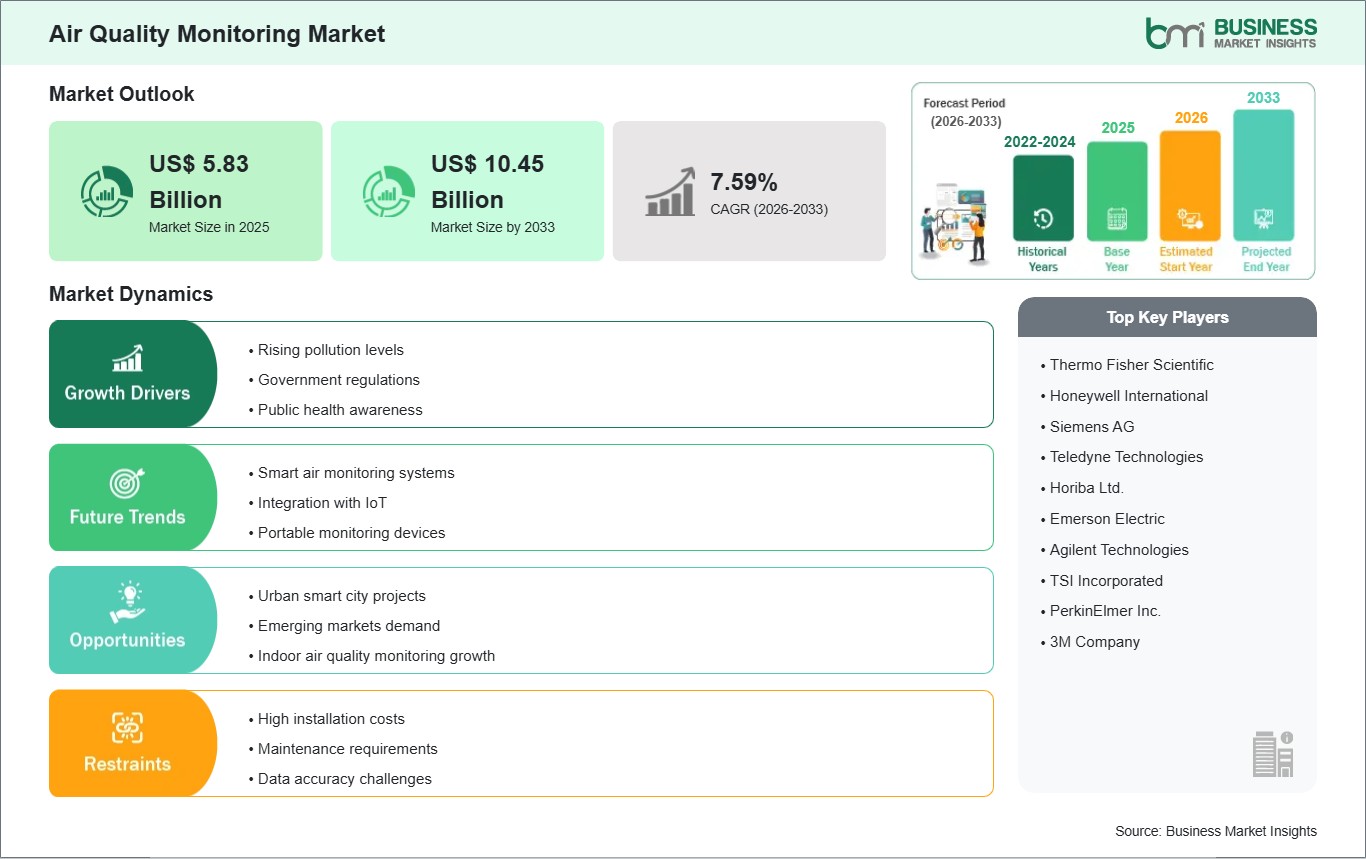
Air quality monitoring refers to the integrated application of stationary and mobile sensing technologies engineered to measure the concentration of atmospheric pollutants, including particulate matter, gaseous chemicals and biological contaminants. By utilizing advanced analytical instruments such as electrochemical sensors, non-dispersive infrared (NDIR) detectors, and light-scattering laser counters, these systems provide high-resolution data for environmental assessment and regulatory compliance. This technology is fundamental to protecting public health, optimizing industrial emission controls, and supporting the development of sustainable urban infrastructure. Market expansion is being propelled by the rising global incidence of respiratory disorders, the proliferation of smart city initiatives, and the increasing institutional requirement for real-time indoor air quality monitoring in green-certified buildings.
However, several factors may restrain market progression. The high capital intensity associated with the procurement and installation of regulatory-grade monitoring stations remains a primary hurdle for developing economies and small-scale industrial operators. The industry also faces persistent technical challenges regarding sensor-calibration drift and cross-sensitivity, where fluctuations in temperature and humidity can compromise the accuracy of low-cost IoT devices. Additionally, the absence of universal standardization for data collection protocols leads to inconsistencies that complicate regional pollution comparisons and hinder effective policy formulation. These hurdles, compounded by the high energy consumption and substantial maintenance requirements of complex multi-pollutant analyzers, increase the total cost of ownership and may limit the spatial density of monitoring networks in resource-constrained regions.
Despite these hurdles, the market outlook remains highly favorable as the sector transitions toward proactive environmental management. Opportunities are emerging through the integration of artificial intelligence (AI) and machine learning; the market is witnessing a surge in AI-driven predictive analytics that can forecast pollution spikes by correlating historical data with real-time weather and traffic patterns. The expansion of mobile and wearable monitoring solutions is gaining significant traction, with modular sensors being integrated into public transport networks and personal devices to provide hyper-local air quality insights. Furthermore, the growth of cloud-based data platforms and satellite-ground sensor fusion aligns with global goals for transparent environmental reporting and climate resilience. Collectively, these innovations position the air quality monitoring industry for sustained long-term development as a cornerstone of the modern, data-driven, and health-conscious global ecosystem.
Segment Analysis
Air Quality Monitoring Market Segmentation
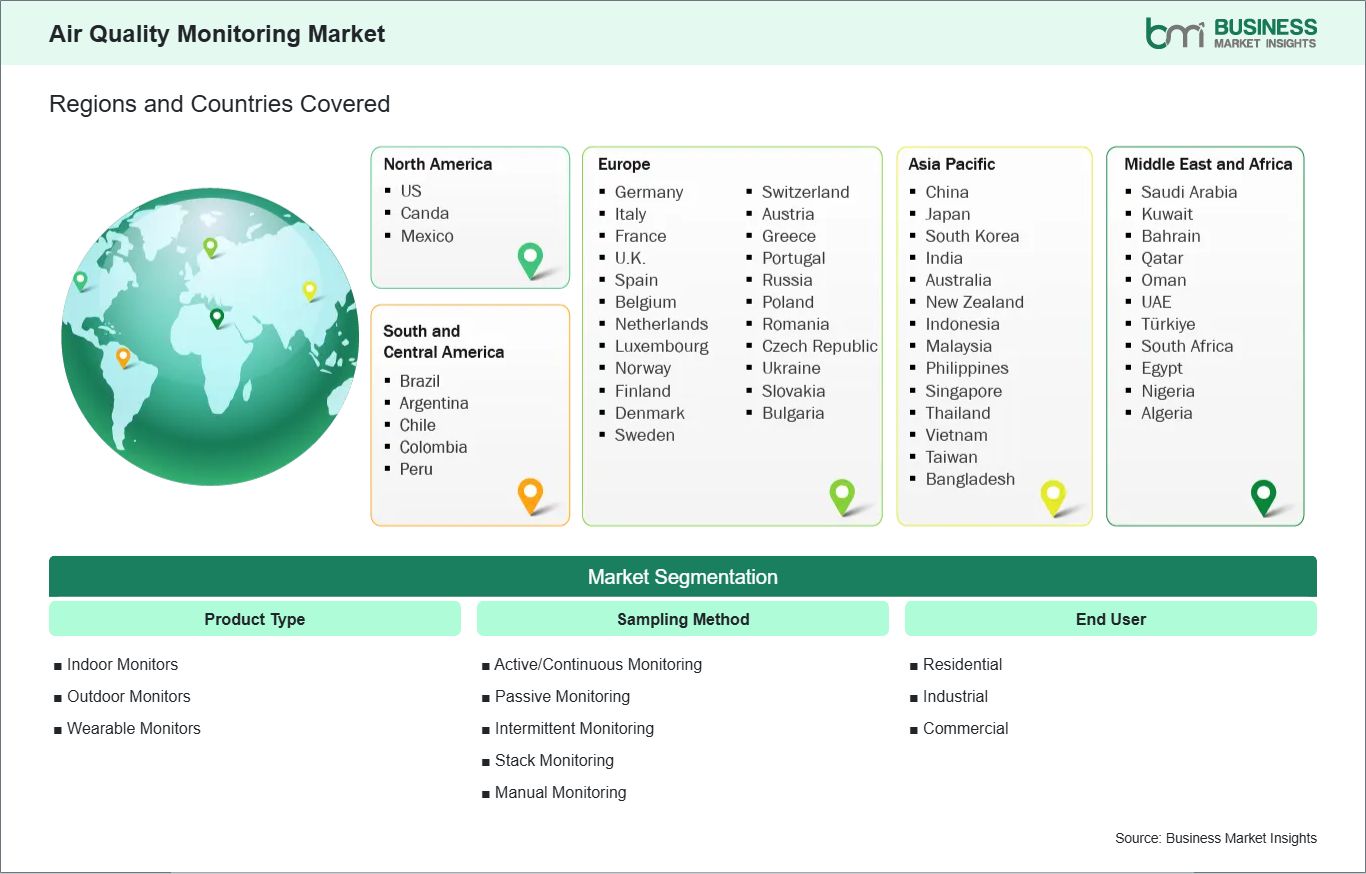
Key segments that contributed to the derivation of the Air Quality Monitoring market analysis are product type, sampling method, and end user.
- By Product Type, the market is segmented into Indoor Monitors, Outdoor Monitors, and Wearable Monitors.
- By Sampling Method, the market is divided into Active/Continuous Monitoring, Passive Monitoring, Intermittent Monitoring, Stack Monitoring, and Manual Monitoring.
- By End User, the market is categorized into Residential, Industrial, and Commercial.
Market Forces
Air Quality Monitoring Market Drivers and Opportunities
Rising Demand for Public Health, Regulation, and Urbanization
The air quality monitoring market is being driven by the growing need to safeguard public health, comply with environmental regulations, and manage the effects of rapid urbanization. Rising concerns about respiratory diseases, allergies, and long‑term health risks linked to air pollution are amplifying the adoption of monitoring systems across cities, industries, and households. Governments worldwide are enforcing stricter emission standards and air quality guidelines, compelling industries to invest in advanced monitoring technologies to ensure compliance. The expansion of urban centers and industrial activity is reinforcing demand, as densely populated regions face heightened pollution challenges. Additionally, the rise of smart city initiatives is propelling the integration of air quality sensors into urban infrastructure, enabling real‑time monitoring and public awareness. Technological advancements in IoT, cloud computing, and wireless communication are further driving adoption, making monitoring systems more accessible and cost‑effective. Collectively, public health priorities, regulatory mandates, and urbanization trends are fueling sustained growth in the global air quality monitoring market.
Rising Integration of IoT, AI, and Smart Infrastructure
Opportunities in the air quality monitoring market are expanding through the integration of IoT connectivity, artificial intelligence, and smart infrastructure initiatives. IoT‑enabled monitoring systems are opening lucrative opportunities by offering real‑time data collection, predictive analytics, and seamless integration with smart city platforms. AI‑driven solutions are gaining traction, enabling automated pollution detection, forecasting, and adaptive response strategies. The growing emphasis on sustainability is fueling demand for interoperable monitoring solutions that support renewable energy projects, green buildings, and eco‑friendly urban planning. Emerging applications in healthcare are driving innovation, as air quality monitoring supports patient care, hospital safety, and telemedicine platforms. Additionally, consumer demand for portable and wearable air quality devices is creating new pathways for adoption, empowering individuals to track personal exposure levels. The expansion of industrial automation and environmental monitoring networks is reinforcing opportunities, where air quality systems integrate with broader environmental management platforms. Vendors who focus on cost‑effective, AI‑enabled, and IoT‑ready solutions are well‑positioned to capture growth. The convergence of IoT, AI, and sustainability underscores a transformative trajectory for the global air quality monitoring market.
Size and Share Analysis
Air Quality Monitoring Market Size and Share Analysis
The Air Quality Monitoring market demonstrates steady growth, with size and share analysis revealing evolving trends and competitive positioning among key players. The report examines subsegments categorized within product type, sampling method, and end user, offering insights into their contribution to overall market performance.
Based on Product Type, the Indoor Monitors subsegment holds a strong presence, driven by rising concerns about indoor pollution from household activities, HVAC systems, and chemical emissions. These monitors are indispensable for residential and commercial spaces, ensuring healthy environments and compliance with safety standards. The Outdoor Monitors subsegment is essential for tracking ambient air quality in cities, industrial zones, and public infrastructure, supporting government regulations and pollution control initiatives. The Wearable Monitors subsegment anchors demand in personal health and fitness, enabling individuals to track exposure to pollutants in real time. Together, these product types address diverse monitoring needs across settings.
Report Coverage
Air Quality Monitoring Market Report Coverage and Deliverables
The "Air Quality Monitoring Market Size and Forecast (2022 - 2033)" report provides a detailed analysis of the market covering below areas:
- Air Quality Monitoring market size and forecast at global, regional, and country levels for all market segments covered under the scope
- Air Quality Monitoring market trends, as well as drivers, restraints, and opportunities
- Air Quality Monitoring market analysis covering key trends, global and regional framework, major players, regulations, and recent developments
- Industry landscape and competition analysis covering market concentration, heat map analysis, prominent players, and recent developments for the Air Quality Monitoring market
- Detailed company profiles, including SWOT analysis
Geographic Insights
Air Quality Monitoring Market Geographic Insights
The geographical scope of the Air Quality Monitoring market report is divided into five regions: North America, Asia Pacific, Europe, Middle East & Africa, and South & Central America.
North America maintains a preeminent position within the global industry, a status reinforced by the region's advanced environmental infrastructure and a decisive transition toward high-frequency, real-time data collection. The regional landscape is characterized by high-density investments in the United States and Canada, where the expansion of both ambient and indoor monitoring networks has become a strategic priority. This market leadership is supported by a robust ecosystem of technology pioneers who are increasingly focusing on the integration of Internet of Things (IoT) and Artificial Intelligence (AI) to enhance the precision and accessibility of pollution data.
Local consumer and industrial trends reflect a shift toward personalized safety and Healthy Building certifications. There is a growing demand for Indoor Air Quality (IAQ) Monitors in residential and commercial settings, driven by heightened awareness of the long-term health impacts of particulate matter and volatile organic compounds. In the industrial sector, organizations are moving beyond basic compliance to adopt mobile and wearable sensors that provide localized, real-time alerts for personnel operating in high-risk environments. This focus on Information Transparency allows North American users to make data-driven decisions regarding ventilation and outdoor activity, particularly during periods of increased wildfire activity or urban smog. Regulatory influences play a critical role, with federal agencies such as the Environmental Protection Agency (EPA) providing substantial funding for community-based monitoring projects. While recent policy shifts have sparked discussions regarding the economic evaluation of health benefits, the overarching trend remains toward more stringent oversight of fine particulate matter and ozone. As the region continues to address environmental disparities, the deployment of Networked Sensor Systems and Cloud-Based Analytics is expected to remain a primary driver for ensuring the long-term accuracy and public trust in North American air quality monitoring networks.
Industry Activity
Recent Developments
The Air Quality Monitoring market is evaluated by gathering qualitative and quantitative data post primary and secondary research, which includes important corporate publications, association data, and databases. A few of the key developments in the Air Quality Monitoring market are:
- In September 2025, Ruuvi launched Ruuvi Air, a smart indoor air quality monitoring system that continuously tracks temperature, humidity, CO₂, VOCs, NOx, PM2.5, and air pressure. Using its AI-enabled mobile app, Ruuvi Air converts sensor data into actionable insights and a proprietary Indoor Air Quality Score, empowering users to optimize homes, workplaces, and other indoor spaces for healthier air and improved well-being.
- In August 2024, Renesas Electronics launched the RRH62000, an ultra-compact AI-enabled air quality sensor module for homes, schools, and public buildings. The module integrates seven sensors, including PM1/2.5/10, TVOC, CO₂, temperature, and humidity, along with an on-board MCU and embedded AI algorithms to deliver real-time air quality monitoring, predictive insights, and compliance with global green building standards, enabling smarter HVAC control and maintenance across diverse indoor environments.
Trust & Transparency
Research Methodology
The market analysis combines proprietary research with secondary data from government agencies, company disclosures, regulatory filings, industry databases and expert interviews. Market estimates are validated through data triangulation, cross-market benchmarking and analyst
review.
View Full Research Methodology
Key Sources Referred:
World Bank - Global Trade IndicatorsWorld Trade Organization (WTO)International Monetary Fund (IMF)International Trade Administration (ITA)Company WebsitesCompany Annual ReportsCompany Investor Presentations