Market Summary
Executive Summary and Global Market Analysis
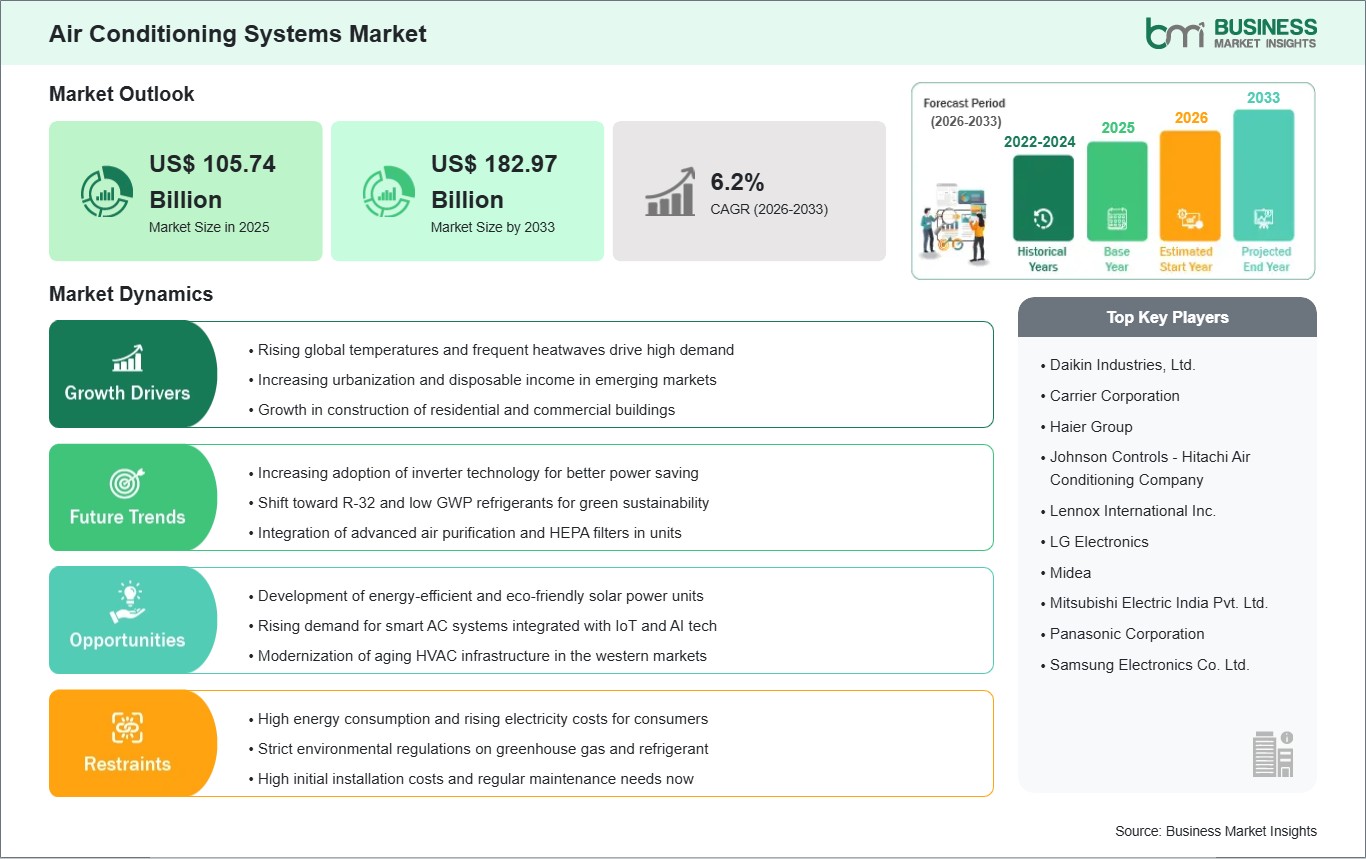
Air conditioning systems are sophisticated thermal management assemblies designed to regulate indoor air temperature, humidity, and quality to ensure human comfort or protect climate-sensitive industrial processes. These systems operate through a complex refrigeration cycle—comprising high-performance compressors, evaporators, condensers, and expansion valves—to facilitate heat exchange between indoor spaces and the external environment. As modern infrastructure evolves, these systems have transitioned from luxury amenities to critical utility components, supporting residential habitability in warming climates, commercial productivity in high-rise office environments, and the operational integrity of data centers and pharmaceutical facilities.
However, the market faces significant structural restraints that could impede growth. High initial capital expenditure for premium, energy-efficient units remains a barrier for cost-sensitive consumers in emerging economies. Furthermore, the industry is grappling with stringent environmental mandates, such as the global phase-down of high-GWP (Global Warming Potential) hydrofluorocarbon refrigerants, forcing manufacturers to undergo expensive R&D cycles to adopt natural or low-GWP alternatives. Additionally, the energy-intensive nature of traditional cooling solutions poses challenges amidst rising global electricity prices and corporate sustainability targets.
Despite these hurdles, the market is entering a lucrative era of transformation driven by the integration of Artificial Intelligence (AI) and the Internet of Things (IoT). These "smart" systems allow for predictive maintenance and real-time energy optimization, significantly reducing long-term operational costs. Moreover, the global shift toward decarbonization is creating massive opportunities in the replacement market, where aging units are being swapped for next-generation, high-efficiency heat pumps and inverter-based systems, ensuring the market remains a resilient cornerstone of the global HVAC industry.
Segment Analysis
Air Conditioning Systems Market Segmentation
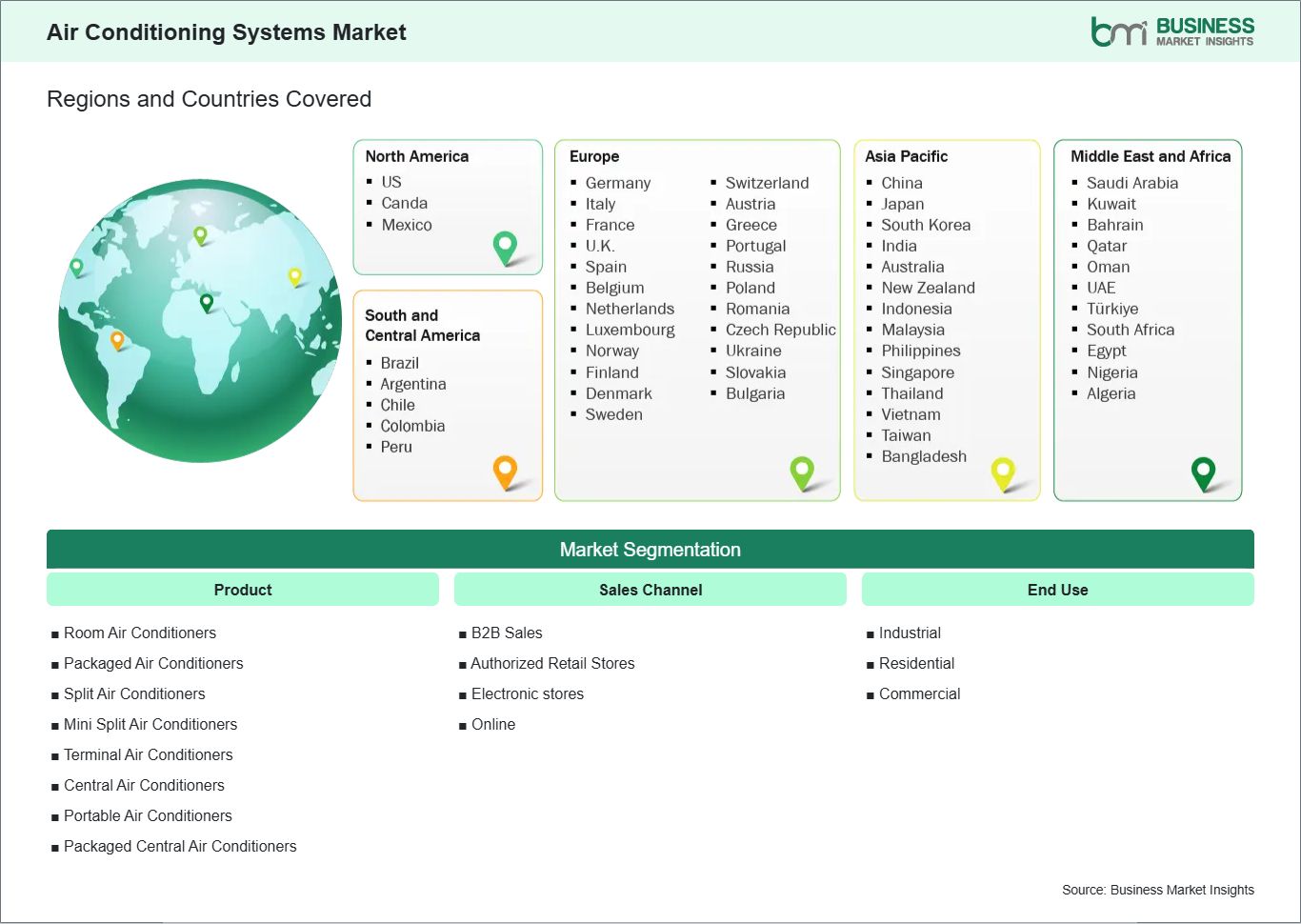
Key segments that contributed to the derivation of the Air Conditioning Systems market analysis are product, sales channel, and end use.
- By Product, the market is segmented into Room air conditioners, packaged air conditioners, split air conditioners, mini split air conditioners, Terminal air conditioners, Central air conditioners, Portable air conditioners, and packaged central air conditioners.
- By Sales Channel, the market is divided into B2B Sales, Authorized Retail Stores, Electronic stores, and Online.
- By End Use, the market is categorized into Industrial, Residential, and Commercial.
Market Forces
Air Conditioning Systems Market Drivers and Opportunities
Acceleration of Urbanization and Rising Global Temperatures
The compounding effects of rapid urbanization and the increasing frequency of extreme heat events primarily propel the global air conditioning systems market. As populations migrate toward urban centers, the resulting high-density construction creates "urban heat islands" where concrete and asphalt trap heat, making mechanical cooling a necessity rather than a preference. This demographic shift toward cities, particularly in emerging economies across Asia and Africa, has led to a massive expansion in residential and commercial infrastructure. Modern building designs, which often feature large glass facades and limited natural ventilation, rely heavily on integrated climate control systems to maintain habitable indoor environments.
Simultaneously, the escalation of global ambient temperatures has fundamentally altered the consumer perception of air conditioning, transitioning it from a luxury commodity to an essential utility for public health and economic productivity. Prolonged summer seasons and intense heatwaves have become more common, even in historically temperate regions, leading to a surge in first-time buyers and a high volume of system upgrades. In the commercial and industrial sectors, reliable cooling is critical for maintaining the operational integrity of heat-sensitive environments, such as hyperscale data centers, pharmaceutical storage facilities, and automated manufacturing lines. This steady environmental pressure ensures a resilient demand pipeline, as both private homeowners and institutional developers prioritize cooling capacity and reliability to mitigate the risks associated with a warming climate.
Integration of AI-Powered Energy Management Systems
The most significant opportunity within the air conditioning market lies in the technological convergence of Artificial Intelligence (AI) and the Internet of Things (IoT). As global energy prices rise and environmental regulations tighten, there is a lucrative opening for manufacturers to provide "intelligent" cooling solutions that move beyond static temperature settings. AI-driven systems utilize machine learning algorithms to analyze vast arrays of data from occupancy sensors, local weather forecasts, and historical usage patterns. This allows the equipment to perform "predictive cooling," where the system pre-emptively adjusts its output to balance comfort with extreme energy efficiency. By dynamically managing loads and shutting down cooling in unoccupied zones, these smart systems can drastically reduce the carbon footprint of a building.
Furthermore, the shift toward IoT-enabled ecosystems facilitates a move from reactive to predictive maintenance. Connected sensors can monitor the real-time health of critical components like compressors and fans, identifying subtle vibrations or pressure changes that signal a potential failure before it occurs. This "condition-based" monitoring provides immense value to facility managers and homeowners by preventing costly emergency repairs and extending the overall lifespan of the hardware. As smart home and smart city initiatives gain momentum, air conditioning units that offer seamless integration with centralized building management systems and voice-controlled platforms are positioned to capture a premium market share. This digital evolution not only enhances the user experience through personalized comfort but also aligns with global sustainability goals, opening new revenue streams in high-tech, energy-conscious markets.
Size and Share Analysis
Air Conditioning Systems Market Size and Share Analysis
The Air Conditioning Systems market demonstrates steady growth, with size and share analysis revealing evolving trends and competitive positioning among key players. The report further examines subsegments categorized within product, sales channel, and end use, offering insights into their contribution to overall market performance.
Within the product category, split air conditioners' sub-segment represents a significant portion of the market due to their versatile installation options and high energy-efficiency ratings in residential settings.
By sales channel, the authorized retail stores sub-segment continues to hold a substantial position as consumers prioritize physical product inspection and the assurance of professional installation services provided by certified technicians.
In terms of end use, the residential sub-segment remains a primary contributor to market volume, fueled by the global expansion of the middle class and a heightened focus on indoor air quality and personalized comfort solutions.
Report Coverage
Air Conditioning Systems Market Report Coverage and Deliverables
The "Air Conditioning Systems Market Size and Forecast (2022 - 2033)" report provides a detailed analysis of the market covering below areas:
- Air Conditioning Systems market size and forecast at global, regional, and country levels for all the key market segments covered under the scope
- Air Conditioning Systems market trends, as well as market dynamics such as drivers, restraints, and key opportunities
- Air Conditioning Systems market analysis covering key market trends, global and regional framework, major players, regulations, and recent market developments
- Industry landscape and competition analysis covering market concentration, heat map analysis, prominent players, and recent developments for the Air Conditioning Systems market
- Detailed company profiles, including SWOT analysis
Geographic Insights
Air Conditioning Systems Market Geographic Insights
The geographical scope of the Air Conditioning Systems market report is divided into five regions: North America, Asia Pacific, Europe, the Middle East & Africa, and South & Central America.
In North America, the market is primarily characterized by a mature landscape where demand is driven by the replacement of aging infrastructure and a rigorous transition toward high-efficiency, smart-enabled systems that comply with intensifying federal energy standards. Europe maintains a distinct focus on sustainability and decarbonization, with market participants increasingly pivoting toward integrated heat pump technologies and low-global-warming-potential refrigerants to align with strict continental environmental mandates. The Asia-Pacific region serves as the central engine of global growth, fueled by massive urbanization, a burgeoning middle class with rising disposable incomes, and an expansive manufacturing ecosystem that supports both domestic consumption and international exports.
In the Middle East & Africa, the market is propelled by the necessity of high-capacity cooling in extreme arid climates and the development of ambitious smart city initiatives that integrate centralized district cooling solutions. Meanwhile, South & Central America are witnessing a steady increase in demand as industrial expansion and modern commercial developments necessitate reliable climate control in rapidly growing metropolitan hubs. This multi-regional growth trajectory ensures a resilient global market, as local economies continue to prioritize thermal comfort, energy security, and environmental stewardship within their unique socio-economic contexts.
Industry Activity
Recent Developments
The Air Conditioning Systems market is evaluated by gathering qualitative and quantitative data post primary and secondary research, which includes important corporate publications, association data, and databases. A few of the key developments in the Air Conditioning Systems market are:
- In December 2025, Samsung Electronics announced its flagship showcase at CES 2026, where it highlighted a transformative era of home living that merged AI-powered customized care with high-performance hardware. During the event, the company expanded its Bespoke AI living appliance lineup, specifically designed to adapt to user lifestyles through enhanced device synergy. A central innovation in this debut was the upgraded Bespoke AI WindFree Pro, which utilized advanced algorithms and integrated Air Conditioning Systems technology to deliver intuitive temperature control and optimized energy efficiency, ensuring a seamless and intelligent climate experience for modern homes.
- In November 2025, LG Electronics announced the official Australian launch of its upgraded DUALCOOL™ AI Air residential units, which were made available to the local market starting in October 2025. This new model, powered by the company's enhanced AI Core-Tech, integrates optimized comfort with advanced energy-saving features to elevate the indoor living experience. By leveraging human-centric "Affectionate Intelligence," these sophisticated Air Conditioning Systems were designed to intuitively adapt to household needs, featuring a Smart Inverter and AI Air mode that utilized spatial analysis to maintain consistent, efficient climate control across diverse Australian environments.
Trust & Transparency
Research Methodology
The market analysis combines proprietary research with secondary data from government agencies, company disclosures, regulatory filings, industry databases and expert interviews. Market estimates are validated through data triangulation, cross-market benchmarking and analyst
review.
View Full Research Methodology
Key Sources Referred:
International Energy Agency (IEA) Company website Company annual reports Company investor presentations