Signal Conditioning Market Outlook (2022-2033)

Historic Data: 2022-2024   |   Base Year: 2025   |   Forecast Period: 2026-2033
Report Content: Market Scope, Market Segmentation, Market Dynamics, and Competitive Analysis

Report Coverage:
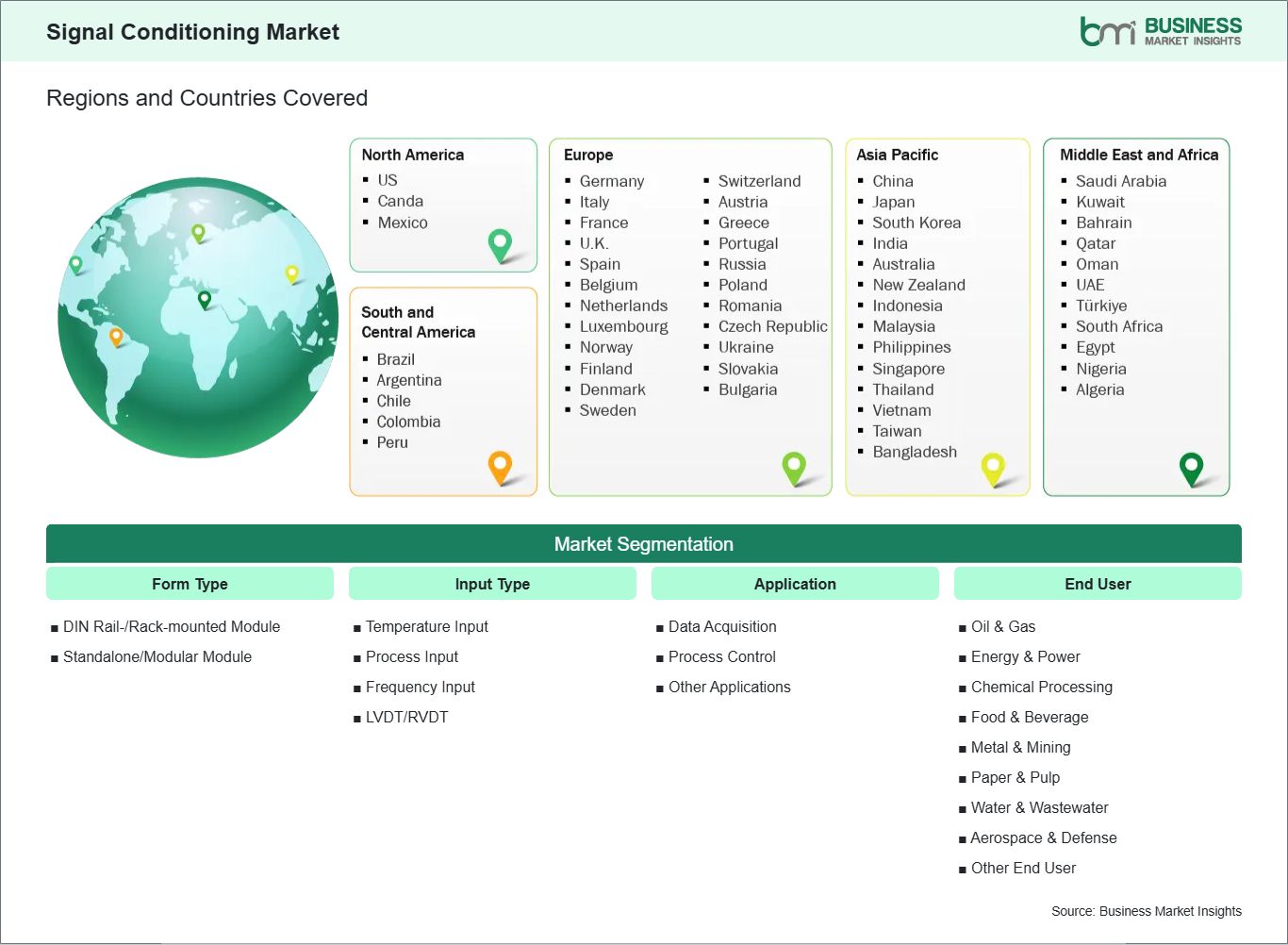
  • Form Type (DIN Rail-/Rack-mounted Module, Standalone/Modular Module)
  • Input Type (Temperature Input, Process Input, Frequency Input, LVDT/RVDT)
  • Application (Data Acquisition, Process Control, Other Applications)
  • End User (Oil & Gas, Energy & Power, Chemical Processing, Food & Beverage, Metal & Mining, Paper & Pulp, Water & Wastewater, Aerospace & Defense, Other End User)

No. of Pages: 417
Report Code: BMIPUB00034336
Category: Electronics and Semiconductor
Signal Conditioning Market

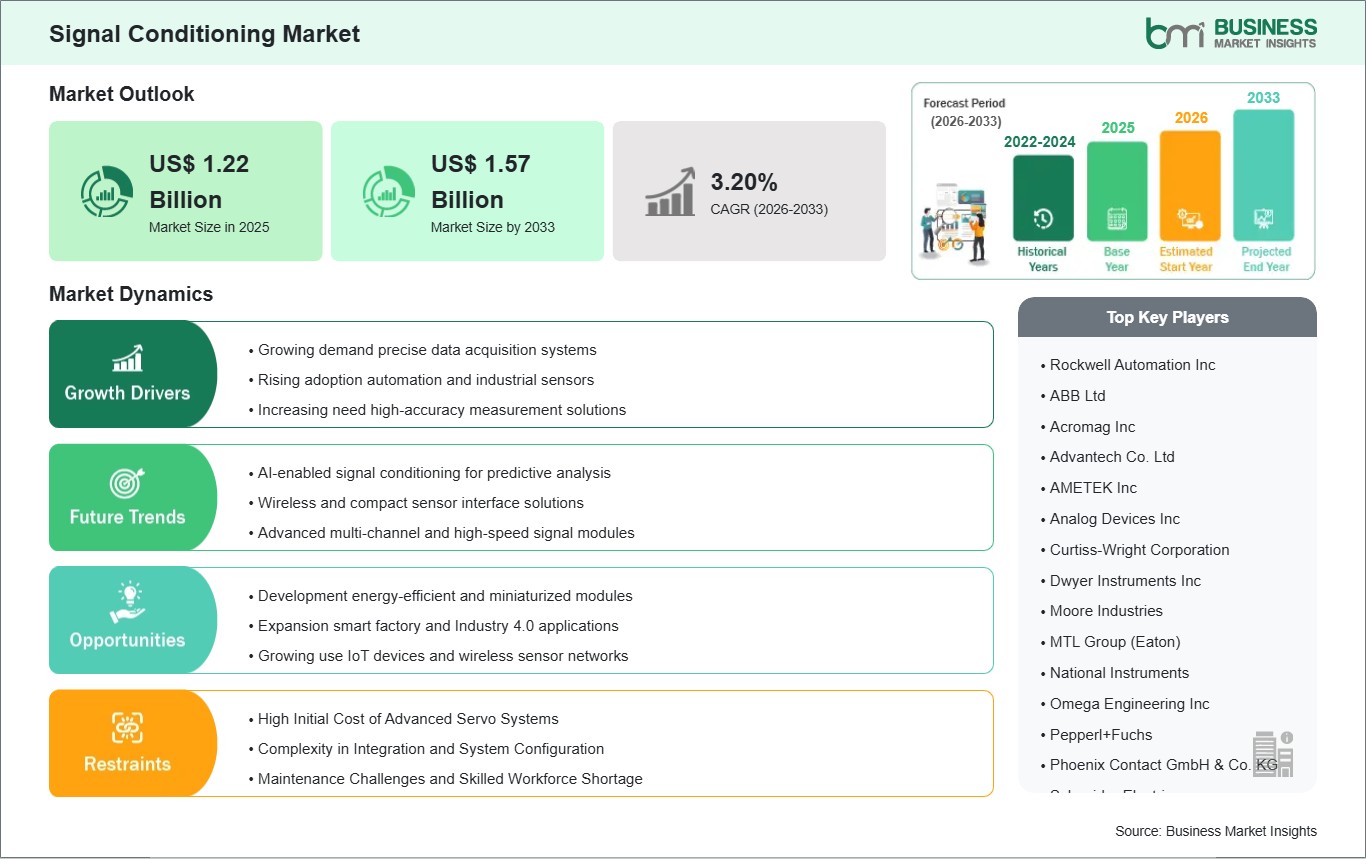
The Signal Conditioning Market size is expected to reach US$ 1.57 billion by 2033 from US$ 1.22 billion in 2025. The market is estimated to record a CAGR of 3.20% from 2026 to 2033.

Executive Summary and Global Market Analysis:

As industries recognize the need for reliable data and the ability to accurately collect and process data, the global signal conditioning market continues to grow. Signal conditioning is critical to transforming raw sensor outputs into usable electrical signals for monitoring, measuring, and controlling applications. Components used for signal conditioning include amplifiers, filters, converters, and isolation modules. Growing interest in industrial automation, smart manufacturing solutions, and IoT devices has driven demand for sophisticated signal conditioning solutions capable of delivering accurate, real-time data across a wide range of applications.

Many factors are contributing to this expansion, including the need for precision and reliability within sectors such as manufacturing, aerospace, energy, and process industries. When working with weak, noisy, or high-frequency sensor signals, signal conditioning is essential for converting to standard signals that can interface with data acquisition and control systems. Growing investments in robotics and instrumentation, as well as renewable energy monitoring, will create continued opportunity for advanced signal conditioning technologies. Integrating these technologies into existing infrastructures requires significant technical knowledge and specialized skills. Smaller organizations with limited engineering resources may face challenges in adopting these systems.

Signal Conditioning Market - Strategic Insights:

global-market-strategic-framework
Get more information on this report

Signal Conditioning Market Segmentation Analysis:

Key segments that contributed to the derivation of the signal conditioning market analysis are form type, input type, application and end user.

  • By form type, the Signal Conditioning market is segmented into DIN rail-/rack-mounted module and standalone/modular module. The DIN rail-/rack-mounted module segment dominated the market in 2025.
  • Based on input type, the Signal Conditioning market is classified into temperature input, process input, frequency input, and LVDT/RVDT. The process input segment dominated the market in 2025.
  • In terms of application, the Signal Conditioning market is classified into data acquisition, process control, and other applications. The data acquisition segment dominated the market in 2025.
  • On the basis of end user, the Signal Conditioning market is categorized into oil & gas, energy & power, chemical processing, food & beverage, metal & mining, paper & pulp, water & wastewater, aerospace & defense, and other end user. The oil & gas segment dominated the market in 2025.

Signal Conditioning Market Drivers and Opportunities:

Growing demand precise data acquisition systems

The international market for signal conditioning is being fueled by the growing requirement for accurate and trustworthy data acquisition. This is being adopted in various sectors, and the need for quality signals has become a crucial aspect of manufacturing units, energy management systems, and process control units. The precise processing of signals is necessary for real-time decision-making, and signal conditioning has become a vital part of modern industrial and instrumentation systems. This becomes even more important in environments where electrical interference is a possibility, and the integrity of the signal is a prime requirement.

In terms of regional adoption, different regions have different influences. In the North American region, smart factories and automated systems have adopted precise signal conditioning in order to ensure the development of advanced smart factory systems. In Europe, precision data acquisition systems have been adopted in automotive systems and renewable energy systems in order to ensure that precise information is available from sensors.

In the Asia Pacific region, nations such as China, Japan, and India are integrating accurate signal processing into their rapidly growing industrial and infrastructure developments. The handling of high-speed data in telecommunications, electronics production, and smart manufacturing processes requires reliable signal conditioning. These solutions ensure that the quality and performance requirements of massive operations are met by facilitating the digital transformation initiatives in the Asia Pacific region.

Development energy-efficient and miniaturized modules

The drive for energy efficiency and smaller form factors is reshaping the signal conditioning market. Modern modules are designed to provide robust performance while minimizing power consumption and footprint. Advances in electronics and circuit design now allow signal conditioners to combine functions like amplification, filtering, and isolation within compact modules, making them well-suited for space-limited applications such as portable instruments and wearable devices. These developments help manufacturers optimize power usage while maintaining high levels of functionality and reliability.

In North America, energy-efficient and compact signal conditioners are particularly valuable for sectors where weight and power constraints are critical, such as aerospace, defense, and high-performance industrial systems. Modern designs not only reduce energy consumption but also often incorporate diagnostic features and digital communication interfaces, enabling distributed control architectures without compromising performance. This approach aligns with broader goals of operational efficiency and sustainability.

The trend toward miniaturization is also evident across the Asia Pacific region, where rapid growth in consumer electronics, automotive sensors, and telecommunication networks is driving demand for small, efficient signal conditioning modules. Compact designs allow high-density sensor arrays and embedded monitoring solutions to function effectively without excessive power draw, making them integral to smart city initiatives and IoT systems.

Signal Conditioning Market Size and Share Analysis:

The signal conditioning market is experiencing steady growth, with market size and share analysis reflecting evolving treatment preferences and competitive dynamics among key players. The report evaluates important subsegments categorized within form type, input type, application and end user, highlighting their respective contributions to overall market performance.

By form type, the DIN rail-/rack-mounted module segment dominated the Signal Conditioning market in 2025. This is driven by the widespread adoption of modular form factors that allow easy integration into industrial control panels, automation systems, and distributed monitoring setups. DIN rail and rack-mounted modules provide flexibility, scalability, and reliable performance, making them a key revenue driver for manufacturers and ensuring consistent demand across industrial environments.

Based on input type, the process input segment dominated the market in 2025. The leadership of process input devices is attributed to their critical role in converting signals from various sensors and field instruments into standardized outputs for monitoring and control. Industries heavily rely on process input signal conditioners for accurate data collection, system reliability, and efficient process management, making them highly preferred in industrial automation applications.

In terms of application, the data acquisition segment dominated the market in 2025. The strong adoption of data acquisition applications is driven by the increasing need for real-time monitoring, analytics, and optimization of industrial processes. Signal conditioning solutions support precise measurement, noise reduction, and signal integrity, enabling organizations to make informed decisions and maintain operational efficiency.

On the basis of end user, the oil & gas segment dominated the market in 2025. The leadership of this segment is attributed to the extensive use of signal conditioning equipment in monitoring critical process parameters such as pressure, temperature, and flow in upstream, midstream, and downstream operations. Oil & gas companies rely on advanced signal conditioning solutions to ensure operational safety, regulatory compliance, and efficient asset management, driving strong demand for these systems.

Signal Conditioning Market Report Highlights:

Report Attribute Details
Market size in 2025 US$ 1.22 Billion
Market Size by 2033 US$ 1.57 Billion
Global CAGR (2026 - 2033)3.20%
Historical Data 2022-2024
Forecast period 2026-2033
Segments Covered By Form Type
  • DIN Rail-/Rack-mounted Module
  • Standalone/Modular Module
By Input Type
  • Temperature Input
  • Process Input
  • Frequency Input
  • LVDT/RVDT
By Application
  • Data Acquisition
  • Process Control
  • Other Applications
By End User
  • Oil & Gas
  • Energy & Power
  • Chemical Processing
  • Food & Beverage
  • Metal & Mining
  • Paper & Pulp
  • Water & Wastewater
  • Aerospace & Defense
  • Other End User
Regions and Countries Covered
North America US, Canada, Mexico
Europe Belgium, Austria, Finland, Denmark, Greece, Poland, Romania, Russia, Ukraine, Czech Republic, Slovakia, Bulgaria, Italy, Luxembourg, Germany, Switzerland, France, Netherlands, Norway, Portugal, Spain, Sweden, United Kingdom
Asia-Pacific Australia, China, India, Japan, South Korea, Indonesia, Malaysia, Philippines, Singapore, Thailand, Vietnam, Bangladesh, New Zealand, Taiwan
South and Central America Brazil, Argentina, Peru, Chile, Colombia
Middle East and Africa Bahrain, Kuwait, Oman, Qatar, Saudi Arabia, United Arab Emirates, Turkiye, South Africa, Egypt, Algeria, Nigeria
Market leaders and key company profiles
  • RockwellAutomationInc
  • ABBLtd
  • AcromagInc
  • AdvantechCoLtd
  • AMETEKInc
  • AnalogDevicesInc
  • CurtissWrightCorporation
  • DwyerInstrumentsInc
  • MooreIndustries
  • MTLGroupEATON
Get more information on this report

Signal Conditioning Market Report Coverage and Deliverables:

The "Signal Conditioning Market Size and Forecast (2022 - 2033)" report provides a detailed analysis of the market covering below areas:

  • Signal Conditioning market size and forecast at global, regional, and country levels for all the key market segments covered under the scope
  • Signal Conditioning market trends, as well as drivers, restraints, and opportunities
  • Signal Conditioning market analysis covering key trends, regional framework, major players, regulations, and recent developments
  • Industry landscape and competition analysis covering market concentration, heat map analysis, prominent players, and recent developments for the Signal Conditioning market
  • Detailed company profiles, including SWOT analysis

Signal Conditioning Market Geographic Insights:

The geographical scope of the Signal Conditioning market report is divided into five regions: North America, Asia Pacific, Europe, Middle East & Africa, and South & Central America. The Signal Conditioning market in North America is expected to grow during the forecast period.

North America maintains a leading position in the global signal conditioning market, largely due to its sophisticated industrial ecosystem, early embrace of automation, and strong emphasis on research and development. The United States, in particular, serves as a central hub for advanced electronics, industrial instrumentation, and automation technologies, driving significant demand for dependable signal conditioning solutions. Key industries, including aerospace, defense, automotive, and energy, are increasingly investing in systems that rely on precise sensor data and high-performance signal processing, reinforcing the region’s leadership in market adoption.

The region benefits from a well-established network of technology providers, system integrators, and research institutions that actively support innovation in signal processing and data acquisition. Companies in North America are adopting flexible, modular, and scalable signal conditioning solutions to enhance smart manufacturing initiatives, predictive maintenance, and IoT-based monitoring, enabling more efficient operations and informed decision-making. Moreover, stringent regulatory standards across sectors such as energy, aerospace, and medical devices further drive demand for reliable, high-accuracy components. The combination of technical expertise, robust infrastructure, and sector-specific requirements ensures that North America continues to dominate the global signal conditioning landscape.

global-market-geography
Get more information on this report

Signal Conditioning Market Research Report Guidance:

  • The report includes qualitative and quantitative data in the Signal Conditioning market across form type, input type, application, end user, and geography.
  • The report starts with the key takeaways (chapter 2), highlighting the key trends and outlook of the Signal Conditioning market.
  • Chapter 3 focuses on the research methodology of the study.
  • Chapter 4 includes ecosystem analysis.
  • Chapter 5 highlights the major industry dynamics in the Signal Conditioning market, including factors that are driving the market, prevailing deterrents, potential opportunities, as well as future trends. Impact analysis of these drivers and restraints is also covered in this section.
  • Chapter 6 discusses the Signal Conditioning market scenario, in terms of historical market revenues, and forecast till the year 2033.
  • Chapters 7 to 11 cover the Signal Conditioning market segments by form type, input type, application, end user, and geography across North America, Europe, Asia Pacific, Middle East and Africa, and South and Central America. They cover the market volume, revenue forecast, and factors driving the market.
  • Chapter 12 describes the competitive analysis with the heat map analysis for the key players operating in the market.
  • Chapter 13 describes the industry landscape analysis. It provides detailed descriptions of business activities such as market initiatives, new developments, mergers, and joint ventures globally, along with a competitive landscape.
  • Chapter 14 provides detailed profiles of the major companies operating in the Signal Conditioning market. Companies have been profiled on the basis of their key facts, business descriptions, products, financial overview, SWOT analysis, and key developments.
  • Chapter 15, i.e., the appendix, is inclusive of a brief overview of the company, list of abbreviations, and disclaimer.

Signal Conditioning Market News and Key Development:

The signal conditioning market is evaluated by gathering qualitative and quantitative data post primary and secondary research, which includes important corporate publications, association data, and databases. A few of the key developments in the signal conditioning market are:

  • In February 2026, PCB Piezotronics announced that it had launched the Model 410D01 single‑channel DIN‑rail ICP® signal conditioner, designed for industrial automation and OEM machinery. This new module powers ICP® sensors, conditions dynamic signals, and provides multiple analog outputs for integration with PLC and control systems, supporting real‑time process monitoring in repetitive machine applications.
  • In May 2024, Phoenix Contact announced an upgrade and expansion of its MACX Analog signal conditioner and measuring transducer product family, adding new versions with explosion protection, extended temperature operation, and broad functional safety certifications (up to SIL 3), making the product range more versatile for industrial control and process automation applications.

Key Sources Referred:

  • International Electrotechnical Commission
  • Institute of Electrical and Electronics Engineers
  • International Organization for Standardization
  • Bureau of Indian Standards
  • Central Electricity Authority
  • Ministry of Power
  • Indian Electrical and Electronics Manufacturers' Association
  • European Committee for Electrotechnical Standardization
  • VDE Association for Electrical Electronic & Information Technologies
  • Company Websites
  • Company Annual Reports
  • Company Investor Presentations
The List of Companies - Signal Conditioning Market
  • RockwellAutomationInc
  • ABBLtd
  • AcromagInc
  • AdvantechCoLtd
  • AMETEKInc
  • AnalogDevicesInc
  • CurtissWrightCorporation
  • DwyerInstrumentsInc
  • MooreIndustries
  • MTLGroupEATON
  • NationalInstruments
  • OmegaEngineeringInc
  • PepperlFuchs
  • PhoenixContactGmbHCo
  • SchneiderElectric
  • SiemensAG
  • TEConnectivityLtd
  • WeidmüllerInterfaceGmbHCoKg
  • YokogawaElectricCorporation
Frequently Asked Questions
How big is the Signal Conditioning Market?

The Signal Conditioning Market is valued at US$ 1.22 Billion in 2025, it is projected to reach US$ 1.57 Billion by 2033.

What is the CAGR for Signal Conditioning Market by (2026 - 2033)?

As per our report Signal Conditioning Market, the market size is valued at US$ 1.22 Billion in 2025, projecting it to reach US$ 1.57 Billion by 2033. This translates to a CAGR of approximately 3.20% during the forecast period.

What segments are covered in this report?

The Signal Conditioning Market report typically cover these key segments-

  • Form Type (DIN Rail-/Rack-mounted Module, Standalone/Modular Module)
  • Input Type (Temperature Input, Process Input, Frequency Input, LVDT/RVDT)
  • Application (Data Acquisition, Process Control, Other Applications)
  • End User (Oil & Gas, Energy & Power, Chemical Processing, Food & Beverage, Metal & Mining, Paper & Pulp, Water & Wastewater, Aerospace & Defense, Other End User)

What is the historic period, base year, and forecast period taken for Signal Conditioning Market?

The historic period, base year, and forecast period can vary slightly depending on the specific market research report. However, for the Signal Conditioning Market report:

  • Historic Period : 2022-2024
  • Base Year : 2025
  • Forecast Period : 2026-2033
  • Who are the major players in Signal Conditioning Market?

    The Signal Conditioning Market is populated by several key players, each contributing to its growth and innovation. Some of the major players include:

  • RockwellAutomationInc
  • ABBLtd
  • AcromagInc
  • AdvantechCoLtd
  • AMETEKInc
  • AnalogDevicesInc
  • CurtissWrightCorporation
  • DwyerInstrumentsInc
  • MooreIndustries
  • MTLGroupEATON
  • NationalInstruments
  • OmegaEngineeringInc
  • PepperlFuchs
  • PhoenixContactGmbHCo
  • SchneiderElectric
  • SiemensAG
  • TEConnectivityLtd
  • WeidmüllerInterfaceGmbHCoKg
  • YokogawaElectricCorporation
  • Who should buy this report?

    The Signal Conditioning Market report is valuable for diverse stakeholders, including:

    • Investors: Provides insights for investment decisions pertaining to market growth, companies, or industry insights. Helps assess market attractiveness and potential returns.
    • Industry Players: Offers competitive intelligence, market sizing, and trend analysis to inform strategic planning, product development, and sales strategies.
    • Suppliers and Manufacturers: Helps understand market demand for components, materials, and services related to concerned industry.
    • Researchers and Consultants: Provides data and analysis for academic research, consulting projects, and market studies.
    • Financial Institutions: Helps assess risks and opportunities associated with financing or investing in the concerned market.

    Essentially, anyone involved in or considering involvement in the Signal Conditioning Market value chain can benefit from the information contained in a comprehensive market report.

    Available Report Formats

    pdf-format excel-format pptx-format
    Buy Now
    Sales Assistance
    +1 646 791 7070 (US & UK)
    Customization Form

    Please tell us your area of interest
    (Market Segments/ Regions and Countries/ Companies)