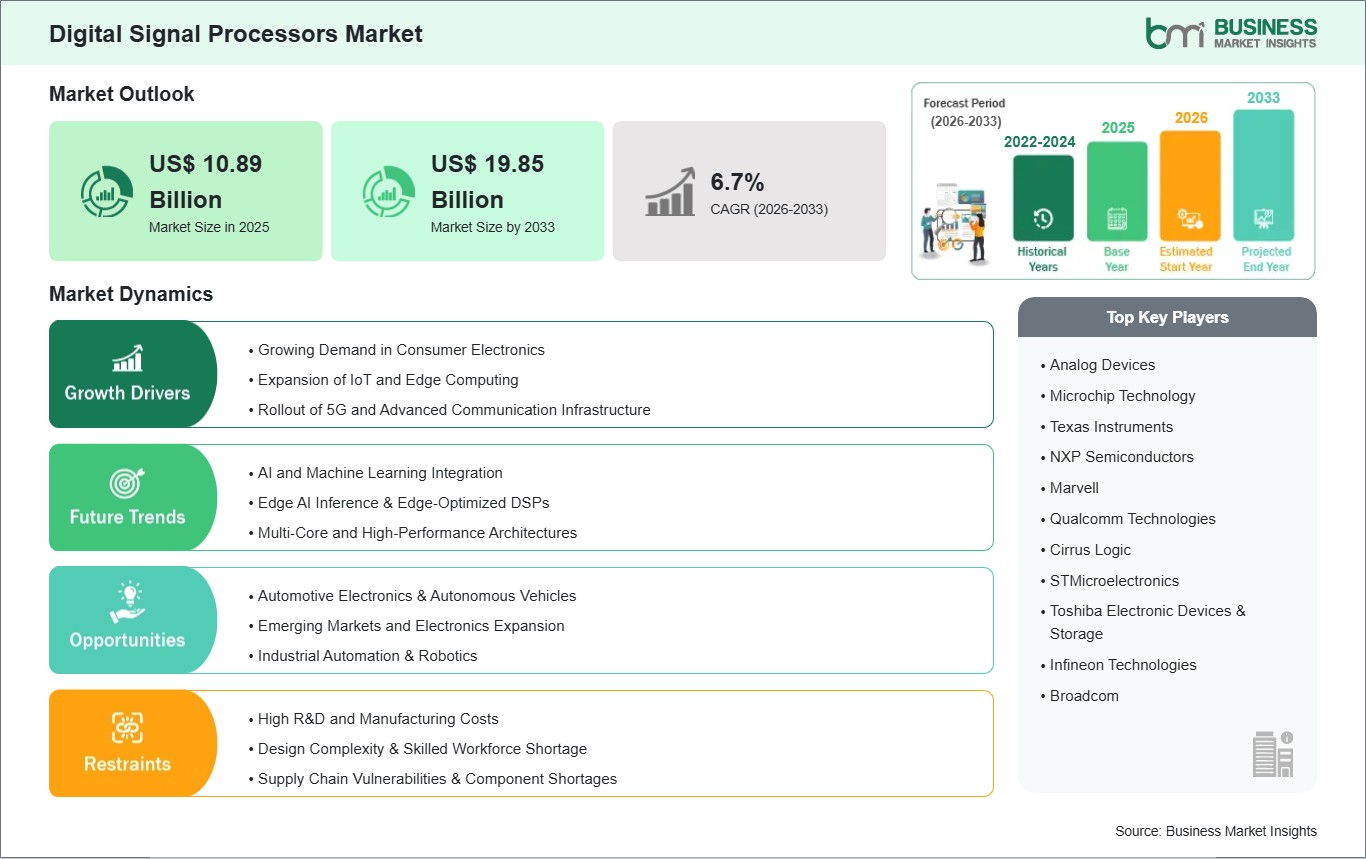
The digital signal processors market size is expected to reach US$19.85 billion by 2033 from US$10.89 billion in 2025. The market is estimated to record a CAGR of 6.7% from 2026 to 2033.
The global digital signal processor (DSP) market is experiencing robust growth, driven by the rising demand for high-performance computing across diverse applications such as speech recognition, audio/video processing, and industrial automation. Multi-core and mid-range DSPs dominate, offering enhanced processing speed, parallelism, and cost-efficient performance. Application-specific DSPs are increasingly preferred for specialized tasks, while consumer electronics and automotive industries remain the primary end-users. Voice-enabled devices, smart assistants, and AI-driven applications further accelerate market adoption. Asia Pacific leads geographically due to rapid industrialization, expanding electronics manufacturing, and increased IoT deployment. Technological advancements, coupled with rising investments in intelligent systems, position the DSP market for sustained global expansion over the coming years.
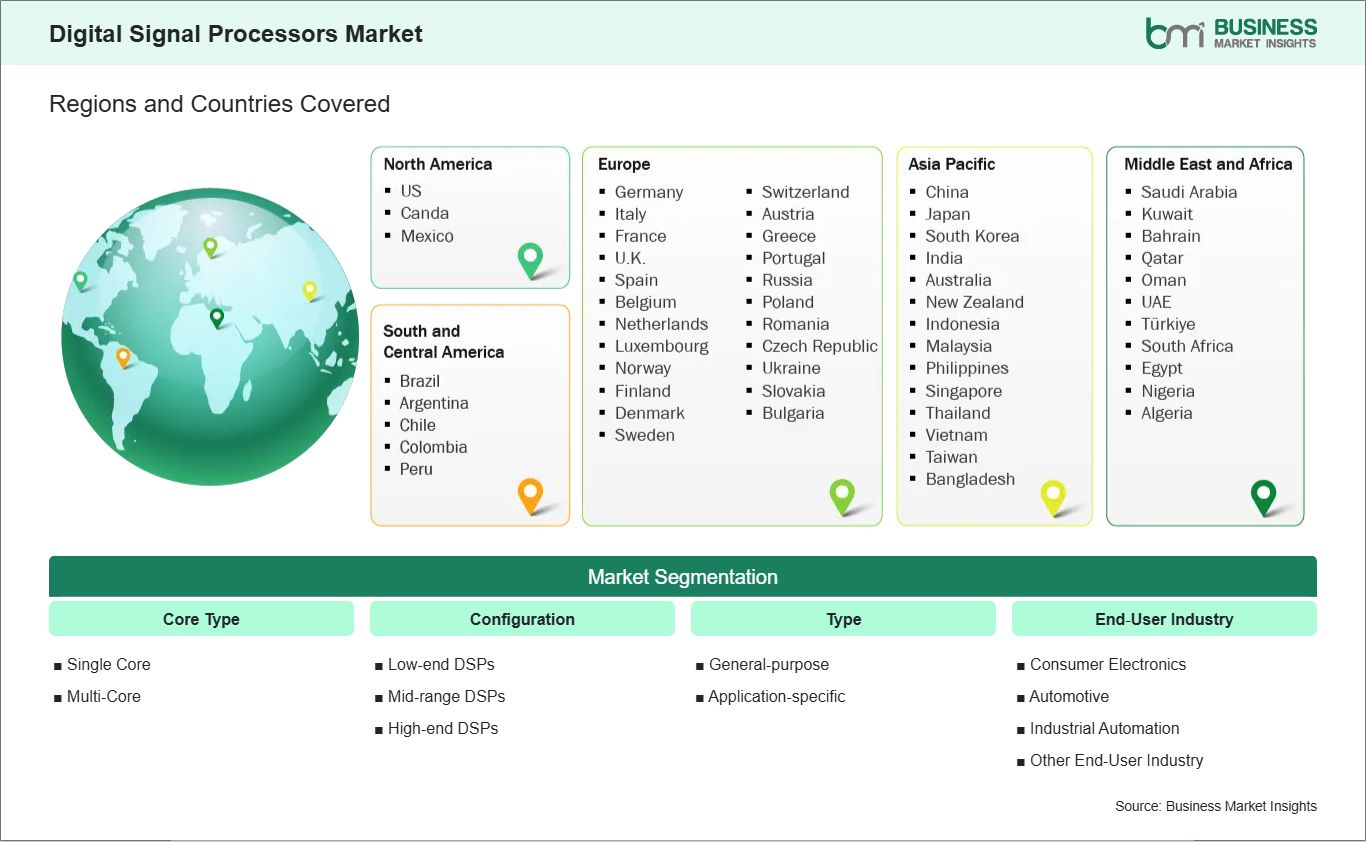
The digital signal processor market is segmented by core type, Configuration, Type, application, end-user industry, and region. Multi-core DSPs lead in core type, offering superior parallel processing capabilities. Mid-range DSPs dominate Configuration, balancing performance and affordability. Application-specific DSPs are preferred for specialized tasks, with speech processing and recognition applications experiencing the fastest growth. Consumer electronics drives the largest end-user demand, while automotive, industrial automation, and healthcare contribute significantly.

Key segments that contributed to the derivation of the Digital Signal Processors market analysis are Type, Deployment, and Application.
The global digital signal processor (DSP) market is primarily driven by the escalating demand for high-performance computing in consumer electronics, automotive, and industrial automation sectors. Multi-core and mid-range DSPs enable faster processing, parallel computation, and energy-efficient operations, making them essential for advanced applications such as speech recognition, AI-assisted audio/video processing, real-time monitoring, and autonomous vehicle systems. Consumer electronics like smartphones, smart speakers, wearables, and home automation devices increasingly rely on DSPs for superior performance. Similarly, automotive applications, including infotainment, advanced driver-assistance systems (ADAS), and in-vehicle communications, are accelerating DSP adoption. The convergence of AI, IoT, and smart devices further amplifies demand, positioning DSPs as a critical enabler of next-generation technological solutions worldwide.
Asia Pacific presents a significant growth opportunity for DSP manufacturers due to rapid industrialization, increasing consumer electronics adoption, and widespread IoT deployment. Countries like China, India, Japan, and South Korea are investing heavily in smart devices, connected automobiles, industrial automation, and AI-enabled technologies, all of which rely on DSPs for efficient signal processing. The region’s large manufacturing base, favorable economic policies, and technological innovation ecosystem support high-volume DSP production and consumption. Moreover, the rising demand for affordable yet high-performance DSP solutions in emerging markets presents new avenues for market expansion. By strategically targeting the Asia Pacific, DSP providers can leverage rapid technological adoption, growing consumer demand, and industrial digital transformation to drive long-term revenue growth.
The 3D Gaming Console market demonstrates steady growth, with size and share analysis revealing evolving trends and competitive positioning among key players. The report further examines subsegments categorized within component, platform, consoles, and application, offering insights into their contribution to overall market performance.
For instance, the Software subsegment continues to grow rapidly, fueled by AI-driven tools like Muse that empower developers to create dynamic, scalable content across consoles.
By Core Type, the market is segmented into Single Core, Multi‑Core. The Multi-Core DSPs segment dominated the market in 2025. Multi-core DSPs dominate due to their ability to handle complex computations simultaneously. Industries like automotive, consumer electronics, and industrial automation prefer them for faster processing, improved energy efficiency, and support for advanced applications such as AI, machine learning, and real-time signal processing, driving global market growth.
By Configuration, the market is segmented into Low‑end DSPs, Mid‑range DSPs, and High‑end DSPs. The Mid-Range DSPs segment held the largest share of the market in 2025 as they balance performance and cost effectively. Suitable for applications like audio/video processing, communication systems, and speech recognition, they offer sufficient processing power without the high cost of high-end DSPs, making them ideal for widespread industrial and consumer adoption.
By Type, the market is segmented into General‑purpose and application-specific. The Application-Specific DSPs segment held the largest share of the market in 2025, as they are tailored to particular tasks like speech processing, imaging, or communications. Their optimized design delivers higher efficiency and performance than general-purpose DSPs, attracting industries that require precise, high-speed processing for specialized applications, boosting their adoption across automotive, healthcare, and consumer electronics sectors.
By End‑User Industry, the market is segmented into Consumer Electronics, Automotive, Industrial Automation, and Others. The Consumer Electronics segment held the largest share of the market in 2025, fueled by smartphones, smart speakers, wearables, and home automation devices. High demand for audio/video processing, AI-enabled features, and connectivity solutions makes DSPs essential, positioning this industry as the largest driver of global DSP market expansion.

| Report Attribute | Details |
|---|---|
| Market size in 2025 | US$ 10.89 Billion |
| Market Size by 2033 | US$ 19.85 Billion |
| Global CAGR (2026 - 2033) | 6.7% |
| Historical Data | 2022-2024 |
| Forecast period | 2026-2033 |
| Segments Covered | By Core Type
|
|
Regions and Countries Covered
| |
| North America | US, Canada, Mexico |
| Europe | Belgium, Austria, Finland, Denmark, Greece, Poland, Romania, Russia, Ukraine, Czech Republic, Slovakia, Bulgaria, Italy, Luxembourg, Germany, Switzerland, France, Netherlands, Norway, Portugal, Spain, Sweden, United Kingdom |
| Asia-Pacific | Australia, China, India, Japan, South Korea, Indonesia, Malaysia, Philippines, Singapore, Thailand, Vietnam, Bangladesh, New Zealand, Taiwan |
| South and Central America | Brazil, Argentina, Peru, Chile, Colombia |
| Middle East and Africa | Bahrain, Kuwait, Oman, Qatar, Saudi Arabia, United Arab Emirates, Turkiye, South Africa, Egypt, Algeria, Nigeria |
| Market leaders and key company profiles |
|
The "Digital Signal Processors Market Size and Forecast (2022-2033)" report provides a detailed analysis of the market covering below areas:
The geographical scope of the Digital signal processors market report is divided into five regions: North America, Asia Pacific, Europe, Middle East & Africa, and South & Central America. The Digital signal processors market in Asia Pacific is expected to grow significantly during the forecast period.
Asia Pacific dominates the global digital signal processor (DSP) market, driven by rapid industrialization, a growing consumer electronics sector, and increasing adoption of IoT, AI, and smart technologies. Countries such as China, India, Japan, and South Korea lead in manufacturing, R&D, and technological innovation, fueling high demand for multi-core and mid-range DSPs. The region’s automotive industry, particularly in advanced driver-assistance systems (ADAS) and in-vehicle infotainment, further boosts DSP adoption.
Rising smartphone penetration, smart home devices, and wearable technology create additional market opportunities. Favorable government policies, large-scale electronics manufacturing, and expanding technology infrastructure position the Asia Pacific as a key growth hub, ensuring sustained DSP market expansion and attracting global suppliers seeking high-volume consumption markets.

The Digital signal processors market is evaluated by gathering qualitative and quantitative data post primary and secondary research, which includes important corporate publications, association data, and databases. A few of the key developments in the Digital Signal Processors market are:
The Digital Signal Processors Market is valued at US$ 10.89 Billion in 2025, it is projected to reach US$ 19.85 Billion by 2033.
As per our report Digital Signal Processors Market, the market size is valued at US$ 10.89 Billion in 2025, projecting it to reach US$ 19.85 Billion by 2033. This translates to a CAGR of approximately 6.7% during the forecast period.
The Digital Signal Processors Market report typically cover these key segments-
The historic period, base year, and forecast period can vary slightly depending on the specific market research report. However, for the Digital Signal Processors Market report:
The Digital Signal Processors Market is populated by several key players, each contributing to its growth and innovation. Some of the major players include:
The Digital Signal Processors Market report is valuable for diverse stakeholders, including:
Essentially, anyone involved in or considering involvement in the Digital Signal Processors Market value chain can benefit from the information contained in a comprehensive market report.
Please tell us your area of interest
(Market Segments/ Regions and Countries/ Companies)