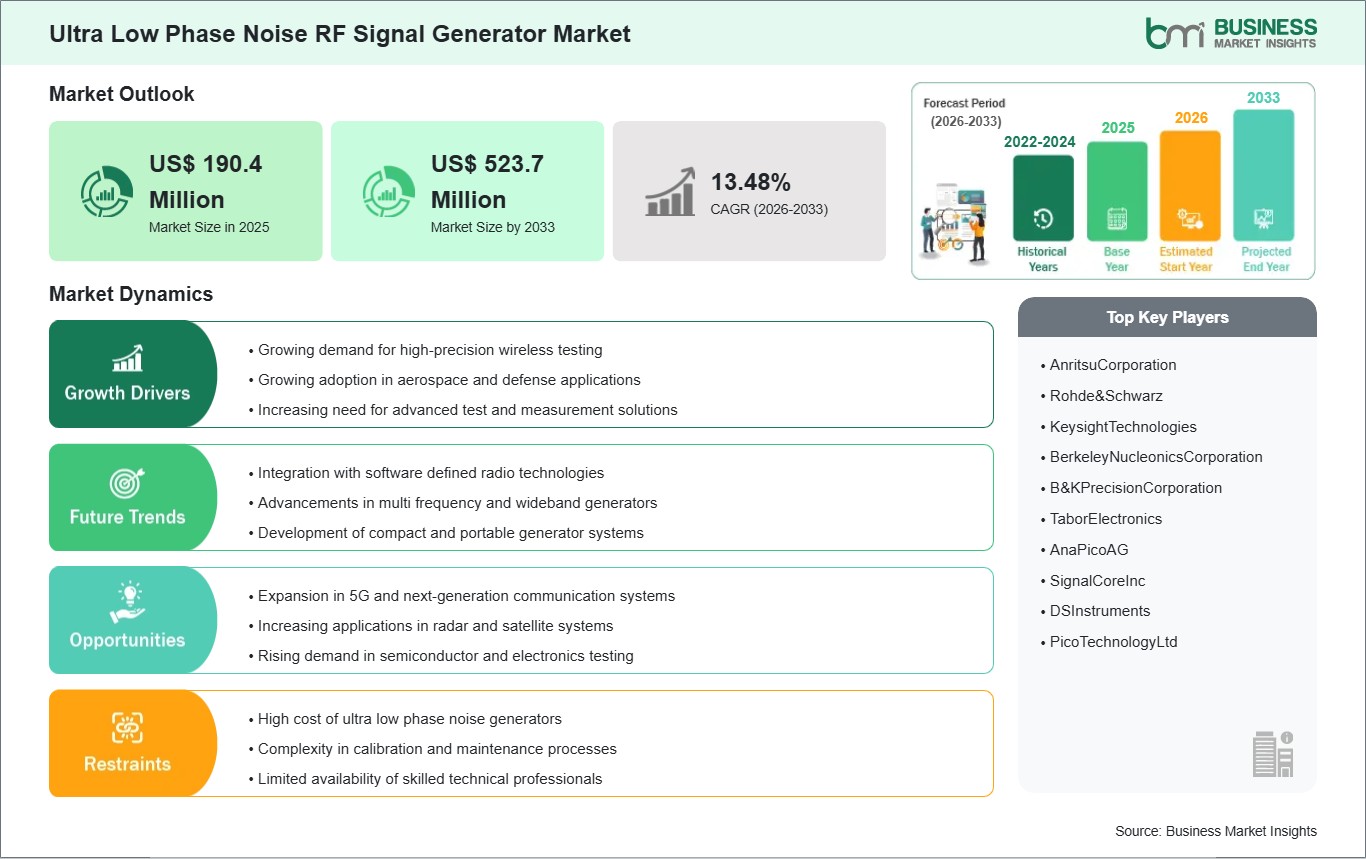
The Ultra-Low Phase Noise RF Signal Generator Market size is expected to reach US$ 523.7 million by 2033 from US$ 190.4 million in 2025. The market is estimated to record a CAGR of 13.48% from 2026 to 2033.
The global ultra-low phase noise RF signal generator market is experiencing rapid growth. This growth is being driven by the increasing need for high-accuracy testing and measurement across numerous industries, including telecommunications, aerospace, defense and semiconductor. Signal generators play a vital role in ensuring the integrity of high-frequency signals. The need for low phase noise is important in high-frequency applications such as radar systems, 5G and upcoming 6G networks and satellite communications, as low phase noise is essential for accurate performance evaluation.
Technological advancements such as direct digital synthesizers (DDS), frequency multipliers and integrated Phase-Locked Loop (PLL) systems are increasing the frequency stability, spectral purity and versatility of output. This enables engineers to perform highly reliable tests in both R&D and production environments. In addition, the growing complexity of wireless communication systems and the need for stringent compliance testing and calibration are further fueling the demand for ultra-low phase noise generators. Integration with Automated Test Equipment (ATE) and Software Defined Test Systems (SDTS) is also enhancing efficiency and reducing the time required for testing. The competitive landscape in this marketplace is centered around product differentiation through offering wider frequency ranges, smaller form factor designs and improved user interfaces.
Growth in quantum computing, radar technology innovation and high-speed data communication is generating additional opportunities for ultra-low phase noise RF generators that will ultimately establish the market as an important foundation for precision-enabled applications.

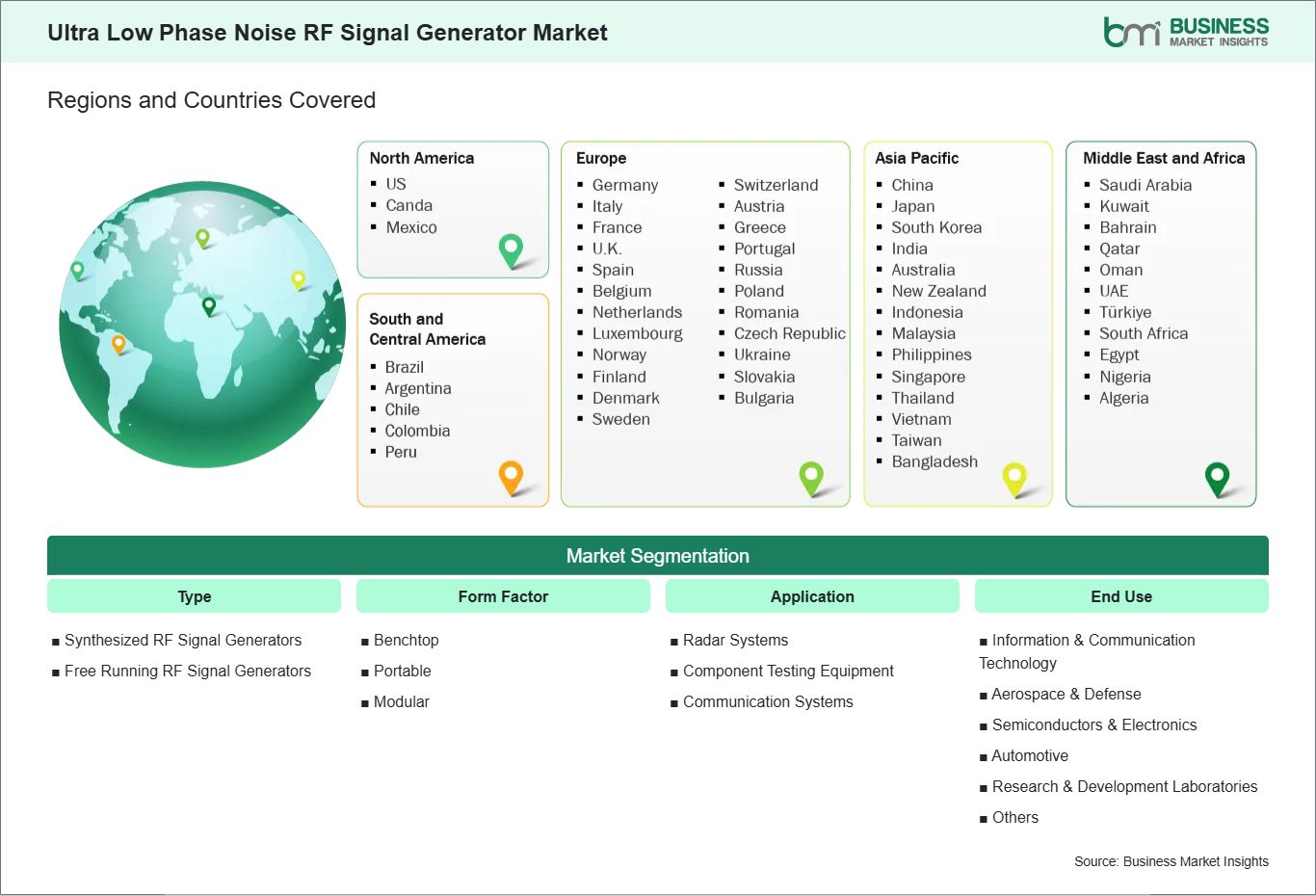
Key segments that contributed to the derivation of the ultra‑low phase noise RF signal generator market analysis are type, form factor, application, and end use.
Increasing demand for high-precision wireless testing in numerous industries drives the growth of the worldwide ultra-low phase noise RF signal generator market. As communication networks, radar systems, and satellite platforms advance toward greater complexity and capability, the need for stable, precise RF signal generation will continue to grow in importance. In fact, these generators play a critical role in assessing the performance of communication devices within real-world operating conditions, improving reliability, and minimizing errors in RF measurements. Thus, accurate and repeatable high-precision testing is particularly important in industries including aerospace, telecom, defense, and radar systems, where even slight variations in an RF signal can greatly affect overall system performance.
The ability of ultra-low phase noise RF signal generators to enable engineers to perform accurate, comprehensive testing of complex RF components such as amplifiers, mixers, and filters thereby improves the quality of measurement data and ultimately the development of next-generation wireless systems. Furthermore, the growth of wireless applications and an increasing number of higher frequency bands will also contribute to a greater need for precision signal sources. The latest improvements in generator technology (i.e., increased spectral purity; reduced jitter) will allow them to meet the more complex testing requirements necessary to meet the demands of the marketplace. High precision testing remains the main driver for global growth in ultra-low phase noise RF signal generator production.
The worldwide market is currently reaping benefits from the rapid growth of 5G and next generation comms. As we progress towards using higher frequencies and more intricate modulation schemes in our mobile networks, RF designers need ultra-low phase noise generators to ensure the integrity of their signals, the phase stability, and the performance of their systems. These devices play a crucial role in the creation of base stations, user equipment, and network infrastructure that lets high-speed communication to occur without significant interference. In order for operators to provide seamless connectivity with low latency and adherence to stringent testing requirements, all next-generation network technologies will need to include solutions like those of ultra-low phase noise RF signal generators. These products enable the reproduction of realistic conditions in both lab and field tests for high-frequency communication, helping to shorten design cycles and improve product reliability. The adoption of ultra-low phase noise RF signal generators continues to grow as the most significant focus of equipment makers and wireless carriers is delivering high-bandwidth communication services.
In addition, wireless communications are converging with IoT, autonomous systems, and smart devices, and this convergence is growing the demand for ultra-low phase RF signal generation . As a result, as the number of devices connected to one another grows exponentially and they continue to consume more bandwidth than previously, accurate RF signal generation will be necessary for the validation of system performance, interoperability testing, and spectral compliance. Therefore, an ultra-low phase noise RF signal generator is playing an integral part in the development and deployment of advanced global communications networks.
The ultra‑low phase noise RF signal generator market demonstrates steady growth, with size and share analysis highlighting evolving trends and competitive dynamics among key players. The report examines subsegments categorized within type, form factor, application, and end use, offering insights into their contribution to overall market performance.
By Type, the synthesized RF signal generators subsegment dominated the market in 2025, driven by higher precision and stability requirements in advanced wireless communication testing.
Based on Form Factor, the benchtop subsegment dominated the market in 2025, owing to its widespread use in research laboratories and development environments requiring high measurement accuracy.
On the Basis of Application, the component testing equipment subsegment dominated the market in 2025, supported by the increasing need to test complex RF components in telecom, automotive, and aerospace industries.
By End Use, the information & communication technology subsegment dominated the market in 2025, propelled by rapid deployment of 5G networks and growing demand for wireless connectivity infrastructure testing.
| Report Attribute | Details |
|---|---|
| Market size in 2025 | US$ 190.4 Million |
| Market Size by 2033 | US$ 523.7 Million |
| Global CAGR (2026 - 2033) | 13.48% |
| Historical Data | 2022-2024 |
| Forecast period | 2026-2033 |
| Segments Covered | By Type
|
|
Regions and Countries Covered
| |
| North America | US, Canada, Mexico |
| Europe | Belgium, Austria, Finland, Denmark, Greece, Poland, Romania, Russia, Ukraine, Czech Republic, Slovakia, Bulgaria, Italy, Luxembourg, Germany, Switzerland, France, Netherlands, Norway, Portugal, Spain, Sweden, United Kingdom |
| Asia-Pacific | Australia, China, India, Japan, South Korea, Indonesia, Malaysia, Philippines, Singapore, Thailand, Vietnam, Bangladesh, New Zealand, Taiwan |
| South and Central America | Brazil, Argentina, Peru, Chile, Colombia |
| Middle East and Africa | Bahrain, Kuwait, Oman, Qatar, Saudi Arabia, United Arab Emirates, Turkiye, South Africa, Egypt, Algeria, Nigeria |
| Market leaders and key company profiles |
|
The "Ultra‑Low Phase Noise RF Signal Generator Market Size and Forecast (2022 - 2033)" report provides a detailed analysis of the market covering below areas:
The geographical scope of the Ultra‑Low Phase Noise RF Signal Generator Market report is divided into North America, Asia Pacific, Europe, Middle East & Africa, and South & Central America. North America held the largest share in 2025.
North America dominates the ultra-low phase noise RF signal generator market, primarily driven by high investment in advanced telecommunications, defense research, and semiconductor testing. The United States leads in adoption for radar system development, 5G network deployment, and aerospace applications, supported by sophisticated R&D infrastructure and technology-focused government initiatives.
Asia Pacific represents a fast-growing market, with China, Japan, South Korea, and India increasing adoption due to rapid telecom expansion, semiconductor manufacturing, and defense modernization programs. The region is investing in high-precision testing equipment to meet global quality standards and support emerging applications such as high-frequency 5G testing and satellite communication systems.
Europe emphasizes stringent compliance and innovation, with Germany, France, and the UK prioritizing RF testing for automotive radar, aerospace, and telecommunication applications. Collaborative R&D programs and government-backed research initiatives are driving technological advancements in signal generator precision and reliability.
The Middle East and Africa are emerging markets where defense modernization, oil and gas monitoring, and satellite communication infrastructure create demand for ultra-low phase noise RF signal generators.
South and Central America, particularly Brazil, Mexico, and Argentina, show steady adoption, with emphasis on telecommunications testing, aerospace research, and academic applications. Regional growth is shaped by the need to modernize testing infrastructure and align with international frequency and signal integrity standards.

The Ultra‑Low Phase Noise RF Signal Generator Market is evaluated by gathering qualitative and quantitative data post primary and secondary research, which includes important corporate publications, association data, and databases. A few of the key developments in the spatial light Modulator market are:
The Ultra‑Low Phase Noise RF Signal Generator Market is valued at US$ 190.4 Million in 2025, it is projected to reach US$ 523.7 Million by 2033.
As per our report Ultra‑Low Phase Noise RF Signal Generator Market, the market size is valued at US$ 190.4 Million in 2025, projecting it to reach US$ 523.7 Million by 2033. This translates to a CAGR of approximately 13.48% during the forecast period.
The Ultra‑Low Phase Noise RF Signal Generator Market report typically cover these key segments-
The historic period, base year, and forecast period can vary slightly depending on the specific market research report. However, for the Ultra‑Low Phase Noise RF Signal Generator Market report:
The Ultra‑Low Phase Noise RF Signal Generator Market is populated by several key players, each contributing to its growth and innovation. Some of the major players include:
The Ultra‑Low Phase Noise RF Signal Generator Market report is valuable for diverse stakeholders, including:
Essentially, anyone involved in or considering involvement in the Ultra‑Low Phase Noise RF Signal Generator Market value chain can benefit from the information contained in a comprehensive market report.
Please tell us your area of interest
(Market Segments/ Regions and Countries/ Companies)