Market Summary
Executive Summary and Global Market Analysis
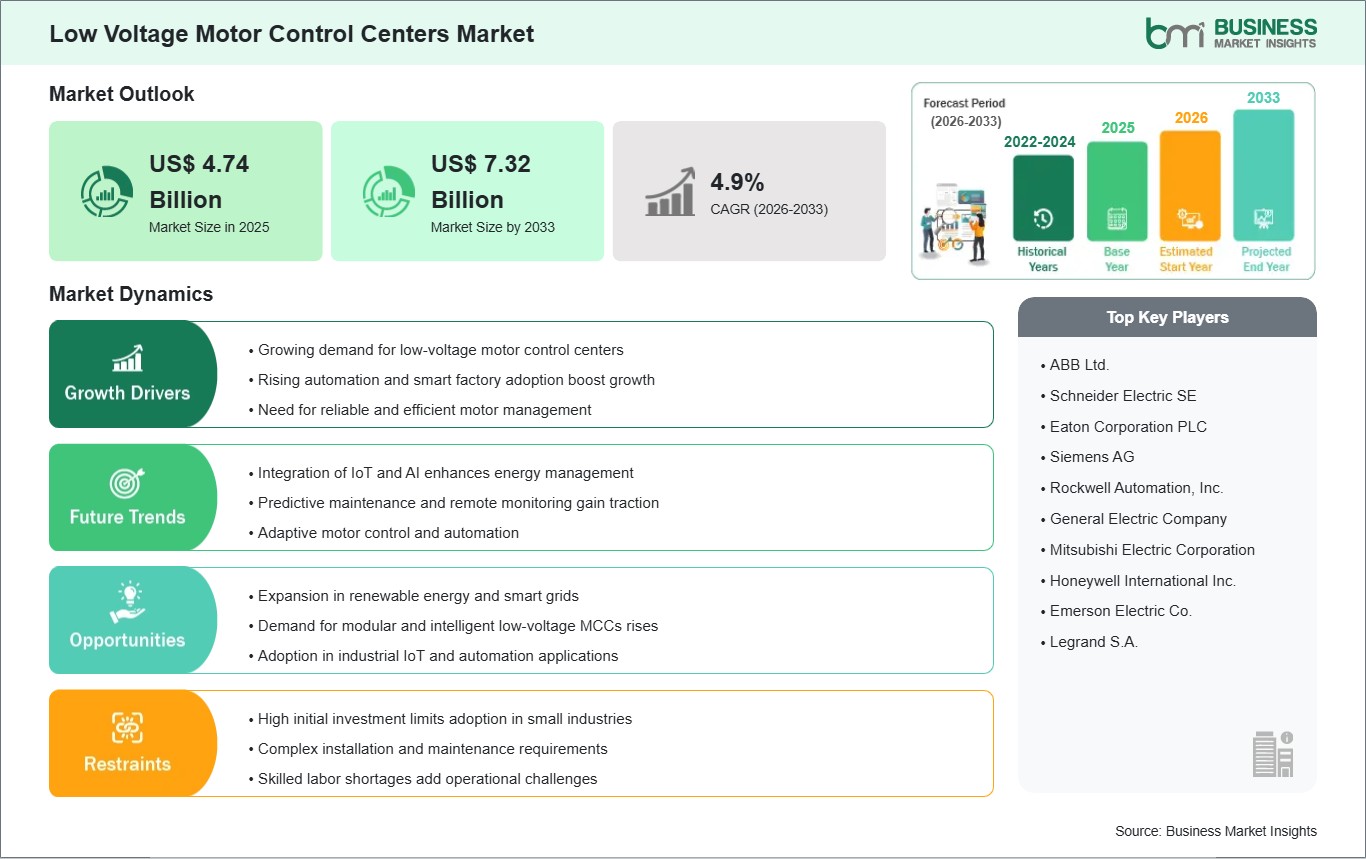
Low Voltage Motor Control Centers (LV MCCs) are specialized electrical assemblies designed to group and centralize the control, protection, and monitoring of electric motors operating at voltages typically below 1,000V. These technologies deliver significant clinical and economic value by offering a centralized point of failure diagnostics for critical hospital life-support systems, providing energy-efficient motor regulation for high-volume manufacturing, and ensuring the electrical safety of personnel through modular, arc-mitigating designs. Market expansion is primarily attributed to the rising global demand for industrial automation (Industry 4.0), a massive surge in infrastructure modernization and smart building projects, and the escalating adoption of energy-efficient motor drives to meet global carbon-reduction targets. Furthermore, the integration of IIoT-enabled digital twins and edge analytics, which allow for real-time monitoring of thermal and electrical health, is substantially improving procedural efficiency and reducing unplanned downtime.
However, several challenges can restrain market growth: high initial procurement and integration costs, particularly for "smart" intelligent units that carry a 35 - 55% premium over traditional relay-based assemblies, can limit adoption in price-sensitive emerging markets. Stringent regulatory hurdles and evolving cybersecurity mandates (such as IEC 62443 compliance) lengthen the time-to-market for connected products and increase development overhead. Additionally, the industry faces constraints due to a global shortage of skilled electrical personnel, where the lack of technicians capable of commissioning and maintaining complex, networked motor control systems can lead to sub-optimal utilization of high-tech infrastructure.
Despite these hurdles, the market holds immense opportunities in the universal mandate for green energy transition and the accelerating deployment of LV MCCs in large-scale solar and wind farm control stations. The expansion of hyperscale data centers, which require modular, pre-commissioned MCC skids to reduce onsite construction time, and the development of regenerative motor control solutions that feed excess kinetic energy back into the local grid are expected to create significant opportunities for market growth.
Segment Analysis
Low Voltage Motor Control Centers Market Segmentation
Key segments that contributed to the derivation of the Low Voltage Motor Control Centers market analysis are component, type, and industry.
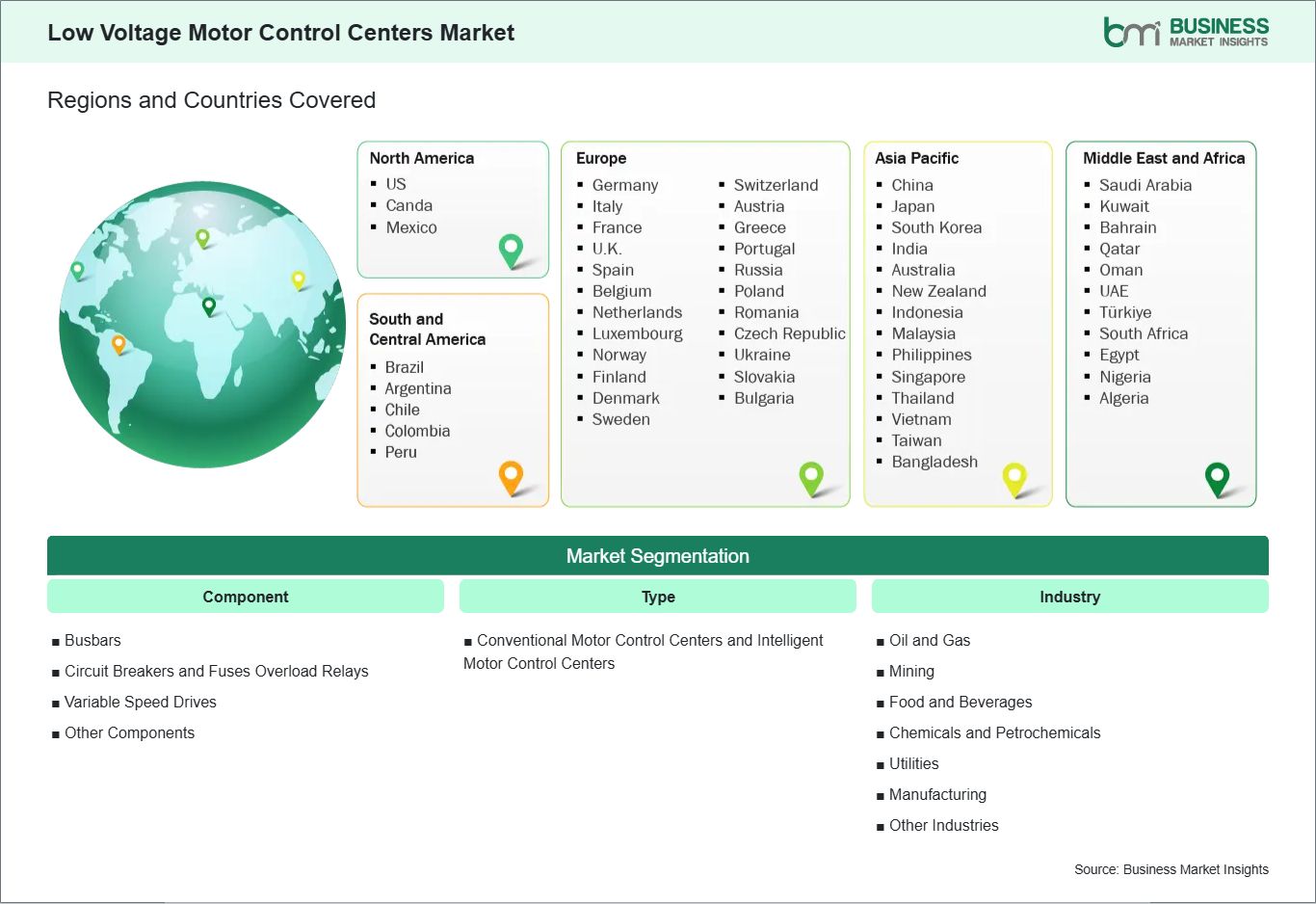
- By Component, the market is segmented into Busbars, Circuit Breakers and Fuses Overload Relays, Variable Speed Drives, and Others.
- By Type, the market is divided into Conventional Motor Control Centers and Intelligent Motor Control Centers.
- By Industry, the market is categorized into Oil and Gas, Mining, Food and Beverages, Chemicals and Petrochemicals, Utilities, Manufacturing, and Others.
Market Forces
Low Voltage Motor Control Centers Market Drivers and Opportunities
Advancing Industrial Automation and Intelligent Motor Management
The primary driver for the Low Voltage Motor Control Centers (LV MCC) Market is the accelerating global adoption of industrial automation and the subsequent transition toward intelligent motor management. As heavy industries such as oil and gas, mining, and water treatment strive for higher productivity with reduced human intervention, LV MCCs have evolved from simple motor starters into sophisticated command hubs that integrate seamlessly with Industry 4.0 ecosystems. This shift is particularly evident in the surging demand for Intelligent Motor Control Centers (iMCCs), which utilize digital relays and communication protocols like EtherNet/IP and Modbus to provide real-time diagnostic data. Furthermore, the global push for energy efficiency is a non-discretionary driver; the integration of Variable Frequency Drives (VFDs) and soft starters within LV MCCs is essential for meeting stringent IE4 and IE5 efficiency mandates. The expansion of utility infrastructure and the electrification of large-scale industrial assets in emerging economies ensure a steady, high-volume growth path for these critical power distribution systems.
Digital Twins and Remote Predictive Diagnostics
A significant high-value opportunity lies in the convergence of Low Voltage MCCs with Digital Twin technology and AI-driven analytics. By creating a virtual replica of the MCC, operators can simulate stress-test scenarios and fault conditions before physical implementation, significantly reducing onsite startup times and commissioning risks. There is also a major growth frontier in the adoption of cloud-based remote diagnostics and predictive maintenance. Next-generation "connected" MCCs can detect early signs of bearing wear, insulation decay, and harmonic distortion weeks before a potential failure occurs, allowing maintenance teams to intervene proactively and eliminate costly unplanned downtime.
Furthermore, the rise of the renewable energy sector, including wind and solar farms, presents a lucrative opportunity for MCCs designed to manage tracking motors and auxiliary balance-of-plant equipment. Manufacturers who focus on modular, arc-flash resistant designs that prioritize personnel safety while offering "plug-and-play" scalability for brownfield retrofits are positioned to lead the market into an increasingly digitalized and secure industrial landscape.
Size and Share Analysis
Low Voltage Motor Control Centers Market Size and Share Analysis
The Low Voltage Motor Control Centers market demonstrates steady growth, with size and share analysis revealing evolving trends and competitive positioning among key players. The report further examines subsegments categorized within component, type, and industry, offering insights into their contribution to overall market performance.
Based on component, the Busbars subsegment holds a significant market share. Busbars are indispensable for providing a robust and compact power distribution spine within the enclosure, replacing traditional complex wiring. A notable trend in 2026 is the adoption of phase-segregated and insulated busbar systems that enhance arc-flash protection and reduce energy losses. These innovations are particularly vital in the Data Centers and Utilities sectors, where maintaining continuous power availability and thermal efficiency is a primary operational requirement to prevent costly downtime.
Report Coverage
Low Voltage Motor Control Centers Market Report Coverage and Deliverables
The "Low Voltage Motor Control Centers Market Size and Forecast (2022 - 2033)" report provides a detailed analysis of the market covering below areas:
- Low Voltage Motor Control Centers market size and forecast at global, regional, and country levels for all the key market segments covered under the scope
- Low Voltage Motor Control Centers market trends, as well as market dynamics such as drivers, restraints, and key opportunities
- Low Voltage Motor Control Centers market analysis covering key market trends, global and regional framework, major players, regulations, and recent market developments
- Industry landscape and competition analysis covering market concentration, heat map analysis, prominent players, and recent developments for the Low Voltage Motor Control Centers market
- Detailed company profiles, including SWOT analysis
Geographic Insights
Low Voltage Motor Control Centers Market Geographic Insights
The geographical scope of the Low Voltage Motor Control Centers market report is divided into five regions: North America, Asia Pacific, Europe, Middle East & Africa, and South & Central America.
The Asia-Pacific Low Voltage Motor Control Centers Market is segmented into China, Japan, South Korea, India, Australia, New Zealand, Indonesia, Malaysia, the Philippines, Singapore, Thailand, Vietnam, Taiwan, Bangladesh, and the Rest of Asia. This region is the fastest-growing market globally. The expansion is primarily fueled by rapid urbanization and the proliferation of "Smart Factory" initiatives that integrate cloud-based analytics with motor control hardware. India and China lead the regional growth, supported by a burgeoning manufacturing sector and significant investments in renewable energy integration, which necessitate flexible and high-efficiency power distribution solutions.
Growth is further bolstered by a significant shift toward intelligent motor control models among process industries looking to reduce unplanned downtime through predictive maintenance. The integration of IoT sensors and Ethernet-based communication protocols into MCC buckets, alongside the rising demand for arc-flash safety and energy-efficient Variable Speed Drives (VSDs), solidifies Asia-Pacific as a critical hub for innovation and the future scaling of the Low Voltage Motor Control Centers industry.
Industry Activity
Recent Developments
The Low Voltage Motor Control Centers market is evaluated by gathering qualitative and quantitative data post primary and secondary research, which includes important corporate publications, association data, and databases. A few of the key developments in the Low Voltage Motor Control Centers market are:
- In April 2024, Rockwell Automation introduced its new FLEXLINE™ 3500 low voltage motor control center (MCC) for IEC markets globally at Hannover Messe 2024. The FLEXLINE 3500 is designed to integrate motor control and power distribution into a centralized, modular solution suitable for diverse industrial applications, including food &beverage, oil &gas, and manufacturing.
- In May 2024, Eaton completed the acquisition of Exertherm , a UK-based provider of continuous thermal monitoring solutions for electrical equipment. Exertherm's technology, which is deployed in low-voltage MCCs, switchgear, and busways, will be integrated into Eaton's Brightlayer software, enhancing operational insights, reliability, and safety across industrial and data center applications. This acquisition strengthens Eaton's portfolio in intelligent power management and represents a positive development for the low-voltage MCC market.
Trust & Transparency
Research Methodology
The market analysis combines proprietary research with secondary data from government agencies, company disclosures, regulatory filings, industry databases and expert interviews. Market estimates are validated through data triangulation, cross-market benchmarking and analyst
review.
View Full Research Methodology
Key Sources Referred:
World Bank - Global Trade Indicators World Trade Organization (WTO) International Monetary Fund (IMF) International Trade Administration (ITA) Company website Company annual reports Company investor presentations