Market Summary
Executive Summary and Global Market Analysis
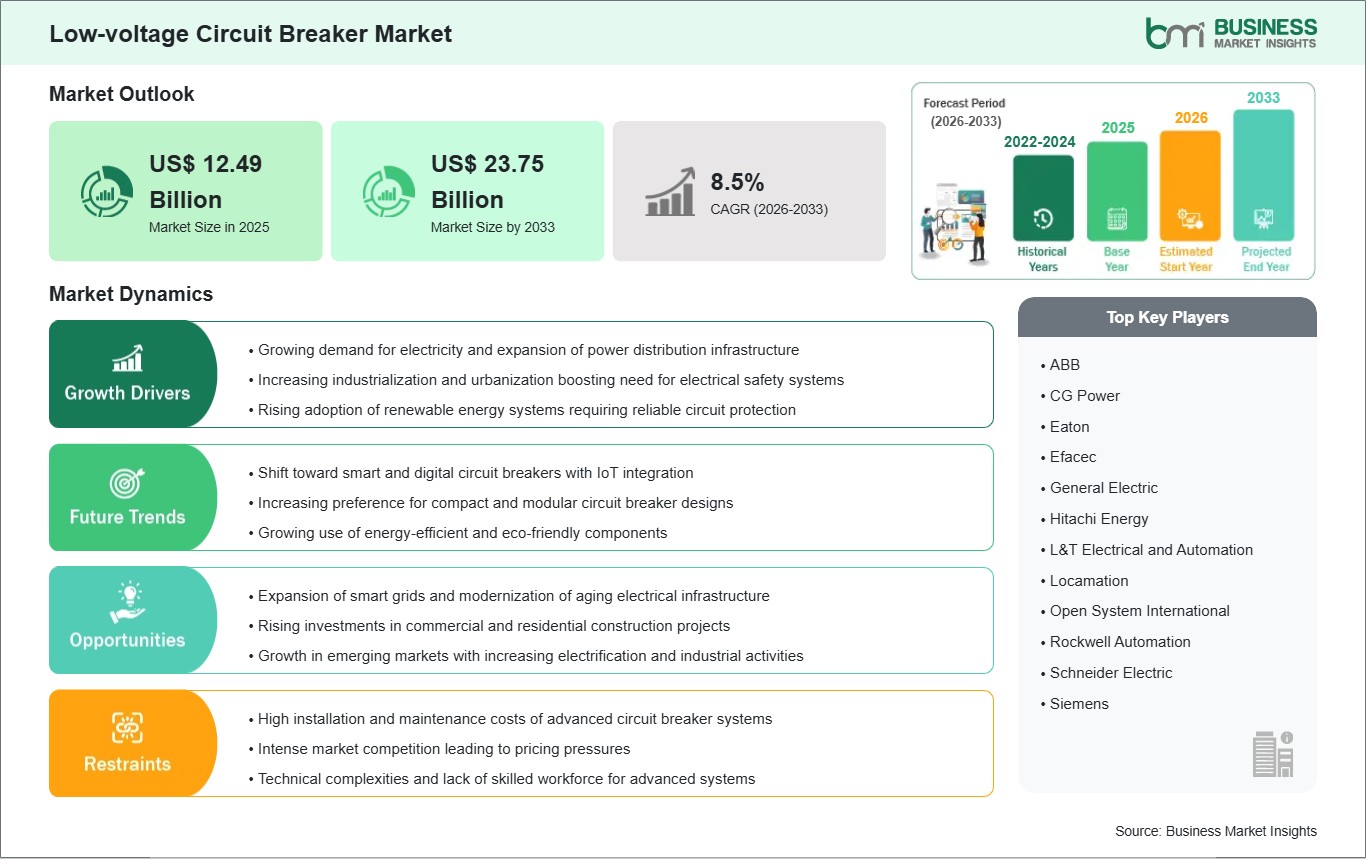
Low-voltage circuit breakers refer to automated electrical switching devices engineered to protect electrical circuits from damage caused by overcurrent, overloads, or short circuits in systems operating at low voltage levels. These components are essential for safeguarding electrical infrastructure across residential, commercial, and industrial sectors, ensuring the operational integrity of lighting, power distribution, and motor control circuits. Market expansion is being propelled by the global surge in infrastructure modernization and urbanization, which necessitates the installation of advanced circuit protection in new buildings and aging electrical grids, and by the rapid integration of renewable energy sources and electric vehicle charging infrastructure.
However, several factors may restrain market progression. Volatility in the prices of key raw materials, such as copper, silver, and specialized engineering plastics, can significantly impact the manufacturing costs and final pricing of these devices. The industry also faces challenges related to technical complexity and high initial investment, particularly as the transition toward smart, IoT-enabled breakers requires sophisticated microprocessor integration and complex retrofitting procedures for existing installations. Additionally, a lack of globally harmonized standards, especially for newer direct current (DC) protection technologies, can create interoperability hurdles and regulatory uncertainty for manufacturers operating across multiple regions. These challenges increase the total cost of ownership and require significant strategic investment in research and specialized maintenance capabilities.
Despite these hurdles, the market outlook remains favorable. Opportunities are emerging through the adoption of Industry 4.0 and digital transformation, where smart circuit breakers equipped with remote monitoring and predictive analytics enable real-time energy management and proactive fault detection. The expansion of the data center and battery energy storage sectors is gaining traction, as these facilities require high-density, reliable circuit protection to manage critical digital loads and energy flows. Furthermore, the growth of green manufacturing and sustainable building practices, supported by stringent electrical safety regulations, aligns with institutional mandates for improved energy efficiency and reduced fire hazards. Advanced techniques such as solid-state and hybrid circuit breaking are also expanding capabilities, allowing for faster interruption speeds and enhanced reliability in safety-critical applications. Collectively, these innovations position the low-voltage circuit breaker industry for sustained long-term development and central importance in the global transition toward a more electrified and intelligent energy landscape.
Low-voltage Circuit Breaker Market Segmentation Analysis:
Segment Analysis
Low-voltage Circuit Breaker Market Segmentation
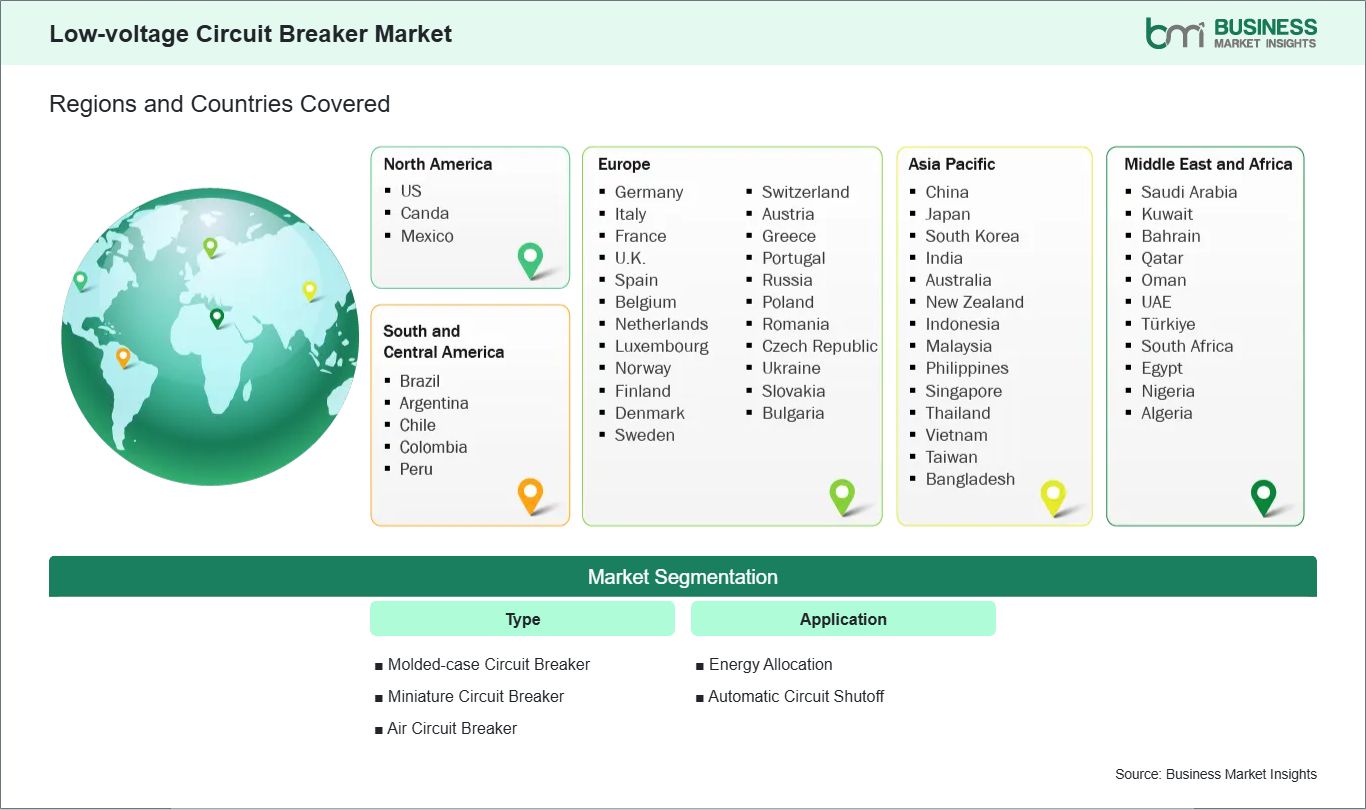
Key segments that contributed to the derivation of the Low-voltage Circuit Breaker market analysis are type and application.
- By Type, the market is segmented into Molded-case Circuit Breaker, Miniature Circuit Breaker, and Air Circuit Breaker.
- By Application, the market is divided into Energy Allocation and Automatic Circuit Shutoff.
Market Forces
Low-voltage Circuit Breaker Market Drivers and Opportunities
Rising Demand for Reliable Power Distribution and Safety Compliance
A primary driver for the low-voltage circuit breaker market is the growing need for reliable power distribution and enhanced electrical safety across residential, commercial, and industrial applications. Circuit breakers play a vital role in safeguarding electrical systems from overloads and short circuits, ensuring uninterrupted operations while reducing risks of fire, equipment damage, and costly downtime. The rapid pace of urbanization and industrialization worldwide is accelerating demand for modern electrical infrastructure, while the expansion of renewable energy projects and smart grids is further reinforcing adoption. Governments and regulatory authorities are mandating stricter safety standards, compelling utilities and enterprises to replace outdated systems with advanced circuit breaker technologies. Moreover, the rising penetration of electric vehicles and the rollout of charging infrastructure are creating new requirements for low-voltage protection solutions. Collectively, safety compliance, infrastructure modernization, and energy transition initiatives are propelling sustained growth in the global low-voltage circuit breaker market, positioning it as a cornerstone of future-ready electrical networks.
Advancing Smart Technologies and Opportunities in Emerging Power Markets
A significant opportunity in the low-voltage circuit breaker market lies in the integration of smart technologies, digital monitoring, and adoption across emerging economies. Modern circuit breakers equipped with IoT connectivity, sensors, and predictive analytics allow real-time monitoring of electrical loads, enabling proactive maintenance and reducing downtime. The convergence of smart grids with advanced circuit protection is creating new pathways for energy efficiency and sustainability. Industrial automation and data centers are also driving demand for intelligent breakers that can handle complex load management. Beyond technological innovation, emerging markets in Asia-Pacific, Africa, and Latin America present lucrative prospects due to rapid electrification, infrastructure development, and government-led investments in power distribution networks. Vendors who focus on developing cost-effective, digitally enabled, and energy-efficient solutions tailored for diverse applications are well-positioned to capture new market segments. The integration of smart technologies, predictive analytics, and regional expansion underscores a transformative growth trajectory for the global low-voltage circuit breaker market.
Size and Share Analysis
Low-voltage Circuit Breaker Market Size and Share Analysis
The Low-voltage Circuit Breaker market demonstrates steady growth, with size and share analysis revealing evolving trends and competitive positioning among key players. The report examines subsegments categorized within type and application, offering insights into their contribution to overall market performance.
Based on Type, the Molded‑case Circuit Breaker (MCCB) subsegment holds the primary market presence. These breakers are indispensable due to their adaptability, cost‑efficiency, and robust protection mechanisms, making them highly suitable for residential and light industrial environments. Their compact design and reliable performance ensure consistent safeguarding against overloads and short circuits, reinforcing their role as a foundational solution in electrical distribution. The Miniature Circuit Breaker (MCB) subsegment is essential for household and small‑scale applications, providing precise protection in low‑current systems.
Report Coverage
Low-voltage Circuit Breaker Market Report Coverage and Deliverables
The "Low-voltage Circuit Breaker Market Size and Forecast (2022 - 2033)" report provides a detailed analysis of the market covering below areas:
- Market size and forecast at global, regional, and country levels for all market segments covered under the scope
- Market trends, as well as drivers, restraints, and opportunities
- Market analysis covering key trends, global and regional framework, major players, and recent developments
- Market concentration, heat map analysis, prominent players, and recent developments
- Detailed company profiles, including SWOT analysis
Geographic Insights
Low-voltage Circuit Breaker Market Geographic Insights
The geographical scope of the Low-voltage Circuit Breaker market report is divided into five regions: North America, Asia Pacific, Europe, Middle East & Africa, and South & Central America.
North America holds a prominent position within the global industry, driven by an extensive mandate for grid modernization and the aggressive integration of renewable energy sources. The regional landscape is defined by the transition toward Intelligent Electrical Architectures, where traditional protective devices are being replaced by smart, IoT-enabled circuit breakers that provide real-time diagnostics and remote monitoring capabilities. This shift is particularly pronounced in the United States, where aging utility infrastructure and the rising frequency of extreme weather events have necessitated significant institutional investment in grid resilience and automated fault isolation systems. Technological progression in the region is further catalyzed by the rapid expansion of Digital Infrastructure and Data Centers, which require high-density power distribution and superior circuit protection to ensure uninterrupted operations. Recent developments involve the deployment of advanced Air Circuit Breakers (ACBs) and Molded Case Circuit Breakers (MCCBs) that are optimized for the high fault currents and dynamic load profiles characteristic of hyperscale computing facilities. Furthermore, the burgeoning Electric Vehicle (EV) Charging Infrastructure network is creating a new frontier for low-voltage protection, requiring specialized breakers that can handle rapid switching and high-power DC charging loads while maintaining stringent safety standards in both public and residential environments.
Industry Activity
Recent Developments
The Low-voltage Circuit Breaker market is evaluated by gathering qualitative and quantitative data post primary and secondary research, which includes important corporate publications, association data, and databases. A few of the key developments in the Low-voltage Circuit Breaker market are:
- In February 2026, Zhejiang Chuangqi Electric Co., Ltd. (CHAC Electric) launched the CQM6 Series molded case circuit breakers (MCCBs), featuring breaking capacities up to 75kA and rated currents up to 1250A. The compact, modular design supports industrial automation and smart grid applications, strengthening the company`s position in the global low-voltage circuit protection market.
- In October 2025, HD Hyundai Electric secured UL and cUL certifications for its molded case circuit breakers (MCCBs) and other low- and medium-voltage circuit breakers, strengthening its position in the North American market. The company also announced plans to double its annual production capacity to approximately 13 million units with a new smart manufacturing facility in Cheongju, supporting its expansion in the power distribution equipment segment.
Trust & Transparency
Research Methodology
The market analysis combines proprietary research with secondary data from government agencies, company disclosures, regulatory filings, industry databases and expert interviews. Market estimates are validated through data triangulation, cross-market benchmarking and analyst
review.
View Full Research Methodology
Key Sources Referred:
World Bank & Global Trade IndicatorsWorld Trade Organization (WTO)(International Monetary Fund )IMFInternational Trade Administration (ITA)Company websiteCompany annual reportsCompany investor presentations