Market Summary
Executive Summary and Global Market Analysis
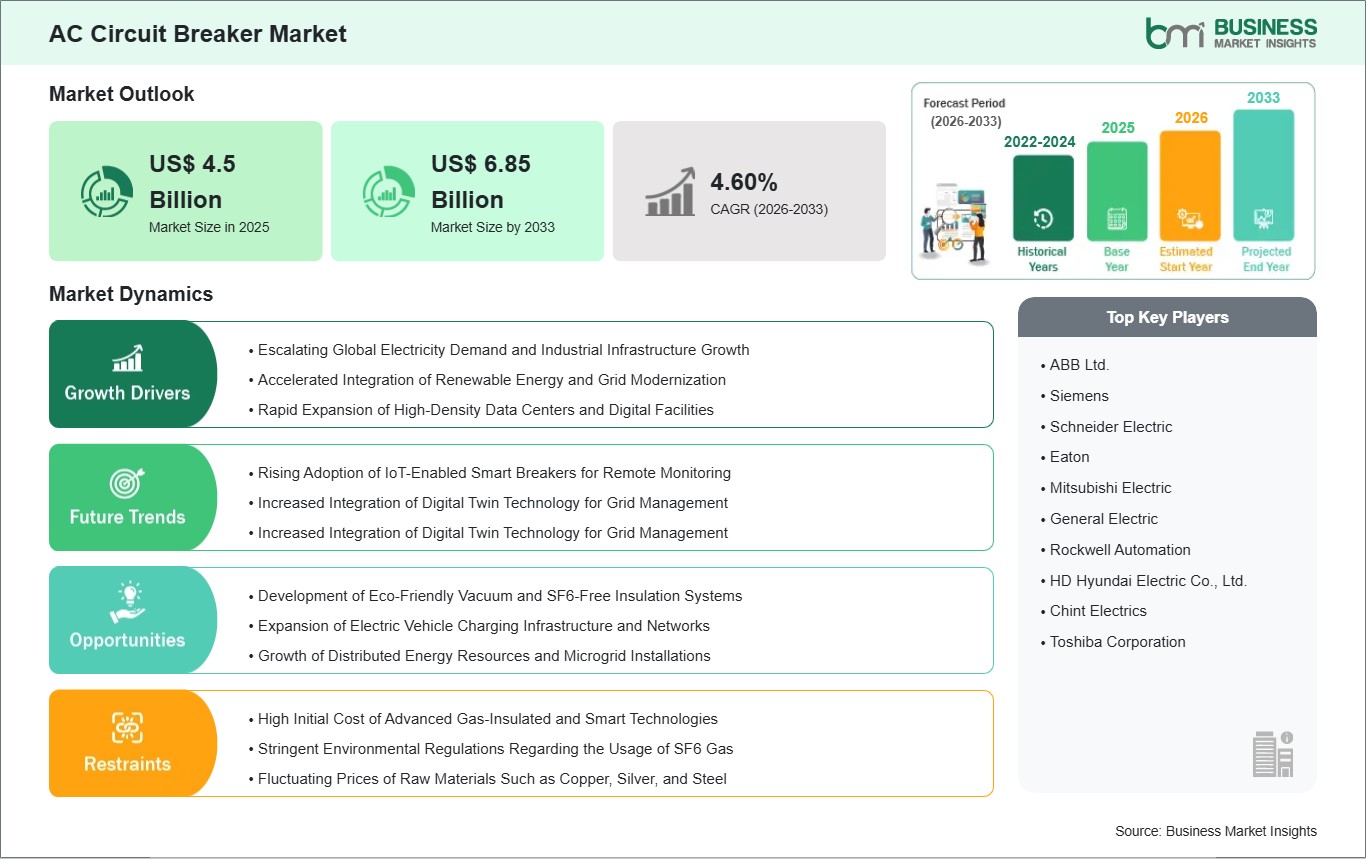
AC circuit breakers play a critical role in the protection and control of electrical power systems, offering reliable interruption of current flow during faults such as overloads or short circuits. They are essential for industries such as utilities, manufacturing, construction, renewable energy, and transportation. AC circuit breakers have several advantages, including high interrupting capacity, rapid response times, and the ability to be reset and reused after a fault. Increasing global electricity demand, the rapid expansion of smart grid infrastructure, and the growing integration of renewable energy sources into the power grid are fueling the market. Additionally, innovations in digital monitoring, IoT-enabled smart breakers, and eco-friendly insulation materials are enhancing service efficiency and reliability.
However, several challenges can restrain market growth, such as high initial installation costs, limited availability of space in urban substations, and stringent environmental regulations regarding the use of SF6 gas. The industry is also sensitive to fluctuations in raw material prices and disruptions in global supply chains. Despite these hurdles, the market holds significant opportunities driven by the rising demand for distributed energy resources (DERs), the modernization of aging grid infrastructure in developed countries, and increased adoption of digital management solutions. Investment in vacuum-based and F-gas-free technologies is also expected to open new avenues for market expansion.
Segment Analysis
AC Circuit Breaker Market Segmentation
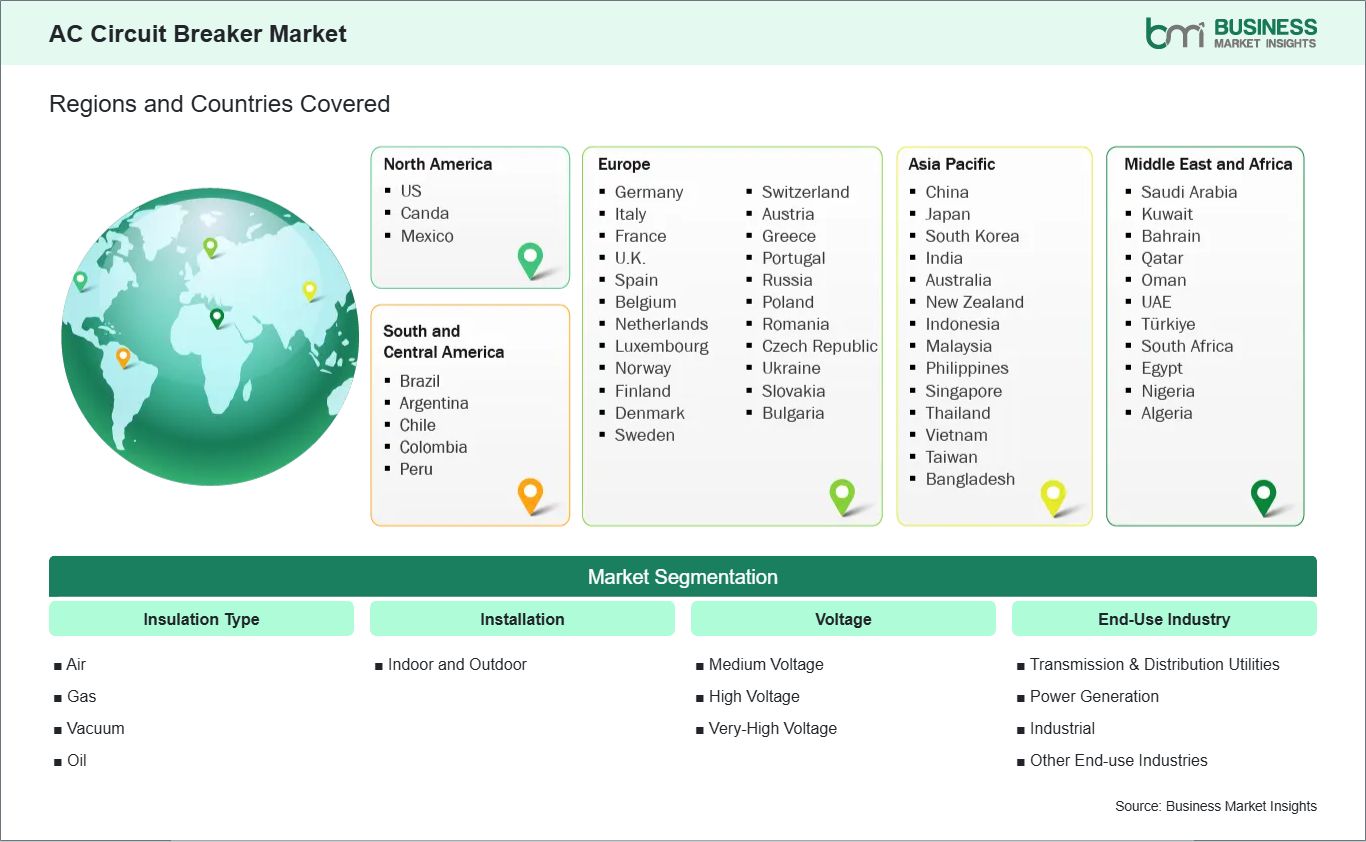
Key segments that contributed to the derivation of the AC circuit breaker market analysis are insulation type, installation, voltage, and end-use industry.
- By Insulation Type, the market is segmented into Air, Gas, Vacuum, and Oil.
- By Installation, the market is divided into Indoor and Outdoor.
- By Voltage, the market is categorized into Medium Voltage, High Voltage, and Very-High Voltage.
- By End-Use Industry (Application), the market is categorized into Transmission &Distribution Utilities, Power Generation, Industrial, and Others.
Market Forces
AC Circuit Breaker Market Drivers and Opportunities
Escalating Global Electricity Demand and Industrial Infrastructure Expansion
The primary driver for the AC circuit breaker market is the relentless surge in global electricity consumption, fueled by rapid industrialization and the digitalization of the global economy. As emerging nations expand their manufacturing sectors and developed economies transition toward high-density data centers for AI and cloud computing, the strain on electrical distribution systems has reached unprecedented levels. This demand necessitates the installation of robust AC circuit breakers to prevent catastrophic equipment failure and ensure operational continuity.
The global power demand is projected to grow, particularly in energy-intensive sectors like automotive and electronics. Furthermore, the rise of the "Smart Factory" and Industry 4.0 requires specialized, high-performance breakers capable of handling complex load profiles and frequent switching cycles. These devices are no longer mere safety components; they are essential assets for protecting high-value industrial machinery and mission-critical infrastructure. As countries continue to build new residential complexes and commercial hubs to accommodate growing urban populations, the requirement for reliable low-voltage and medium-voltage AC protection solutions is expected to maintain a strong upward trajectory.
Accelerated Integration of Renewable Energy and Grid Modernization Initiatives
The global shift toward decarbonization has created a monumental opportunity for the AC circuit breaker market, particularly through the integration of renewable energy sources and the modernization of aging power grids. As solar and wind power become dominant contributors to the energy mix, traditional unidirectional grids are being replaced by complex, bidirectional smart grids.
These modern networks require advanced AC circuit breakers with digital monitoring and IoT capabilities to manage the inherent intermittency of renewable generation. This transition allows manufacturers to develop "intelligent" breakers that provide real-time data on grid health and predictive maintenance alerts, significantly reducing downtime for utility providers. Additionally, the massive movement toward the electrification of transportation, specifically the deployment of global EV charging infrastructure, presents a new, high-growth application for AC circuit protection. Utilities in North America and Europe are currently investing billions in retrofitting substations with eco-friendly, vacuum-based breakers to replace older greenhouse-gas-emitting models. This wave of "green" grid modernization, supported by government subsidies and net-zero mandates, offers a lucrative avenue for innovation in SF6-free technologies, positioning forward-thinking companies to capture significant market share in the coming decade.
Size and Share Analysis
AC Circuit Breaker Market Size and Share Analysis
The AC circuit breaker market demonstrates steady growth, with size and share analysis revealing evolving trends and competitive positioning among key players. The report further examines subsegments categorized within insulation type, installation, voltage, and end-use industry, offering insights into their contribution to overall market performance.
Based on insulation type, vacuum circuit breakers are typically used for medium-voltage applications where environmental friendliness and long service life are high priorities. This segment is widely utilized across various industries due to its reliability and low maintenance requirements.
By installation, the outdoor circuit breakers subsegment involves the movement of power across long-distance transmission lines and plays a vital role in supporting rural electrification and large-scale renewable projects. This segment benefits from increasing globalization and the expansion of national grids.
In terms of end-use industry, the Transmission &Distribution (T&D) Utilities utilize circuit breakers for protecting the backbone of the electrical grid, requiring strict handling of very-high voltage loads to ensure timely delivery of power to end consumers.
Report Coverage
AC Circuit Breaker Market Report Coverage and Deliverables
The "AC Circuit Breaker Market Size and Forecast (2022 - 2033)" report provides a detailed analysis of the market covering below areas:
- AC circuit breaker market size and forecast at global, regional, and country levels for all the key market segments covered under the scope.
- AC circuit breaker market trends, as well as market dynamics such as drivers, restraints, and key opportunities.
- AC circuit breaker market analysis covering key market trends, global and regional framework, major players, regulations, and recent market developments.
- Industry landscape and competition analysis covering market concentration, heat map analysis, prominent players, and recent developments for the AC Circuit Breaker Market.
- Detailed company profiles, including SWOT analysis.
Geographic Insights
AC Circuit Breaker Market Geographic Insights
The geographical scope of the AC circuit breaker market report is divided into five regions: North America, Asia Pacific, Europe, Middle East &Africa, and South &Central America.
The Asia-Pacific AC circuit breaker market is segmented into China, Japan, South Korea, India, Australia, and others. The region is experiencing robust growth, driven by the rapid expansion of cross-border infrastructure, growing international trade volumes, and rising demand for time-sensitive energy services. Major economies like China and India are leading the way, fueled by increasing industrial output and strategic logistics investments.
The region is also witnessing increased adoption of advanced technologies, including AI-based monitoring and digital switchgear, particularly relevant for sectors like data centers and heavy manufacturing. Capacity expansion, alongside fleet modernization efforts by regional utilities, is enhancing operational efficiency and reducing downtime. Additionally, the surge in manufacturing activity and the growth of express delivery networks for high-tech components are positioning Asia-Pacific as a key hub in the global power ecosystem.
Industry Activity
Recent Developments
The AC circuit breaker market is evaluated by gathering qualitative and quantitative data post primary and secondary research, which includes important corporate publications, association data, and databases. A few of the key developments in the AC circuit breaker market are:
- In July 2025, ABB announced that to revealed the next generation of its flagship air circuit breaker, the SACE Emax 3. Aimed at large facilities with high power demands, including data centers, advanced manufacturing sites, and critical infrastructure, including hospitals and airports, the innovative Emax 3 is designed to address increased concerns about grid stability, cybersecurity, and the surging power needs of Artificial Intelligence (AI) in data centers.
- In October 2024, Schneider Electric announced the launch of the MasterPacT MTZ Active, a revolutionary new circuit breaker designed to set new benchmarks for safety, efficiency, and sustainability while ensuring business continuity. In a world increasingly driven by electricity and digitization, MasterPacT MTZ Active enables customers to respond to complex daily challenges, including 24/7 uptime demands, spiraling energy costs, and urgent calls for sustainable practices.
Trust & Transparency
Research Methodology
The market analysis combines proprietary research with secondary data from government agencies, company disclosures, regulatory filings, industry databases and expert interviews. Market estimates are validated through data triangulation, cross-market benchmarking and analyst
review.
View Full Research Methodology
Key Sources Referred:
World Bank - Global Trade IndicatorsWorld Trade Organization (WTO)International Monetary Fund (IMF)International Trade Administration (ITA)Company websiteCompany annual reportsCompany investor presentations