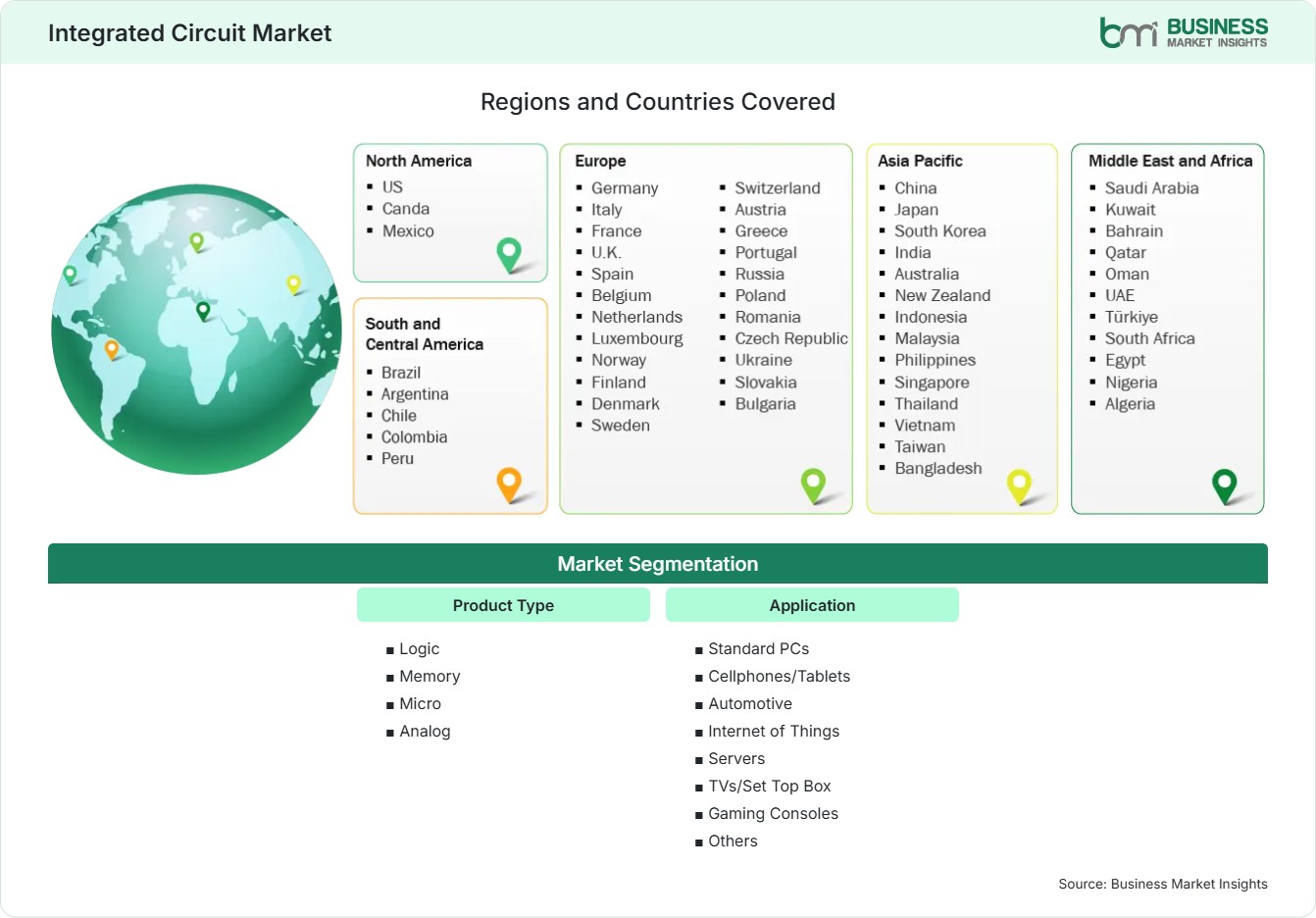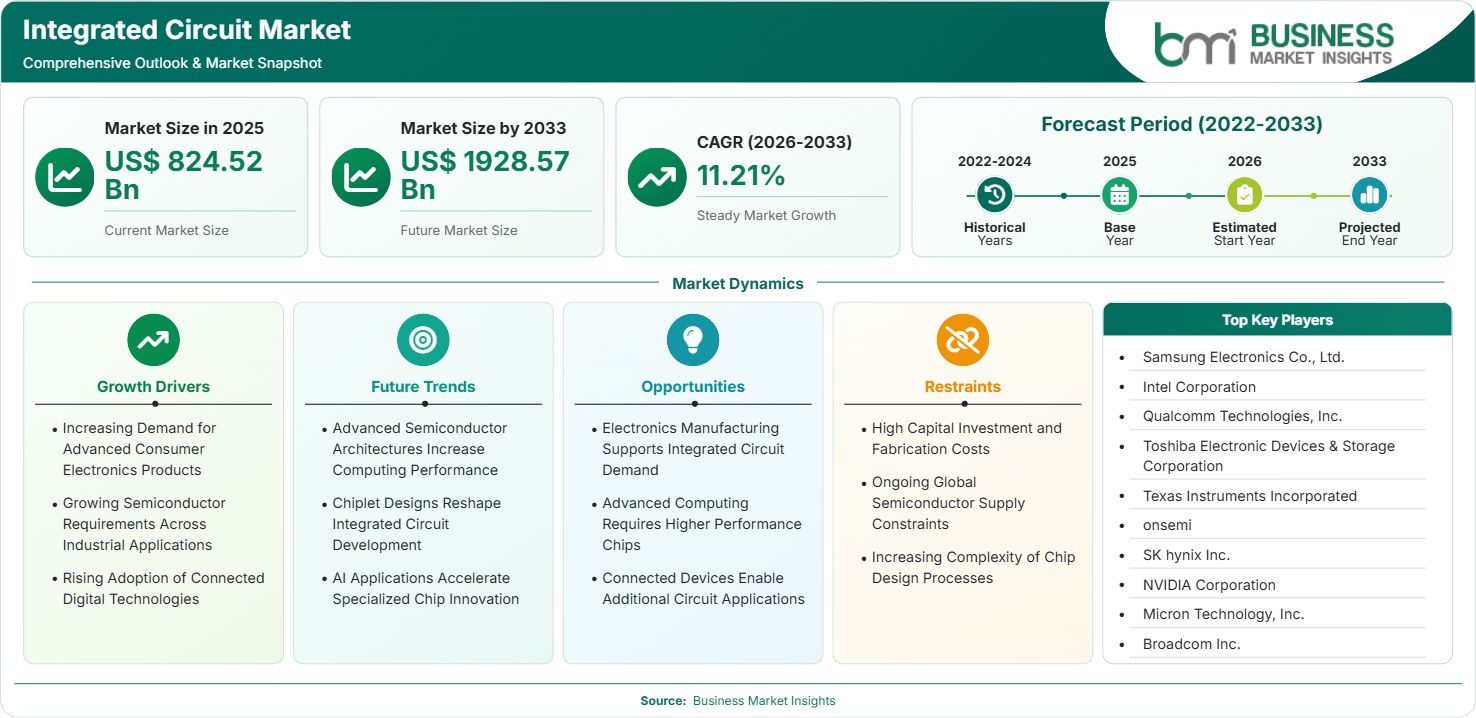
Integrated Circuit Market Regional Highlights
North America Integrated Circuit Market
North America accounts for 27%–30% of 2025 revenue and is projected to expand at a 10%–12% CAGR through 2033. The area has an advantage due to its leadership in chip architecture, AI accelerators, cloud computing, EDA software, and valuable semiconductor tools. The market share is concentrated in the USA, which offers government incentives to boost the local supply chain and production capacity. The robust hyperscaler capex drives the demand for logic and memory. The Integrated Circuit Market growth outlook remains tied to packaging availability, skilled labor, and commercialization of new fabrication technologies.
- AI infrastructure spending is increasing demand for accelerators, networking processors, server CPUs, and high-bandwidth memory, encouraging deeper collaboration between chip designers, foundries, memory suppliers, and advanced packaging providers across the regional ecosystem.
- U.S. industrial policy is strengthening domestic fabrication and research capabilities, although long construction timelines and workforce shortages can delay capacity utilization and increase the strategic value of existing qualified manufacturing infrastructure.
- Defense, aerospace, healthcare, and industrial automation create resilient demand for specialized and long-lifecycle devices, helping diversify regional exposure beyond consumer electronics and supporting investments in trusted, secure semiconductor supply chains.
- Cloud providers increasingly commission custom silicon for specific workloads, creating opportunities for IP licensors, design-service firms, packaging specialists, and foundries capable of delivering differentiated performance, efficiency, and faster product qualification.
US Integrated Circuit Market
The United States represents 78%–82% of the North American Integrated Circuit Market demand in 2025 and is expected to grow at a 10%–12% CAGR through 2033. Its power lies in the presence of leaders in fabless design, hyperscale cloud providers, semiconductor equipment experience, and increased domestic manufacturing investment. AI-driven data centers are changing buying preferences for accelerators, network processors, CPUs, and memory systems. Manufacturing incentives by the federal government help the visibility of investments, while export controls lead to changes in the value chain structure.
- Generative and agentic AI workloads are increasing demand for compute density, memory bandwidth, and interconnect performance, pushing suppliers toward application-specific architectures and tighter integration between processors, accelerators, memory, and networking components.
- Domestic capacity projects support supply resilience, but economic success depends on sustained utilization, competitive process technology, reliable equipment supply, and sufficient technical talent across engineering, operations, maintenance, and packaging functions.
- Automotive electrification and defense modernization broaden demand for analog, power-management, microcontroller, sensing, and secure processing solutions, creating a more diversified application base than the region's highly visible AI infrastructure cycle.
- Custom chips designed by cloud and technology companies could reshape supplier relationships, favoring companies that combine design flexibility, advanced IP, software optimization, and scalable manufacturing partnerships over standardized product portfolios.
Europe Integrated Circuit Market
Europe holds a 7%–9% Integrated Circuit Market share in 2025 and is forecast to register an 8%–10% CAGR during 2026–2033. Demand is driven by automotive, industrial, and power electronics applications in Germany. Design and production capabilities are offered by France, the Netherlands, and Ireland. Germany is the largest national market, whereas Ireland and France offer better prospects for growth through investments in technology infrastructure. Growth in the region focuses on resilience of supply, automotive reliability, and energy-efficient components. Support from policies enhances strategic capabilities, despite dependency on advanced nodes.
- Automotive software-defined architectures are increasing semiconductor content per vehicle, especially for sensing, connectivity, electrification, driver assistance, and centralized computing, strengthening demand for specialized logic, analog, power, and microcontroller devices.
- Germany remains the principal volume opportunity, supported by automotive and industrial production, while France benefits from strategic electronics initiatives and Ireland from its concentration of technology investment and semiconductor manufacturing activity.
- European investment increasingly emphasizes mature and specialty nodes, power semiconductors, automotive devices, and research infrastructure, reflecting regional industrial strengths rather than direct competition across every leading-edge manufacturing segment.
- Energy efficiency regulations and electrification policies favor devices that reduce system losses and support intelligent power control, expanding opportunities for analog, embedded processing, sensors, and application-specific integrated solutions.
Asia Pacific Integrated Circuit Market
Asia Pacific commands 48%–52% of 2025 revenue and is projected to achieve the fastest regional CAGR of 12%–14% through 2033. Production and demand are based in China, South Korea, Taiwan, and Japan, whereas the semiconductor ecosystem is being extended into India and Southeast Asia. China continues to be the biggest consumption base, South Korea continues to invest in memory products, and India has great growth potential. The drive within the region comes from AI servers, smartphones, consumer electronics, foundries, and advanced packaging.
- AI infrastructure is accelerating purchases of advanced logic and memory, while established electronics manufacturing provides a broad installed customer base spanning smartphones, computers, appliances, industrial equipment, and connected consumer products.
- South Korea remains strategically important for memory innovation, particularly high-bandwidth products, while Taiwan's foundry ecosystem supports advanced logic production and China continues building greater domestic semiconductor capability across multiple product categories.
- India is emerging as a high-growth investment destination for design, assembly, testing, packaging, and manufacturing, supported by expanding electronics demand and government efforts to establish a more comprehensive domestic semiconductor ecosystem.
- Southeast Asian economies are gaining from supply-chain diversification, especially in assembly, testing, materials, and backend manufacturing, allowing multinational suppliers to distribute operational risk and access additional skilled manufacturing capabilities.
- Advanced packaging is becoming a regional competitive frontier because AI systems require greater bandwidth and denser integration, favoring ecosystems able to coordinate wafers, substrates, memory, testing, and system-level manufacturing at scale.
Rest of World Integrated Circuit Market
The share of the South and Central American market is relatively small; however, it is growing due to digitalization, cloud computing, connected infrastructure, and automotive manufacturing in Brazil and Mexico. The Rest of World market makes up 12% to 15% of the company’s revenue in 2025, and it is forecasted to grow at a CAGR of 9% to 11% through 2033.
Middle East and Africa demand is concentrated in data centers, telecommunications, industrial infrastructure, smart-city systems, and energy modernization. Israel provides a strong design ecosystem, while Gulf economies offer faster growth through digital infrastructure investment.
- Brazil and Mexico provide the strongest South and Central American opportunities through automotive production, industrial automation, consumer electronics, and growing cloud infrastructure that increases demand for processors, memory, connectivity, and power-management devices.
- Gulf states are accelerating data-center and AI investments, creating demand for high-performance computing hardware, networking silicon, memory, and energy-efficient infrastructure designed for high ambient temperatures and intensive workloads.
- Israel's established chip-design expertise strengthens the region's technology ecosystem, while Africa's longer-term opportunity centers on telecommunications, mobile connectivity, renewable-energy controls, and increasingly digital public and private infrastructure.
- Limited local fabrication means regional growth remains sensitive to exchange rates, trade policy, logistics, and imported component availability, increasing the importance of distributors, local design support, and resilient inventory strategies.