
Photonic Integrated Circuit Market Outlook: Size, Share, Trends, Growth Analysis, Competitive Landscape & Forecast, 2026–2033

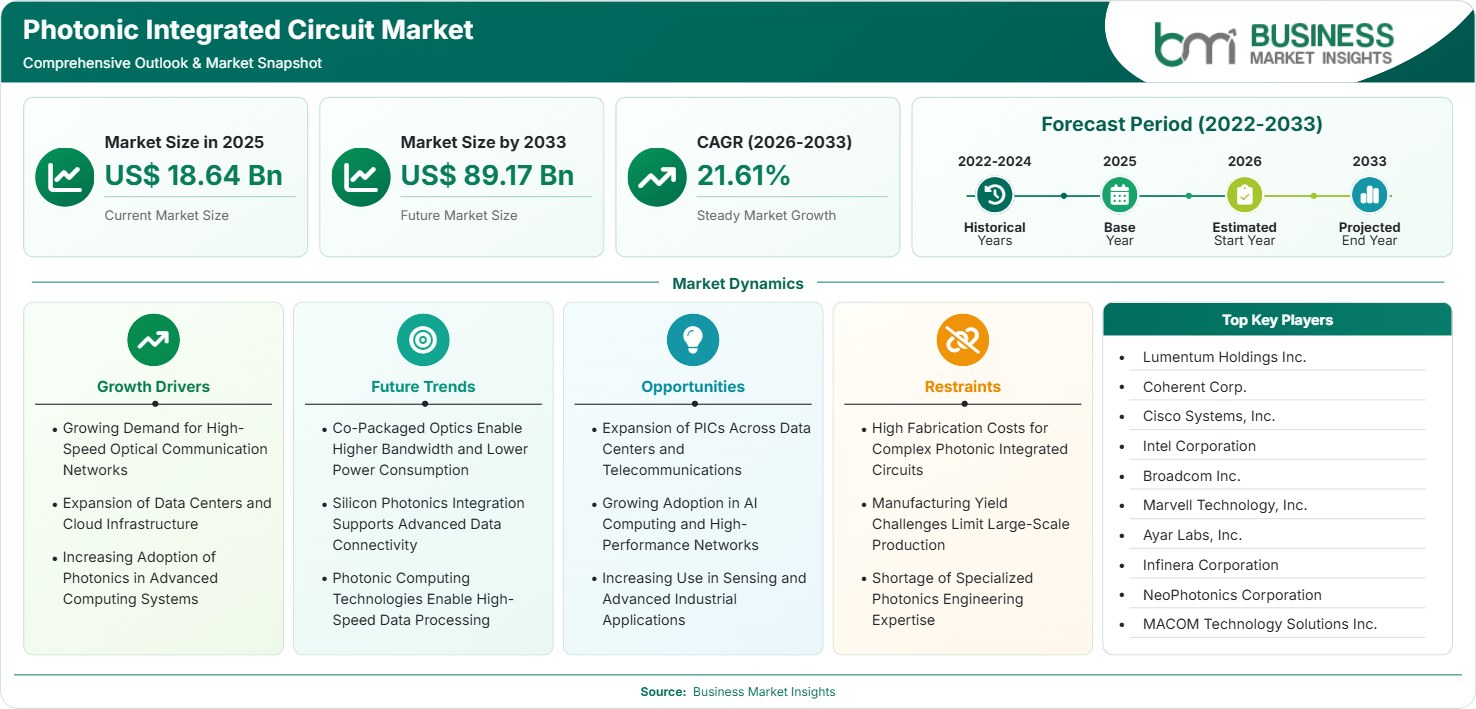
The Photonic Integrated Circuit Market size was valued at US$ 18.64 Billion in 2025 and is projected to reach US$ 89.17 Billion by 2033, growing at a CAGR of 21.61% during 2026–2033, driven by optical bandwidth requirements, AI infrastructure, and advanced computing applications.

Report Coverage
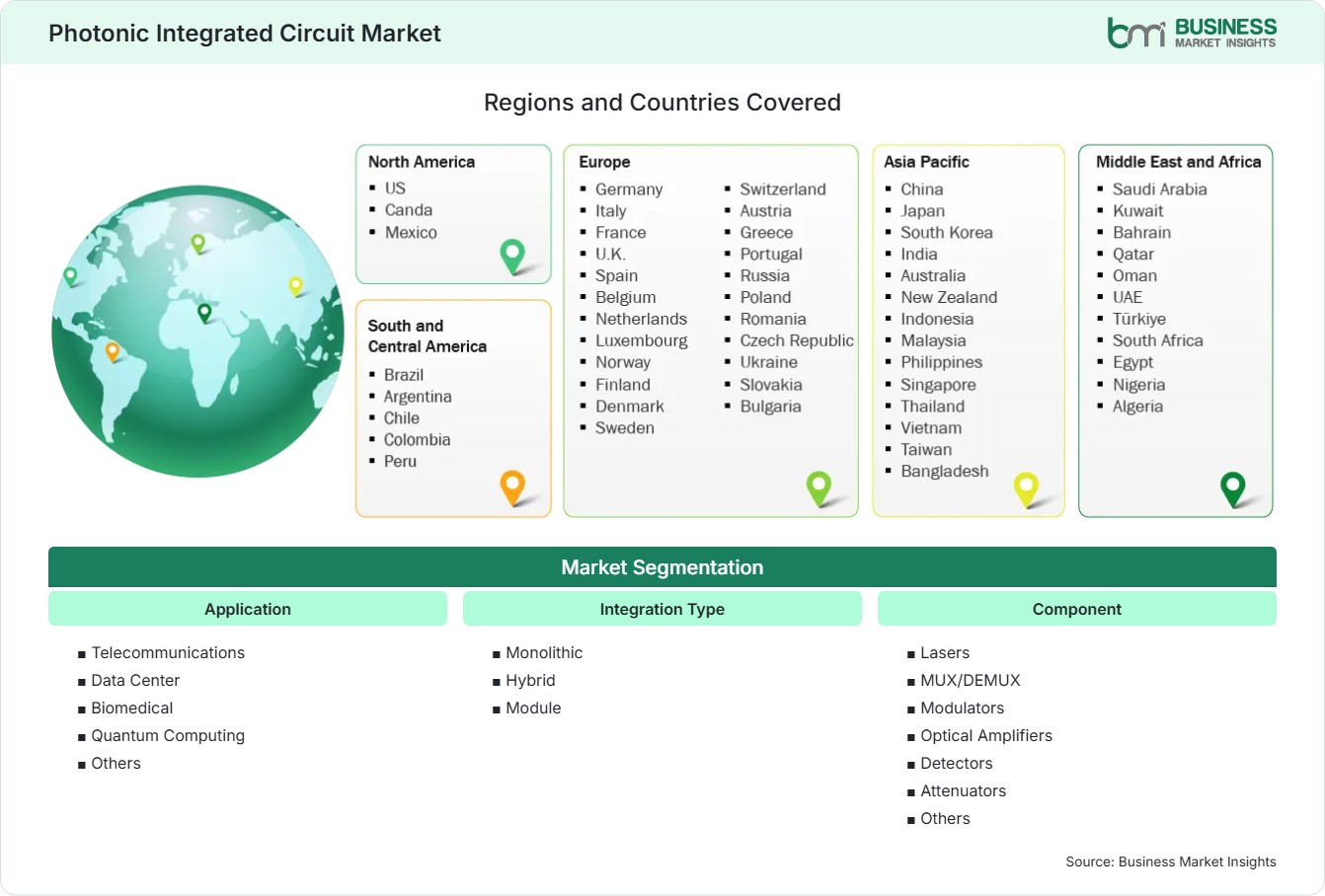
  • Application: Telecommunications, Data Center, Biomedical, Quantum Computing, Others
  • Integration Type: Monolithic, Hybrid, Module
  • Component: Lasers, MUX/DEMUX, Modulators, Optical Amplifiers, Detectors, Attenuators, Others
US$ 18.64 Bn Market size in 2025
US$ 89.17 Bn Market Size by 2033
21.61% CAGR, 2026 - 2033
2026-2033 Forecast Period

01 AI Overview

Photonic Integrated Circuit Market Summary

  • North America Region: North America holds a 32%–36% share in 2025 and grows at a 20.2%–22.0% CAGR during 2026–2033, supported by data center investment, optical networking, and photonics research. The US accounts for 78%–82% of regional demand, supported by optical networking, cloud computing, and advanced packaging, with a 20.5%–22.5% CAGR during 2026–2033.
  • Fastest Growing Region: Asia Pacific holds a 34%–38% share in 2025 and grows at a 22.5%–24.0% CAGR during 2026–2033, supported by semiconductor manufacturing, telecommunications upgrades, data center construction, electronics production, AI infrastructure, and increasing adoption of integrated optical technologies.
  • Leading Segment: Telecommunications holds a 38%–42% share in 2025 and grows at a 19.5%–21.0% CAGR during 2026–2033, supported by fiber network expansion, high-speed connectivity, optical transmission requirements, network capacity upgrades, and increasing demand for compact integrated photonic components.
  • High Growth Segment: Quantum Computing holds a 7%–10% share in 2025 and grows at a 26.0%–29.0% CAGR during 2026–2033, supported by photonic architectures, quantum communication, integrated optical control, research investment, and demand for scalable computing platforms.
  • Key Market Opportunity: Growing AI infrastructure requirements create opportunities for integrated optical interconnects, silicon photonics, co-packaged architectures, high-speed transceivers, optical computing, and energy-efficient data movement.
  • Major Market Players: Lumentum Holdings Inc., Coherent Corp., Cisco Systems, Inc., Intel Corporation, Broadcom Inc., Marvell Technology, Inc., Ayar Labs, Inc., Infinera Corporation, NeoPhotonics Corporation, MACOM Technology Solutions Inc.
02 Strategic Insights

Photonic Integrated Circuit Market: Strategic Insights

Photonic Integrated Circuit Market Strategic Framework
FREE PDF
Request your free sample
Request free sample
03 Stakeholder View

Key Takeaways

  • The value chain is becoming more integrated as photonic design, wafer fabrication, optical component manufacturing, packaging, testing, and system integration increasingly need to operate as coordinated processes.
  • Telecommunication continues to be the largest application segment, whereas the data centers and AI infrastructure offer increased incremental demand for high-bandwidth and low-power optical connectivity.
  • The technology development is now moving towards silicon photonics, hybrid integration, optical co-packaging, optical IO, modulators, and integrated optical sources.
  • Asia Pacific offers the strongest expansion potential because semiconductor manufacturing, telecommunications infrastructure, electronics production, and data center investment are developing in parallel.
  • Strategic investment is increasingly focused on manufacturing capacity, optical packaging, modulation technologies, photonic chiplets, and vertically integrated component portfolios, strengthening competitive positions across the supply chain.
  • Quantum computing, biomedical systems, sensing, and advanced industrial applications provide longer-term diversification opportunities as photonic integration moves beyond conventional communications and networking applications.
04 Geographic Outlook

Photonic Integrated Circuit Market Regional Highlights

North America Photonic Integrated Circuit Market

North America holds a 32%–36% share in 2025 and grows at a 20.2%–22.0% CAGR through 2033. The US represents the dominant portion of regional demand, while Canada contributes through telecommunications, research, and specialized photonics applications. The Photonic Integrated Circuit Market share remains supported by strong integration between chip development, optical systems, packaging, and data infrastructure.

  • Data center expansion is increasing demand for compact optical interconnects, integrated light engines, high-speed transceivers, and architectures that reduce electrical signaling distances within computing infrastructure.
  • Semiconductor and photonics development capabilities support domestic design, fabrication, packaging, and testing, helping companies shorten development cycles and improve control over strategically important optical technologies.
  • AI infrastructure is increasing the importance of optical connectivity because conventional electrical interconnects face bandwidth, power, and thermal limitations as computing systems scale.
  • Telecommunications modernization continues supporting demand for integrated optical components used in transmission, switching, amplification, modulation, and high-capacity network equipment.

US Photonic Integrated Circuit Market

The US Photonic Integrated Circuit Market represents 78%–82% of North American demand in 2025 and grows at a 20.5%–22.5% CAGR through 2033. Demand is supported by cloud infrastructure, AI computing, telecommunications, semiconductor investment, advanced packaging, and photonics research. Domestic capabilities across optical components and integrated circuits strengthen commercialization prospects.

  • Hyperscale computing infrastructure is strengthening demand for optical I/O, silicon photonics, high-speed transceivers, and integrated optical technologies designed for increasingly dense computing architectures.
  • Domestic semiconductor initiatives are supporting investment in advanced manufacturing, packaging, and photonic technologies, creating opportunities for suppliers able to integrate optical and electronic functions.
  • Telecommunications operators and equipment suppliers continue upgrading network capacity, creating demand for integrated optical components with higher bandwidth and improved energy efficiency.

Europe Photonic Integrated Circuit Market

Europe holds a 20%–24% share in 2025 and Europe Photonic Integrated Circuit Market forecast to grow at a 19.0%–21.0% CAGR through 2033. Germany, the United Kingdom, France, the Netherlands, and Italy are leading markets, while Belgium and selected Nordic economies provide additional technology opportunities. European demand is supported by telecommunications, industrial photonics, semiconductor research, automotive electronics, and advanced sensing.

  • Germany remains important for industrial photonics, optical communications, semiconductor technologies, and precision manufacturing, supporting adoption across industrial and communications applications.
  • The Netherlands and the United Kingdom provide strong photonics research and technology ecosystems, supporting advanced component development, optical systems, and integrated manufacturing capabilities.
  • France and Italy contribute through telecommunications, aerospace-related optical technologies, industrial applications, and specialized photonic research programs.
  • European manufacturers are increasingly focused on supply-chain resilience, advanced packaging, and localized technology development to reduce dependence on external photonic component sources.

Asia Pacific Photonic Integrated Circuit Market

Asia Pacific holds a 34%–38% share in 2025 and grows at a 22.5%–24.0% CAGR through 2033. China, Japan, South Korea, and Taiwan are leading markets, while India and Southeast Asia provide strong expansion potential. Semiconductor manufacturing, telecommunications infrastructure, electronics production, and data center development support demand. The Photonic Integrated Circuit Market trends are increasingly influenced by regional chip manufacturing capabilities and growing requirements for high-speed optical connectivity across digital infrastructure.

  • China provides substantial demand through telecommunications infrastructure, data center development, electronics manufacturing, and continued investment in semiconductor and photonic technologies.
  • Japan remains important for precision optical components, semiconductor technologies, telecommunications equipment, and research-intensive applications requiring advanced integration and high reliability.
  • South Korea and Taiwan benefit from strong semiconductor ecosystems, electronics manufacturing, advanced packaging capabilities, and growing requirements for optical connectivity within computing infrastructure.
  • India and Southeast Asia offer expanding opportunities as digital infrastructure, telecommunications capacity, electronics manufacturing, and data center investment continue developing across major markets.

Rest of World Photonic Integrated Circuit Market

Rest of World holds a 10%–14% share in 2025 and grows at a 19.5%–21.5% CAGR through 2033. South and Central America are led by Brazil, Mexico, and Chile, where telecommunications modernization and data infrastructure support optical technology adoption. Brazil provides a broad communications and digital infrastructure base, while Mexico benefits from electronics manufacturing and cross-border technology supply chains.

The Middle East and Africa provide additional opportunities through telecommunications upgrades, cloud infrastructure, smart infrastructure, and data center development. The UAE, Saudi Arabia, and South Africa are leading markets, while other economies provide longer-term opportunities as network capacity and digital services expand.

  • Brazil and Mexico provide opportunities for optical networking suppliers as telecommunications capacity, digital infrastructure, and data-intensive services increase requirements for higher-speed connectivity.
  • Gulf markets are developing data center and telecommunications infrastructure, supporting demand for optical interconnects, network components, and integrated photonic technologies.
  • South Africa provides a regional technology base for telecommunications and data infrastructure, creating opportunities for optical component suppliers with localized support capabilities.
  • Emerging markets require cost-effective and interoperable photonic solutions, making modular architectures and scalable deployment models important for broader adoption.
Global Market Geography
FREE PDF
Request your free sample
Request free sample
05 Segment Analysis

Photonic Integrated Circuit Market Segmentation

Application

Telecommunications hold a 38%–42% share in 2025 and grows at a 19.5%–21.0% CAGR through 2033. Telecommunications remain the largest application because optical networks require compact, high-speed, energy-efficient components. Data centers are expanding rapidly as AI workloads increase interconnect requirements, while biomedical and quantum applications broaden demand. The Photonic Integrated Circuit Market scope is therefore expanding from communications toward computing and specialized optical systems.

  • Telecommunications: Optical transmission, switching, and network equipment use integrated photonics to support bandwidth expansion, compact architectures, signal management, and efficient high-speed connectivity.
  • Data Center: Data center architectures increasingly require integrated optical interconnects to manage bandwidth density, power constraints, rack-level connectivity, and communication between computing and networking systems.
  • Biomedical: Photonic integration supports compact optical sensing, diagnostic instrumentation, imaging, spectroscopy, and other systems requiring controlled light generation, detection, and signal processing.
  • Quantum Computing: Integrated photonics supports optical control, quantum communication, signal manipulation, and scalable architectures where precise light generation and detection are required.

Integration Type

Monolithic integration holds a 43%–47% share in 2025 and grows at a 20.5%–22.0% CAGR through 2033. Monolithic designs provide compact footprints, lower interconnect complexity, and opportunities for scalable wafer manufacturing. Hybrid integration remains important where different material platforms are combined to achieve performance not readily available from a single substrate.

  • Monolithic: Monolithic architectures integrate multiple photonic functions on one substrate, improving compactness, repeatability, and potential manufacturing scalability for high-volume applications.
  • Hybrid: Hybrid integration combines different material and device platforms, enabling designers to balance optical performance, active-device characteristics, fabrication compatibility, and system requirements.
  • Module: Module architectures provide greater system flexibility by combining photonic components into application-specific assemblies, supporting customized networking and communications configurations.

Component

Lasers hold a 24%–28% share in 2025 and grow at a 20.0%–22.0% CAGR through 2033. Integrated lasers remain fundamental to optical signal generation, while modulators, detectors, optical amplifiers, and multiplexing components enable signal transmission and management. Component demand is moving toward higher integration, lower power consumption, improved reliability, and compatibility with advanced packaging. The Photonic Integrated Circuit Market analysis indicates growing emphasis on complete optical engines rather than isolated components.

  • Lasers: Integrated lasers provide optical sources for communications and computing systems, with demand shaped by wavelength control, power efficiency, reliability, and packaging compatibility.
  • MUX/DEMUX: Multiplexing and demultiplexing components combine or separate optical channels, supporting higher data throughput and efficient use of optical transmission infrastructure.
  • Modulators: Modulators convert electrical information into controlled optical signals, making their bandwidth, linearity, power consumption, and integration important for high-speed communications.
  • Optical Amplifiers: Optical amplifiers strengthen signals without repeated electrical conversion, supporting longer transmission distances and maintaining performance across demanding optical networks.
  • Detectors: Detectors convert optical signals into electrical information, with performance requirements centered on sensitivity, speed, reliability, and compatibility with integrated optical architectures.
  • Attenuators: Attenuators regulate optical signal levels and help manage power balance, signal integrity, and component protection within integrated photonic systems.
06 Market Forces

Photonic Integrated Circuit Market Dynamics

Key Market Drivers

Growing Demand for High-Speed Optical Communication Networks

Higher bandwidth requirements across telecommunications and computing networks are increasing demand for integrated optical technologies that can manage larger data flows within compact architectures. Integrated photonics reduces dependence on multiple discrete optical components and can improve signal routing, modulation, detection, and transmission efficiency. The Photonic Integrated Circuit Market trend is closely connected with network operators and equipment manufacturers seeking higher capacity without proportional increases in system size and power consumption.

Expansion of Data Centers and Cloud Infrastructure

Data center expansion is increasing the amount of information exchanged between processors, memory, storage, and networking equipment. As computing architectures become more distributed, electrical interconnects face increasing pressure from signal loss, power consumption, and thermal constraints. Photonic integration provides a route toward higher bandwidth and improved energy efficiency by moving more data through optical channels. This requirement is particularly important for AI infrastructure, where large computing clusters create intensive communication requirements. Integrated lasers, modulators, detectors, and optical engines can reduce system complexity and support higher-density interconnect designs.

Increasing Adoption of Photonics in Advanced Computing Systems

Advanced computing is creating new requirements for faster data movement between processors and other system components. Photonic technologies can reduce communication bottlenecks by transferring information optically across distances where conventional electrical connections become less efficient. Integrated photonic devices are therefore moving closer to computing packages, chiplets, and system architectures. AI workloads are reinforcing this transition because distributed processing requires continuous movement of large data volumes. This transition expands the addressable market beyond conventional communications and creates demand for more integrated and application-specific photonic solutions.

Key Market Opportunities

Expansion of PICs Across Data Centers and Telecommunications

Data centers and telecommunications networks provide the broadest commercial opportunity because both applications require continuous increases in bandwidth, density, and energy efficiency. Integrated photonics can replace collections of discrete optical components with compact architectures that support multiple optical functions. This creates opportunities for suppliers offering silicon photonics, indium phosphide devices, hybrid integration, integrated lasers, modulators, and optical engines. Data center operators are also evaluating optical architectures closer to computing systems, creating opportunities for new packaging approaches and optical I/O designs.

Growing Adoption in AI Computing and High-Performance Networks

AI computing is creating a new demand base for optical connectivity because accelerated computing systems require substantial communication between processors and memory resources. Photonic integration can address these requirements through high-bandwidth optical links, compact optical engines, and closer integration between photonic and electronic components. The opportunity extends across scale-up and scale-out architectures, where different connectivity requirements influence component design.

Increasing Use in Sensing and Advanced Industrial Applications

Sensing and industrial application offer possibilities for diversification other than communication and data center sectors. Optical sensing systems may become compact through the use of integrated photonics in which light sources, waveguides, detectors, and signal processing are all packed into one system. The system can offer portability, repeatability, and easier integration with industrial machines. Possible uses include sensing, monitoring, biomedical instrumentation, environmental sensing, and custom-built industrial systems. The adoption will depend on the specific application needs, reliability, integration costs, and manufacturing capabilities.

Market Restraints and Challenges

High Fabrication Costs for Complex Photonic Integrated Circuits

Factor: Advanced materials and processes may be needed for the manufacture of more advanced photonic devices. This increases the cost of developing and manufacturing the photonic device. Impact: The increased costs will lead to slow uptake in cases where consumers cannot justify replacing current discrete optical systems. The complex nature of some designs also needs application-specific processes.

Manufacturing Yield Challenges Limit Large-Scale Production

Factor: Photonic integrated circuits combine optical and electronic structures that can have demanding alignment, material, fabrication, and packaging requirements. Impact: Yield variability can increase unit costs, extend qualification periods, and restrict the ability of manufacturers to scale production quickly. Optical devices can also require testing procedures that differ from conventional electronic semiconductor manufacturing, creating additional process complexity.

07 Company Analysis

Competitive Landscape

The competitive structure is shaped by integrated photonics expertise, optical component breadth, semiconductor manufacturing access, packaging capabilities, intellectual property, and relationships with networking and computing customers. The Photonic Integrated Circuit Market analysis also indicates stronger competition between vertically integrated suppliers and companies focused on specific photonic technologies.

Company Name

Overview

Products and Services relevant to this market

Lumentum Holdings Inc.

Optical and photonic technology supplier with capabilities spanning lasers, optical components, and networking solutions.

Photonic components, lasers, optical modules, integrated optical solutions, switching technologies, and networking products.

Coherent Corp.

Vertically integrated photonics company serving communications, data centers, industrial, and advanced technology applications.

Silicon photonics, InP devices, lasers, modulators, photodiodes, optical engines, and integrated photonic technologies.

Cisco Systems, Inc.

Networking technology provider with optical connectivity capabilities supporting high-speed infrastructure and data communications.

Optical networking platforms, transceivers, coherent technologies, connectivity systems, and network infrastructure solutions.

Intel Corporation

Semiconductor company with established silicon photonics capabilities integrated with advanced computing and networking architectures.

Silicon photonics, optical I/O, photonic integrated circuits, optical compute interconnects, and networking technologies.

Broadcom Inc.

Semiconductor supplier with broad networking and optical connectivity capabilities serving data infrastructure.

Optical components, networking semiconductors, connectivity solutions, transceivers, and data center optical technologies.

Marvell Technology, Inc.

Data infrastructure semiconductor company expanding optical connectivity and silicon photonics capabilities for AI infrastructure.

Silicon photonics light engines, optical DSPs, connectivity solutions, optical interconnects, and data infrastructure technologies.

Ayar Labs, Inc.

Photonic computing company focused on optical I/O technologies for high-performance computing architectures.

Optical I/O chiplets, integrated photonics, optical engines, and high-bandwidth computing interconnect solutions.

Infinera Corporation

Optical networking technology provider with expertise in integrated photonics and high-capacity optical systems.

Photonic integrated circuits, optical engines, coherent technologies, transmission systems, and optical networking platforms.

NeoPhotonics Corporation

Photonics technology company associated with advanced optical components and integrated solutions for communications.

Photonic components, coherent optical technologies, lasers, modulators, receivers, and integrated optical solutions.

MACOM Technology Solutions Inc.

Semiconductor and photonics supplier serving telecommunications, data center, industrial, and defense-related applications.

Lasers, photonic components, optical semiconductors, modulators, drivers, and high-speed connectivity technologies.

10 Trust & Transparency

Research Methodology

The market analysis combines proprietary research with secondary data from government agencies, company disclosures, regulatory filings, industry databases and expert interviews. Market estimates are validated through data triangulation, cross-market benchmarking and analyst review.

View Full Research Methodology

11 Questions Answered

Frequently Asked Questions

What will influence future commercialization?

Manufacturing yield, packaging reliability, process standardization, cost reduction, foundry availability, and compatibility with semiconductor architectures will strongly influence adoption across communications, computing, sensing, biomedical, and emerging photonic applications.

How does photonic integration support AI infrastructure?

Photonic integration enables high-bandwidth optical links between computing elements and networking systems. Optical I/O and related architectures can reduce communication bottlenecks while addressing power and thermal constraints associated with dense computing environments.

Why are data centers becoming important customers?

Data centers require high-speed communication between computing, memory, storage, and networking systems. Optical integration can provide higher bandwidth density and support lower-power connectivity as computing architectures become more distributed.

Which integration approach has the strongest commercial position in Photonic Integrated Circuit Market report?

Monolithic integration has a strong position because it can provide compact architectures and scalable manufacturing. Hybrid integration remains important where different material platforms are needed to achieve specific optical performance requirements.

What is driving demand for integrated photonic technologies?

Demand is being driven by higher optical bandwidth requirements, data center expansion, AI computing, telecommunications upgrades, and the need to reduce power and space requirements associated with high-speed data movement.

Access the Full Photonic Integrated Circuit Market Report

Get segment-level forecasts, regional estimates, competitive benchmarking, company profiles and downloadable Excel datasets.

Access the full Photonic Integrated Circuit Market Report
350 pages PDF & Excel | 2026-08-19