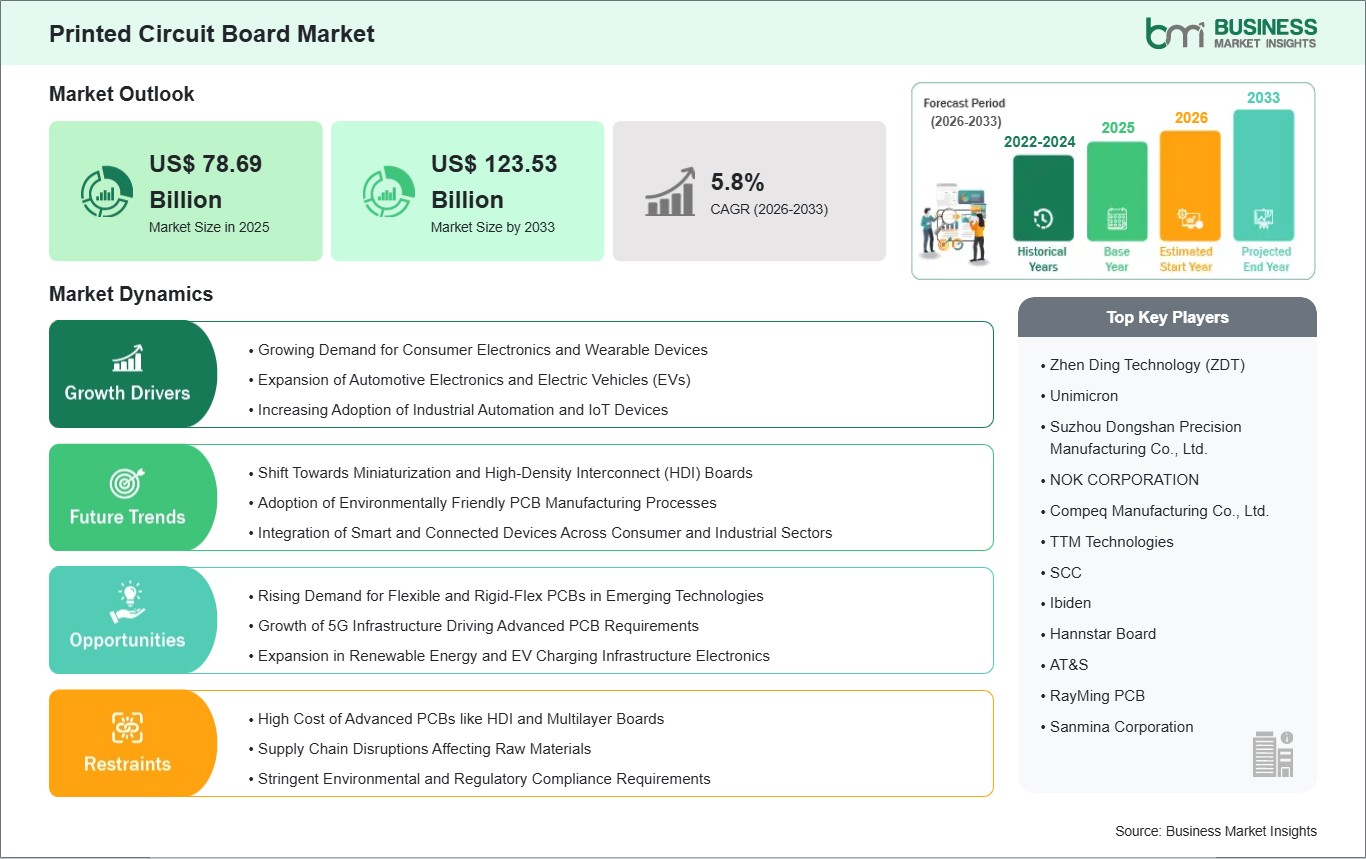
The printed circuit board market size is expected to reach US$ 123.53 billion by 2033 from US$ 78.69 billion in 2025. The market is estimated to record a CAGR of 5.8% from 2025 to 2033.
The printed circuit board market is central to the worldwide digitization of infrastructures and electronic systems. Printed circuit boards are the means to achieving energy, efficient, scalable, and cost, effective results for computing, communication, and industrial applications. They have become the backbone of consumer electronics, automotive systems, telecommunications, healthcare devices, aerospace, and industrial machinery. The market is propelled by the demand for compact and high, performing electronic devices, the adoption of cloud computing, edge computing, IoT devices, and artificial intelligence applications, which require advanced PCB designs to operate reliably.
Firmly rooted in the future are a series of product innovations: multilayer, flexible, rigid, flex, and high, density interconnect boards, as well as advanced materials that enhance thermal management, signal integrity, and durability. North America, Europe, and Asia Pacific are the three major regions, supported by technological innovation, infrastructure expansion, and electronics manufacturing growth. Problems like design complexity, integration with legacy systems, and increasing material costs still exist, but the continuous progress in manufacturing processes, automation, and materials innovation will eventually lead to market growth. In sum, the printed circuit board market is scheduled to grow at a steady pace, a trend that is clearly discernible against the backdrop of rising electronic device penetration and digital transformation across industries.

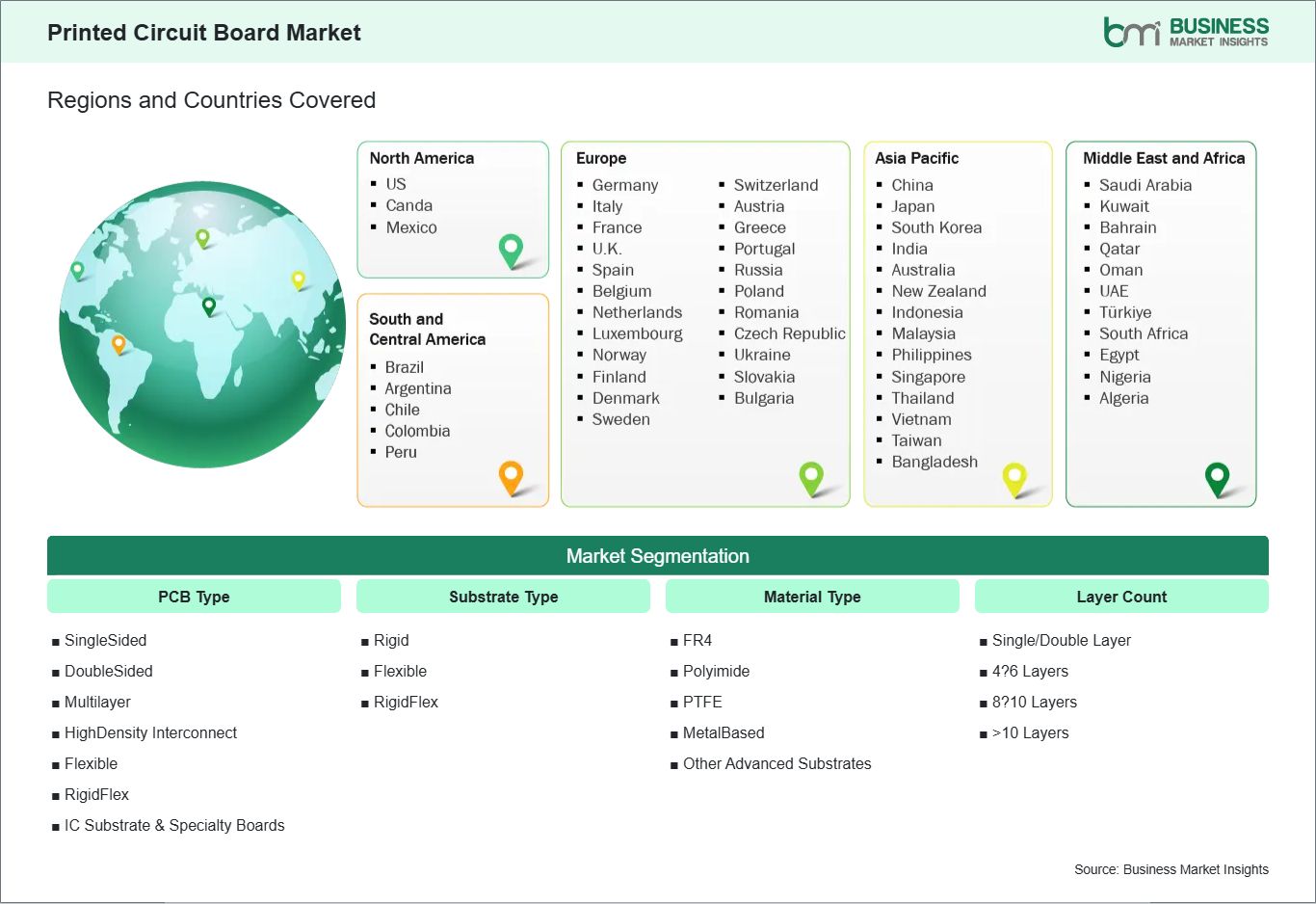
Key segments that contributed to the derivation of the printed circuit board market analysis are PCB type, substrate type, material/laminate type, layer count, technology, and end-use industry.
The widespread use of smartphones, tablets, laptops, and wearable devices is one of the main factors driving the demand for printed circuit boards. Consumer electronics require compact, high-performance, and reliable PCBs to support advanced features and connectivity. As technology evolves, manufacturers are producing devices with more functionalities and smaller sizes, which necessitates the use of multilayer and high-density PCBs. Regions with a growing middle class and higher disposable incomes are witnessing the strongest growth. Therefore, the consumer electronics sector remains a key driver for the global PCB market, prompting manufacturers to innovate and expand production capacity.
The rapid growth of the automotive electronics industry presents a significant opportunity for the PCB market. Modern vehicles increasingly rely on electronic systems, including advanced driver-assistance systems (ADAS), infotainment, electric vehicle (EV) battery management, and autonomous driving technologies. These systems require specialized PCBs, such as rigid, flex, and high-density interconnect boards, to ensure reliable performance under harsh automotive conditions. As governments promote electric mobility and stricter emission standards, the demand for sophisticated automotive electronics—and therefore PCBs—is expected to rise. This creates a strategic opportunity for PCB manufacturers to supply innovative solutions for the automotive sector’s expanding electronic requirements.
By PCB type, the printed circuit board market is segmented into Single-Sided, Double-Sided, Multilayer, High-Density Interconnect (HDI), Flexible, Rigid-Flex, IC Substrate, and Specialty Boards. The Multilayer segment dominated the market in 2024 due to its ability to support complex electronic circuits, higher component density, and growing demand from consumer electronics and telecommunications sectors.
By substrate type, the market is segmented into Rigid, Flexible, and Rigid-Flex. The Rigid segment held the largest share of the market in 2024 owing to its durability, cost-effectiveness, and widespread use across automotive, industrial, and consumer electronics applications.
By material type, the market is segmented into FR-4 (Epoxy Glass), Polyimide, PTFE (Teflon), Metal-Based (Aluminum/Copper), and Other Advanced Substrates. The FR-4 (Epoxy Glass) segment dominated the market in 2024, driven by its high electrical insulation properties, mechanical strength, and affordability.
By layer count, the market is segmented into Single/Double Layer, 4–6 Layers, 8–10 Layers, and >10 Layers. The Single/Double Layer segment accounted for the largest share of the market in 2024 due to its simplicity, lower manufacturing cost, and extensive use in consumer electronics and basic industrial devices.
By technology, the market is segmented into Surface Mount Technology (SMT) and Through-Hole Technology (THT). The Surface Mount Technology (SMT) segment dominated the market in 2024, supported by its higher assembly efficiency, miniaturization capabilities, and compatibility with modern electronic devices.
By end-use industry, the market is segmented into Consumer Electronics, Automotive, IT & Telecommunications, Industrial Electronics, Healthcare / Medical Devices, Aerospace & Defense, and Other Sectors. The Consumer Electronics segment dominated the market in 2024 due to the rising adoption of smartphones, laptops, wearable devices, and other connected gadgets worldwide.
| Report Attribute | Details |
|---|---|
| Market size in 2025 | US$ 78.69 Billion |
| Market Size by 2033 | US$ 123.53 Billion |
| Global CAGR (2026 - 2033) | 5.8% |
| Historical Data | 2022-2024 |
| Forecast period | 2026-2033 |
| Segments Covered | By PCB Type
|
| Regions and Countries Covered | North America
|
| Market leaders and key company profiles |
|
The Printed Circuit Board Market Size and Forecast (2022–2033) report provides a detailed analysis of the market covering below areas:
The geographical scope of the printed circuit board market report is divided into five regions: North America, Asia Pacific, Europe, Middle East & Africa, and South & Central America. The printed circuit board market in Asia Pacific is expected to grow significantly during the forecast period.
The Asia-Pacific printed circuit board market is segmented into China, Japan, South Korea, India, Australia, New Zealand, Indonesia, Malaysia, the Philippines, Singapore, Thailand, Vietnam, Taiwan, Bangladesh, and the Rest of Asia. The strong growth in the region is largely a result of rapid digitalization, increasing adoption of consumer electronics, and growing investments in automotive, industrial, and telecommunications sectors. Leading market growth is expected from major economies like China, Japan, and India due to high demand for advanced multilayer, HDI, and flexible PCBs that support smartphones, laptops, wearable devices, and electric vehicles.
Moreover, the region is witnessing increased adoption of PCBs in emerging technologies such as 5G infrastructure, IoT devices, and automotive electronics, which is being supported by rising consumer spending and industrial modernization. Government initiatives aimed at digital transformation, smart cities, electric mobility, and industrial automation are further contributing to the acceleration of the market. In addition, increasing investments in high-tech manufacturing facilities, R&D, and electronic component production, together with modernization of industrial infrastructure, are key factors driving demand, making Asia Pacific a leading region for the global printed circuit board market to grow further.

The printed circuit board market is evaluated by gathering qualitative and quantitative data post primary and secondary research, which includes important corporate publications, association data, and databases. A few of the key developments in the printed circuit board market are:
The Printed Circuit Board Market is valued at US$ 78.69 Billion in 2025, it is projected to reach US$ 123.53 Billion by 2033.
As per our report Printed Circuit Board Market, the market size is valued at US$ 78.69 Billion in 2025, projecting it to reach US$ 123.53 Billion by 2033. This translates to a CAGR of approximately 5.8% during the forecast period.
The Printed Circuit Board Market report typically cover these key segments-
The historic period, base year, and forecast period can vary slightly depending on the specific market research report. However, for the Printed Circuit Board Market report:
The Printed Circuit Board Market is populated by several key players, each contributing to its growth and innovation. Some of the major players include:
The Printed Circuit Board Market report is valuable for diverse stakeholders, including:
Essentially, anyone involved in or considering involvement in the Printed Circuit Board Market value chain can benefit from the information contained in a comprehensive market report.
Please tell us your area of interest
(Market Segments/ Regions and Countries/ Companies)