Market Summary
Executive Summary and Global Market Analysis
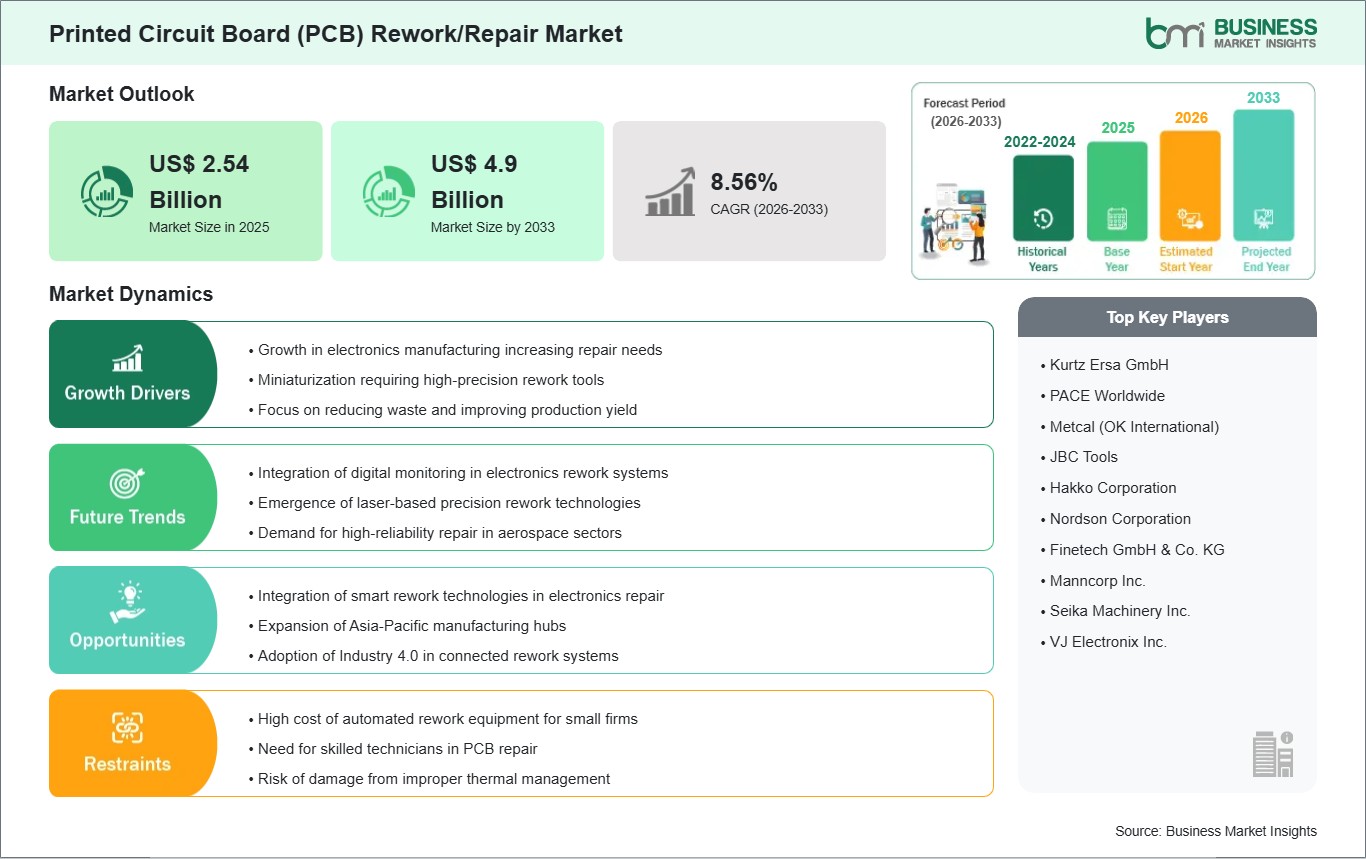
The global Printed Circuit Board (PCB) Rework/Repair Market is experiencing steady growth driven by the rising complexity of electronic assemblies, stringent quality control standards, and the increasing need to reduce waste and production cost in electronics manufacturing supply chains. PCB rework/repair refers to the process of fixing or modifying defective, failed, or sub‑optimal printed circuit boards, using specialized soldering tools and advanced techniques that ensure functional integrity while avoiding complete board replacement.
The market is heavily influenced by electronics industry demand, particularly from sectors such as consumer devices, automotive controls, telecommunications, and medical diagnostics. As PCB assemblies become more complex with higher component densities and miniaturized parts (e.g., BGAs, CSPs), the requirement for both manual and automated rework solutions has become critical for maintaining throughput and yield in production environments.
Leading players in the PCB rework/repair space continue to invest in advanced technologies such as precision laser rework, real‑time thermal profiling, and AI‑guided process control, enabling higher repair accuracy and reduced cycle times. These innovations are complemented by robust service offerings, including operator training, calibration support, and predictive maintenance programs. As manufacturers prioritize sustainability and cost‑efficiency, PCB rework/repair is increasingly integrated into broader quality assurance and electronics lifecycle management strategies.
Segment Analysis
Printed Circuit Board (PCB) Rework/Repair Market Segmentation
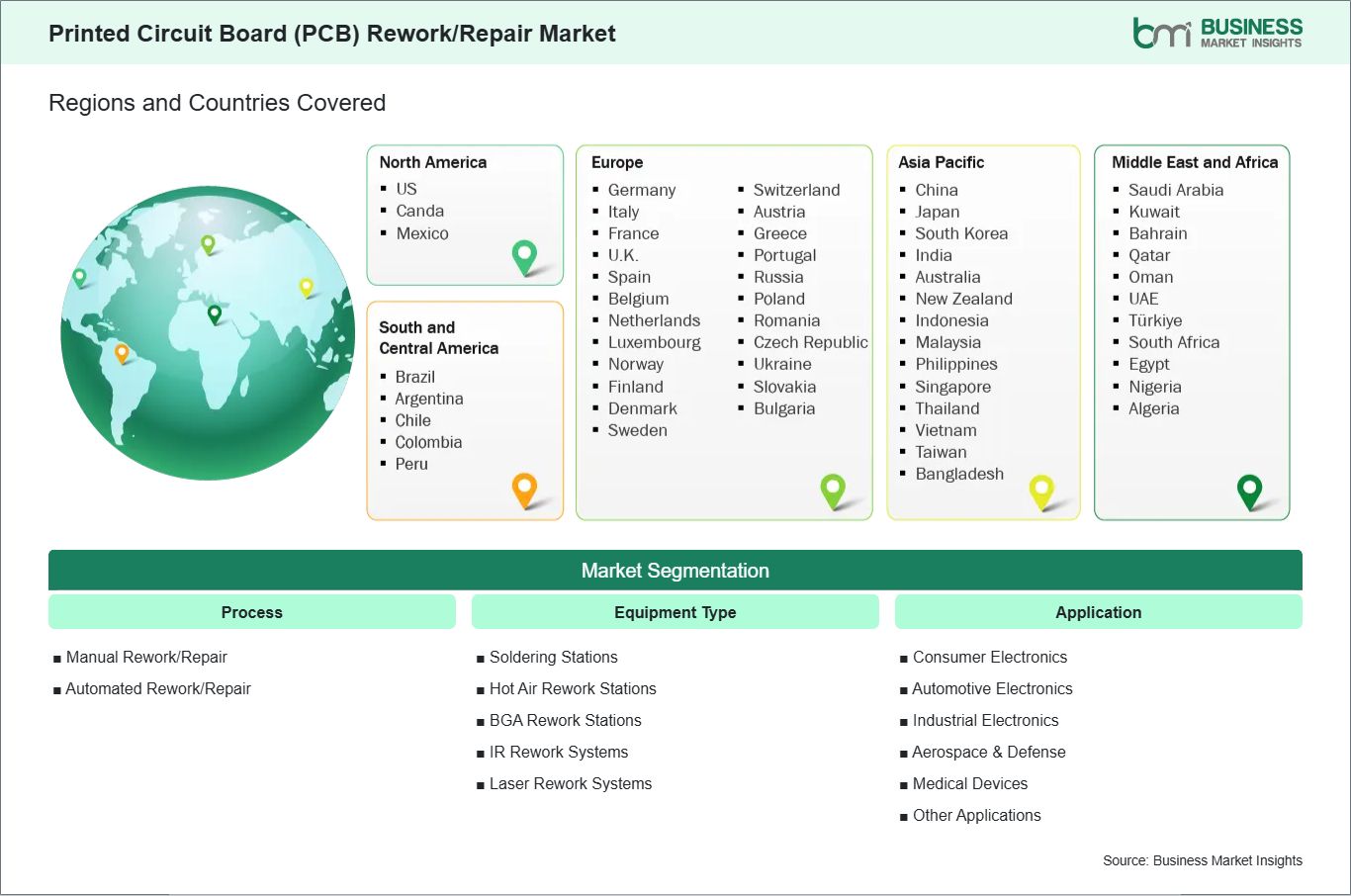
Key segments that contributed to the derivation of the PCB rework/repair market analysis are process, equipment type, and application.
- By process, the PCB Rework/Repair market is segmented into manual rework/repair and automated rework/repair. The manual rework/repair segment dominated the market in 2025.
- Based on equipment type, the market is segmented into soldering stations, hot air rework stations, BGA rework stations, IR rework systems, and laser rework systems. The hot air rework stations segment dominated the market in 2025.
- In terms of application, the market is classified into consumer electronics, automotive electronics, industrial electronics, aerospace & defense, medical devices, and other applications. The consumer electronics segment dominated the market in 2025.
Market Forces
Printed Circuit Board (PCB) Rework/Repair Market Drivers and Opportunities
Rising Adoption of Advanced Electronics Manufacturing
The expanding complexity and miniaturization in modern electronics are major factors driving the PCB Rework/Repair Market. Advanced boards with high‑density interconnects (HDI) and multi‑layer stack‑ups present greater manufacturing challenges and higher failure risk during assembly and testing. PCB rework/repair provides manufacturers with an efficient mechanism to correct defects, recondition assemblies, and improve overall yield without scrapping entire boards.
In sectors like automotive controls and medical instrumentation, where reliability and safety are paramount, implementing robust rework/repair practices ensures that production targets are met with minimal downtime. The ability to promptly address defects using both manual and automated systems helps reduce rework lead time and enhances throughput, enabling companies to remain competitive in fast‑paced product cycles.
Integration of Automated and Smart Rework Technologies
Growing interest in automation and smart manufacturing is creating significant opportunities for the PCB Rework/Repair market. Automated rework systems, especially those equipped with adaptive thermal profiling, vision-guided alignment, and programmable workflows, reduce dependency on operator skill and improve repeatability of complex repairs. Integration of data analytics and process monitoring software allows manufacturers to capture performance insights, optimize repair cycles, and predict equipment maintenance needs.
Size and Share Analysis
Printed Circuit Board (PCB) Rework/Repair Market Size and Share Analysis
The PCB Rework/Repair Market demonstrates steady growth, with size and share analysis highlighting evolving trends and competitive dynamics among key players. The report examines subsegments categorized within process, equipment type, and application, offering insights into their contribution to overall market performance.
By process, the manual rework/repair subsegment dominated the market in 2025, driven by requirement for expert judgment in delicate operations and legacy assemblies, but automated rework/repair is steadily increasing share as throughput and consistency become priorities.
Based on equipment type, the hot air rework stations subsegment dominated the market in 2025, driven by broad applicability and established usage in assembly lines, while laser rework systems are registering higher growth due to precision capabilities and minimal thermal damage risk.
In terms of application, consumer electronics subsegment dominated the market in 2025, driven by the product diversity and frequent design updates, followed by automotive electronics where safety-critical modules necessitate rigorous rework practices.
Report Coverage
Printed Circuit Board (PCB) Rework/Repair Market Report Coverage and Deliverables
The "Printed Circuit Board (PCB) Rework/Repair Market Size and Forecast (2022 - 2033)" report provides a detailed analysis of the market covering below areas:
- PCB Rework/Repair Market size and forecast at global, regional, and country levels for all the key market segments covered under the scope
- PCB Rework/Repair Market trends, as well as drivers, restraints, and opportunities
- PCB Rework/Repair Market analysis covering key trends, global and regional framework, major players, regulations, and recent developments
- Industry landscape and competition analysis covering market concentration, heat map analysis, prominent players, and recent developments for the PCB Rework/Repair Market
- Detailed company profiles, including SWOT analysis
Geographic Insights
Printed Circuit Board (PCB) Rework/Repair Market Geographic Insights
The geographical scope of the PCB Rework/Repair Market report is divided into North America, Asia Pacific, Europe, Middle East & Africa, and South & Central America. North America held the largest share in 2025.
Asia Pacific exhibits rapid growth as electronics manufacturing hubs like China, India, Japan, and South Korea expand production capacities and prioritize yield optimization practices. Europe follows as a mature market with established OEMs emphasizing service quality and sustainability in electronics assembly. Emerging regions in Latin America and the Middle East & Africa are gradually adopting PCB rework/repair solutions, driven by increasing domestic electronics assembly activities, government support for tech manufacturing, and need for cost-efficient production practices.
Industry Activity
Recent Developments
The Printed Circuit Board (PCB) Rework/Repair Market is evaluated by gathering qualitative and quantitative data post primary and secondary research, which includes important corporate publications, association data, and databases. A few of the key developments in the printed circuit board (PCB) rework/repair market are:
- In May 2025, Kurtz Ersa announced a new automated laser rework system optimized for HDI and fine‑pitch PCB assemblies, improving throughput in high‑mix production environments.
- In January 2025, Hirox Europe expanded its hot‑air rework portfolio with AI‑assisted thermal profiling, enabling adaptive heat control and reduced operator variability.
Trust & Transparency
Research Methodology
The market analysis combines proprietary research with secondary data from government agencies, company disclosures, regulatory filings, industry databases and expert interviews. Market estimates are validated through data triangulation, cross-market benchmarking and analyst
review.
View Full Research Methodology
Key Sources Referred:
International Electrotechnical Commission (IEC)IPC (Association Connecting Electronics Industries)International Organization for StandardizationJoint Electron Device Engineering CouncilEuropean Institute of Printed Circuits (EIPC)International Trade Administration