Market Summary
Executive Summary and Global Market Analysis
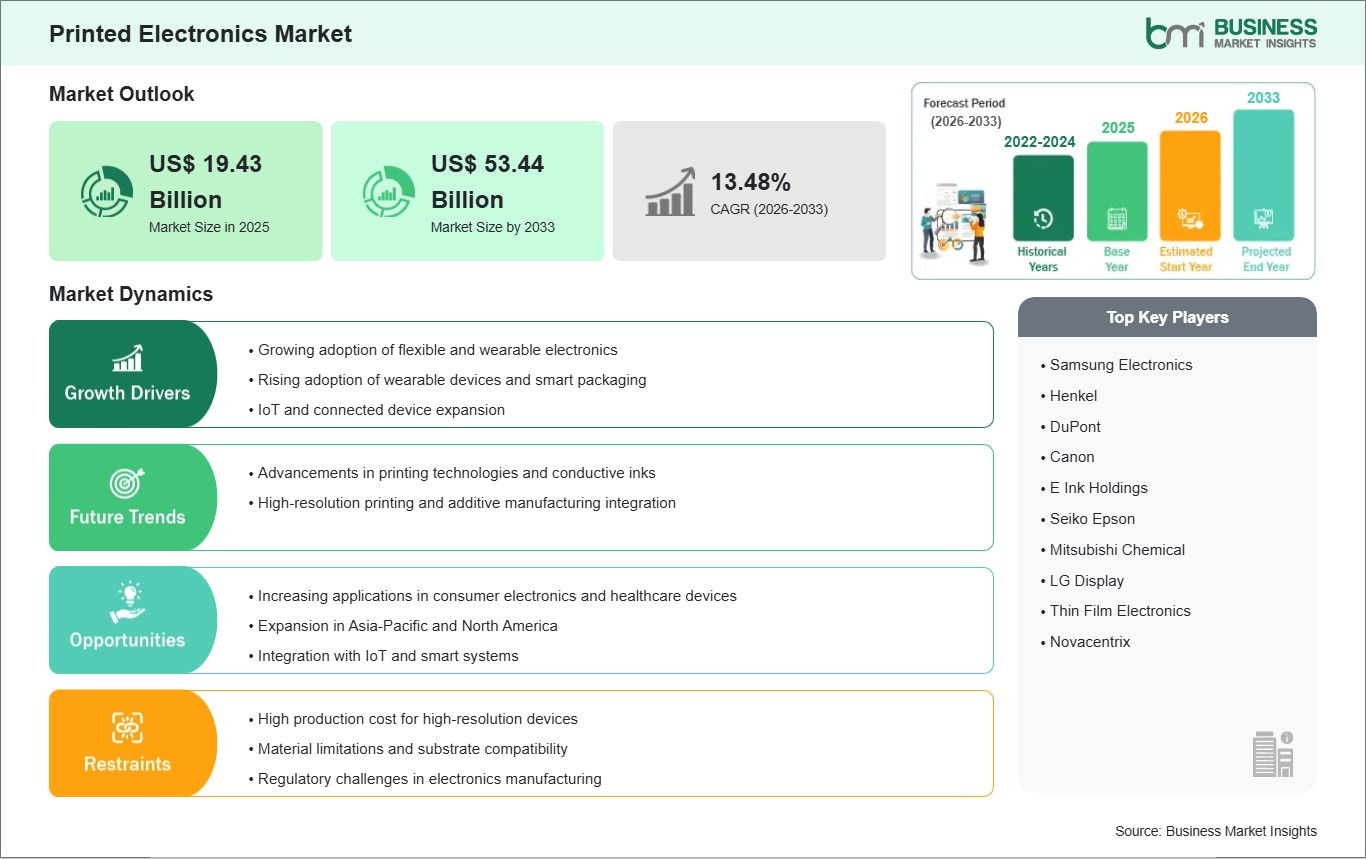
The global printed electronics market is experiencing rapid expansion due to the increasing demand for lightweight, flexible, and cost-effective electronic components. Printed electronics refer to the use of printing technologies to create electronic circuits and devices on various substrates, including plastic, paper, and flexible materials. This technology enables the production of thin, flexible, and low-cost electronic devices that can be integrated into a wide range of consumer and industrial applications.
Advancements in printing technologies such as inkjet printing, screen printing, and gravure printing have significantly enhanced the manufacturing capabilities of printed electronics. These techniques allow manufacturers to produce complex electronic circuits with high precision while reducing production costs and material waste. The ability to fabricate electronics using additive manufacturing processes also supports sustainable manufacturing practices and scalable production.
The growing adoption of flexible displays, smart packaging, wearable electronics, and connected sensors is further accelerating market growth. Industries such as consumer electronics, healthcare, and automotive are increasingly adopting printed electronic components for applications that require lightweight designs and adaptable form factors. In addition, the integration of printed electronics into Internet of Things (IoT) devices is expanding their role in next-generation smart systems.
Competitive dynamics in the printed electronics market increasingly focus on technological innovation, material development, and large-scale production capabilities. Manufacturers are investing in conductive inks, advanced substrates, and high-resolution printing technologies to improve device performance and reliability. Strategic collaborations between electronics manufacturers, material suppliers, and research institutions are also supporting innovation and accelerating commercialization of printed electronic solutions.
As industries continue to prioritize flexible design, energy efficiency, and miniaturization, printed electronics are expected to play a crucial role in shaping the future of electronic device manufacturing.
Segment Analysis
Printed Electronics Market Segmentation
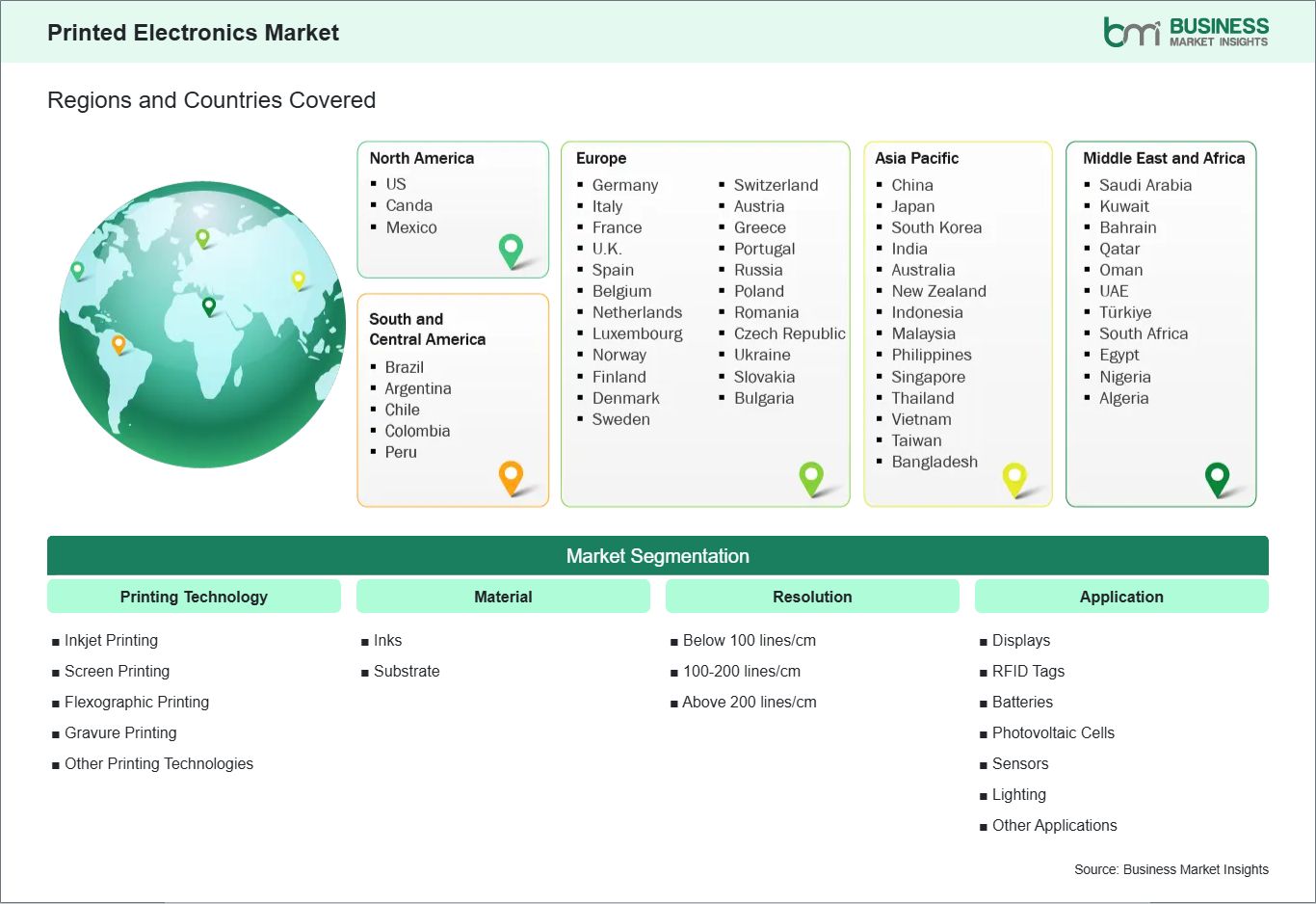
Key segments that contributed to the derivation of the printed electronics market analysis are printing technology, material, resolution, application, and end-use industry.
- By printing technology, the printed electronics market is segmented into inkjet printing, screen printing, flexographic printing, gravure printing, and other printing technologies. The screen printing segment dominated the market in 2025.
- Based on material, the market is segmented into inks and substrates. The inks segment dominated the market in 2025.
- In terms of resolution, the market is segmented into below 100 lines/cm, 100–200 lines/cm, and above 200 lines/cm. The 100–200 lines/cm segment dominated the market in 2025.
- In terms of application, the market is segmented into displays, RFID tags, batteries, photovoltaic cells, sensors, lighting, and other applications. The RFID tags segment dominated the market in 2025.
- By end-use industry, the market is segmented into automotive & transportation, healthcare, consumer electronics, aerospace & defense, construction & architecture, retail & packaging, and other end-use industries. The consumer electronics segment dominated the market in 2025.
Market Forces
Printed Electronics Market Drivers and Opportunities
Growing Demand for Flexible and Lightweight Electronics
The rising demand for flexible and lightweight electronic devices is one of the key factors driving the growth of the printed electronics market. Traditional electronic manufacturing techniques often rely on rigid materials and complex fabrication processes, whereas printed electronics enable the production of electronic circuits on flexible substrates such as plastic films, paper, and textiles.
This flexibility allows electronic components to be integrated into innovative products including wearable health monitors, foldable displays, and smart packaging solutions. As consumer electronics manufacturers focus on product miniaturization and advanced designs, printed electronics provide an efficient manufacturing approach.
Printed electronics technologies also offer cost advantages compared with conventional semiconductor fabrication methods. Additive printing processes reduce material wastage and simplify manufacturing steps, resulting in lower production costs. These economic benefits are particularly important for high-volume applications such as RFID tags and flexible sensors.
Expanding IoT and Smart Packaging Applications
The rapid growth of Internet of Things (IoT) technologies is creating new opportunities for printed electronics. IoT devices require compact, lightweight, and energy-efficient electronic components that can be integrated into a wide range of products and environments.
Smart packaging is one of the fastest-growing applications of printed electronics. Companies in retail and logistics sectors are increasingly deploying printed RFID tags and sensors to monitor product location, condition, and authenticity throughout the supply chain.
In the healthcare sector, printed biosensors and wearable devices are enabling continuous monitoring of patient health indicators such as heart rate, body temperature, and glucose levels.
As industries continue to invest in IoT infrastructure and smart monitoring technologies, demand for printed electronic components is expected to increase significantly.
Size and Share Analysis
Printed Electronics Market Size and Share Analysis
The Printed Electronics Market demonstrates strong growth, with size and share analysis highlighting evolving trends and competitive dynamics among key players. The report examines subsegments categorized within printing technology, material, resolution, application, and end-use industry.
By printing technology, the screen printing subsegment dominated the market in 2025, driven by its capability to deposit thicker conductive layers required for sensors and photovoltaic cells.
Based on material, the inks subsegment dominated the market in 2025, supported by rising demand for conductive, dielectric, and semiconducting inks used in printed electronic components.
In terms of resolution, the 100–200 lines/cm segment dominated the market in 2025 due to its suitability for producing mid-range precision circuits for commercial electronic applications.
In terms of application, RFID tags accounted for the largest market share as industries such as retail, logistics, and packaging increasingly adopt RFID technologies for supply chain visibility.
By end-use industries, consumer electronics held the largest market share in 2025 due to rising demand for wearable electronics, flexible displays, and smart devices.
Report Coverage
Printed Electronics Market Report Coverage and Deliverables
The "Printed Electronics Market Size and Forecast (2022 - 2033)" report provides a detailed analysis of the market covering below areas:
- Printed Electronics Market size and forecast at global, regional, and country levels for all key market segments covered under the scope
- Printed Electronics Market trends, drivers, restraints, and opportunities
- Printed Electronics Market analysis covering key trends, global and regional framework, major players, regulations, and recent developments
- Industry landscape and competition analysis covering market concentration, heat map analysis, and prominent players
- Detailed company profiles including SWOT analysis
Geographic Insights
Printed Electronics Market Geographic Insights
The geographical scope of the Printed Electronics Market report is divided into North America, Asia Pacific, Europe, Middle East & Africa, and South & Central America. North America held the largest share in 2025.
Asia Pacific is a leading region in the printed electronics market due to the strong presence of electronics manufacturing industries in China, Japan, South Korea, and Taiwan. These countries have well-established semiconductor and consumer electronics ecosystems supporting commercialization of printed electronics technologies.
North America represents a major innovation hub with numerous technology companies and research institutions developing new materials and printing techniques for electronic manufacturing.
Europe is another significant market driven by strong research initiatives and government support for advanced manufacturing technologies. Countries including Germany, the UK, and France are actively promoting printed electronics innovation.
Meanwhile, emerging markets in Latin America and the Middle East & Africa are gradually adopting printed electronics technologies in packaging, renewable energy, and consumer electronics applications.
Industry Activity
Recent Developments
The Printed Electronics Market is evaluated by gathering qualitative and quantitative data post primary and secondary research. A few of the key developments in the printed electronics market are,
- In November 2024, Samsung Electronics announced the development of advanced printed sensor technologies designed for integration into flexible consumer electronics and wearable devices.
- In October 2024, Henkel expanded its conductive ink portfolio designed for printed electronics applications, enabling improved performance for RFID antennas, sensors, and flexible circuits.
Trust & Transparency
Research Methodology
The market analysis combines proprietary research with secondary data from government agencies, company disclosures, regulatory filings, industry databases and expert interviews. Market estimates are validated through data triangulation, cross-market benchmarking and analyst
review.
View Full Research Methodology
Key Sources Referred:
International Energy Agency (IEA)International Electrotechnical Commission (IEC)Semiconductor Industry Association (SIA)International Trade AdministrationInternational Bar Association