Market Summary
Executive Summary and Global Market Analysis
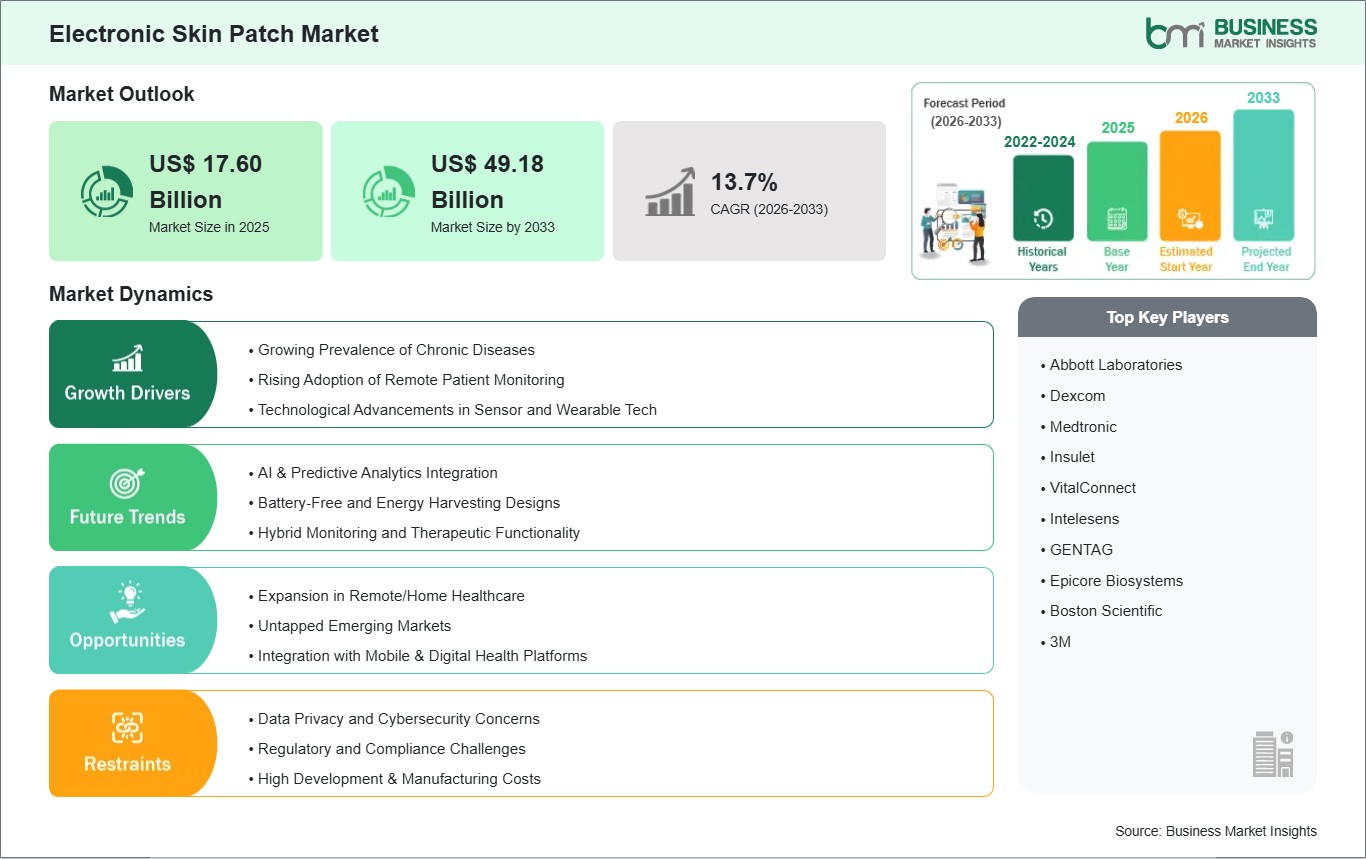
The global electronic skin patch market is experiencing strong growth, driven by the rising demand for continuous, real-time health monitoring and the shift toward personalized and remote healthcare. Electronic skin patches are lightweight, wearable devices designed to monitor physiological parameters such as heart rate, glucose levels, temperature, and other vital signs. Their non-invasive nature, ease of use, and compatibility with wireless technologies make them attractive for both clinical and home-care settings. Growth is further supported by the increasing prevalence of chronic diseases like diabetes and cardiovascular disorders, along with advancements in flexible electronics, sensors, and battery technologies. Healthcare providers are increasingly adopting these patches to improve patient compliance, reduce hospital visits, and enable early diagnosis, making electronic skin patches a key component of next-generation digital healthcare.
Globally, North America holds a significant share of the electronic skin patch market due to advanced healthcare infrastructure, early adoption of wearable technologies, and the strong presence of key market players. Europe follows closely, supported by growing awareness of remote patient monitoring and favorable regulatory frameworks. The Asia-Pacific region is expected to witness the fastest growth, driven by a large patient population, increasing healthcare expenditure, and rapid technological adoption in countries such as China, Japan, and India. Rising investments also influence market growth in research and development and collaborations between technology companies and healthcare providers.
Segment Analysis
Electronic Skin Patch Market Segmentation
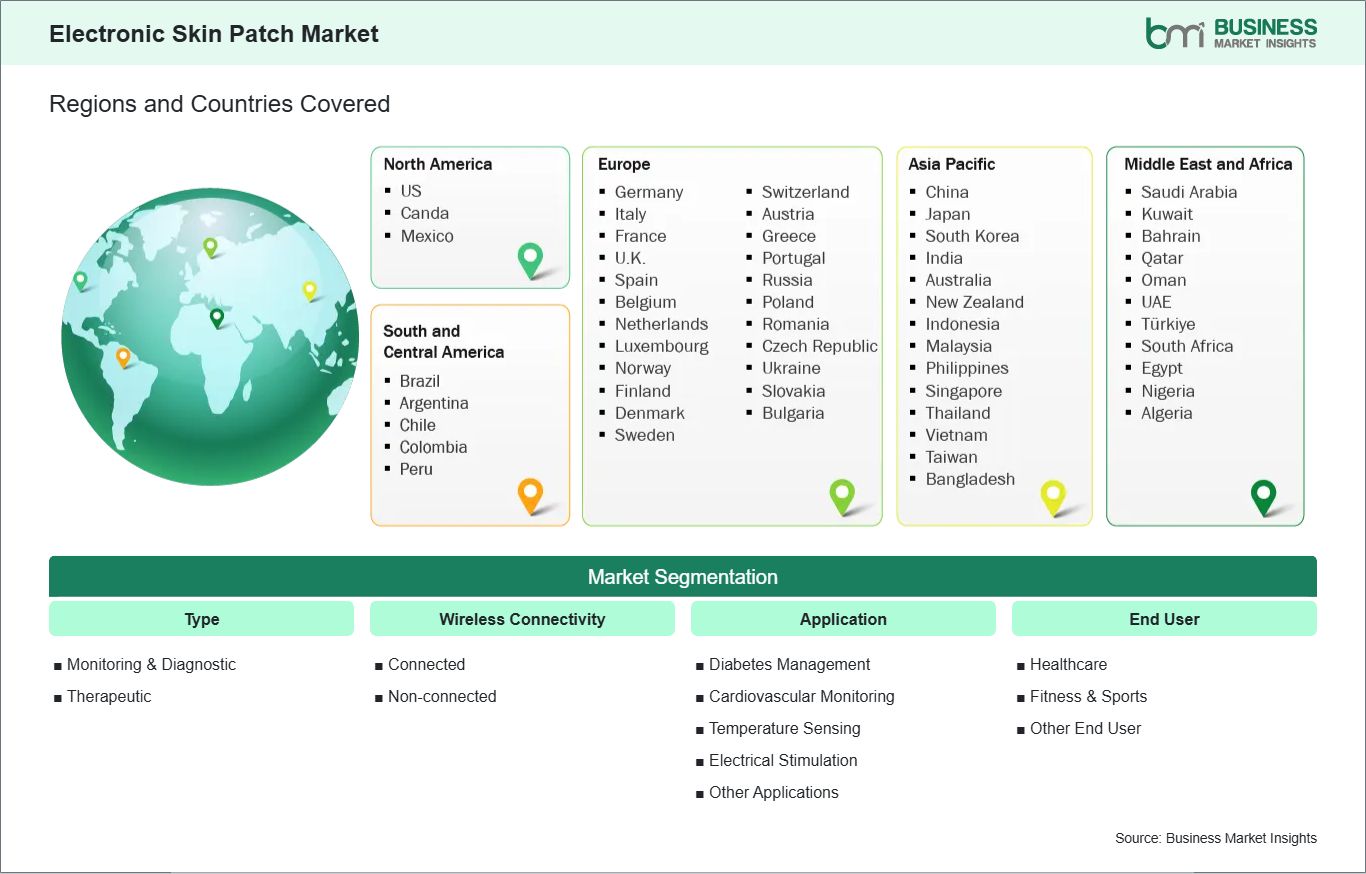
Key segments that contributed to the derivation of the Electronic Skin Patch market analysis are Type, Wireless Connectivity, Application, and End User.
- By Type, the Electronic skin patch market is segmented into Monitoring & Diagnostic, Therapeutic. The Monitoring & Diagnostic segment dominated the market in 2025.
- By Wireless Connectivity, the Electronic skin patch market is segmented into Connected, Non-connected. The Connected segment dominated the market in 2025.
- By Application, the Electronic skin patch market is segmented into Diabetes Management, Cardiovascular Monitoring, Temperature Sensing, Electrical Strimulation, and Others. The Cardiovascular Monitoring segment dominated the market in 2025.
- By End User, the Electronic skin patch market is segmented into Healthcare, Fitness & Sports, and Others. The Healthcare segment dominated the market in 2025.
Market Forces
Electronic Skin Patch Market Drivers and Opportunities
Rising Demand for Continuous and Remote Health Monitoring
The electronic skin patch market is primarily driven by the growing need for continuous, real-time health monitoring, fueled by the increasing prevalence of chronic diseases such as diabetes, cardiovascular disorders, and respiratory conditions. Traditional monitoring methods are often invasive or require frequent hospital visits, whereas electronic skin patches offer a non-invasive, comfortable, and patient-friendly alternative. The rapid adoption of telemedicine and remote patient monitoring, especially after the COVID-19 pandemic, has further accelerated demand. Technological advancements in flexible electronics, sensors, wireless connectivity, and battery efficiency have improved device accuracy and usability. Additionally, healthcare providers are increasingly focused on early diagnosis, preventive care, and cost reduction, all of which electronic skin patches effectively support.
Expansion of Digital Health and Emerging Healthcare Markets
The market presents significant opportunities through the rapid expansion of digital health ecosystems and increasing adoption in emerging economies. Integration of electronic skin patches with artificial intelligence, cloud computing, and mobile health platforms enables advanced data analytics, personalized treatment, and predictive healthcare, creating new growth avenues. Emerging markets in Asia-Pacific, Latin America, and the Middle East offer strong potential due to large patient populations, rising healthcare investments, and improving access to medical technologies. Furthermore, growing interest in home healthcare and wearable wellness devices opens opportunities beyond clinical applications. Collaborations between medical device manufacturers, technology firms, and healthcare providers are expected to accelerate innovation, product development, and market penetration, further strengthening long-term growth prospects.
Size and Share Analysis
Electronic Skin Patch Market Size and Share Analysis
By Type, the market is segmented into Monitoring & Diagnostic, Therapeutic. The Monitoring & Diagnostic segment dominated the market in 2025. The monitoring and diagnostic segment leads the market due to its widespread use in continuous tracking of vital signs such as heart rate, glucose levels, and temperature. These patches enable early disease detection, real-time data collection, and improved clinical decision-making, driving strong adoption across healthcare settings.
By Wireless Connectivity, the market is segmented into Connected, Non-connected. The Connected segment held the largest share of the market in 2025. The connected segment dominates the market as it enables real-time data transmission to smartphones, cloud platforms, and healthcare systems. Integration with IoT and digital health platforms supports remote patient monitoring, timely interventions, and data-driven healthcare, making connected patches highly preferred over non-connected alternatives.
By Application, the market is segmented into Diabetes Management, Cardiovascular Monitoring, Temperature Sensing, Electrical stimulation, and Others. The Cardiovascular Monitoring segment held the largest share of the market in 2025. Cardiovascular monitoring represents a leading application segment due to the global rise in heart-related disorders. Electronic skin patches allow continuous ECG and heart-rate monitoring, helping clinicians detect irregularities early. Their non-invasive nature improves patient compliance and supports long-term monitoring outside traditional clinical environments.
By End User, the market is segmented into Healthcare, Fitness & Sports, and Others. The Healthcare segment held the largest share of the market in 2025. Healthcare providers are the primary end users of electronic skin patches, driven by their use in hospitals, clinics, and diagnostic centers. These devices help reduce patient hospitalization time, improve workflow efficiency, and enhance remote monitoring capabilities, supporting better patient outcomes and cost-effective healthcare delivery.
Report Coverage
Electronic Skin Patch Market Report Coverage and Deliverables
The "Electronic Skin Patch Market Size and Forecast (2022-2033)" report provides a detailed analysis of the market covering below areas:
- Electronic skin patch market size and forecast at global, regional, and country levels for all the key market segments covered under the scope
- Electronic skin patch market trends, as well as market dynamics such as drivers, restraints, and key opportunities
- Electronic skin patch market analysis covering key market trends, global and regional framework, major players, regulations, and recent market developments
- Industry landscape and competition analysis covering market concentration, heat map analysis, prominent players, and recent developments for the Electronic skin patch market
- Detailed company profiles, including SWOT analysis
Geographic Insights
Electronic Skin Patch Market Geographic Insights
The geographical scope of the Electronic skin patch market report is divided into five regions: North America, Asia Pacific, Europe, Middle East & Africa, and South & Central America. The Electronic skin patch market in Asia Pacific is expected to grow significantly during the forecast period.
The Asia Pacific region is expected to witness the fastest growth in the electronic skin patch market due to a large patient population and rising prevalence of chronic diseases such as diabetes and cardiovascular disorders. Increasing healthcare expenditure, rapid urbanization, and improving healthcare infrastructure are supporting market expansion. Countries such as China, Japan, South Korea, and India are adopting advanced wearable and digital health technologies at a growing pace. Government initiatives promoting remote healthcare, along with expanding telemedicine services, are further driving demand.
Additionally, the presence of electronics manufacturing hubs and growing awareness of continuous health monitoring contribute significantly to regional market growth.
Industry Activity
Recent Developments
The Electronic skin patch market is evaluated by gathering qualitative and quantitative data post primary and secondary research, which includes important corporate publications, association data, and databases. A few of the key developments in the Electronic Skin Patch market are:
- In September 2025, Melbourne-based start-up Nutromics developed a cutting-edge wearable device dubbed a “lab-on-a-patch” that aims to replace traditional blood tests with continuous biomarker monitoring for conditions like sepsis and heart attacks. The technology leverages DNA-based biosensors capable of detecting hundreds of targets in real time, beyond glucose monitoring. Nutromics raised around $7.5 million in funding, bringing its total to approximately $60 million, with backing from major firms like Dexcom as it moves toward FDA approval and clinical use.
- In November 2025, Epicore Biosystems announced the launch of its next-generation Gx Sweat Patch, a soft, disposable electronic skin patch designed for continuous monitoring of hydration, electrolyte balance, and physiological stress. The patch integrates microfluidic sensors and wireless connectivity to deliver real-time data to mobile devices, supporting applications in healthcare, sports performance, and occupational safety. The product launch reflects growing demand for non-invasive, wearable diagnostics capable of delivering actionable health insights outside traditional clinical settings.
Trust & Transparency
Research Methodology
The market analysis combines proprietary research with secondary data from government agencies, company disclosures, regulatory filings, industry databases and expert interviews. Market estimates are validated through data triangulation, cross-market benchmarking and analyst
review.
View Full Research Methodology
Key Sources Referred:
World Bank - Global Trade Indicators World Trade Organization (WTO) International Monetary Fund (IMF) International Trade Administration (ITA) Company websites Company annual reports Company investor presentations