Automotive Safety Electronics Market Outlook (2022-2033)

Historic Data: 2022-2024   |   Base Year: 2025   |   Forecast Period: 2026-2033
Report Content: Market Scope, Market Segmentation, Market Dynamics, and Competitive Analysis

Report Coverage:
  • Component (Electronic Control Unit Sensors, Current Carrying Devices, Other)
  • Application (ADAS, Infotainment, Body Electronics, Safety Systems, Powertrain Electronics)

No. of Pages: 400
Report Code: BMIPUB00032700
Category: Electronics and Semiconductor
Automotive Safety Electronics Market
Buy Now

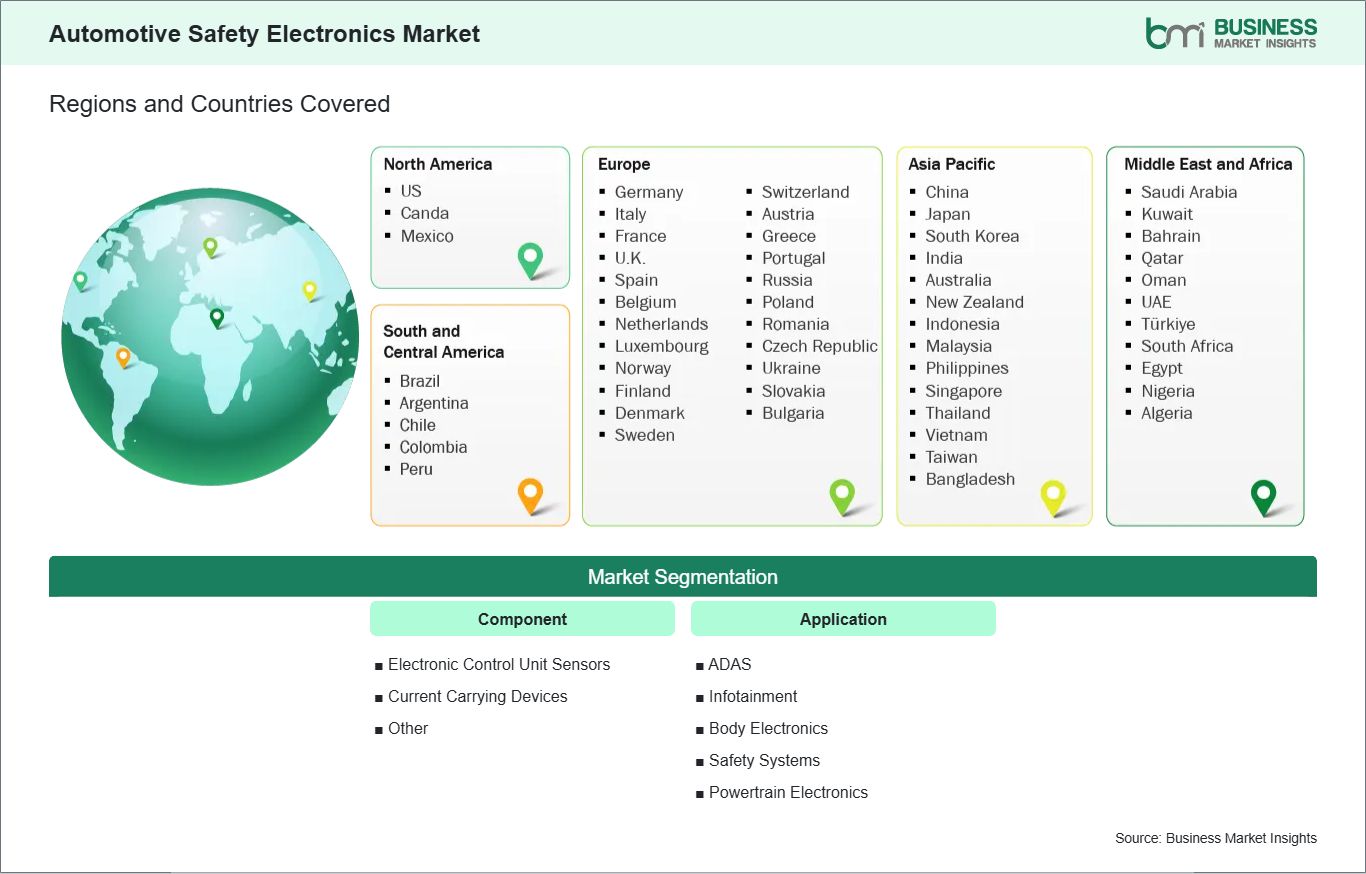
The Automotive Safety Electronics market size is expected to reach US$ 61.65 billion by 2033 from US$ 30.1 billion in 2025. The market is estimated to record a CAGR of 6.1% from 2026 to 2033.

Executive Summary and Global Market Analysis:

Automotive Safety Electronics is about electronic systems and parts that are merged with the road, going machines in order to avert accidents, kindle the safety of the vehicle's occupants, and lower the extent of their injuries by means of active and passive safety functions like sensing, monitoring, control, and automated response technologies.The automotive safety electronics market is expanding due to increased governmental regulation mandating improved automobile safety as well as a greater adoption of Advanced Driver Assistance Systems (ADAS) and heightened interest by consumers toward improved road safety. At the same time, opportunities for growth are becoming available as a result of the accelerating demand for electric and self-driving vehicles, improved sensor/AI capabilities and the growing production of vehicles in developing nations. Together, these factors are driving the increased integration of advanced electronics into automobiles.

Automotive Safety Electronics Market - Strategic Insights:

global-market-strategic-framework
Get more information on this report

Automotive Safety Electronics Market Segmentation Analysis:

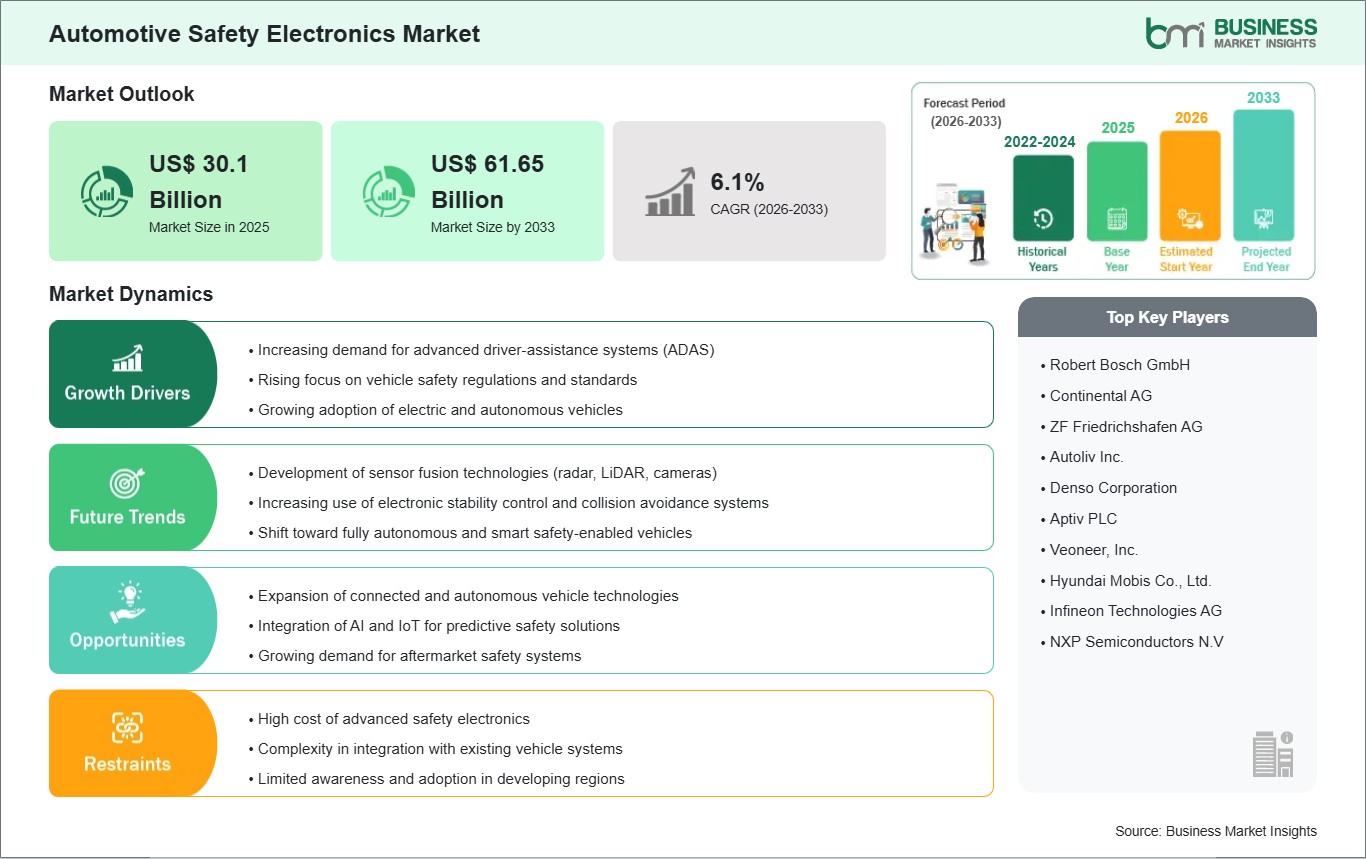
Key segments that contributed to the derivation of the Automotive Safety Electronics market analysis are component, and application.

  • By component, the Automotive Safety Electronics market is divided into Electronic Control Unit Sensors, Current Carrying Devices, and Other. The ECU segment dominated the market in 2024.
  • By applicaton, the market is divided into ADAS, Infotainment, Body Electronics, Safety Systems, Powertrain Electronicss. ADAS held the largest share in 2024, as manufacturers prioritize real-time vehicle safety, and quality control.

Automotive Safety Electronics Market Drivers and Opportunities:

Stringent Government Safety Regulations

Across the globe, governments are intensifying their efforts to reduce road accidents and improve overall passenger safety by implementing increasingly stringent vehicle safety regulations. These policies are designed not only to protect drivers and passengers but also to enhance the safety of pedestrians and other road users. As a result, automotive manufacturers are required to integrate a wide range of advanced safety features into their vehicles, often at the design stage rather than as optional add-ons. Technologies such as Electronic Stability Control (ESC), Automatic Emergency Braking (AEB), lane-keeping assistance, collision warning systems, and advanced airbag configurations are now becoming mandatory in many regions. Compliance with these regulations demands significant investment in automotive safety electronics, software integration, and system testing, encouraging manufacturers to adopt more innovative and reliable safety solutions.

In addition, safety rating programs and government-backed assessment frameworks are influencing consumer purchasing decisions by highlighting vehicle safety performance. Buyers are increasingly prioritizing vehicles that meet or exceed regulatory safety standards, further motivating automakers to enhance their safety offerings. Together, stricter regulations and heightened public awareness are creating a strong and sustained demand for advanced automotive safety electronics across both mature and emerging automotive markets, making safety a key competitive differentiator in the global automotive industry.

Rapid Growth of Electric and Autonomous Vehicles

The rapid expansion of electric and autonomous vehicles is transforming the global automotive industry and significantly increasing the demand for advanced safety technologies. As these next-generation vehicles rely heavily on digital systems rather than purely mechanical components, safety is increasingly dependent on advanced sensors, intelligent control systems, and sophisticated monitoring solutions. Technologies such as radar, lidar, cameras, ultrasonic sensors, and real-time data processing units work together to detect obstacles, assess road conditions, and respond quickly to potential hazards. In electric vehicles, safety systems play a critical role in managing high-voltage components, battery performance, and thermal conditions, helping to prevent malfunctions and ensure passenger protection.

Meanwhile, autonomous vehicles require an even higher level of safety integration, as they must continuously monitor their surroundings and make split-second decisions with minimal or no human intervention. Advanced driver-assistance systems (ADAS) and autonomous safety frameworks are essential to maintaining safe operation in complex and unpredictable traffic environments. As adoption of electric and autonomous vehicles accelerates worldwide, consumer trust and regulatory approval increasingly depend on the reliability of these safety technologies. Consequently, automakers and technology providers are investing heavily in the development of smarter, more responsive, and highly reliable safety solutions. This growing reliance on advanced safety technology positions it as a fundamental pillar supporting the widespread acceptance and long-term success of electric and autonomous vehicles.

Automotive Safety Electronics Market Size and Share Analysis:

By component, the Automotive Safety Electronics market is divided into Electronic Control Unit Sensors, Current Carrying Devices, and Other. The ECU segment dominated the market in 2024. These devices make instantaneous decisions and maintain reliability in their use.

By applicaton, the market is divided into ADAS, Infotainment, Body Electronics, Safety Systems, Powertrain Electronicss. ADAS held the largest share in 2024, as manufacturers prioritize real-time vehicle safety, and quality control.

Automotive Safety Electronics Market Report Highlights:

Report Attribute Details
Market size in 2025 US$ 30.1 Billion
Market Size by 2033 US$ 61.65 Billion
Global CAGR (2026 - 2033)6.1%
Historical Data 2022-2024
Forecast period 2026-2033
Segments Covered By Component
  • Electronic Control Unit Sensors
  • Current Carrying Devices
  • Other
By Application
  • ADAS
  • Infotainment
  • Body Electronics
  • Safety Systems
  • Powertrain Electronics
Regions and Countries Covered North America
  • US
  • Canada
  • Mexico
Europe
  • Belgium
  • Austria
  • Finland
  • Denmark
  • Greece
  • Poland
  • Romania
  • Russia
  • Ukraine
  • Czech Republic
  • Slovakia
  • Bulgaria
  • Italy
  • Luxembourg
  • Germany
  • Switzerland
  • France
  • Netherlands
  • Norway
  • Portugal
  • Spain
  • Sweden
  • United Kingdom
Asia-Pacific
  • Australia
  • China
  • India
  • Japan
  • South Korea
  • Indonesia
  • Malaysia
  • Philippines
  • Singapore
  • Thailand
  • Vietnam
  • Bangladesh
  • New Zealand
  • Taiwan
South and Central America
  • Brazil
  • Argentina
  • Peru
  • Chile
  • Colombia
Middle East and Africa
  • Bahrain
  • Kuwait
  • Oman
  • Qatar
  • Saudi Arabia
  • United Arab Emirates
  • Turkiye
  • South Africa
  • Egypt
  • Algeria
  • Nigeria
Market leaders and key company profiles
  • Robert Bosch GmbH
  • Continental AG
  • ZF Friedrichshafen AG
  • Autoliv Inc.
  • Denso Corporation
  • Aptiv PLC
  • Veoneer, Inc.
  • Hyundai Mobis Co., Ltd.
  • Infineon Technologies AG
Get more information on this report

Automotive Safety Electronics Market Report Coverage and Deliverables:

The Automotive Safety Electronics Market Size and Forecast (2022–2033) report provides a detailed analysis of the market covering below areas:

  • Automotive Safety Electronics market size and forecast at global, regional, and country levels for all the key market segments covered under the scope
  • Automotive Safety Electronics market trends, as well as market dynamics such as drivers, restraints, and key opportunities
  • Automotive Safety Electronics market analysis covering key market trends, global and regional framework, major players, regulations, and recent market developments
  • Industry landscape and competition analysis covering market concentration, heat map analysis, prominent players, and recent developments for the Automotive Safety Electronics market
  • Detailed company profiles, including SWOT analysis

Automotive Safety Electronics Market Geographic Insights:

The geographical scope of the Automotive Safety Electronics market spans five key regions: North America, Asia Pacific, Europe, the Middle East & Africa, and South & Central America. Among these, the Asia Pacific region is anticipated to register the fastest growth over the forecast period, supported by strong vehicle production volumes and rapid adoption of advanced safety technologies.

The Asia Pacific Automotive Safety Electronics market covers major countries including China, Japan, South Korea, India, Australia, Indonesia, Thailand, Vietnam, Malaysia, the Philippines, Taiwan, and the Rest of Asia. Growth across the region is largely driven by rising automotive manufacturing activity, increasing consumer awareness of vehicle safety, and supportive government regulations mandating the use of safety features such as airbags, ABS, ESC, and advanced driver assistance systems (ADAS). Leading automotive hubs such as China, Japan, South Korea, and India are at the forefront of integrating electronic safety solutions, leveraging technologies such as sensors, cameras, radar, AI, and embedded systems to enhance vehicle safety, performance, and compliance with global standards.

Strong demand from passenger vehicles and commercial vehicles continues to underpin market expansion, alongside growing electrification and the shift toward connected and autonomous vehicles. Investments in smart manufacturing, semiconductor production, and automotive electronics ecosystems further support regional growth. Additionally, collaboration between governments, automakers, and technology providers is accelerating innovation, improving supply chain resilience, and strengthening Asia Pacific’s position as a global hub for automotive safety electronics development and deployment.

global-market-geography
Get more information on this report

Automotive Safety Electronics Market Research Report Guidance:

  • The report includes qualitative and quantitative data in the Automotive Safety Electronics market across component, application, and geography.
  • The report starts with the key takeaways (chapter 2), highlighting the key trends and outlook of the Automotive Safety Electronics market.
  • Chapter 3 includes the research methodology of the study.
  • Chapter 4 further includes ecosystem analysis.
  • Chapter 5 highlights the major industry dynamics in the Automotive Safety Electronics market, including factors that are driving the market, prevailing deterrents, potential opportunities, as well as future trends. Impact analysis of these drivers and restraints is also covered in this section.
  • Chapter 6 discusses the Automotive Safety Electronics market scenario, in terms of historical market revenues, and forecast till the year 2031.
  • Chapters 7 to 10 cover Automotive Safety Electronics market segments by type, destination, and end user, and geography across North America, Europe, Asia Pacific, Middle East and Africa, and South and Central America. They cover the market volume revenue forecast and factors driving the market.
  • Chapter 11 describes the competitive analysis along with the heat map analysis for the key players operating in the market.
  • Chapter 12 describes the industry landscape analysis. It provides detailed descriptions of business activities such as market initiatives, new developments, mergers, and joint ventures globally, along with a competitive landscape.
  • Chapter 13 provides detailed profiles of the major companies operating in the Automotive Safety Electronics market. Companies have been profiled on the basis of their key facts, business descriptions, products and services, financial overview, SWOT analysis, and key developments.
  • Chapter 14, i.e., the appendix is inclusive of a brief overview of the company, list of abbreviations, and disclaimer

Automotive Safety Electronics Market News and Key Development:

The Automotive Safety Electronics market is evaluated by gathering qualitative and quantitative data post primary and secondary research, which includes important corporate publications, association data, and databases. A few of the key developments in the Automotive Safety Electronics market are:

  • In December 2025, Drako Tech has introduced DriveOS with HyperSafety, which the company claims is the automotive sector’s first real-time operating system for vehicles running on a single ECU.
  • In June 2025, Hyundai Mobis announced it has developed rear safety control technology that warns drivers and automatically maintains a safe distance when a rear vehicle approaches too closely. This technology integrates sensors such as rear-side radars and front cameras with driving control technology.

Key Sources Referred:

  • International Organization of Motor Vehicle Manufacturers (OICA)
  • International Organization for Standardization (ISO)
  • National Highway Traffic Safety Administration (NHTSA)
  • Company website
  • Company annual reports
  • Company investor presentations

The List of Companies - Automotive Safety Electronics Market

  • Robert Bosch GmbH
  • Continental AG
  • ZF Friedrichshafen AG
  • Autoliv Inc.
  • Denso Corporation
  • Aptiv PLC
  • Veoneer, Inc.
  • Hyundai Mobis Co., Ltd.
  • Infineon Technologies AG
  • NXP Semiconductors N.V
Frequently Asked Questions
How big is the Automotive Safety Electronics Market?

The Automotive Safety Electronics Market is valued at US$ 30.1 Billion in 2025, it is projected to reach US$ 61.65 Billion by 2033.

What is the CAGR for Automotive Safety Electronics Market by (2026 - 2033)?

As per our report Automotive Safety Electronics Market, the market size is valued at US$ 30.1 Billion in 2025, projecting it to reach US$ 61.65 Billion by 2033. This translates to a CAGR of approximately 6.1% during the forecast period.

What segments are covered in this report?

The Automotive Safety Electronics Market report typically cover these key segments-

  • Component (Electronic Control Unit Sensors, Current Carrying Devices, Other)
  • Application (ADAS, Infotainment, Body Electronics, Safety Systems, Powertrain Electronics)

What is the historic period, base year, and forecast period taken for Automotive Safety Electronics Market?

The historic period, base year, and forecast period can vary slightly depending on the specific market research report. However, for the Automotive Safety Electronics Market report:

  • Historic Period : 2022-2024
  • Base Year : 2025
  • Forecast Period : 2026-2033
  • Who are the major players in Automotive Safety Electronics Market?

    The Automotive Safety Electronics Market is populated by several key players, each contributing to its growth and innovation. Some of the major players include:

  • Robert Bosch GmbH
  • Continental AG
  • ZF Friedrichshafen AG
  • Autoliv Inc.
  • Denso Corporation
  • Aptiv PLC
  • Veoneer, Inc.
  • Hyundai Mobis Co., Ltd.
  • Infineon Technologies AG
  • NXP Semiconductors N.V
  • Who should buy this report?

    The Automotive Safety Electronics Market report is valuable for diverse stakeholders, including:

    • Investors: Provides insights for investment decisions pertaining to market growth, companies, or industry insights. Helps assess market attractiveness and potential returns.
    • Industry Players: Offers competitive intelligence, market sizing, and trend analysis to inform strategic planning, product development, and sales strategies.
    • Suppliers and Manufacturers: Helps understand market demand for components, materials, and services related to concerned industry.
    • Researchers and Consultants: Provides data and analysis for academic research, consulting projects, and market studies.
    • Financial Institutions: Helps assess risks and opportunities associated with financing or investing in the concerned market.

    Essentially, anyone involved in or considering involvement in the Automotive Safety Electronics Market value chain can benefit from the information contained in a comprehensive market report.

    Available Report Formats

    pdf-format excel-format pptx-format
    Buy Now

    Customization Form

    Please tell us your area of interest
    (Market Segments/ Regions and Countries/ Companies)