Market Summary
Executive Summary and Global Market Analysis
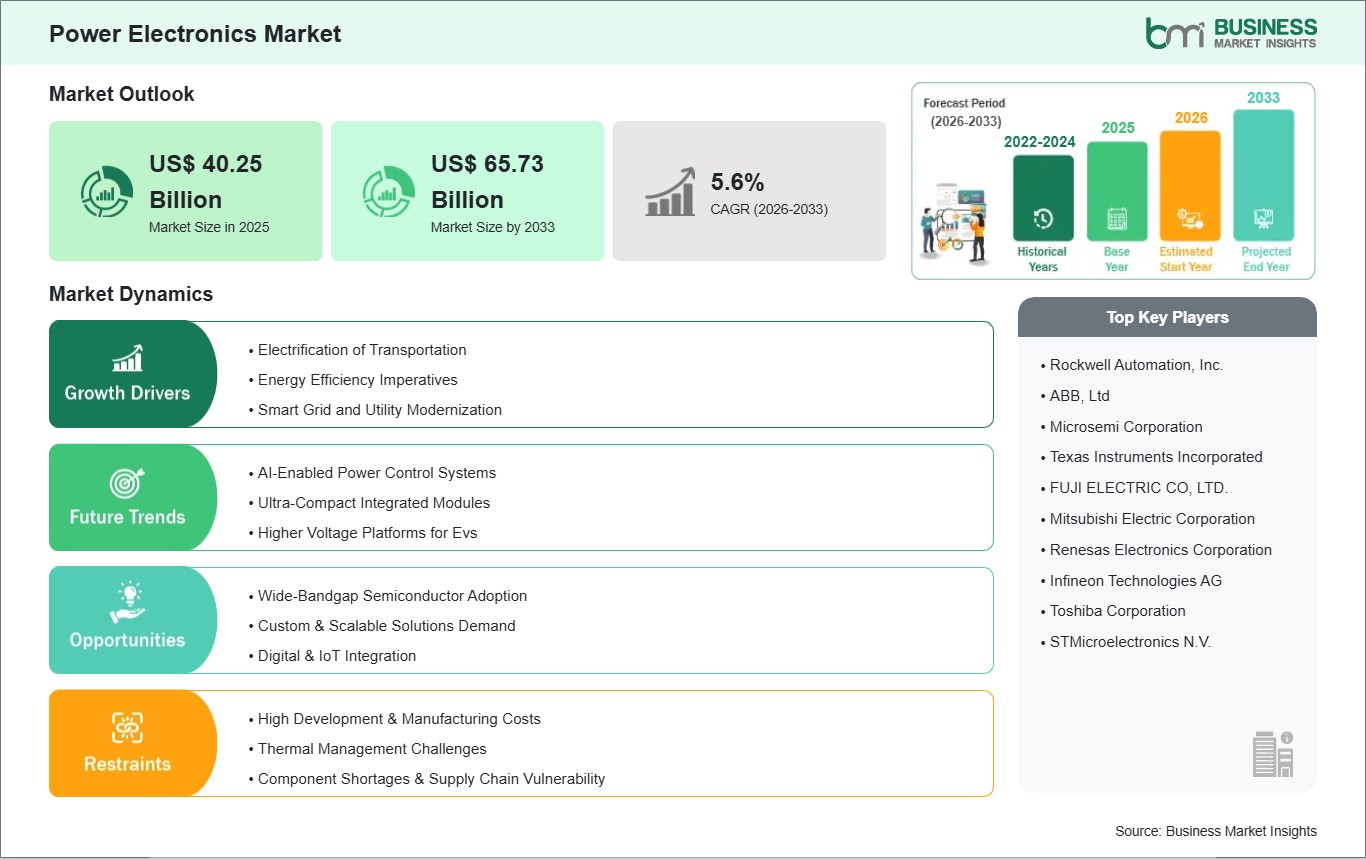
The need for energy, efficient solutions in the transportation, industrial, and consumer sectors is the main factor that has driven the global power electronics market in these segments. The fast spreading of electric vehicles (EVs), the use of energy sources like solar and wind, and the trend to make the smart grids larger are the most visible ways leading to these purchases of the advanced power conversion, inverters, converters, and semiconductor devices.
Industrial automation, robotics, and digital infrastructure data centers, telecom networks, and AI-enabled systems are also contributing to the demand for power electronics that perform well and are reliable. Besides that, progress in wide-bandgap semiconductor (SiC and GaN) and modular, small-sized products is allowing users to increase their systems' energy efficiency, performance, and scalability.
The market has a lot of room for growth. Still, it has to confront the following problems at the same time: high production costs, difficulties in thermal management, bottlenecks in the supply chain, and obstacles in meeting regulations. Difficulty in integrating with old systems and variation in investment cycles of end-user industries may also slow down the adoption of new technologies.
Regardless of these challenges, the market is expected to keep expanding thanks to a variety of opportunities that are available right now, such as the growing EV charging infrastructure, the government subsidies for clean energy technology, the increasing adoption in emerging markets, and the integration of AI and IoT, enabling power management. The world of competition will evolve further as more and more innovations in ultra-compact modules, high-voltage platforms, and intelligent thermal management solutions take place.
Segment Analysis
Power Electronics Market Segmentation
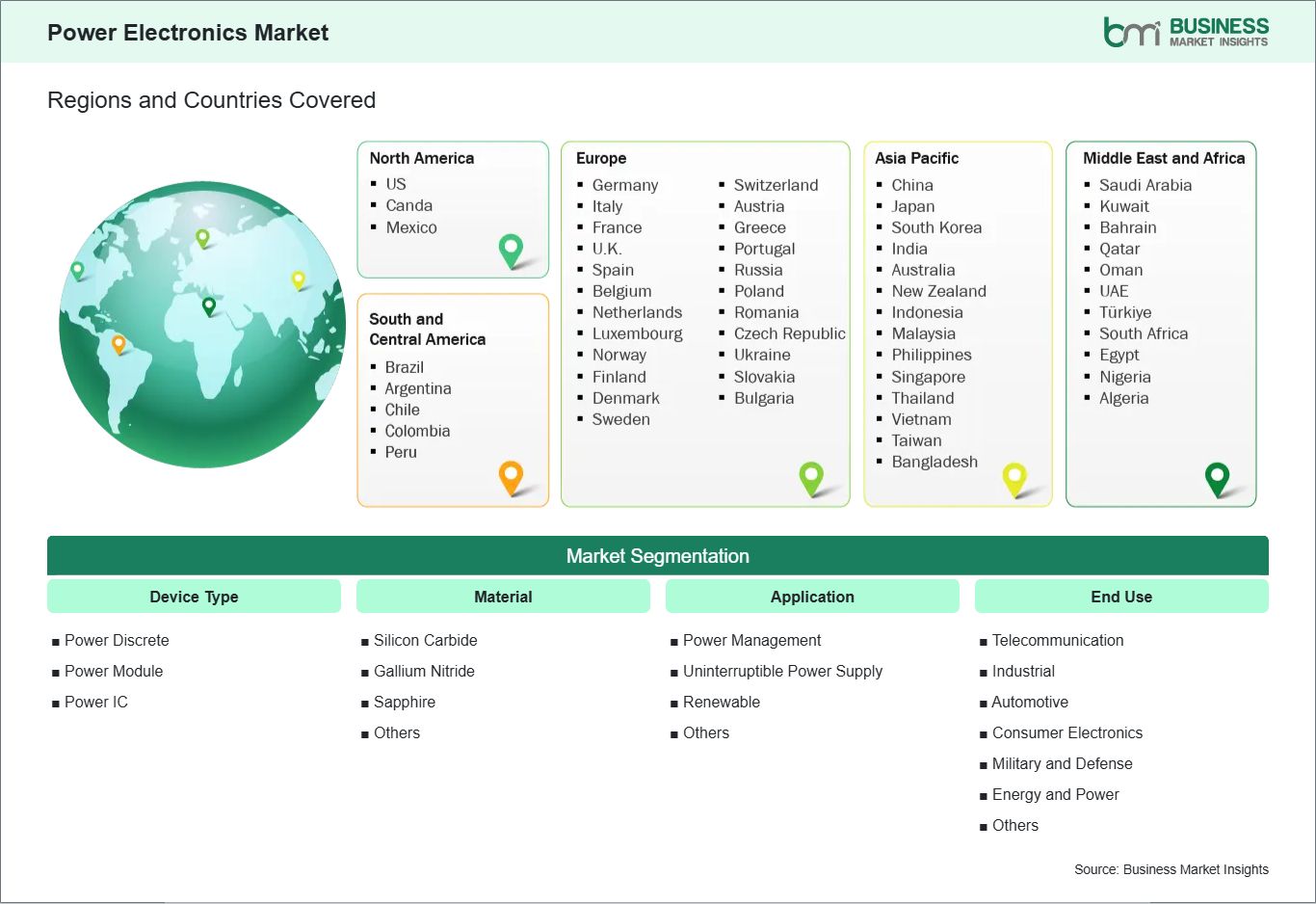
Key segments that contributed to the derivation of the power electronics market analysis are device type, material, application, and end use.
- By device type, the power electronics market is segmented into Power Discrete, Power Module, and Power IC. The Power Discrete segment dominated the market in 2024.
- By material, the market is classified into Silicon Carbide (SiC), Gallium Nitride (GaN), Sapphire, and Others. The SiC segment held the largest share in the power electronics market in 2024.
- By application, the market includes Power Management, Uninterruptible Power Supply (UPS), Renewable Energy, and Others. The Power Management segment held the largest share in the power electronics market in 2024.
- By end-use industry, the market is categorized into Telecommunication, Industrial, Automotive, Consumer Electronics, Military and Defense, Energy and Power, and Others. The Automotive and Industrial segment held the largest share in the power electronics market in 2024.
Market Forces
Power Electronics Market Drivers and Opportunities
Electrification of Transportation
Electrification of passenger vehicles with electric vehicles (EVs), hybrid vehicles (HEVs), and electrified public transport is becoming the dominant trend that is pushing the power electronics market to expand. The automotive manufacturers are spending more and more on advanced inverters, onboard chargers, and power converters in order to comply with the requirements of efficiency, performance, and safety. The increased global focus on cutting greenhouse gas emissions and the government incentives for EVs are thus speeding up the use of power electronics solutions in the entire transport sector.
Wide-Bandgap Semiconductor Adoption
The invention and implementation of wide-bandgap (SiC and GaN) semiconductors are opening up a lot of possibilities for very efficient power conversion systems. These state, of, the, art materials have significantly better efficiency, smaller size, and better thermal stability than the conventional silicon-based devices. The industries of renewable energy, industrial automation, and EV infrastructure are among the most advanced users of SiC and GaN technologies, and they are doing so to cut energy losses, raise the system's uptime, and facilitate EVs to be charged rapidly.
Size and Share Analysis
Power Electronics Market Size and Share Analysis
Based on device type, the power electronics market is segmented into Power Discrete, Power Module, and Power IC. Power Discrete devices currently dominate due to their widespread use in energy conversion and power management applications.
By material, the market is classified into Silicon Carbide (SiC), Gallium Nitride (GaN), Sapphire, and Others. SiC leads adoption in high-power and high-temperature applications due to its superior efficiency and thermal performance.
By application, the market includes Power Management, Uninterruptible Power Supply (UPS), Renewable Energy, and Others. Power Management remains the largest segment due to the growing demand for efficient energy conversion across industries.
By end-use industry, the market is categorized into Telecommunication, Industrial, Automotive, Consumer Electronics, Military and Defense, Energy and Power, and Others. Automotive and Industrial sectors are high-growth areas due to the increasing adoption of electric vehicles, industrial automation, and smart manufacturing.
Report Coverage
Power Electronics Market Report Coverage and Deliverables
The Power Electronics Market Size and Forecast (2022–2033) report provides a detailed analysis of the market covering below areas:
- Power Electronics Market size and forecast at global, regional, and country levels for all the key market segments covered under the scope
- Power Electronics Market trends, as well as market dynamics such as drivers, restraints, and key opportunities
- Power Electronics Market analysis covering key market trends, global and regional framework, major players, regulations, and recent market developments
- Industry landscape and competition analysis covering market concentration, heat map analysis, prominent players, and recent developments for the Power Electronics Market
- Detailed company profiles, including SWOT analysis
Geographic Insights
Power Electronics Market Geographic Insights
The geographical scope of the Power Electronics Market report is divided into five regions: North America, Asia Pacific, Europe, Middle East &; Africa, and South & Central America. The Power Electronics Market in Asia Pacific is expected to grow significantly during the forecast period.
The power electronics market worldwide is segmented into five major regions, namely, North America, Europe, Asia-Pacific, the Middle East & Africa, and South & Central America. Asia-Pacific is expected to have the fastest pace of growth during the prediction period. The necessary factors for such a rapid expansion are the quick electrification of vehicles, the evolution of the renewable energy sector, going industrial with automation techniques, and the implementation of energy-efficient policies by the local Government. China, Japan, South Korea, India, and various Southeast Asian countries are making steep investments in ultra-efficient power devices, SiC and GaN technologies, and industrial power modules to not only meet the still increasing demand for energy but also to facilitate smart grids and renewable energy projects.
North America maintains its position as a key market mainly because of the large number and variety of leading semiconductor manufacturers located in this region, quick market introduction of power modules on the device level for research, and the rising demand for automotive, industrial, and renewable energy sectors. The U.S. and Canada are mainly contributing to the electrification of vehicles, the next generation of manufacturing (smart manufacturing), and energy storage systems by using advanced power ICs, SiC devices, and modular power solutions.
Europe is at the moment going through a stable phase of growth where the local automotive and industrial sectors are the main contributors, along with incentives from the Government for green energy, and investments in high-efficiency power solutions for renewable energy integration. The Middle East & Africa and South & Central America regions are slowly but surely increasing their rates of growth as well.
Industry Activity
Recent Developments
The Power Electronics Market is evaluated by gathering qualitative and quantitative data post primary and secondary research, which includes important corporate publications, association data, and databases. A few of the key developments in the HVAC controls market are:
- In May 2025, Mitsubishi Electric Corporation (Chiyoda-ku, Tokyo) and Musashi Energy Solutions Co., Ltd. (Hokuto City, Yamanashi Prefecture), a subsidiary of Musashi Seimitsu Industry Co., Ltd. (Toyohashi City, Aichi Prefecture), announced today their signing of a partnership and co-development agreement on May 14 for Innovative Energy Storage Devices to be incorporated into Innovative Energy Storage Modules, and Battery Management Systems (BMSs) that monitor and control battery usage for railway operators and rolling stock manufacturers.
- In December 2023, ROHM Co., Ltd. (“ROHM”) and Toshiba Electronic Devices & Storage Corporation (“Toshiba Electronic Devices & Storage”) to collaborate in the manufacture and increased volume production of power devices has been recognized and will be supported by the Ministry of Economy, Trade and Industry as a measure supporting the Japanese Government’s target of secure and stable semiconductor supply. ROHM and Toshiba Electronic Devices & Storage will respectively make intensive investments in silicon carbide (SiC) and silicon (Si) power devices, effectively enhance their supply capabilities, and complementarily utilize each other’s production capacity.
Trust & Transparency
Research Methodology
The market analysis combines proprietary research with secondary data from government agencies, company disclosures, regulatory filings, industry databases and expert interviews. Market estimates are validated through data triangulation, cross-market benchmarking and analyst
review.
View Full Research Methodology
Key Sources Referred:
World Bank – Global Trade Indicators
World Trade Organization (WTO)
(International Monetary Fund )IMF
International Trade Administration (ITA)
Company website
Company annual reports
Company investor presentations