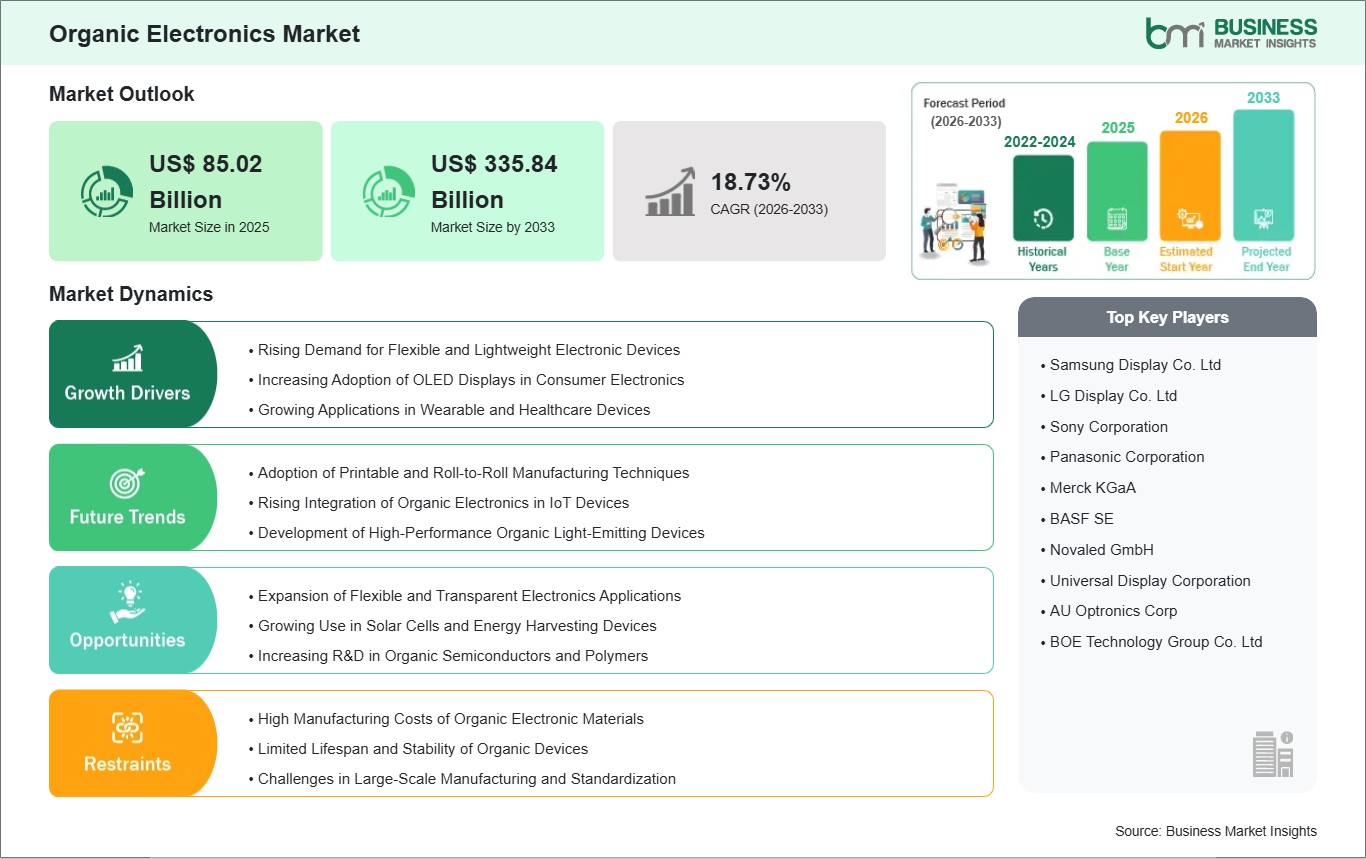
The Organic Electronics Market size is expected to reach US$ 335.84 Billion by 2033 from US$ 85.02 Billion in 2025. The market is estimated to record a CAGR of 18.73% from 2026 to 2033.
The organic electronics market is expanding as industries seek flexible, lightweight, and energy-efficient electronic solutions. Organic electronics use conductive polymers and small molecules to create devices that are adaptable, thin, and capable of bending or stretching. These technologies are widely used in consumer electronics, wearables, flexible displays, lighting, and sensors. The market is driven by the growing demand for portable, flexible devices and the increasing focus on energy-efficient, lightweight electronic components.
One of the key factors supporting growth is the rising demand for flexible and lightweight electronic devices that can provide portability and adaptability for consumer, industrial, and healthcare applications. Additionally, the growing use of organic electronics in solar cells and energy-harvesting devices is creating new opportunities for low-cost, lightweight, and flexible energy solutions. These technologies help support sustainable energy initiatives and expand applications in urban, industrial, and wearable systems.
However, certain restraints remain. Organic electronics may have lower durability and efficiency compared with traditional silicon-based devices, which can limit their adoption in high-performance applications. In addition, large-scale manufacturing and standardization of organic electronic components remain challenging in some regions, potentially slowing market growth.

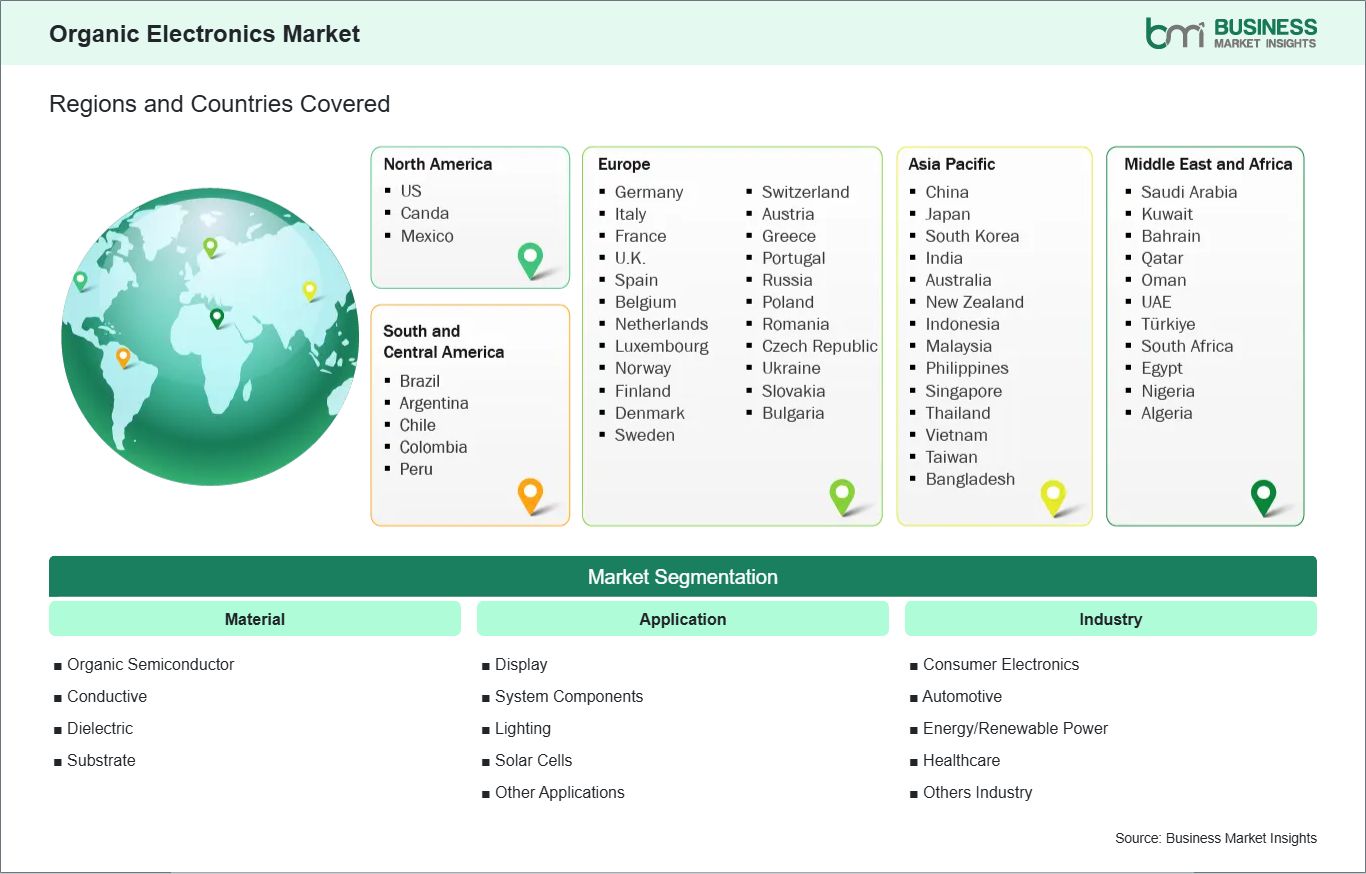
Key segments that contributed to the derivation of the organic electronics market analysis are material, application, industry.
The rising demand for flexible and lightweight electronic devices is a major driver for the organic electronics market. Consumers and industries are increasingly seeking electronic products that are portable, thin, and adaptable to various surfaces. Organic electronic materials, including conductive polymers and small molecules, enable the production of bendable, stretchable, and lightweight devices. These materials are being used in displays, wearable electronics, sensors, and flexible lighting systems, allowing manufacturers to design innovative products that are not possible with traditional silicon-based electronics.
Industries such as consumer electronics, healthcare, and wearables are rapidly adopting organic electronic technologies to meet evolving consumer preferences. Flexible displays for smartphones, foldable tablets, and wearable fitness devices are examples where organic electronics offer advantages like lightweight design, low power consumption, and mechanical flexibility. These benefits are driving the adoption of organic electronic components in next-generation devices. Manufacturers are also exploring integration with smart textiles and other innovative applications where flexibility and adaptability are critical.
In addition, the trend toward miniaturization and portability in electronic devices is increasing the demand for materials that provide both electrical performance and design flexibility. Organic electronics enable efficient energy use and compatibility with lightweight substrates, making them highly suitable for modern consumer electronics and emerging applications. As demand for flexible, portable, and wearable devices continues to grow, the organic electronics market is expected to expand steadily.
The growing use of organic electronics in solar cells and energy harvesting devices is creating strong opportunities for the market. Organic photovoltaic materials allow the development of lightweight, flexible, and low-cost solar panels that can be integrated into buildings, vehicles, and portable devices. Unlike traditional silicon-based solar cells, organic solar cells can be produced on flexible substrates and adapted to a variety of surfaces, providing new opportunities for renewable energy deployment in urban, industrial, and consumer applications.
In addition to solar energy, organic electronics are being used in energy harvesting devices such as flexible sensors, wearable devices, and low-power electronics. These systems can convert light, thermal, or mechanical energy into electricity to power portable or remote devices. Organic materials offer advantages such as low fabrication costs, compatibility with large-area production, and the ability to conform to non-traditional surfaces, which makes them highly suitable for emerging energy-harvesting applications.In addition to that, research and development activities are improving the efficiency and longevity of organic solar cells and energy harvesting devices. The cooperation between the developers of the technology, the academic sector, and the industry is helping to hasten the commercialization of organic energy solutions. As the interest for renewable energy sources, flexible electronics, and sustainable power solutions continues to rise, the integration of organic electronics in solar cells and energy harvesting has tremendous market growth potential.

The global organic electronics market is experiencing steady growth, with market size and share analysis reflecting evolving treatment preferences and competitive dynamics among key players. The report evaluates important subsegments categorized within material, application, industry, highlighting their respective contributions to overall market performance.
By material, the dielectric subsegment dominated the market in 2025, due to its widespread use in separating non-conductive materials in electronics, solar, and semiconductor manufacturing processes where precise material differentiation is critical.
Based on application, the display subsegment dominated the market in 2025, due to high demand for defect-free glass panels and components in smartphones, TVs, and other consumer electronics requiring accurate sorting and quality inspection.
By industry, the consumer electronics subsegment dominated the market in 2025, due to the rapid growth of smartphones, tablets, and display devices, which rely heavily on optical sorting technologies for high-precision component inspection and yield improvement.
| Report Attribute | Details |
|---|---|
| Market size in 2025 | US$ 85.02 Billion |
| Market Size by 2033 | US$ 335.84 Billion |
| Global CAGR (2026 - 2033) | 18.73% |
| Historical Data | 2022-2024 |
| Forecast period | 2026-2033 |
| Segments Covered | By Material
|
|
Regions and Countries Covered
| |
| North America | US, Canada, Mexico |
| Europe | Belgium, Austria, Finland, Denmark, Greece, Poland, Romania, Russia, Ukraine, Czech Republic, Slovakia, Bulgaria, Italy, Luxembourg, Germany, Switzerland, France, Netherlands, Norway, Portugal, Spain, Sweden, United Kingdom |
| Asia-Pacific | Australia, China, India, Japan, South Korea, Indonesia, Malaysia, Philippines, Singapore, Thailand, Vietnam, Bangladesh, New Zealand, Taiwan |
| South and Central America | Brazil, Argentina, Peru, Chile, Colombia |
| Middle East and Africa | Bahrain, Kuwait, Oman, Qatar, Saudi Arabia, United Arab Emirates, Turkiye, South Africa, Egypt, Algeria, Nigeria |
| Market leaders and key company profiles |
|
The "Organic Electronics Market Size and Forecast (2022 - 2033)" report provides a detailed analysis of the market covering below areas:
The geographical scope of the organic electronics market report is divided into: North America, Asia Pacific, Europe, Middle East & Africa, and South & Central America. North America held the largest share in 2025.
North America holds a dominant position in the organic electronics market. As consumers increasingly demand flexible, lightweight, and wearable electronic devices, companies in the region are investing in organic electronic technologies to develop new and innovative products. North America is also witnessing a rising adoption of flexible displays, wearable devices, and smart textiles. There’s a good deal of research and development in organic solar cells and energy-harvesting devices in the region. Universities and other research programs (including government programs) work hand in hand with technology companies. In North America, a focus on sustainable energy sources, smart connected devices, and next-generation electronics drives organic electronics adoption in various applications. North America is the dominant region for the organic electronics market. The region is maintaining its leading position through constant investment for research, new product development, and commercialization of organic electronic devices.

The organic electronics market is evaluated by gathering qualitative and quantitative data post primary and secondary research, which includes important corporate publications, association data, and databases. A few of the key developments in the Organic Electronics market are:
The Organic Electronics Market is valued at US$ 85.02 Billion in 2025, it is projected to reach US$ 335.84 Billion by 2033.
As per our report Organic Electronics Market, the market size is valued at US$ 85.02 Billion in 2025, projecting it to reach US$ 335.84 Billion by 2033. This translates to a CAGR of approximately 18.73% during the forecast period.
The Organic Electronics Market report typically cover these key segments-
The historic period, base year, and forecast period can vary slightly depending on the specific market research report. However, for the Organic Electronics Market report:
The Organic Electronics Market is populated by several key players, each contributing to its growth and innovation. Some of the major players include:
The Organic Electronics Market report is valuable for diverse stakeholders, including:
Essentially, anyone involved in or considering involvement in the Organic Electronics Market value chain can benefit from the information contained in a comprehensive market report.
Please tell us your area of interest
(Market Segments/ Regions and Countries/ Companies)