Automotive Electronics Market Outlook (2022-2033)

Historic Data: 2022-2024   |   Base Year: 2025   |   Forecast Period: 2026-2033
Report Content: Market Scope, Market Segmentation, Market Dynamics, and Competitive Analysis

Report Coverage:
  • Application (Infotainment Systems, Advanced Driver Assistance Systems, Powertrain Control Systems, Body Control Modules, Telematics)
  • Component Type (Sensors, Microcontrollers, Integrated Circuits, Connectors, Displays)
  • Vehicle Type (Passenger Vehicles, Commercial Vehicles, Electric Vehicles, Hybrid Vehicles, Luxury Vehicles)
  • Sales Channel (OEM and Aftermarket)

No. of Pages: 400
Report Code: BMIPUB00032685
Category: Electronics and Semiconductor
Automotive Electronics Market
Buy Now

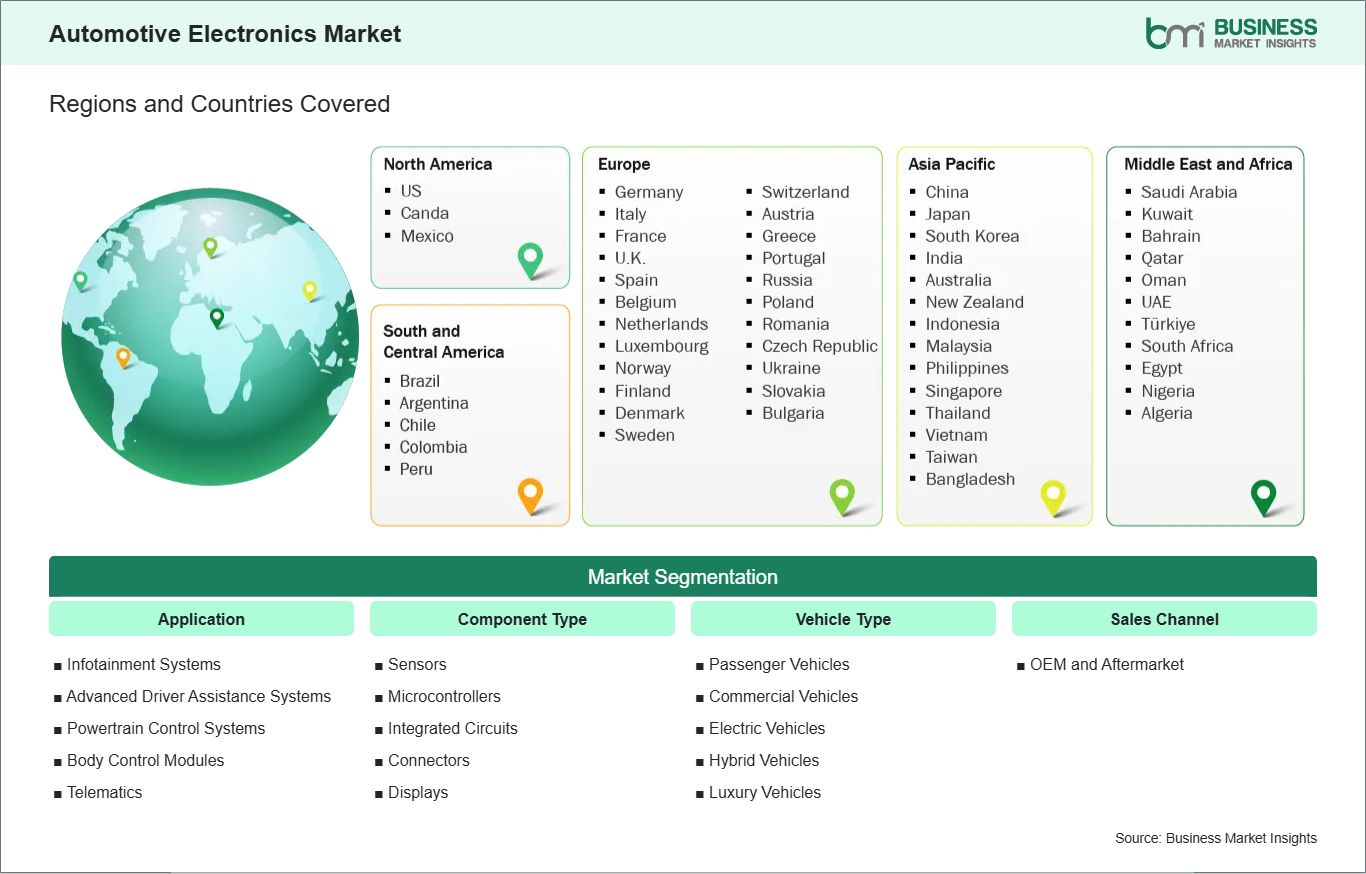
The Automotive Electronics Market size is expected to reach US$ 571.60 billion by 2033 from US$ 296.40 billion in 2025. The market is estimated to record a CAGR of 8.13% from 2026 to 2033.

Executive Summary and Global Market Analysis:

The automotive electronics market is the main factor that leads to the global transformation of vehicles to be safer, more connected, automated, and electrified. The number of electronics has reached a new level where they are now the main supporters in such areas as powertrain control, battery and thermal management, advanced driver assistance systems (ADAS), infotainment, body electronics, and vehicle connectivity which means that the electronic and software content per vehicle has increased significantly. The market growth is fueled by the implementation of regulatory mandates for safety and emissions, pressure from Euro NCAP and NCAP type rating, consumer demand for comfort and digital features, and the fast pace of electrified and hybrid vehicles roll, out which, in turn, heavily rely on power electronics, high voltage architectures, and sophisticated battery management systems.

The journey of ADAS features from rudimentary driver assistance to higher automation levels, as reflected by the burgeoning sales of sensors, radar, cameras, microcontrollers, and high performance domain and zonal computing platforms, is thus far the most significant passenger vehicle, related story of the technology to follow. The major challenges to the market include such factors as supply chain volatility for semiconductors, stringent automotive reliability and functional safety requirements, cybersecurity needs, and rising complexity of software and systems integration across heterogeneous ECUs. But anyway, software defined vehicle architectures, over the air updates, data driven services, and collaborations between automakers and tech companies are creating new recurring revenue streams and transforming value pools across the vehicle lifecycle.

Automotive Electronics Market - Strategic Insights:

global-market-strategic-framework
Get more information on this report

Automotive Electronics Market Segmentation Analysis:

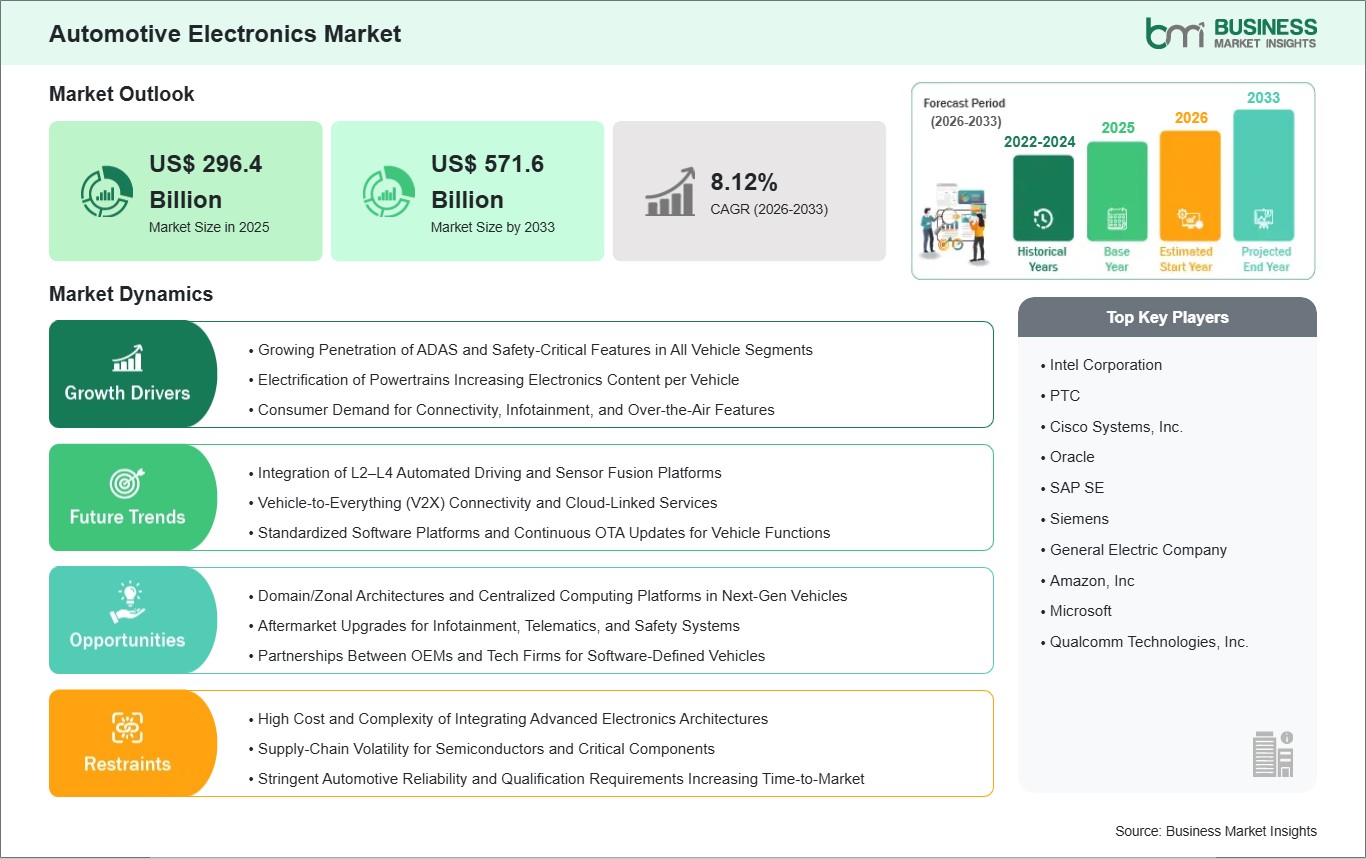
Key segments that contributed to the derivation of the Automotive Electronics market analysis are application, component type, vehicle type, and sales channel.

  • By application, the automotive electronics market is segmented into infotainment systems, advanced driver assistance systems (ADAS), powertrain control systems, body control modules, and telematics. The powertrain control systems segment held the largest share of the market in 2024.
  • By component type, the market is segmented into sensors, microcontrollers, integrated circuits, connectors, and displays. The sensors segment accounted for the largest share of the market in 2024.
  • By vehicle type, the market is segmented into passenger vehicles, commercial vehicles, electric vehicles, hybrid vehicles, and luxury vehicles. The passenger vehicles segment held the largest share of the market in 2024.
  • By sales channel, the market is segmented into OEM and aftermarket. The OEM segment held the largest share of the market in 2024.

Automotive Electronics Market Drivers and Opportunities:

Electrification and ADAS Adoption

Currently, these are the two main factors leading to a substantial rise in the automotive electronics market: electrified powertrains are one, and a rapid adoption of advanced driver assistance systems (ADAS) is the other. Because of their nature, pure electric and plugin hybrid vehicles have to be equipped with power electronics, inverters, onboard chargers, DCDC converters, and battery management systems; therefore, the number of semiconductors in an electric vehicle is hundreds of times higher than in a vehicle with an internal combustion engine. One of the main reasons for such a rapid electrification of the vehicle fleet is a global policy framework of emission standards and OEM decarbonization targets, which, in turn, leads to a huge market for high voltage electronics and thermal management control. Meanwhile, safety requirements and customer expectations are the major reasons of the high adoption rate of ADAS features such as automatic emergency braking, lane keeping assistance, adaptive cruise control, and parking assistance that are nowadays available in the mass market segments. These intelligent systems employ radar, cameras, ultrasonic sensors, lidar, and high, performance ECUs capable of real, time perception and control. Besides that, telematics and over the air update capabilities are some of the new electronic features in the vehicle that keep on extending the footprint as the vehicle becomes more connected.

Software‑Defined and Connected Vehicles

A major opportunity is in the transition to software, defined, connected cars that are backed by centralized and zonal electronic architectures. By OEMs merging a large number of distributed ECUs into a few powerful domain and central compute units, they can make wiring simpler, have less hardware complexity and separate hardware lifecycles from software which is changing very fast. Therefore, continuous over, the, air feature deployment becomes possible from infotainment upgrades to ADAS enhancements and energy, management improvements thus there is the creation of recurring revenue streams through subscriptions and digital services. Those electronics suppliers who provide scalable compute platforms, middleware, and cybersecurity solutions that are functionally safety compliant can increase their take of the pie substantially and become key technology partners rather than simply vendors of commodity components. Fleet management, usage, based insurance, diagnostics, and in, vehicle commerce, which are some of the connectivity advantages, require robust telematics and secure data pipelines. Besides that, the convergence of automotive and consumer electronics ecosystems provides the customers with the integration of app ecosystems, voice assistants, and cloud services, thus they are demanding more flexible, high, bandwidth infotainment and networking hardware. The companies which are able to combine both hardware and software skills, are open, platform supporters, and work with cloud providers are the ones who will gain when cars, as nodes in bigger mobility and data, services networks, become more and more operationally interconnected.

Automotive Electronics Market Size and Share Analysis:

On the basis of application, the automotive electronics market has the following segments: infotainment systems, advanced driver assistance systems (ADAS), powertrain control systems, body control modules, and telematics. The powertrain control systems segment was the most significant part of the market in 2024. Powertrain electronics control engine and transmission management, fuel injection, emission control, and, in the case of xEVs, battery and inverter operation, thus, they are the main ones for the fulfillment of tightening fuel efficiency and emission regulations in all vehicle classes.

Considering the component type, the market is divided into the following categories: sensors, microcontrollers, integrated circuits, connectors, and displays. The sensors segment had the largest share of the market in 2024. Modern vehicles incorporate numerous sensors among which are pressure, temperature, position, radar, lidar, and camera modules to enable ADAS, powertrain optimization, safety systems, and comfort features that is why the volume of sensor integration is increasing rapidly.

Based on vehicle type, the market is divided into five segments: passenger vehicles, commercial vehicles, electric vehicles, hybrid vehicles, and luxury vehicles. The passenger vehicles segment was the leading market player in 2024 in terms of market share resulting from high production volumes and the rapid adoption of infotainment, connectivity, and safety features in mass market cars and SUVs.

By sales channel, the market can be divided into OEM and aftermarket. The OEM segment dominated the market with the biggest share in 2024. To a large extent, the most complex devices, in particular, ADAS, powertrain, and body systems, are directly installed at the factory and are deeply integrated into vehicle platforms, thus a supply from automakers and tier, one supplier is the most feasible way.

Automotive Electronics Market Report Highlights:

Report Attribute Details
Market size in 2025 US$ 296.4 Billion
Market Size by 2033 US$ 571.6 Billion
Global CAGR (2026 - 2033)8.12%
Historical Data 2022-2024
Forecast period 2026-2033
Segments Covered By Application
  • Infotainment Systems
  • Advanced Driver Assistance Systems
  • Powertrain Control Systems
  • Body Control Modules
  • Telematics
By Component Type
  • Sensors
  • Microcontrollers
  • Integrated Circuits
  • Connectors
  • Displays
By Vehicle Type
  • Passenger Vehicles
  • Commercial Vehicles
  • Electric Vehicles
  • Hybrid Vehicles
  • Luxury Vehicles
By Sales Channel
  • OEM and Aftermarket
Regions and Countries Covered North America
  • US
  • Canada
  • Mexico
Europe
  • Belgium
  • Austria
  • Finland
  • Denmark
  • Greece
  • Poland
  • Romania
  • Russia
  • Ukraine
  • Czech Republic
  • Slovakia
  • Bulgaria
  • Italy
  • Luxembourg
  • Germany
  • Switzerland
  • France
  • Netherlands
  • Norway
  • Portugal
  • Spain
  • Sweden
  • United Kingdom
Asia-Pacific
  • Australia
  • China
  • India
  • Japan
  • South Korea
  • Indonesia
  • Malaysia
  • Philippines
  • Singapore
  • Thailand
  • Vietnam
  • Bangladesh
  • New Zealand
  • Taiwan
South and Central America
  • Brazil
  • Argentina
  • Peru
  • Chile
  • Colombia
Middle East and Africa
  • Bahrain
  • Kuwait
  • Oman
  • Qatar
  • Saudi Arabia
  • United Arab Emirates
  • Turkiye
  • South Africa
  • Egypt
  • Algeria
  • Nigeria
Market leaders and key company profiles
  • Hitachi Automotive Systems, Ltd.
  • Infineon Technologies AG
  • Robert Bosch GmbH
  • Valeo Inc.
  • Visteon Corporation
  • Xilinx, Inc.
  • ZF Friedrichshafen AG
  • Continental AG
  • DENSO Corporation
  • Hella GmbH & Co. Kgaa
Get more information on this report

Automotive Electronics Market Report Coverage and Deliverables:

The Automotive Electronics Market Size and Forecast (2022–2033) report provides a detailed analysis of the market covering below areas:

  • Automotive electronics market size and forecast at global, regional, and country levels for all the key market segments covered under the scope
  • Automotive electronics market trends, as well as market dynamics such as drivers, restraints, and key opportunities
  • Automotive electronics market analysis covering key market trends, global and regional framework, major players, regulations, and recent market developments
  • Industry landscape and competition analysis covering market concentration, heat map analysis, prominent players, and recent developments for the Automotive electronics market
  • Detailed company profiles, including SWOT analysis

Automotive Electronics Market Geographic Insights:

The geographical scope of the automotive electronics market report is divided into five regions: North America, Asia Pacific, Europe, Middle East & Africa, and South & Central America. The automotive electronics market in Asia Pacific is expected to grow significantly during the forecast period.

The Asia-Pacific Automotive electronics market is segmented into China, Japan, South Korea, India, Australia, New Zealand, Indonesia, Malaysia, the Philippines, Singapore, Thailand, Vietnam, Taiwan, Bangladesh, and the Rest of Asia. China, Japan, South Korea, and India. the four largest contributors and the ones with the most significant growth potential. China is the biggest automotive manufacturer in the world and a major hub for the production of electric vehicles globally, which in turn is creating a strong demand for power electronics, battery, management systems, ADAS modules, and infotainment units. Japan and South Korea are home to the leading OEMs and tier, one supplier that introduce the most advanced safety, comfort, and connectivity technologies, such as radar, cameras, head, up displays, and integrated cockpit platforms. The explosive growth of the passenger, car and two, wheeler market in India is leading to the increased use of basic safety, telematics, and body, electronics features, with emission and crash, safety regulations getting stricter to support this trend. The Asia Pacific region as a whole is witnessing a rise in the demand for electronics due to government incentives for EVs, the localization of semiconductor and battery manufacturing, and the investments in charging infrastructure. North America is still a very important region because of the presence of premium OEMs, EV specialists, and technology companies that are leading the way in connectivity and autonomous, driving features. Europe is a leader in implementing tough environmental and safety regulations, which is a major factor in the rapid ADAS and xEV technology adoption by the German, French, and Scandinavian automakers. The rest, of, world markets, such as Latin America and the Middle East & Africa, are smaller but still significant in terms of aftermarket electronics, basic safety upgrades, and new EV programs, which are mostly supplied by global manufacturers that operate local assembly plants.

global-market-geography
Get more information on this report

Automotive Electronics Market Research Report Guidance:

  • The report includes qualitative and quantitative data in the Automotive electronics market across application, component type, vehicle type, and sales channel, and geography.
  • The report starts with the key takeaways (chapter 2), highlighting the key trends and outlook of the Automotive electronics market.
  • Chapter 3 includes the research methodology of the study.
  • Chapter 4 further includes ecosystem analysis.
  • Chapter 5 highlights the major industry dynamics in the Automotive electronics market, including factors that are driving the market, prevailing deterrents, potential opportunities, as well as future trends. Impact analysis of these drivers and restraints is also covered in this section.
  • Chapter 6 discusses the Automotive electronics market scenario, in terms of historical market revenues, and forecast till the year 2031.
  • Chapters 7 to 11 cover Automotive electronics market segments by application, component type, vehicle type, and sales channel, and geography across North America, Europe, Asia Pacific, Middle East and Africa, and South and Central America. They cover the market revenue forecast and factors driving the market.
  • Chapter 12 describes the competitive analysis along with the heat map analysis for the key players operating in the market.
  • Chapter 13 describes the industry landscape analysis. It provides detailed descriptions of business activities such as market initiatives, new developments, mergers, and joint ventures globally, along with a competitive landscape.
  • Chapter 14 provides detailed profiles of the major companies operating in the Automotive electronics market. Companies have been profiled on the basis of their key facts, business descriptions, products and services, financial overview, SWOT analysis, and key developments.
  • Chapter 15, i.e., the appendix is inclusive of a brief overview of the company, list of abbreviations, and disclaimer.

Automotive Electronics Market News and Key Development:

The Automotive electronics market is evaluated by gathering qualitative and quantitative data post primary and secondary research, which includes important corporate publications, association data, and databases. A few of the key developments in the automotive electronics market are:

  • In December 2025, The ZF Group is selling its Advanced Driver Assistance Systems (ADAS) business to US in-cabin electronics leader Harman International Inc. This will give Harman a highly sought-after combination of safety and vehicle interior technologies for automotive manufacturers worldwide. The enterprise value agreed upon is €1.5 billion. The transaction is subject to the necessary regulatory approvals.
  • In March 2025, Renesas Electronics Corporation (TSE:6723), a premier supplier of advanced semiconductor solutions, today introduced a new industry-leading Bluetooth chip that combines a radio transceiver, an Arm® M0+ microcontroller, memory, peripherals and security features in a compact SoC design. The DA14533, the first automotive-qualified device in the company’s Bluetooth® Low Energy system-on-chip (SoC) family, includes advanced power management features to simplify system integration and reduce power consumption.

Key Sources Referred:

  • International Energy Agency
  • World Bank – Global Trade Indicators
  • World Trade Organization (WTO)
  • Automotive Electronics Council
  • ECIA
  • ARAI
  • Electronic Components Industry Association (ECIA)
  • International Trade Administration (ITA)
  • Company website
  • Company annual reports
  • Company investor presentations

The List of Companies - Automotive Electronics Market

  • Hitachi Automotive Systems, Ltd.
  • Infineon Technologies AG
  • Robert Bosch GmbH
  • Valeo Inc.
  • Visteon Corporation
  • Xilinx, Inc.
  • ZF Friedrichshafen AG
  • Continental AG
  • DENSO Corporation
  • Hella GmbH & Co. Kgaa
Frequently Asked Questions
How big is the Automotive Electronics Market?

The Automotive Electronics Market is valued at US$ 296.4 Billion in 2025, it is projected to reach US$ 571.6 Billion by 2033.

What is the CAGR for Automotive Electronics Market by (2026 - 2033)?

As per our report Automotive Electronics Market, the market size is valued at US$ 296.4 Billion in 2025, projecting it to reach US$ 571.6 Billion by 2033. This translates to a CAGR of approximately 8.12% during the forecast period.

What segments are covered in this report?

The Automotive Electronics Market report typically cover these key segments-

  • Application (Infotainment Systems, Advanced Driver Assistance Systems, Powertrain Control Systems, Body Control Modules, Telematics)
  • Component Type (Sensors, Microcontrollers, Integrated Circuits, Connectors, Displays)
  • Vehicle Type (Passenger Vehicles, Commercial Vehicles, Electric Vehicles, Hybrid Vehicles, Luxury Vehicles)
  • Sales Channel (OEM and Aftermarket)

What is the historic period, base year, and forecast period taken for Automotive Electronics Market?

The historic period, base year, and forecast period can vary slightly depending on the specific market research report. However, for the Automotive Electronics Market report:

  • Historic Period : 2022-2024
  • Base Year : 2025
  • Forecast Period : 2026-2033
  • Who are the major players in Automotive Electronics Market?

    The Automotive Electronics Market is populated by several key players, each contributing to its growth and innovation. Some of the major players include:

  • Hitachi Automotive Systems, Ltd.
  • Infineon Technologies AG
  • Robert Bosch GmbH
  • Valeo Inc.
  • Visteon Corporation
  • Xilinx, Inc.
  • ZF Friedrichshafen AG
  • Continental AG
  • DENSO Corporation
  • Hella GmbH & Co. Kgaa
  • Who should buy this report?

    The Automotive Electronics Market report is valuable for diverse stakeholders, including:

    • Investors: Provides insights for investment decisions pertaining to market growth, companies, or industry insights. Helps assess market attractiveness and potential returns.
    • Industry Players: Offers competitive intelligence, market sizing, and trend analysis to inform strategic planning, product development, and sales strategies.
    • Suppliers and Manufacturers: Helps understand market demand for components, materials, and services related to concerned industry.
    • Researchers and Consultants: Provides data and analysis for academic research, consulting projects, and market studies.
    • Financial Institutions: Helps assess risks and opportunities associated with financing or investing in the concerned market.

    Essentially, anyone involved in or considering involvement in the Automotive Electronics Market value chain can benefit from the information contained in a comprehensive market report.

    Available Report Formats

    pdf-format excel-format pptx-format
    Buy Now

    Customization Form

    Please tell us your area of interest
    (Market Segments/ Regions and Countries/ Companies)