Market Summary
Executive Summary and Global Market Analysis
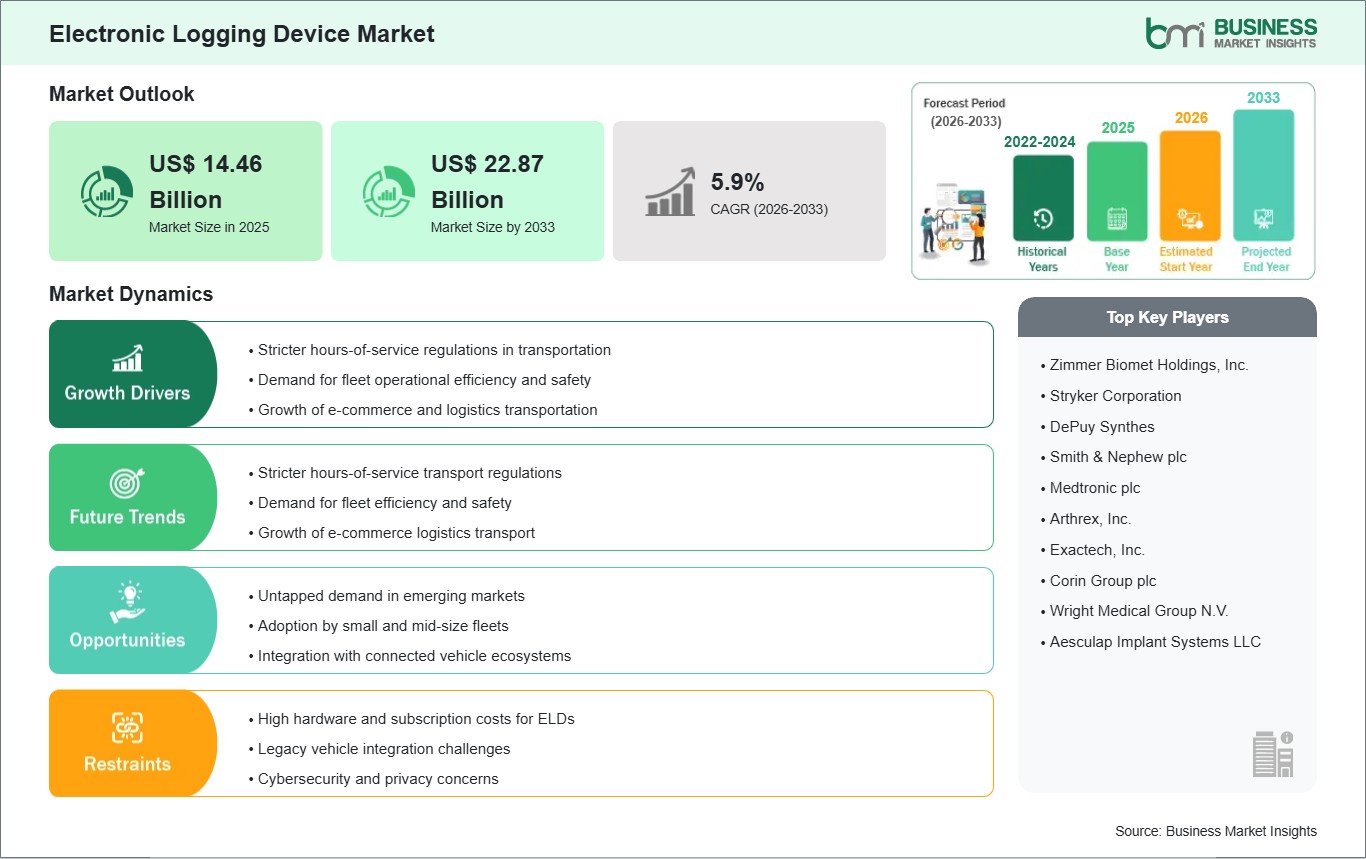
Electronic logging devices have emerged as an essential element in commercial transportation worldwide for ensuring compliance, safety, and operational efficiency. ELDs, telematics units, mobile-based logging applications, hardwired devices, plug-in interfaces, and fleet management software are all being increasingly used in long-haul trucking fleets, last-mile delivery fleets, and bus and coach operations, and these solutions have also gained immense popularity among small and medium-sized fleet operators. Electronic logging devices help fleets gain various advantages, including accurate hours-of-service tracking, improved driver safety, real-time monitoring, enhanced regulatory compliance, and optimized fleet operations. Increasing regulations, rising demand for fleet efficiency, and the growth of logistics and e-commerce industries have generated intense focus on implementing electronic logging solutions.
However, the ELD market has its challenges that may impede its growth. These include the cost of purchasing and integrating devices, the complexity of training drivers and fleet managers, interoperability issues with older vehicles, and the need for regular maintenance and software updates. Costs associated with hardware, subscription-based software services, and evolving regulatory requirements affect the market for ELDs. Despite these challenges, the market for electronic logging devices offers strong growth prospects, mainly driven by the adoption of mobile and cloud-based logging solutions, the integration of AI-enabled fleet analytics, the expansion of long-haul and regional fleets, and the increasing need for automated compliance and fleet management systems.
Segment Analysis
Electronic Logging Device Market Segmentation
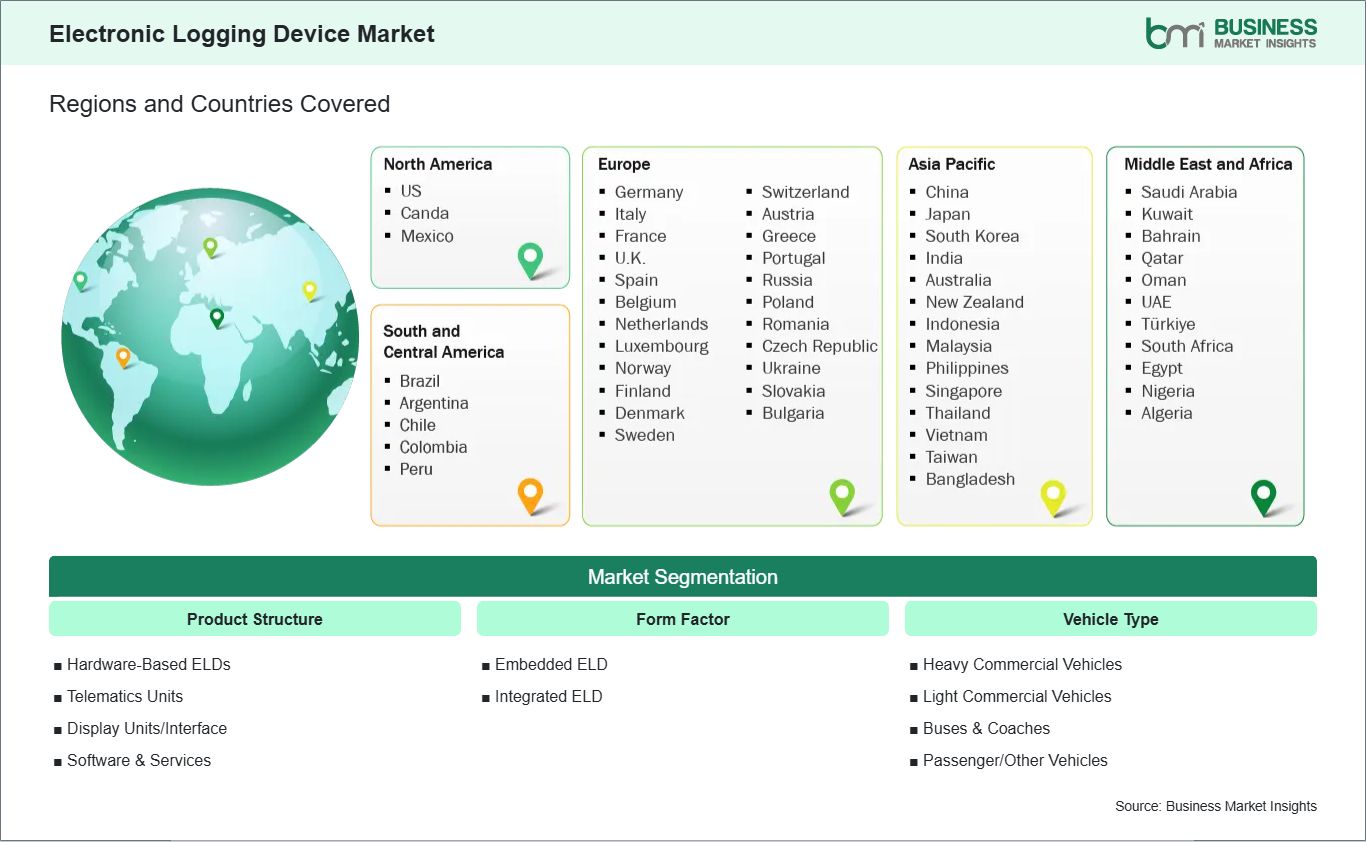
Key segments that contributed to the derivation of the electronic logging device market analysis are product structure, form factor, and vehicle type.
- By product structure, the electronic logging device market is bifurcated into hardware-based ELDs, telematics units, display units/interface, and software & services. The hardware-based ELDs segment dominated the market in 2025.
- By form factor, the market is categorized into embedded ELDs and integrated ELDs. The embedded ELDs segment dominated the market in 2025.
- By vehicle type, the market is segmented into heavy commercial vehicles, light commercial vehicles, buses & coaches, and passenger/other vehicles. The heavy commercial vehicles segment dominated the market in 2025.
Market Forces
Electronic Logging Device Market Drivers and Opportunities
Regulatory Compliance and Safety Mandates
One of the primary drivers of the electronic logging device market is the increasing emphasis on regulatory compliance and driver safety. Governments worldwide, particularly in North America, have mandated ELD usage for commercial vehicles to monitor hours-of-service (HOS) and reduce road accidents caused by driver fatigue. These regulations ensure that fleet operators maintain accurate records, avoid penalties, and enhance overall operational safety. Additionally, ELDs provide real-time data for monitoring driver behavior, reducing risky practices, and promoting safer road operations. The combination of legal requirements and safety priorities continues to drive widespread adoption across heavy and light commercial fleets.
Integration of AI and Fleet Analytics
The adoption of artificial intelligence (AI) and advanced fleet analytics presents a significant growth opportunity for the ELD market. Modern ELDs can now integrate AI-driven predictive analytics to optimize routes, monitor driver behavior, and forecast maintenance needs, enhancing overall fleet efficiency. Fleet operators can leverage data insights to reduce fuel consumption, improve delivery timelines, and minimize operational costs. With the increasing demand for smart transportation solutions and digital fleet management, AI-enabled ELDs offer a competitive advantage, enabling companies to not only comply with regulations but also achieve cost-effective, data-driven fleet operations across long-haul, last-mile, and mixed fleet applications.
Size and Share Analysis
Electronic Logging Device Market Size and Share Analysis
By product structure, the electronic logging device market is segmented into hardware-based ELDs, telematics units, display units/interface, and software & services. Hardware-based ELDs held a significant share in 2025 due to their widespread adoption across commercial fleets, long-haul trucks, and delivery vehicles, driven by strong demand for reliable logging, telematics monitoring, and compliance with hours-of-service regulations.
By form factor, the market is categorized into embedded ELDs and integrated ELDs. Embedded ELDs held a significant share in 2025 owing to regulatory mandates and their seamless integration into vehicle systems, which ensures accurate data capture and uninterrupted compliance reporting.
By vehicle type, the market is segmented into heavy commercial vehicles, light commercial vehicles, buses & coaches, and passenger/other vehicles. Heavy commercial vehicles held a significant share in 2025, as these vehicles face strict hours-of-service regulations and constitute the largest fleet segment requiring electronic logging devices.
Report Coverage
Electronic Logging Device Market Report Coverage and Deliverables
The "Electronic Logging Device Market Size and Forecast (2022-2033)" report provides a detailed analysis of the market covering below areas:
- Electronic Logging Device Market size and forecast at global, regional, and country levels for all the key market segments covered under the scope
- Electronic logging device market trends, as well as market dynamics such as drivers, restraints, and key opportunities
- Electronic logging device market analysis covering key market trends, global and regional framework, major players, regulations, and recent market developments
- Industry landscape and competition analysis covering market concentration, heat map analysis, prominent players, and recent developments for the electronic logging device market
- Detailed company profiles, including SWOT analysis
Geographic Insights
Electronic Logging Device Market Geographic Insights
The geographical scope of the electronic logging device market report is divided into five regions: North America, Asia Pacific, Europe, Middle East & Africa, and South & Central America. The electronic logging device market in Asia Pacific is expected to grow significantly during the forecast period.
The Asia-Pacific electronic logging device market is segmented into China, Japan, South Korea, India, Australia, New Zealand, Indonesia, Malaysia, the Philippines, Singapore, Thailand, Vietnam, Taiwan, Bangladesh, and the Rest of Asia. The region is witnessing strong growth, driven by the rapid expansion of logistics, e-commerce, and commercial transportation sectors. Major economies such as China, Japan, and India are leading market growth due to increasing adoption of ELDs for regulatory compliance, driver safety, and operational efficiency in long-haul and last-mile fleet operations.
The region is also experiencing growing deployment of advanced ELD technologies, including mobile-based logging applications, cloud-enabled fleet management platforms, and telematics-enabled devices. Rising awareness of driver safety, stricter hours-of-service regulations, and government initiatives promoting digital transportation management are further boosting market demand. Additionally, increasing investments in modern fleet infrastructure, integration of AI-based analytics, and the push toward smart logistics are positioning Asia-Pacific as a key growth region in the global electronic logging device market.
Industry Activity
Recent Developments
The electronic logging device market is evaluated by gathering qualitative and quantitative data post primary and secondary research, which includes important corporate publications, association data, and databases. A few of the key developments in the electronic logging device market are:
- The New ELD Mandate 2025 introduces updated rules from the FMCSA that all commercial motor vehicle operators must follow starting in 2025. These ELD regulations include changes to device certification, reporting standards, and compliance procedures. Drivers and fleet operators are now required to adopt advanced logging technology that meets updated federal requirements. These changes are part of ongoing efforts to improve road safety, ensure accurate tracking of driver hours, and facilitate enforcement in the industry. FMCSA updates also include new compliance changes that affect how carriers manage their electronic logs and interact with enforcement agencies. These ELD mandate updates are designed to close gaps in previous systems, increase transparency, and reduce violations. Understanding these upcoming ELD changes is essential for staying compliant and avoiding costly penalties. Staying updated on regulatory developments helps fleets and drivers adjust quickly and meet new standards without disruption
- In February 2022, KeepTruckin, the leader in fleet management technology, announced that its Electronic Logging Device (ELD) solution is now fully certified in Canada for both Android and iOS operating systems. After passing extensive road and bench testing with the accredited certification body CSA Group, KeepTruckin is officially listed on Transport Canada’s website as an approved provider.
Trust & Transparency
Research Methodology
The market analysis combines proprietary research with secondary data from government agencies, company disclosures, regulatory filings, industry databases and expert interviews. Market estimates are validated through data triangulation, cross-market benchmarking and analyst
review.
View Full Research Methodology
Key Sources Referred:
World Bank - Global Trade IndicatorsWorld Trade Organization (WTO)International Monetary Fund (IMF)International Trade Administration (ITA)Company websiteCompany annual reportsCompany investor presentations