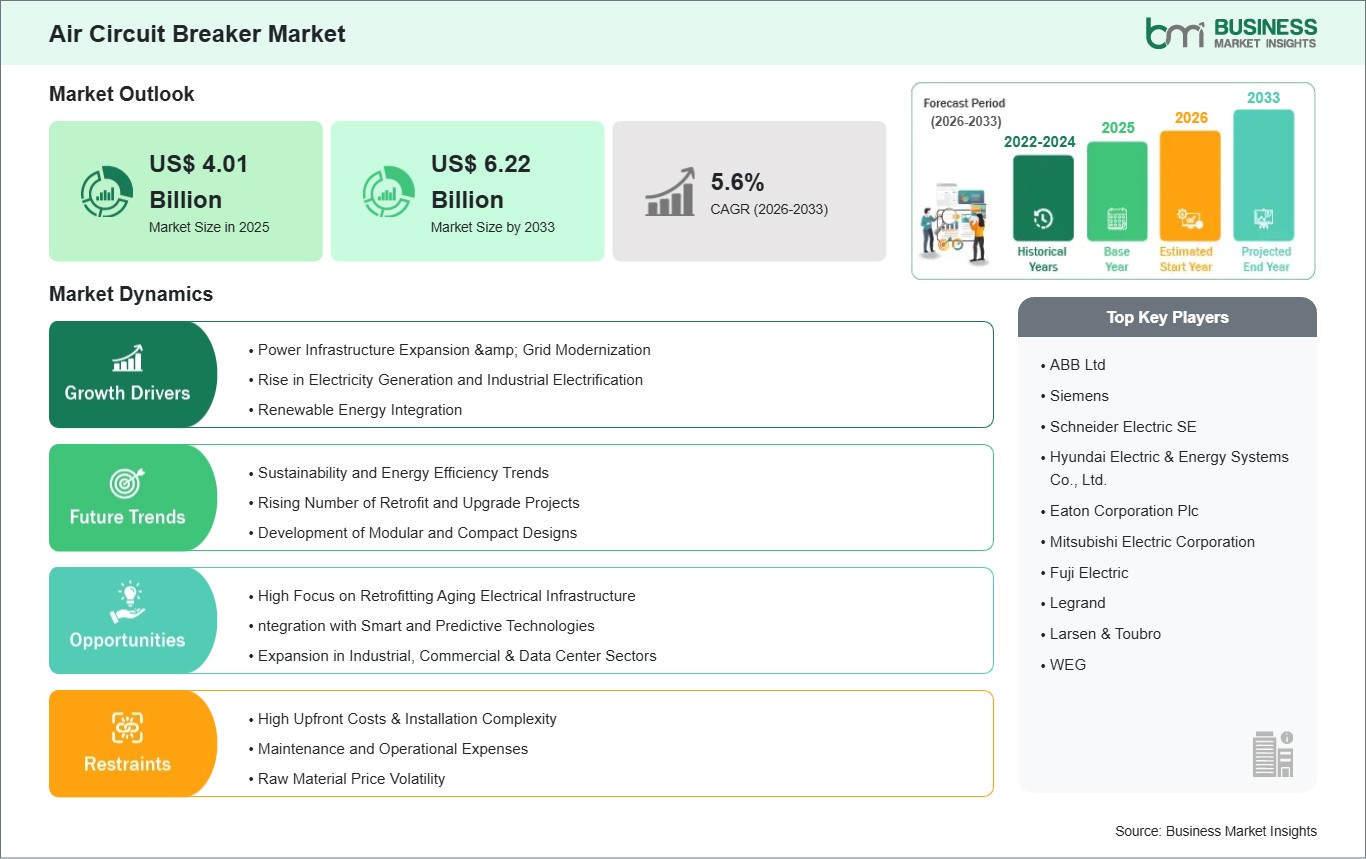
The air circuit breaker market size is expected to reach US$ 6.22 billion by 2033 from US$ 4.01 billion in 2025. The market is estimated to record a CAGR of 5.6% from 2026 to 2033.
An air circuit breaker (ACB) is an electrical protection device designed to interrupt and isolate electrical circuits during overloads, short circuits, or faults by using air as the arc-extinguishing medium. It operates by separating contacts within an air-filled chamber, where the resulting arc is cooled and quenched, ensuring safe disconnection of the power supply. Air circuit breakers are widely used in low- and medium-voltage applications, particularly in industrial plants, commercial buildings, power distribution panels, data centers, and large infrastructure projects, where reliable protection and easy maintenance are essential. Their advantages include high durability, adjustable protection settings, simple construction, and suitability for frequent switching operations. The global demand for air circuit breakers is driven by several factors, including rapid urbanization, expansion of industrial and commercial facilities, and rising investments in power generation and distribution networks. Increasing electricity consumption, integration of renewable energy sources, and the need to modernize aging electrical infrastructure also significantly contribute to market growth. Additionally, stringent safety regulations, growing emphasis on preventing electrical accidents, and the rising adoption of smart and automated power systems are further accelerating the worldwide air circuit breaker market.

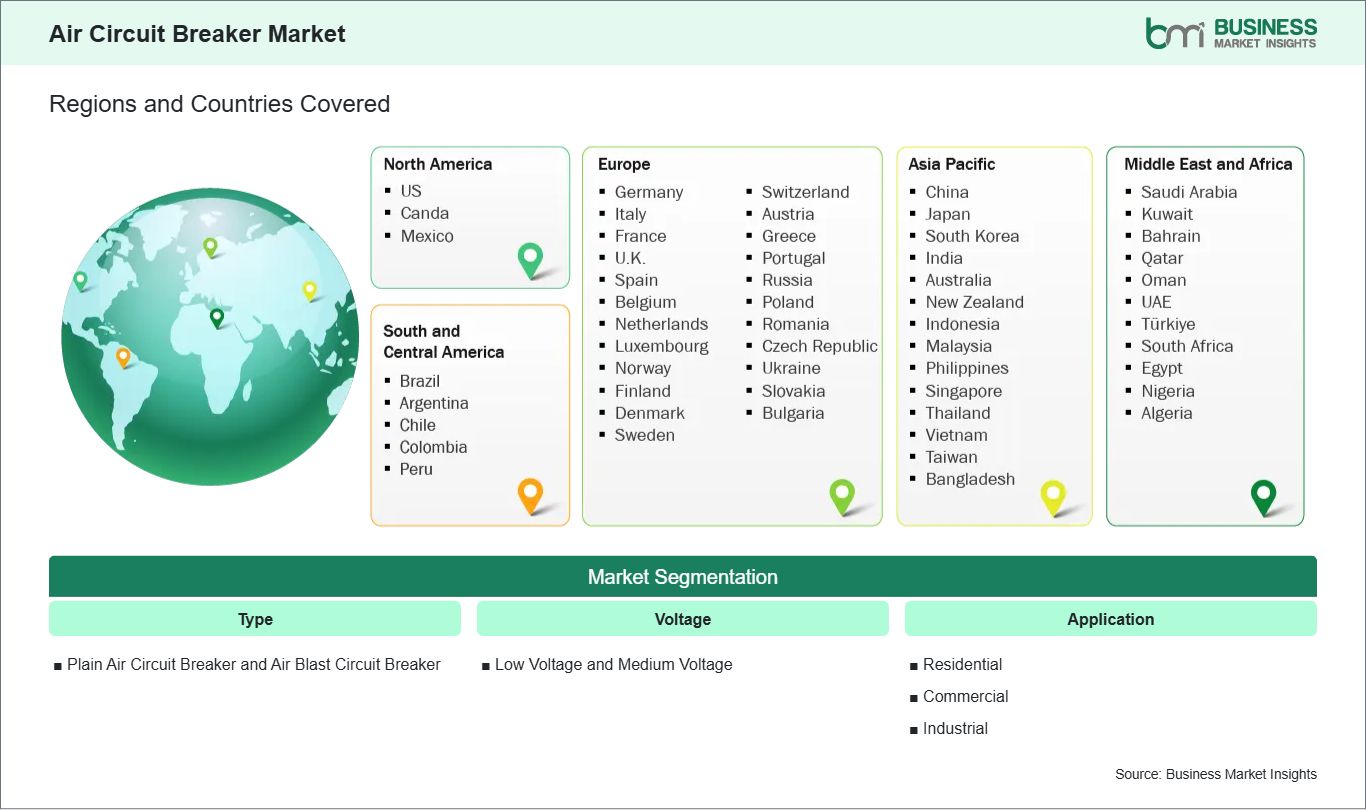
Key segments that contributed to the derivation of the air circuit breaker market analysis are type, voltage, and application.
Power infrastructure expansion and grid modernization are major drivers of the air circuit breaker (ACB) market, as utilities and industries worldwide invest heavily in strengthening electrical networks to meet rising energy demand. Aging grids, particularly in developed economies, are increasingly vulnerable to overloads, short circuits, and power quality issues, creating an urgent need for reliable and high-capacity protection equipment. ACBs play a critical role in modern substations, power distribution panels, and industrial facilities by providing robust protection, high interrupting capacity, and ease of maintenance. As grids integrate renewable energy sources, electric vehicle charging infrastructure, and smart grid technologies, electrical systems become more complex and dynamic, further increasing the need for advanced circuit protection. Additionally, grid modernization projects emphasize safety, operational reliability, and reduced downtime, all of which favor the adoption of ACBs due to their durability, precise fault detection, and compatibility with digital monitoring systems. Consequently, sustained investments in grid expansion and modernization directly translate into higher demand for air circuit breakers across utility and industrial applications.
The focus on retrofitting aging electrical infrastructure is a significant driver of the air circuit breaker (ACB) market, as many industrial, commercial, and utility facilities continue to rely on outdated electrical protection systems. Legacy circuit breakers often lack the advanced safety, monitoring, and fault-handling capabilities required to meet modern power demand, regulatory standards, and reliability expectations. As electrical loads increase due to automation, electrification, and the integration of renewable energy sources, older breakers become more prone to failures, unplanned downtime, and safety risks. Retrofitting existing switchgear with advanced ACBs offers a cost-effective alternative to full system replacement, allowing operators to enhance protection, improve energy efficiency, and extend asset life. Modern ACBs provide features such as digital trip units, real-time diagnostics, predictive maintenance, and improved arc fault protection, which are especially attractive for aging facilities. Consequently, the widespread need to modernize legacy infrastructure creates a large addressable market, driving sustained demand for air circuit breakers across multiple end-use sectors.

By type, the market is segmented into plain air circuit breaker and air blast circuit breaker. The air blast circuit breaker segment held the largest share of the market in 2025. The demand for air blast circuit breakers is increasing due to their high reliability, rapid arc extinction, low maintenance requirements, suitability for high-voltage applications, enhanced safety, and growing investments in power transmission, substations, and expanding electrical infrastructure worldwide.
By voltage, the market is divided into low voltage and medium voltage. The medium voltage segment held the largest share of the market in 2025. Demand for medium voltage air circuit breakers is increasing due to rapid industrialization, grid modernization, renewable energy integration, urban infrastructure expansion, enhanced safety requirements, reliable arc interruption, low maintenance needs, environmental friendliness, and growing investments in substations and distribution networks.
By application, the market is segmented into residential, commercial, and industrial. The industrial segment held the largest share of the market in 2025. The demand for air circuit breakers in industrial applications is increasing due to rising industrial automation, need for reliable power protection, enhanced safety standards, higher fault current handling, easy maintenance, and growing emphasis on uninterrupted and efficient electrical systems.
| Report Attribute | Details |
|---|---|
| Market size in 2025 | US$ 4.01 Billion |
| Market Size by 2033 | US$ 6.22 Billion |
| Global CAGR (2026 - 2033) | 5.6% |
| Historical Data | 2022-2024 |
| Forecast period | 2026-2033 |
| Segments Covered | By Type
|
|
Regions and Countries Covered
| |
| North America | US, Canada, Mexico |
| Europe | Belgium, Austria, Finland, Denmark, Greece, Poland, Romania, Russia, Ukraine, Czech Republic, Slovakia, Bulgaria, Italy, Luxembourg, Germany, Switzerland, France, Netherlands, Norway, Portugal, Spain, Sweden, United Kingdom |
| Asia-Pacific | Australia, China, India, Japan, South Korea, Indonesia, Malaysia, Philippines, Singapore, Thailand, Vietnam, Bangladesh, New Zealand, Taiwan |
| South and Central America | Brazil, Argentina, Peru, Chile, Colombia |
| Middle East and Africa | Bahrain, Kuwait, Oman, Qatar, Saudi Arabia, United Arab Emirates, Turkiye, South Africa, Egypt, Algeria, Nigeria |
| Market leaders and key company profiles |
|
The "Air Circuit Breaker Market Size and Forecast (2022–2033)" report provides a detailed analysis of the market covering below areas:
The geographical scope of the air circuit breaker market report is divided into five regions: North America, Asia Pacific, Europe, Middle East & Africa, and South & Central America. The air circuit breaker market in Asia Pacific is expected to grow significantly during the forecast period.
The Asia Pacific air circuit breaker market is segmented into China, Japan, South Korea, India, Australia, New Zealand, Indonesia, Malaysia, the Philippines, Singapore, Thailand, Vietnam, Taiwan, Bangladesh, and the Rest of Asia Pacific. The demand for air circuit breakers in the Asia Pacific region is increasing due to rapid industrialization, urbanization, and expanding power infrastructure. Many countries such as China, India, and Southeast Asian nations are investing heavily in power generation, transmission, and distribution networks to support growing populations and economic activity. The rise of manufacturing industries, data centers, and commercial buildings has increased the need for reliable and efficient electrical protection systems, driving ACB adoption. Additionally, the integration of renewable energy sources and smart grid technologies requires advanced circuit protection to ensure system stability and safety. Government regulations emphasizing electrical safety standards and energy efficiency further support market growth. Infrastructure development projects, including metro rail systems, airports, and smart cities, also contribute to higher demand for low-voltage switchgear such as air circuit breakers. Moreover, increasing awareness of operational safety, reduced downtime, and ease of maintenance compared to traditional protection devices makes air circuit breakers a preferred choice across various industrial and commercial applications in the Asia Pacific region.

The air circuit breaker market is evaluated by gathering qualitative and quantitative data post primary and secondary research, which includes important corporate publications, association data, and databases. A few of the key developments in the air circuit breaker market are:
The Air Circuit Breaker Market is valued at US$ 4.01 Billion in 2025, it is projected to reach US$ 6.22 Billion by 2033.
As per our report Air Circuit Breaker Market, the market size is valued at US$ 4.01 Billion in 2025, projecting it to reach US$ 6.22 Billion by 2033. This translates to a CAGR of approximately 5.6% during the forecast period.
The Air Circuit Breaker Market report typically cover these key segments-
The historic period, base year, and forecast period can vary slightly depending on the specific market research report. However, for the Air Circuit Breaker Market report:
The Air Circuit Breaker Market is populated by several key players, each contributing to its growth and innovation. Some of the major players include:
The Air Circuit Breaker Market report is valuable for diverse stakeholders, including:
Essentially, anyone involved in or considering involvement in the Air Circuit Breaker Market value chain can benefit from the information contained in a comprehensive market report.
Please tell us your area of interest
(Market Segments/ Regions and Countries/ Companies)