Market Summary
Executive Summary and Global Market Analysis
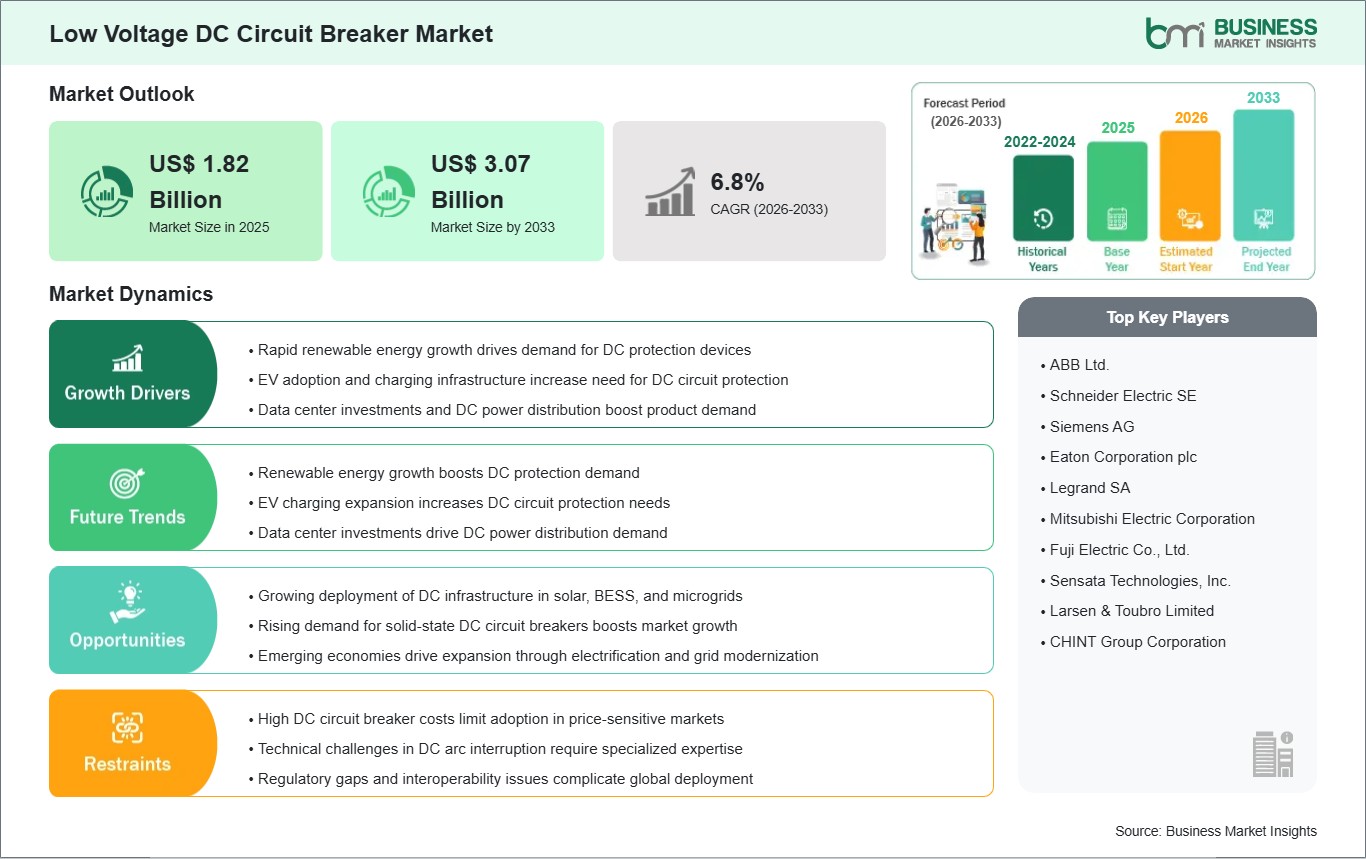
Low voltage DC circuit breakers are automatic electrical switching devices designed to protect direct current (DC) circuits operating at low voltage levels, typically up to 1,500V DC. These breakers are engineered to detect abnormal conditions such as overloads or short circuits and safely interrupt the continuous flow of current. Market progression is primarily propelled by the exponential growth in solar photovoltaic (PV) installations and the massive rollout of electric vehicle (EV) fast-charging infrastructure.
However, several factors may restrain market progression. The technical complexity of DC arc interruption necessitates more sophisticated and expensive designs compared to standard AC breakers, leading to higher initial capital expenditures. Technical hurdles regarding the lack of universal DC protection standards across all regions can complicate the procurement and installation process for multi-national developers. Additionally, the industry faces challenges related to price sensitivity in the residential energy storage segment, where the cost of premium DC protection can significantly impact the overall return on investment for small-scale consumers.
Despite these hurdles, the market holds significant opportunities in the rising adoption of battery energy storage systems (BESS), which require selective and reliable DC protection at the rack and string levels. The expansion into hyperscale data centers, many of which are transitioning to 380V or 800V DC power architectures to improve efficiency, and the integration of IoT-enabled smart breakers for real-time fault diagnostics are expected to support long-term development. Manufacturers are also finding growth potential in hybrid and solid-state circuit breakers, which utilize power electronics to achieve ultra-fast interruption times in the microsecond range.
Segment Analysis
Low Voltage DC Circuit Breaker Market Segmentation
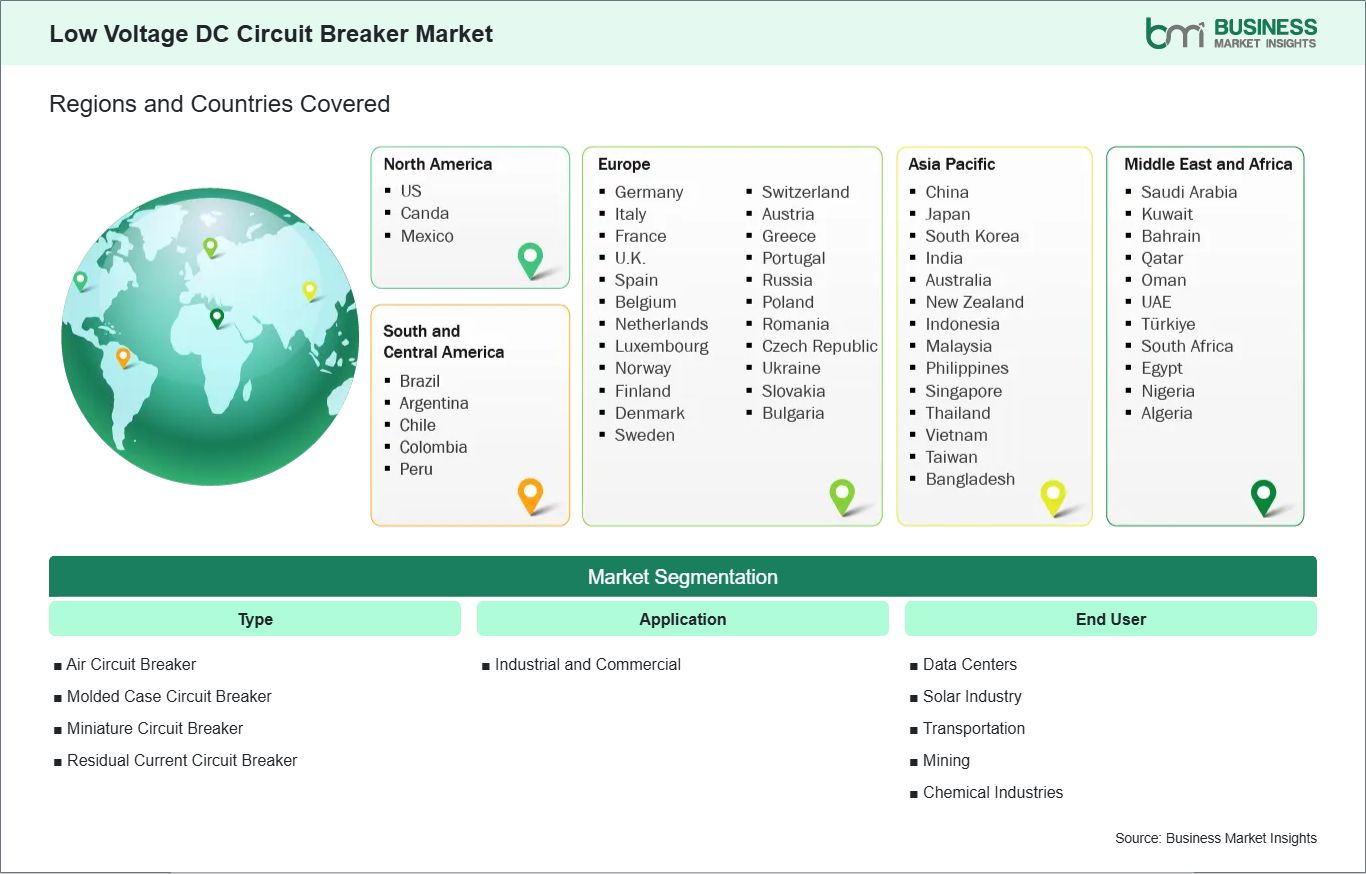
Key segments that contributed to the derivation of the Low Voltage DC Circuit Breaker market analysis are type, application, and end user.
- By Type, the market is segmented into Air Circuit Breaker, Molded Case Circuit Breaker, Miniature Circuit Breaker, and Residual Current Circuit Breaker.
- By Application, the market is divided into Industrial and Commercial.
- By End User, the market is categorized into Data Centers, Solar Industry, Transportation, Mining, and Chemical Industries.
Market Forces
Low Voltage DC Circuit Breaker Market Drivers and Opportunities
Electrification of Transportation and Renewable Energy Integration
A primary driver for the low voltage DC circuit breaker market is the accelerating electrification of transportation and the integration of renewable energy systems into modern power infrastructure. With the rapid adoption of electric vehicles (EVs), charging stations, and energy storage systems, the demand for reliable DC protection devices has surged. Low voltage DC circuit breakers are essential for safeguarding batteries, converters, and distribution systems against overloads and short circuits, ensuring both safety and operational efficiency. The exponential growth of solar photovoltaic installations and wind energy projects further amplifies this driver, as DC power management becomes critical in renewable integration. Additionally, the expansion of data centers and telecom infrastructure, which increasingly rely on DC power distribution for efficiency and reliability, is fueling sustained demand. Government regulations mandating energy efficiency and safety compliance in electrical systems reinforce the adoption of advanced DC circuit breakers. Collectively, the convergence of EV adoption, renewable energy expansion, and digital infrastructure growth is propelling the global market forward, making low voltage DC circuit breakers indispensable in modern energy ecosystems.
Smart Grids, IoT Integration, and Emerging Market Expansion
A significant opportunity in the low voltage DC circuit breaker market lies in the convergence of smart grid technologies, IoT-enabled monitoring, and expansion into emerging economies. As utilities and industries transition toward intelligent power distribution networks, there is growing demand for circuit breakers equipped with digital sensors, remote monitoring, and predictive maintenance capabilities. These smart breakers enable real-time fault detection, automated response, and enhanced grid resilience, aligning with the broader trend of digital transformation in energy systems. The rise of microgrids and distributed energy resources (DERs), including rooftop solar and battery storage, further amplifies this opportunity, as DC circuit breakers are essential for managing bidirectional power flows and ensuring safe integration of decentralized assets. Beyond technological innovation, emerging markets in Asia-Pacific, Africa, and Latin America present lucrative growth prospects due to rapid electrification initiatives, urbanization, and infrastructure investments aimed at expanding reliable access to electricity. Vendors who focus on developing compact, cost-effective, and digitally enabled DC circuit breakers tailored for these regions are well-positioned to capture new market segments. This convergence of smart infrastructure, IoT integration, and geographic expansion underscores a transformative growth frontier for the global low voltage DC circuit breaker market.
Size and Share Analysis
Low Voltage DC Circuit Breaker Market Size and Share Analysis
The Low Voltage DC Circuit Breaker market demonstrates steady growth, with size and share analysis revealing evolving trends and competitive positioning among key players. The report examines subsegments categorized within type, application, and end user, offering insights into their contribution to overall market performance.
Based on type, the Molded Case Circuit Breakers subsegment holds the primary market presence within the circuit protection market. These units are indispensable due to their adaptability, cost-efficiency, and robust protection mechanisms, making them highly suitable for residential and light industrial environments. Their compact design and reliable performance ensure consistent safeguarding against overloads and short circuits, reinforcing their role as a foundational solution in electrical distribution. By combining versatility with durability, MCCBs continue to anchor demand and maintain their dominant influence, positioning themselves as a critical driver of safety and efficiency in modern power systems.
Report Coverage
Low Voltage DC Circuit Breaker Market Report Coverage and Deliverables
The "Low Voltage DC Circuit Breaker Market Size and Forecast (2022 - 2033)" report provides a detailed analysis of the market covering below areas:
- Market size and forecast at global, regional, and country levels for all market segments covered under the scope
- Market trends, as well as drivers, restraints, and opportunities
- Market analysis covering key trends, global and regional framework, major players, and recent developments
- Market concentration, heat map analysis, prominent players, and recent developments
- Detailed company profiles, including SWOT analysis
Geographic Insights
Low Voltage DC Circuit Breaker Market Geographic Insights
The geographical scope of the Low Voltage DC Circuit Breaker market report is divided into five regions: North America, Asia Pacific, Europe, Middle East & Africa, and South & Central America.
Asia Pacific maintains the most substantial market share, supported by its status as the global leader in renewable energy installations and rapid urbanization. North America is recognized as the fastest-growing region, driven by the aggressive modernization of aging power infrastructure and the proliferation of hyperscale data centers. Europe serves as a strategic hub for technical innovation, characterized by stringent environmental regulations and the early adoption of solid-state circuit protection technologies. The Asia-Pacific Low Voltage DC Circuit Breaker Market serves as the primary engine for global expansion, anchored by massive state-led investments in solar photovoltaic arrays and electric vehicle ecosystems in China and India. These nations are leading the transition toward Smart Grid Infrastructure, prioritizing the protection of high-density DC microgrids in industrial and residential sectors. China remains the dominant regional force, utilizing its robust manufacturing base to supply high-performance molded case circuit breakers for its expanding network of EV fast-charging stations. India is witnessing a notable transition, marked by significant institutional support for rural electrification and the development of sustainable transportation corridors that necessitate advanced DC protection.
Industry Activity
Recent Developments
The Low Voltage DC Circuit Breaker market is evaluated by gathering qualitative and quantitative data post primary and secondary research, which includes important corporate publications, association data, and databases. A few of the key developments in the Low Voltage DC Circuit Breaker market are:
- In October 2025, Onsemi completed the acquisition of Vcore Power Technology from Aura Semiconductor, including associated IP licenses. The deal strengthens onsemi`s power management portfolio, particularly in areas like 800 VDC distribution and core power delivery for AI data centers. By enhancing its capabilities across the DC power tree, this acquisition supports innovations in low-voltage DC systems, enabling more reliable, scalable, and efficient power distribution solutions.
- In February 2024, Trystar acquired Primax Technologies, a company specializing in AC and DC power backup solutions, including UPS systems used in critical industrial, utility, and data center applications. The acquisition expands Trystar`s DC power portfolio, strengthening its ability to provide reliable low-voltage DC backup and distribution solutions, which are directly relevant to the low-voltage DC circuit breaker market
Trust & Transparency
Research Methodology
The market analysis combines proprietary research with secondary data from government agencies, company disclosures, regulatory filings, industry databases and expert interviews. Market estimates are validated through data triangulation, cross-market benchmarking and analyst
review.
View Full Research Methodology
Key Sources Referred:
World Bank & Global Trade IndicatorsWorld Trade Organization (WTO)(International Monetary Fund )IMFInternational Trade Administration (ITA)Company websiteCompany annual reportsCompany investor presentations