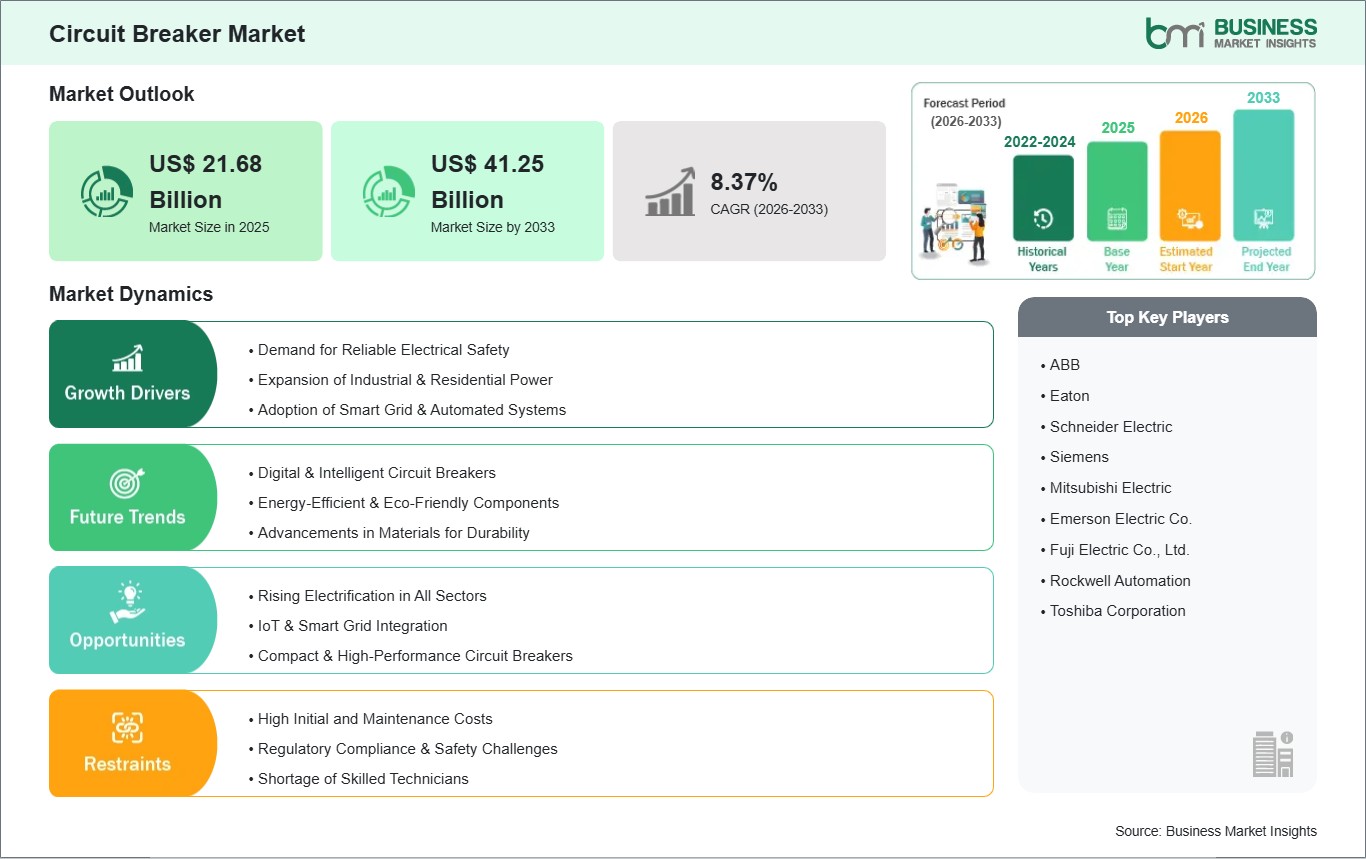
The Circuit Breaker Market size is expected to reach US$ 41.25 Billion by 2033 from US$ 21.68 Billion in 2025. The market is estimated to record a CAGR of 8.37% from 2026 to 2033.
The global circuit breaker market now plays a major role in the electrical equipment and power infrastructure industry. Its growth comes from rapid electrification, grid upgrades, and industrial expansion in both developed and developing countries. Circuit breakers are crucial for keeping electrical systems safe and reliable by stopping fault currents and protecting equipment. As decarbonization gains importance, utilities and industries are putting more money into advanced circuit protection technologies that support renewable energy, smart grids, and automation. The push for energy-efficient infrastructure that meets the needs of modern power networks is a key driver for the market. With digital technology now common in power generation, transmission, and distribution, advanced circuit breakers with remote monitoring, fault diagnostics, and integration with energy management systems are in higher demand. At the same time, strict regulations on electrical safety and system reliability are prompting upgrades to older systems and the use of high-performance protective devices. Still, the high upfront cost of advanced circuit breaker technologies can be a barrier, especially where older systems are widespread. Supply chain problems and shortages of components have also sometimes delayed production and slowed deployment in some areas.

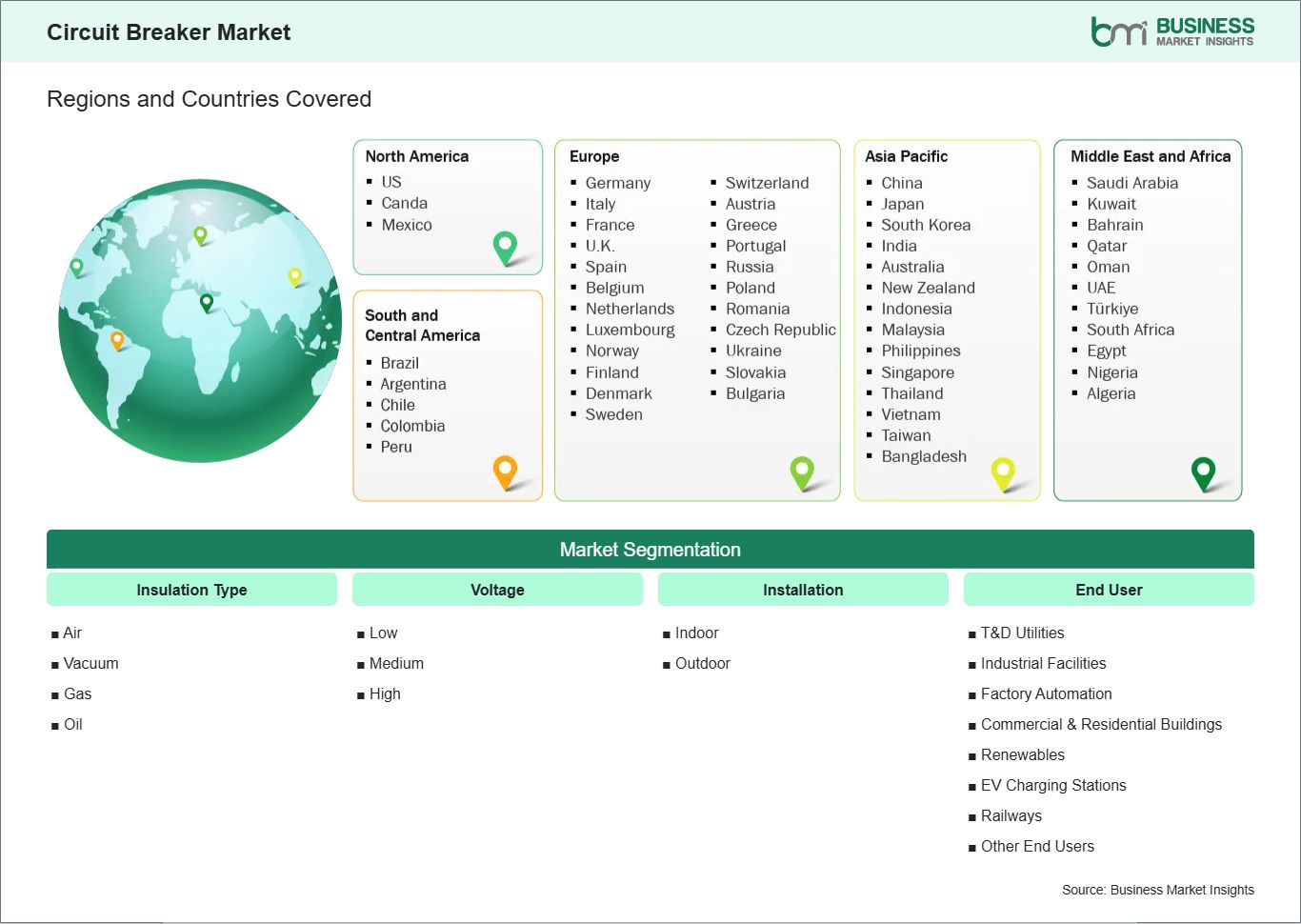
Key segments that contributed to the derivation of the circuit breaker market analysis are insulation type, voltage, installation, and end user.
The global market for circuit breakers is being driven by the increasing need for electrical safety. Circuit breakers are considered to be one of the most essential electrical devices that can help in the overall safety of electrical equipment. They can help in the overall safety of electrical equipment against overload, short circuits, and other unexpected electrical faults. As the complexity of electrical power networks has increased, the need for electrical safety has become extremely critical. With the increasing need for electrical safety, the importance of circuit breakers has become extremely critical. With the increasing need for electrical safety, the importance of circuit breakers has become extremely critical. They have become extremely critical in order to ensure the overall continuity of operations in various industries. They have become extremely critical in order to ensure the overall continuity of operations in various industries.
Advances in circuit breaker technology are further supporting market growth. Modern breakers feature improved insulation, faster response times, and the ability to integrate with smart monitoring systems. These enhancements enable predictive maintenance, real-time fault detection, and energy-efficient operation, reinforcing their role as a key component in ensuring electrical safety and operational reliability worldwide.
The ongoing expansion of electrification across residential, commercial, and industrial sectors presents significant opportunities for the circuit breaker market. As energy consumption rises globally, buildings, factories, and infrastructure projects increasingly require reliable protection to manage higher electrical loads safely. This trend is driving demand for circuit breakers capable of handling diverse applications while ensuring system stability.
The integration of smart technology and automation tools has increased the attractiveness of modern circuit breakers. Real-time monitoring and analysis, and remote control capabilities, help users maximize energy consumption and minimize maintenance costs. Modern circuit breakers, therefore, are not just protective devices; they are key tools for efficient energy management in our increasingly electrified world.
Moreover, the global emphasis placed on energy efficiency and sustainable energy distribution is another factor that is contributing to the market's progress. Circuit breakers that offer superior performance and minimize energy loss are helping to save businesses and industries money, extend the lifespan of equipment, and create a more sustainable electrical infrastructure. As electrification continues to spread throughout all industries, the need for efficient and intelligent circuit breakers is likely to continue to increase, providing future opportunities.
The circuit breaker market is experiencing steady growth, with market size and share analysis reflecting evolving treatment preferences and competitive dynamics among key players. The report evaluates important subsegments categorized within are insulation type, voltage, installation, and end user, highlighting their respective contributions to overall market performance.
By insulation type, the air subsegment dominated the Circuit Breaker and Fuse market in 2025. This is due to the widespread adoption of air-insulated breakers for medium- and high-voltage applications, offering reliability, ease of maintenance, and cost-effectiveness in industrial, commercial, and utility settings.
Based on voltage, the medium-voltage subsegment dominated the Circuit Breaker and Fuse market in 2025. Medium-voltage breakers are extensively used in power distribution networks and industrial facilities, providing safe and efficient interruption of electrical faults, which drives their high adoption globally.
In terms of installation, the indoor subsegment dominated the Circuit Breaker and Fuse market in 2025. Indoor installations are preferred for their controlled environment, enhanced safety, and ease of maintenance, particularly in industrial plants and commercial buildings.
By end user, the T&D utilities subsegment dominated the Circuit Breaker and Fuse market in 2025. Transmission and distribution networks require robust protection systems to ensure grid stability, prevent outages, and comply with regulatory standards, which drives demand for circuit breakers and fuses.
By region, the North America subsegment dominated the Circuit Breaker and Fuse market in 2025. The region’s leadership is supported by mature electrical infrastructure, high industrial activity, and increasing investments in modernization of T&D networks, reinforcing its position as the largest market globally.

| Report Attribute | Details |
|---|---|
| Market size in 2025 | US$ 21.68 Billion |
| Market Size by 2033 | US$ 41.25 Billion |
| Global CAGR (2026 - 2033) | 8.37% |
| Historical Data | 2022-2024 |
| Forecast period | 2026-2033 |
| Segments Covered | By Insulation Type
|
|
Regions and Countries Covered
| |
| North America | US, Canada, Mexico |
| Europe | Belgium, Austria, Finland, Denmark, Greece, Poland, Romania, Russia, Ukraine, Czech Republic, Slovakia, Bulgaria, Italy, Luxembourg, Germany, Switzerland, France, Netherlands, Norway, Portugal, Spain, Sweden, United Kingdom |
| Asia-Pacific | Australia, China, India, Japan, South Korea, Indonesia, Malaysia, Philippines, Singapore, Thailand, Vietnam, Bangladesh, New Zealand, Taiwan |
| South and Central America | Brazil, Argentina, Peru, Chile, Colombia |
| Middle East and Africa | Bahrain, Kuwait, Oman, Qatar, Saudi Arabia, United Arab Emirates, Turkiye, South Africa, Egypt, Algeria, Nigeria |
| Market leaders and key company profiles |
|
The "Circuit Breaker Market Size and Forecast (2022 - 2033)" report provides a detailed analysis of the market covering below areas:
The geographical scope of the Circuit Breaker market report is divided into five regions: North America, Asia Pacific, Europe, Middle East & Africa, and South & Central America. The Circuit Breaker market in North America is expected to grow during the forecast period.
North America has a strong electrical infrastructure and a busy industrial sector. Utilities and large industrial users here have been early adopters of reliable circuit breakers, helping to modernize old grids and reduce power outages. Strict regulations support this progress by focusing on grid stability, workplace electrical safety, and environmental standards. Local manufacturers and tech companies are investing in research and development to launch digital circuit breakers, which offer better connectivity, predictive maintenance, and easy integration with automation systems. The fast growth of renewable energy, such as large solar and wind projects, has also increased the need for advanced circuit protection that can manage complex power flows and two-way currents. North America’s focus on lifecycle services and upgrades has built a strong aftermarket, with many companies updating or replacing their breakers. Collaboration between utilities, government agencies, and private companies is driving pilot projects and large-scale rollouts, keeping North America at the forefront of circuit breaker technology. Although Asia-Pacific and Europe are expanding quickly, North America’s established infrastructure, strong regulations, and commitment to innovation keep it in a leading position worldwide.

The circuit breaker market is evaluated by gathering qualitative and quantitative data post primary and secondary research, which includes important corporate publications, association data, and databases. A few of the key developments in the circuit breaker market are:
The Circuit Breaker Market is valued at US$ 21.68 Billion in 2025, it is projected to reach US$ 41.25 Billion by 2033.
As per our report Circuit Breaker Market, the market size is valued at US$ 21.68 Billion in 2025, projecting it to reach US$ 41.25 Billion by 2033. This translates to a CAGR of approximately 8.37% during the forecast period.
The Circuit Breaker Market report typically cover these key segments-
The historic period, base year, and forecast period can vary slightly depending on the specific market research report. However, for the Circuit Breaker Market report:
The Circuit Breaker Market is populated by several key players, each contributing to its growth and innovation. Some of the major players include:
The Circuit Breaker Market report is valuable for diverse stakeholders, including:
Essentially, anyone involved in or considering involvement in the Circuit Breaker Market value chain can benefit from the information contained in a comprehensive market report.
Please tell us your area of interest
(Market Segments/ Regions and Countries/ Companies)