Market Summary
Executive Summary and Global Market Analysis
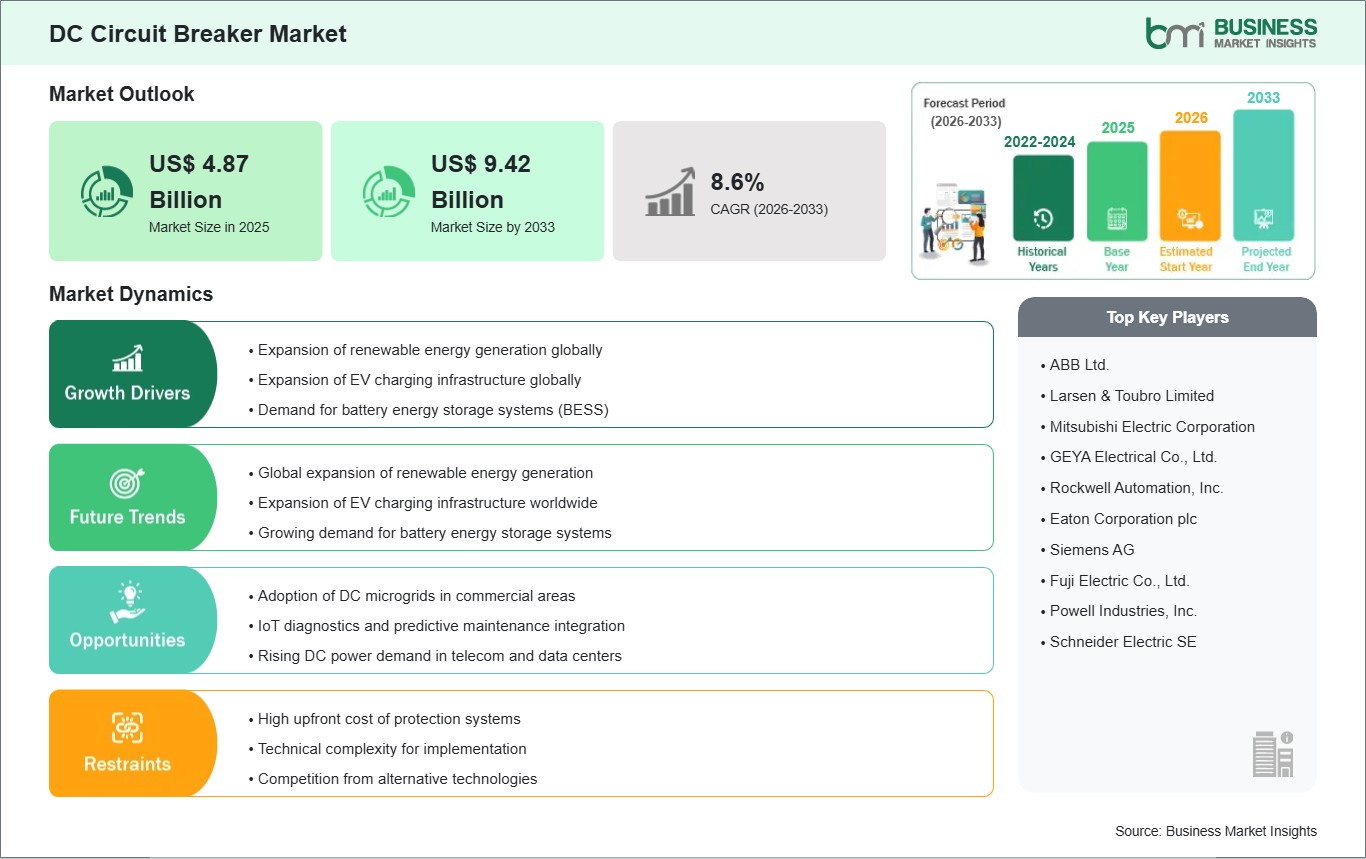
A DC circuit breaker is an electrical device designed to protect direct current (DC) systems from overcurrent, short circuits, and faults by interrupting the flow of electricity when unsafe conditions occur. Unlike AC breakers, DC breakers must handle unidirectional current without the natural zero-crossing point, making their design more complex. They are widely used in renewable energy systems such as solar photovoltaic (PV) arrays, electric vehicles (EVs), data centers, and industrial DC networks to ensure safety and prevent equipment damage. The demand for DC circuit breakers is driven by several factors, including the rapid adoption of renewable energy, the growing EV market, the expansion of microgrids, and the increasing use of DC power distribution in modern electronic and industrial systems. Additionally, government incentives for clean energy, technological advancements in breaker design, and the need for reliable, high-efficiency power management are key contributors to the market’s growth.
Segment Analysis
DC Circuit Breaker Market Segmentation
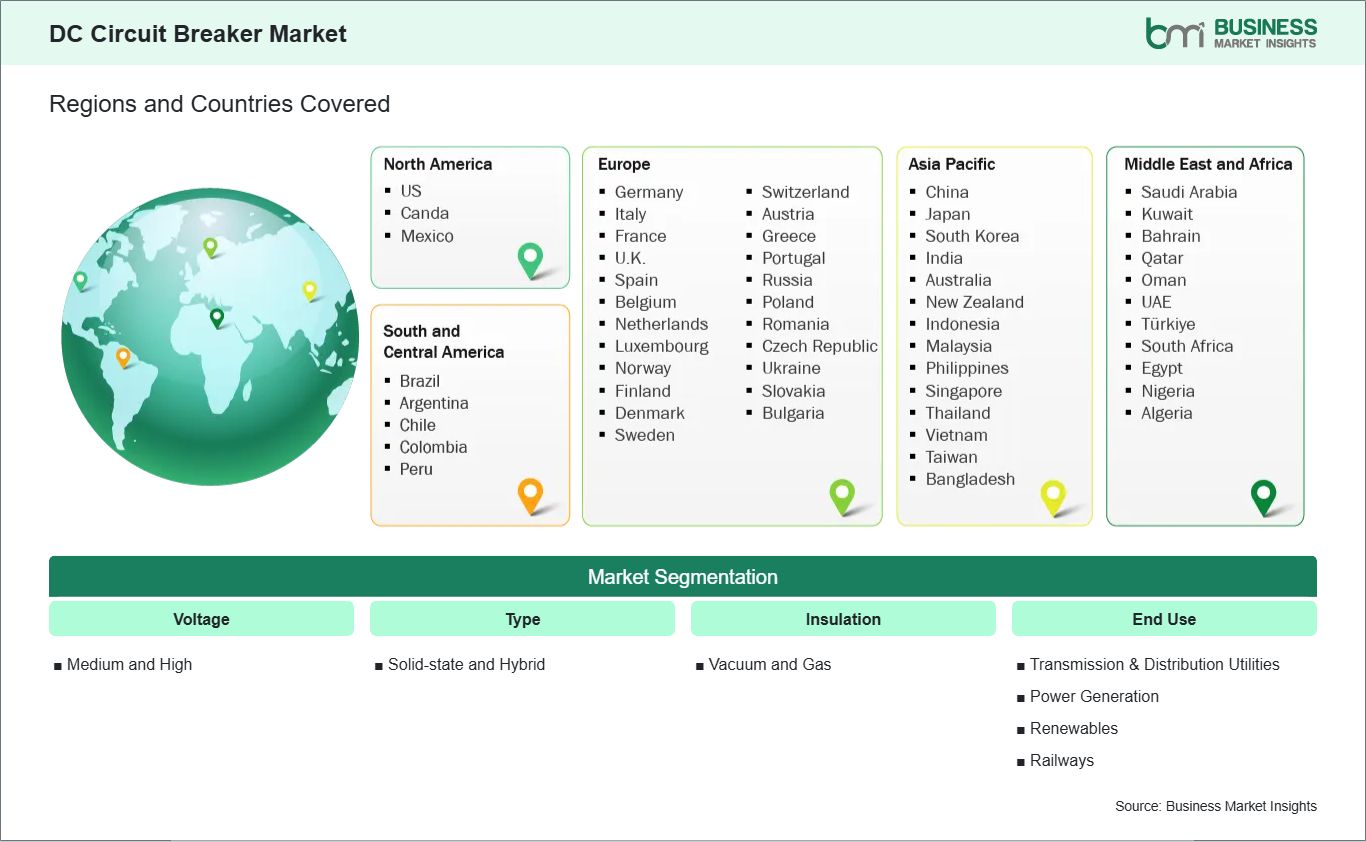
Key segments that contributed to the derivation of the DC circuit breaker market analysis are voltage, type, insulation, and end use.
- By voltage, the market is segmented into medium and high. The medium segment held the largest share of the market in 2025.
- By type, the market is segmented into solid-state and hybrid. The solid-state segment held the largest share of the market in 2025.
- By insulation, the market is segmented into vacuum and gas. The vacuum segment held the largest share of the market in 2025.
- By end use, the market is segmented into transmission & distribution utilities, power generation, renewables, and railways. The transmission & distribution utilities segment held the largest share of the market in 2025.
Market Forces
DC Circuit Breaker Market Drivers and Opportunities
Rising Demand for Renewable Energy Integration
The global shift toward renewable energy sources, such as solar and wind, is a major driver for the DC circuit breaker market. Unlike traditional AC systems, renewable energy installations—particularly solar photovoltaic (PV) systems—operate primarily on direct current (DC), creating a critical need for efficient DC circuit protection. The increasing adoption of rooftop solar panels, solar farms, and hybrid energy systems has amplified the demand for reliable DC circuit breakers to safeguard against overcurrent, short circuits, and system faults. Furthermore, modern energy storage solutions, including lithium-ion batteries in residential, commercial, and industrial applications, rely on DC circuits for energy transfer and require precise protection mechanisms. As governments worldwide implement stricter grid codes and safety standards, the adoption of DC circuit breakers is further accelerated. This driver directly contributes to market expansion by ensuring system reliability, enhancing safety, and supporting the broader renewable energy transition.
Growth in Electric Vehicle (EV) Infrastructure
The rapid expansion of electric vehicle infrastructure presents a significant growth opportunity for the DC circuit breaker market. EV charging stations, battery management systems, and fast-charging networks operate predominantly on DC, necessitating specialized protection devices to prevent electrical faults, overcurrent, and short circuits. As EV adoption rises globally, the demand for reliable and efficient DC circuit breakers is expected to surge, particularly in regions investing heavily in public and private charging infrastructure. Additionally, advances in ultra-fast charging technologies, which require higher DC voltages and currents, further increase the need for robust circuit protection solutions. Manufacturers have the opportunity to innovate with compact, high-performance breakers designed for EV ecosystems, potentially capturing a rapidly expanding market segment. By targeting EV infrastructure, the DC circuit breaker industry can align with global sustainability trends, create high-value applications, and establish long-term growth prospects across automotive and energy storage sectors.
Size and Share Analysis
DC Circuit Breaker Market Size and Share Analysis
By voltage, the market is segmented into medium and high. The medium segment held the largest share of the market in 2025. Medium‑voltage breakers are increasingly adopted because they strike a balance between technical performance and cost‑effectiveness, catering well to both long‑distance transmission systems and distribution networks that require reliable direct current (DC) protection capabilities.
By type, the market is segmented into solid-state and hybrid. The solid‑state segment held the largest share of the market in 2025, owing to its extremely fast fault interruption capabilities (sub‑microsecond switching) and suitability for high‑performance applications such as transmission systems, HVDC links, and critical infrastructure requiring minimal downtime. Increasing investments in transmission & distribution networks worldwide—especially in developing regions like Asia Pacific—have accelerated demand for solid‑state breakers due to their reliability and efficiency in managing DC fault currents.
By insulation, the market is segmented vacuum and gas. The vacuum segment held the largest share of the market in 2025. Vacuum insulation is widely preferred due to its high arc‑quenching efficiency, minimal maintenance requirements, and environmental advantage over gas insulation types. These units are especially prevalent in medium‑voltage networks, microgrid systems, and renewable energy installations where frequent operations and safe switching are critical.
By end use, the market is segmented transmission & distribution utilities, power generation, renewables, and railways. The transmission & distribution utilities segment held the largest share of the market in 2025. The dominance of utility customers is rooted in extensive grid infrastructure projects worldwide, including modernization of legacy AC systems to DC‑centric configurations and the expanding deployment of HVDC transmission lines that necessitate robust DC protection solutions.
Report Coverage
DC Circuit Breaker Market Report Coverage and Deliverables
The "DC Circuit Breaker Market Size and Forecast (2022 - 2033)" report provides a detailed analysis of the market covering below areas:
- DC circuit breaker market size and forecast at global, regional, and country levels for all the key market segments covered under the scope
- DC circuit breaker market trends, as well as market dynamics such as drivers, restraints, and key opportunities
- DC circuit breaker market analysis covering key market trends, global and regional framework, major players, regulations, and recent market developments
- Industry landscape and competition analysis covering market concentration, heat map analysis, prominent players, and recent developments for the air circuit breaker market
- Detailed company profiles, including SWOT analysis
Geographic Insights
DC Circuit Breaker Market Geographic Insights
The geographical scope of the DC circuit breaker market report is divided into five regions: North America, Asia Pacific, Europe, Middle East & Africa, and South & Central America. The DC circuit breaker market in North America is expected to grow significantly during the forecast period.
The Asia Pacific DC circuit breaker market is segmented into China, Japan, South Korea, India, Australia, New Zealand, Indonesia, Malaysia, the Philippines, Singapore, Thailand, Vietnam, Taiwan, Bangladesh, and the Rest of Asia Pacific. The Asia Pacific DC circuit breaker market is experiencing significant growth, driven by several key factors. Rapid industrialization and urbanization in countries such as China, India, and Japan are boosting demand for reliable power distribution systems, where DC circuit breakers play a critical role in protecting electrical infrastructure. The growing adoption of renewable energy sources, particularly solar and wind power, further fuels the market, as these systems often rely on direct current and require advanced protection solutions. Increasing investments in smart grid technologies and electric vehicle charging infrastructure are also contributing, as DC breakers enhance system safety and efficiency. Moreover, government initiatives promoting energy efficiency, grid modernization, and electrification are creating a favorable environment for market expansion. Technological advancements in DC breaker design, including faster response times and higher current interruption capabilities, are encouraging utilities and industries to upgrade existing systems, reinforcing market growth across the region.
Industry Activity
Recent Developments
The DC circuit breaker market is evaluated by gathering qualitative and quantitative data post primary and secondary research, which includes important corporate publications, association data, and databases. A few of the key developments in the DC circuit breaker market are:
- In April 2024, Schaltbau announced the introduction of its Smart Circuit Breaker product line, a family of intelligent circuit breakers which cuts off currents ten to a hundred times faster than conventional contactors, therefore better protecting all kinds of energy storage systems. The company will showcase its newest innovation at this year's Hannover Messe.
- In February 2023, Mitsubishi Electric Corporation announced that it entered into a share transfer agreement on February 16 to wholly acquire Scibreak AB, a Swedish-based company that develops direct current circuit breakers (DCCBs). The two firms aim to strengthen the competitiveness of their unified business by working closely on developing DCCB technologies for highvoltage direct current (HVDC) systems to support the increasing global deployment of renewable energy.
Trust & Transparency
Research Methodology
The market analysis combines proprietary research with secondary data from government agencies, company disclosures, regulatory filings, industry databases and expert interviews. Market estimates are validated through data triangulation, cross-market benchmarking and analyst
review.
View Full Research Methodology
Key Sources Referred:
World Bank - Global Trade IndicatorsWorld Trade Organization (WTO)International Monetary Fund (IMF)International Trade Administration (ITA)Company websiteCompany annual reportsCompany investor presentations