Market Summary
Executive Summary and Global Market Analysis
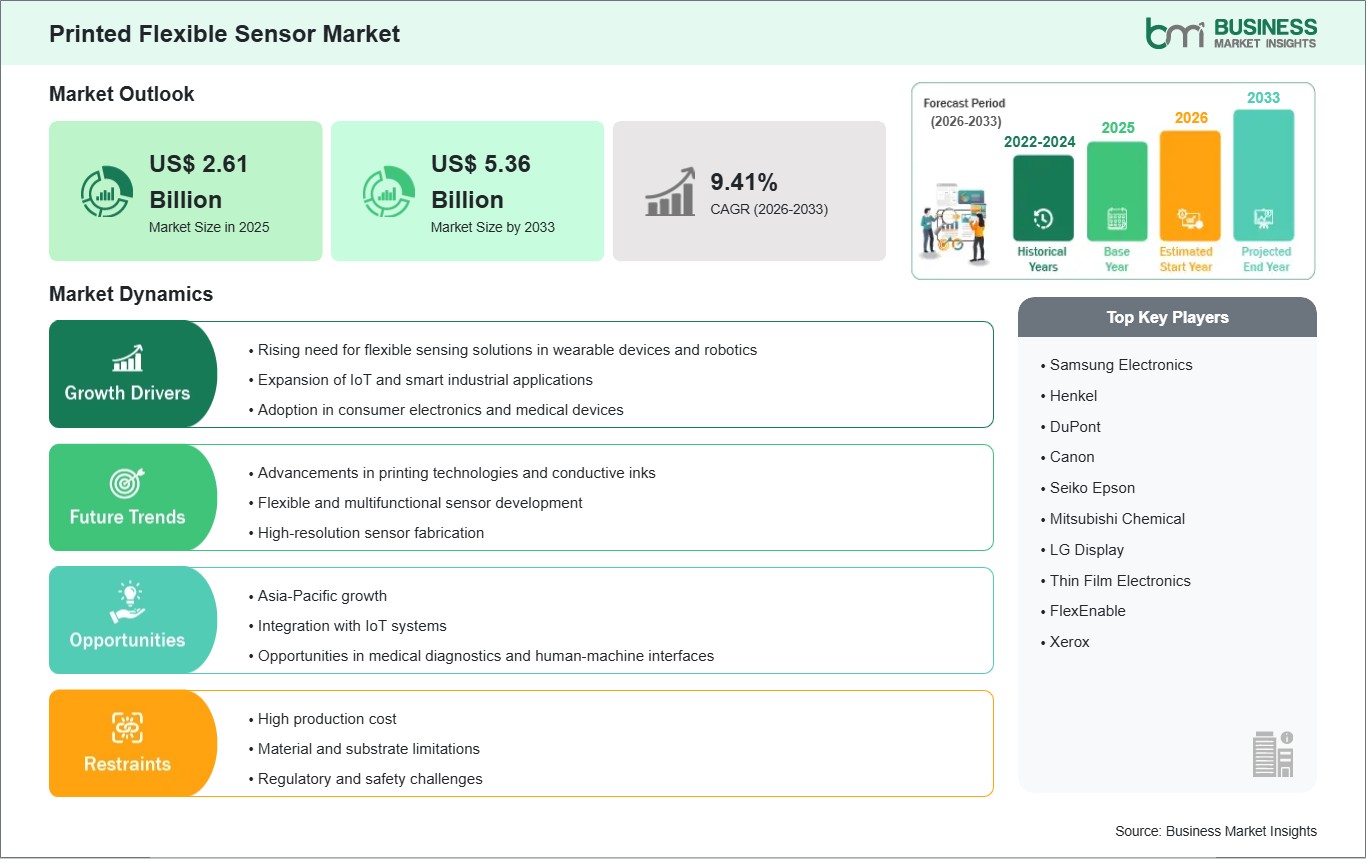
The global printed flexible sensor market is experiencing rapid growth due to increasing demand for lightweight, flexible, and low-cost sensing technologies across multiple industries. Printed flexible sensors are manufactured using advanced printing techniques on flexible substrates such as polymers or paper, enabling the development of sensors that can bend, stretch, and conform to irregular surfaces. These capabilities make them highly suitable for applications in wearable devices, medical monitoring systems, smart packaging, and industrial automation.
Advancements in printed electronics manufacturing technologies have significantly improved the performance and scalability of flexible sensors. Printing techniques such as screen printing, inkjet printing, and aerosol-jet printing allow manufacturers to produce sensors with precise patterns and functional materials while reducing manufacturing costs. These additive manufacturing approaches minimize material waste and enable large-scale production of flexible sensor devices.
The expansion of wearable technology and Internet of Things (IoT) ecosystems is further driving the demand for printed flexible sensors. These sensors enable real-time monitoring of physiological and environmental parameters, making them valuable for healthcare diagnostics, fitness tracking, and smart home applications. In industrial settings, flexible sensors are increasingly used to monitor temperature, pressure, and structural conditions in equipment and infrastructure.
Competitive dynamics within the printed flexible sensor market are centered on innovations in conductive inks, advanced substrate materials, and sensor miniaturization technologies. Companies are also investing in multifunctional sensor systems that combine multiple sensing capabilities into a single flexible platform. As industries increasingly adopt smart monitoring systems and connected devices, printed flexible sensors are expected to become essential components in next-generation electronic systems.
Segment Analysis
Printed Flexible Sensor Market Segmentation
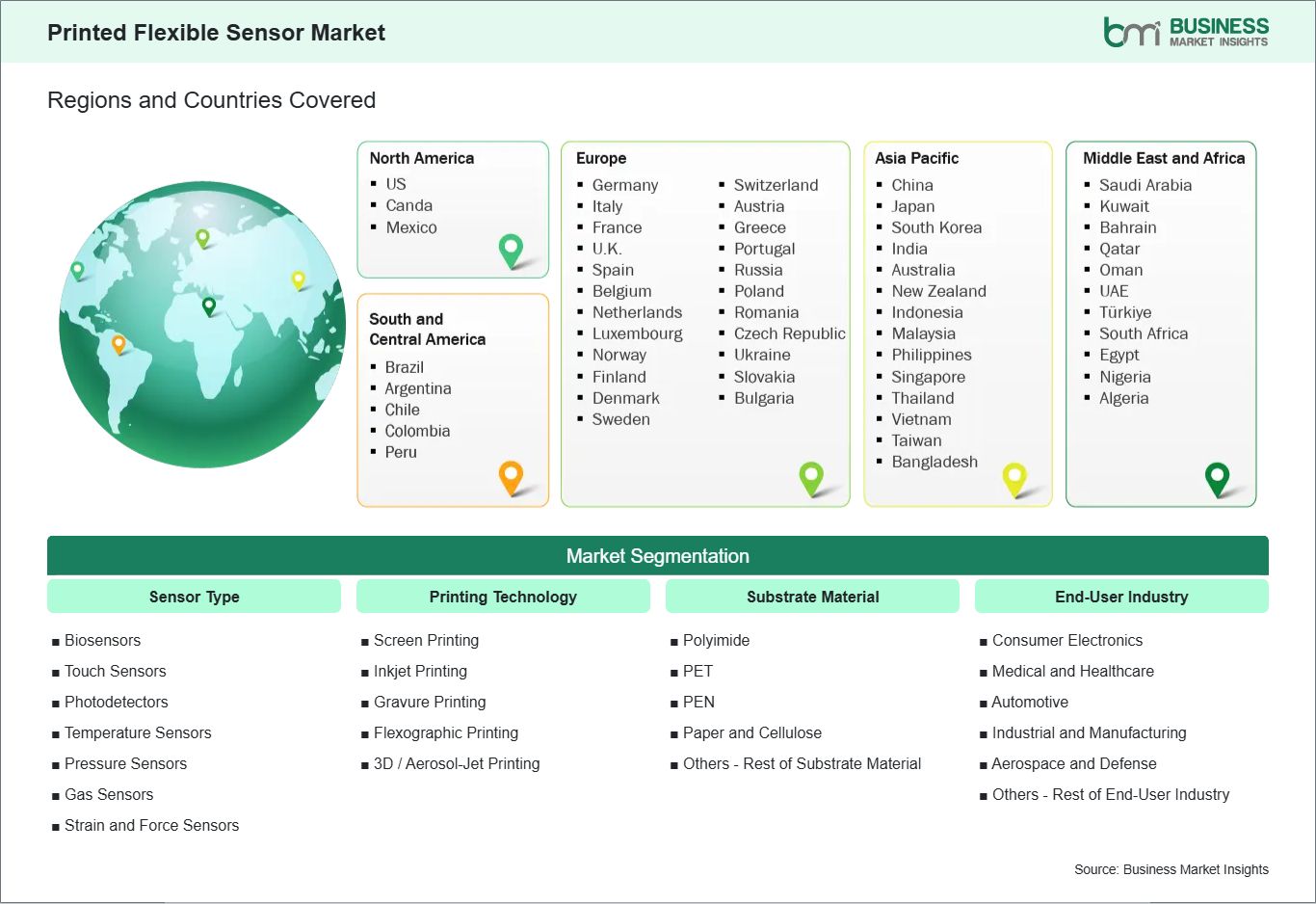
Key segments that contributed to the derivation of the printed flexible sensor market analysis are sensor type, printing technology, substrate material, and end-user industry.
- By sensor type, the printed flexible sensor market is segmented into biosensors, touch sensors, photodetectors, temperature sensors, pressure sensors, gas sensors, and strain and force sensors. The biosensors segment dominated the market in 2025.
- Based on printing technology, the market is categorized into screen printing, inkjet printing, gravure printing, flexographic printing, and 3D / aerosol-jet printing. The screen printing segment dominated the market in 2025.
- In terms of substrate material, the market is classified into polyimide (PI), PET, PEN, paper and cellulose, and others. The PET substrate segment dominated the market in 2025.
- By end-user industry, the market includes consumer electronics, medical and healthcare, automotive, industrial and manufacturing, aerospace and defense, and other end-user industries. The consumer electronics segment dominated the market in 2025.
Market Forces
Printed Flexible Sensor Market Drivers and Opportunities
Growing Demand for Wearable and Healthcare Monitoring Devices
The rapid expansion of wearable technology and digital healthcare solutions is a major factor driving the growth of the printed flexible sensor market. Flexible sensors can be integrated into wearable devices such as smart watches, fitness trackers, and health monitoring patches to measure physiological parameters including heart rate, body temperature, and motion.
These sensors are lightweight, comfortable to wear, and capable of continuous monitoring, making them suitable for long-term health tracking applications. In the healthcare sector, printed flexible biosensors are increasingly used in diagnostic devices and medical monitoring systems to provide real-time patient data.
The ability to produce disposable or low-cost medical sensors using printing technologies is also accelerating their adoption in healthcare settings. Hospitals and diagnostic laboratories are increasingly utilizing printed sensor technologies for point-of-care testing and rapid diagnostics.
Expansion of IoT and Smart Industrial Applications
The growing deployment of Internet of Things (IoT) technologies across industrial and consumer applications is creating new opportunities for printed flexible sensors. These sensors enable real-time monitoring of environmental conditions, structural integrity, and equipment performance in various industrial settings.
Flexible sensors can be integrated into machinery, pipelines, and industrial infrastructure to measure parameters such as temperature, pressure, strain, and gas concentration. This information allows operators to detect anomalies and perform predictive maintenance.
Smart packaging and logistics solutions are also incorporating flexible sensors to monitor product conditions during transportation and storage, ensuring product quality in industries such as food, pharmaceuticals, and electronics.
Size and Share Analysis
Printed Flexible Sensor Market Size and Share Analysis
The Printed Flexible Sensor Market demonstrates steady growth, with size and share analysis highlighting evolving trends and competitive dynamics among key players. The report examines subsegments categorized within sensor type, printing technology, substrate material, and end-user industry.
By sensor type, the biosensors subsegment dominated the market in 2025, driven by the rapid growth of wearable health monitoring devices and diagnostic applications.
Based on printing technology, the screen printing subsegment accounted for the largest share in 2025, supported by its cost-effectiveness and suitability for large-scale manufacturing.
In terms of substrate material, the PET segment dominated the market in 2025 due to its flexibility and compatibility with various printing techniques.
By end-user industries, consumer electronics dominated the market in 2025 due to increasing adoption of flexible sensors in wearable devices and smart electronic systems.
Report Coverage
Printed Flexible Sensor Market Report Coverage and Deliverables
The "Printed Flexible Sensor Market Size and Forecast (2022 - 2033)" report provides a detailed analysis of the market covering below areas:
- Printed Flexible Sensor Market size and forecast at global, regional, and country levels for all key market segments covered under the scope
- Printed Flexible Sensor Market trends, drivers, restraints, and opportunities
- Printed Flexible Sensor Market analysis covering key trends, global and regional framework, major players, regulations, and recent developments
- Industry landscape and competition analysis covering market concentration, heat map analysis, and prominent players
- Detailed company profiles including SWOT analysis
Geographic Insights
Printed Flexible Sensor Market Geographic Insights
The geographical scope of the Printed Flexible Sensor Market report is divided into North America, Asia Pacific, Europe, Middle East & Africa, and South & Central America. North America held the largest share in 2025.
Asia Pacific dominates the market due to strong electronics manufacturing ecosystems in China, Japan, South Korea, and Taiwan. These countries serve as key hubs for flexible electronics production and sensor technology development.
North America represents a major innovation center supported by strong research and development activities and the presence of leading technology companies investing in wearable devices, medical monitoring technologies, and IoT systems.
Europe is another significant market driven by advanced manufacturing capabilities and research initiatives in flexible electronics technologies across countries such as Germany, the United Kingdom, and France.
Meanwhile, emerging markets in Latin America and the Middle East & Africa are gradually adopting printed flexible sensors in healthcare, industrial monitoring, and consumer electronics applications.
Industry Activity
Recent Developments
The Printed Flexible Sensor Market is evaluated by gathering qualitative and quantitative data post primary and secondary research. A few of the key developments in the printed flexible sensor market are,
- In March 2024, Samsung Electronics announced the development of advanced flexible health monitoring sensors designed for integration into wearable electronics and digital healthcare platforms.
- In February 2024, Henkel expanded its portfolio of conductive inks for printed electronics, supporting improved performance in flexible sensor manufacturing applications.
Trust & Transparency
Research Methodology
The market analysis combines proprietary research with secondary data from government agencies, company disclosures, regulatory filings, industry databases and expert interviews. Market estimates are validated through data triangulation, cross-market benchmarking and analyst
review.
View Full Research Methodology
Key Sources Referred:
Semiconductor Industry Association (SIA)International Electrotechnical Commission (IEC)Printed Electronics Association (OE-A)International Bar AssociationInternational Trade Administration