Market Summary
Executive Summary and Global Market Analysis
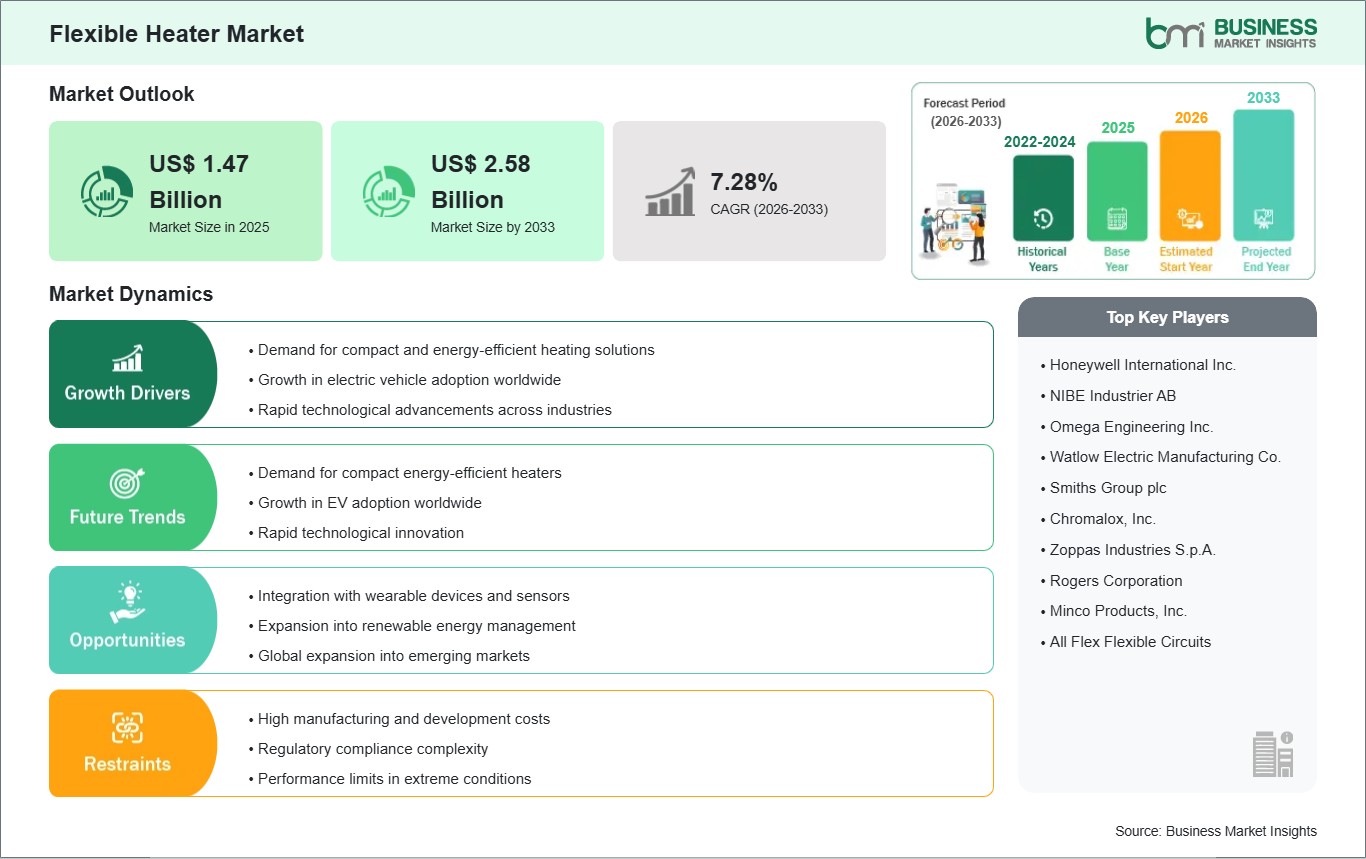
The global flexible heater market is experiencing steady growth driven by rising demand for lightweight, energy-efficient, and customizable heating solutions across diverse industries. Flexible heaters, including silicone rubber, polyimide, polyester, and mica-based types, are widely used for temperature control, freeze protection, condensation prevention, and thermal management applications. Growth is primarily fueled by expanding electronics and semiconductor manufacturing, increasing electric vehicle production, and advancements in medical devices requiring precise thermal regulation. Additionally, rapid industrialization in emerging economies and the need for compact heating components in aerospace and food processing industries further strengthen market expansion globally.
Globally, Asia-Pacific dominates the flexible heater market due to its strong electronics manufacturing base, expanding automotive production, and growing industrial infrastructure. North America and Europe follow, supported by technological advancements, established aerospace industries, and high adoption of advanced medical equipment. Silicone rubber-based heaters account for the largest share owing to their durability, flexibility, and resistance to harsh environments. The electronics and semiconductor sector represents the leading application segment, driven by demand for accurate and uniform temperature control. Increasing focus on energy efficiency, miniaturization of devices, and innovation in material technology are expected to further accelerate market growth.
Segment Analysis
Flexible Heater Market Segmentation
Key segments that contributed to the derivation of the Ethernet Connector Transformer market analysis are Type, Industry.
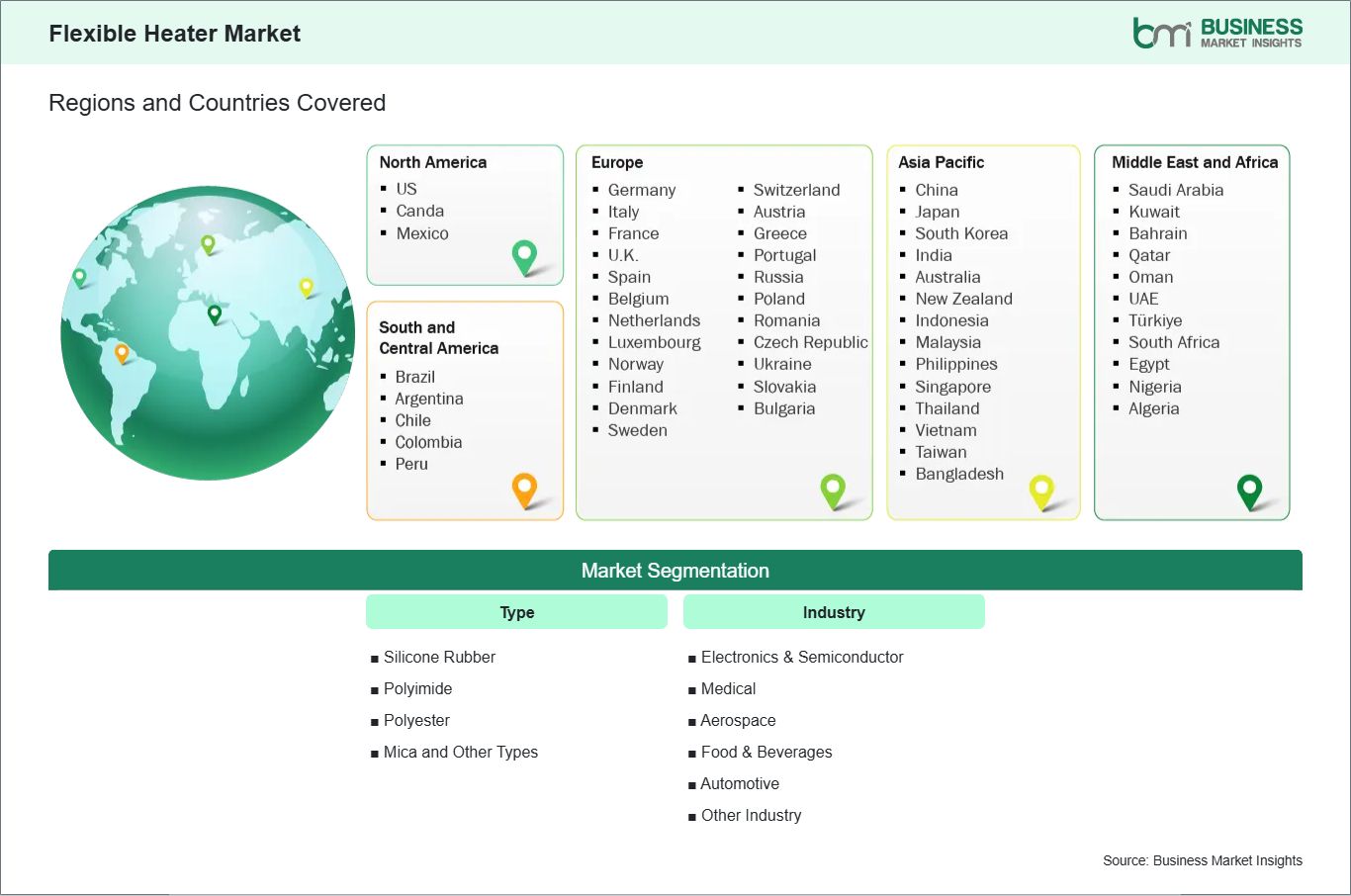
- By Type, the Flexible Heater market is segmented into Silicone Rubber, Polyimide, Polyester, Mica and Other Types. The Silicone Rubber segment dominated the market in 2025.
- By Industry, the Flexible Heater market is segmented into Electronics & Semiconductor, Medical, Aerospace, Food & Beverages, Automotive, Other Industry. The Electronics & Semiconductor segment dominated the market in 2025.
Market Forces
Flexible Heater Market Drivers and Opportunities
Growing Demand in Electronics & Semiconductor Industry
The electronics and semiconductor industry is a major driver for the flexible heater market. Flexible heaters are critical for precise temperature regulation in manufacturing processes, such as wafer fabrication, testing, and assembly of sensitive electronic components. The rapid growth of consumer electronics, smart devices, and advanced semiconductor technologies has significantly increased the need for compact, lightweight, and reliable heating solutions. Silicone rubber and polyimide-based flexible heaters offer uniform heat distribution and durability, making them suitable for high-precision applications. Additionally, as industries focus on reducing energy consumption and improving thermal efficiency, flexible heaters become indispensable, thereby driving global market adoption and accelerating technological innovations in heater materials and designs.
Expansion in Electric Vehicles (EVs) and Automotive Applications
The rise of electric vehicles (EVs) presents a significant growth opportunity for the flexible heater market. EVs require specialized thermal management systems to maintain battery efficiency, ensure passenger comfort, and prevent condensation in sensitive electronic components. Flexible heaters, due to their lightweight, compact design and precise heating capabilities, are ideal for battery warming, seat heating, and mirror/defrost applications. With governments worldwide pushing for sustainable transportation and stricter emissions standards, EV production is rapidly increasing, particularly in the Asia-Pacific, Europe, and North America. This trend provides manufacturers the chance to innovate heater designs, integrate smart thermal solutions, and expand their market share, positioning flexible heaters as essential components in next-generation automotive technologies.
Size and Share Analysis
Flexible Heater Market Size and Share Analysis
By Type, the market is segmented into Silicone Rubber, Polyimide, Polyester, Mica and Other Types. The Silicone Rubber segment dominated the market in 2025. Silicone Rubber-based heaters dominate the market due to high durability, moisture/chemical resistance, flexibility, and broad industrial use cases across electronics, medical, automotive and aerospace sectors.
By Industry, the market is segmented into Electronics & Semiconductor, Medical, Aerospace, Food & Beverages, Automotive, and Other industries. The Electronics & Semiconductor segment held the largest share of the market in 2025. The Electronics & Semiconductor segment holds the largest share because flexible heaters are critical for precise temperature control in manufacturing, testing, and assembly processes of sensitive components.
Report Coverage
Flexible Heater Market Report Coverage and Deliverables
The "Flexible Heater Market Size and Forecast (2022-2033)" report provides a detailed analysis of the market covering below areas:
- Flexible heater market size and forecast at global, regional, and country levels for all the key market segments covered under the scope
- Flexible heater market trends, as well as market dynamics such as drivers, restraints, and key opportunities
- Flexible heater market analysis covering key market trends, global and regional framework, major players, regulations, and recent market developments
- Industry landscape and competition analysis covering market concentration, heat map analysis, prominent players, and recent developments for the Flexible heater market
- Detailed company profiles, including SWOT analysis
Geographic Insights
Flexible Heater Market Geographic Insights
The geographical scope of the Flexible Heater Market Report is divided into five regions: North America, Asia Pacific, Europe, the Middle East & Africa, and South & Central America. The Flexible heater market in the Asia Pacific is expected to grow significantly during the forecast period.
Extensive industrial growth and rising demand from major sectors such as electronics, automotive, and healthcare. Rapid industrialization and expansion of electronics and semiconductor manufacturing hubs in countries like China, India, Japan, and South Korea significantly fuel market growth. Flexible heaters are widely adopted for thermal management in consumer electronics, EV battery systems, and medical equipment, driven by the need for compact, energy‑efficient temperature control solutions. The region’s robust manufacturing base, lower production costs, and supportive government initiatives for advanced technologies further bolster market expansion, with a forecasted strong CAGR through the next decade.
Industry Activity
Recent Developments
The Flexible heater market is evaluated by gathering qualitative and quantitative data post primary and secondary research, which includes important corporate publications, association data, and databases. A few of the key developments in the Ethernet Connector Transformer market are:
- In August 2023, Smiths Group plc, a leading industrial technology firm, announced its acquisition of Heating & Cooling Products (HCP), a U.S.-based company specializing in heating, ventilation, and air conditioning (HVAC) solutions.
- In October 2023, Watlow, a prominent provider of advanced thermal management solutions, launched the ASSURANT HT high-temperature heating jackets, specifically engineered to meet the demanding requirements of semiconductor processing applications.
Trust & Transparency
Research Methodology
The market analysis combines proprietary research with secondary data from government agencies, company disclosures, regulatory filings, industry databases and expert interviews. Market estimates are validated through data triangulation, cross-market benchmarking and analyst
review.
View Full Research Methodology
Key Sources Referred:
World Bank - Global Trade IndicatorsWorld Trade Organization (WTO)International Monetary Fund (IMF)International Trade Administration (ITA)Company websiteCompany annual reportsCompany investor presentations