
Flexible Electronics Materials Market Outlook: Size, Share, Trends, Growth Analysis, Competitive Landscape & Forecast, 2026–2033

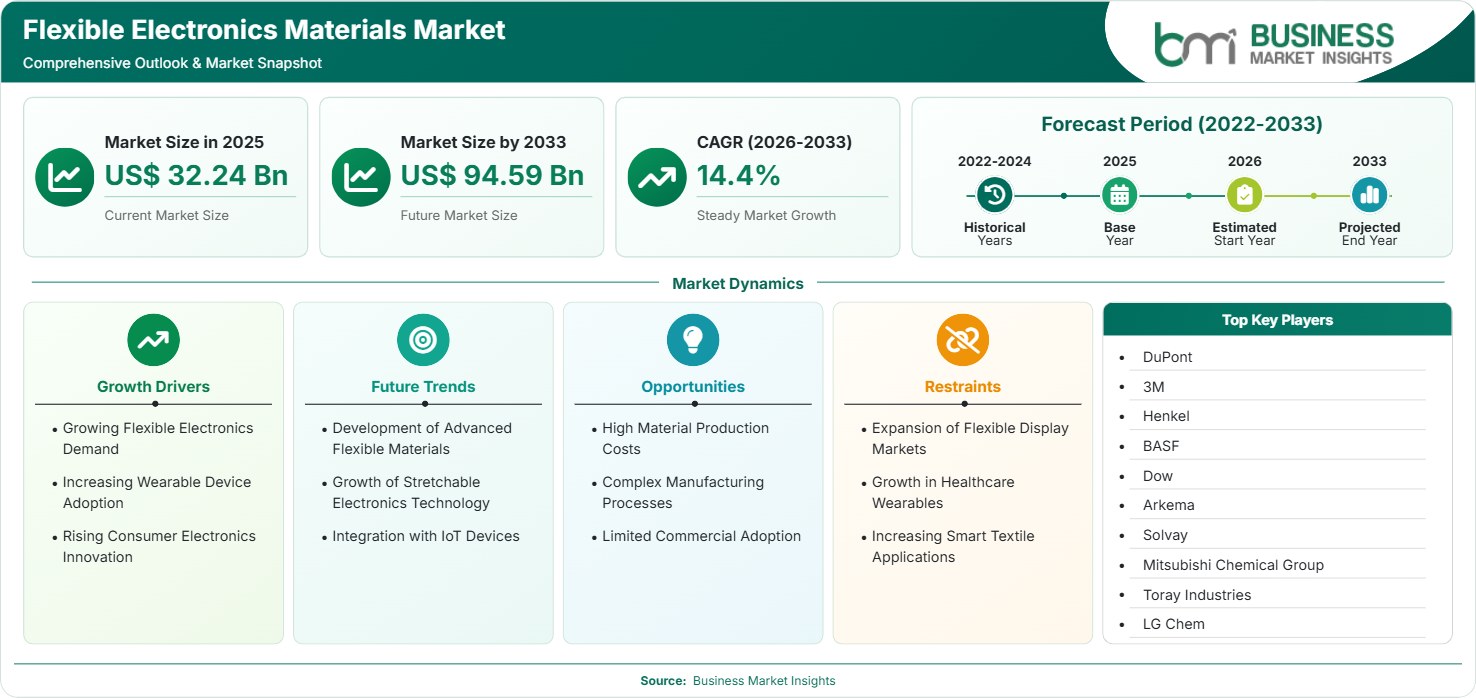
The Flexible Electronics Materials Market size was valued at US$ 32.24 billion in 2025 and is projected to reach US$ 94.59 billion by 2033, growing at a CAGR of 14.4% during 2026–2033, driven by wearable technology expansion, flexible display adoption, advanced material innovation, consumer electronics development, and increasing demand for lightweight electronic components.

Report Coverage
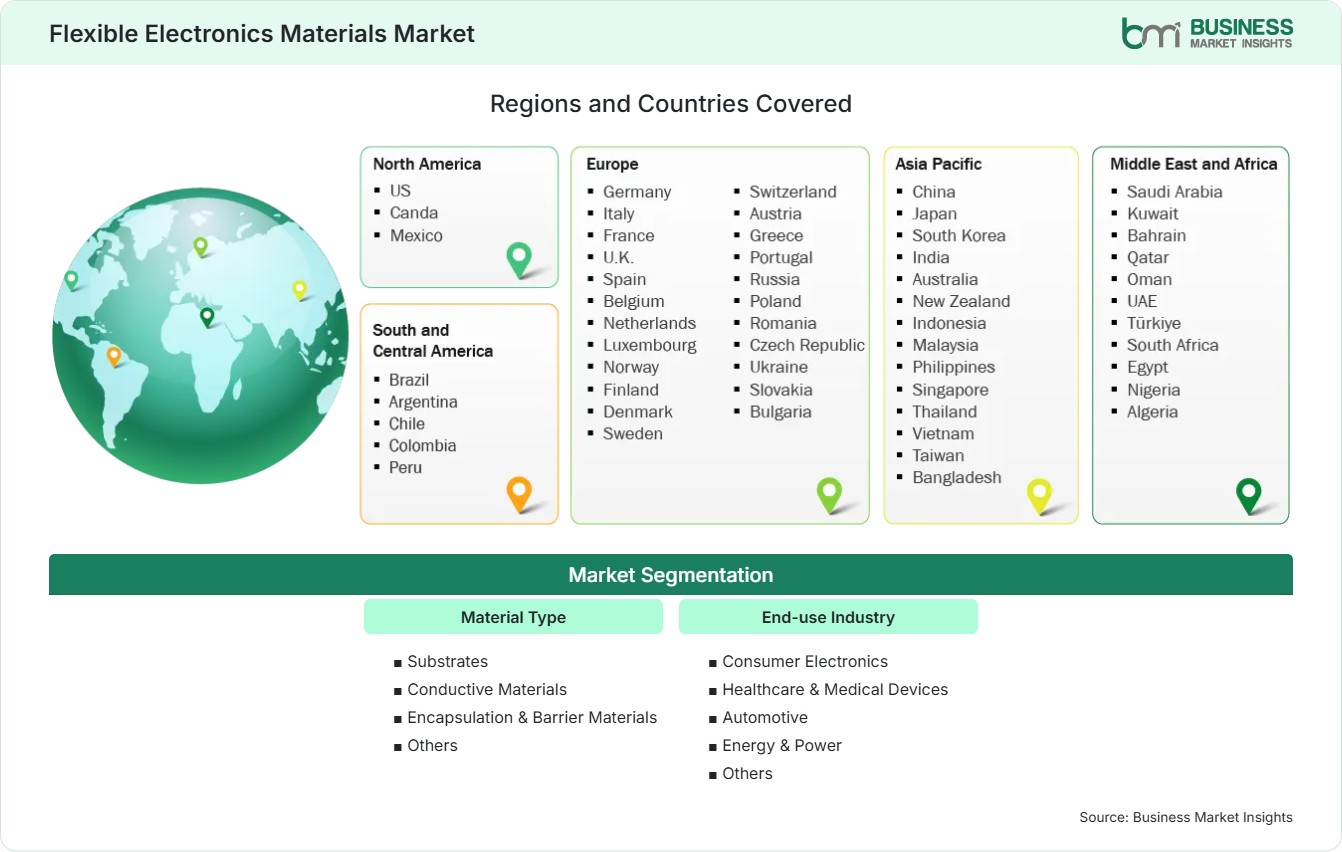
  • Material Type: Substrates, Conductive Materials, Encapsulation & Barrier Materials, Others
  • End-use Industry: Consumer Electronics, Healthcare & Medical Devices, Automotive, Energy & Power, Others
US$ 32.24 Bn Market size in 2025
US$ 94.59 Bn Market Size by 2033
14.4% CAGR, 2026 - 2033
2026-2033 Forecast Period

01 AI Overview

Flexible Electronics Materials Market Summary

  • North America Region: North America holds a 29%–32% share in 2025, growing at a CAGR of 13%–15% during 2026–2033, supported by semiconductor innovation, wearable technology development, healthcare electronics adoption, and advanced material research. The US market expands at a CAGR of 13%–15% during 2026–2033, driven by flexible display investments, R&D activities, and consumer electronics innovation.
  • Fastest Growing Region: Asia Pacific accounts for a 40%–43% share in 2025, expanding at a CAGR of 15%–17% during 2026–2033, supported by electronics manufacturing expansion, display technology development, consumer device demand, and investments from major technology manufacturers across China, South Korea, Japan, and Taiwan.
  • Leading Segment: Conductive Materials hold a 35%–38% share in 2025, growing at a CAGR of 14%–16% during 2026–2033, supported by applications in flexible circuits, touch sensors, wearable devices, and next-generation electronic components requiring high electrical performance.
  • High Growth Segment: Healthcare & Medical Devices represent a 18%–21% share in 2025, expanding at a CAGR of 16%–18% during 2026–2033, driven by smart healthcare solutions, biosensors, wearable monitoring systems, and increasing demand for flexible medical electronics.
  • Key Market Opportunity: Expanding flexible displays, smart textiles, healthcare wearables, and lightweight electronic applications create opportunities for material suppliers developing advanced substrates, conductive solutions, and barrier technologies with improved flexibility and durability.
  • Major Market Players: DuPont, 3M, Henkel, BASF, Dow, Arkema, Solvay, Mitsubishi Chemical Group, Toray Industries, and LG Chem.
02 Strategic Insights

Flexible Electronics Materials Market: Strategic Insights

Flexible Electronics Materials Market Strategic Framework
FREE PDF
Request your free sample
Request free sample
03 Stakeholder View

Key Takeaways

  • The value chain is evolving from conventional electronic materials toward specialized flexible material ecosystems involving substrate suppliers, conductive material developers, device manufacturers, and application-focused technology companies.
  • Consumer electronics, healthcare wearables, automotive electronics, and smart textile applications represent major growth areas as industries seek lightweight and adaptable electronic solutions.
  • Material innovation is focusing on flexible conductive films, advanced polymers, transparent materials, and improved encapsulation systems that enhance durability and device performance.
  • Asia Pacific provides strong investment opportunities due to its electronics manufacturing base, display industry leadership, semiconductor ecosystem, and increasing flexible device production capabilities.
  • Strategic partnerships and technology collaborations are increasing as companies invest in advanced materials, manufacturing capabilities, and next-generation flexible electronic applications.
04 Geographic Outlook

Flexible Electronics Materials Market Regional Highlights

North America Flexible Electronics Materials Market

North America accounted for a 29%–32% share in 2025 and is projected to grow at a CAGR of 13%–15% during 2026–2033. The region benefits from strong research capabilities, advanced electronics manufacturing, and increasing adoption of wearable technologies. The Flexible Electronics Materials Market share in North America is supported by healthcare innovation, semiconductor development, and investments in next-generation electronic materials.

  • The US continues driving regional growth through flexible electronics research, advanced manufacturing initiatives, and investments in wearable and healthcare technologies.
  • Technology companies are increasing demand for advanced substrates, conductive materials, and encapsulation solutions for next-generation electronic products.
  • Healthcare organizations are adopting flexible sensors and wearable monitoring technologies to improve patient tracking and digital healthcare capabilities.
  • Research institutions and manufacturers are collaborating to develop innovative materials that improve flexibility, conductivity, and device reliability.

US Flexible Electronics Materials Market

The US represented a 24%–27% share in 2025 and is expected to expand at a CAGR of 13%–15% during 2026–2033. The country remains a significant market due to strong technology investment, healthcare innovation, and consumer electronics development. Demand is supported by flexible displays, wearable devices, smart sensors, and advanced material research activities across multiple industries.

  • Flexible electronic applications are expanding through investments in wearable healthcare devices, smart sensors, and portable consumer technologies.
  • Semiconductor and electronics companies are developing advanced materials to improve device performance, durability, and manufacturing efficiency.
  • Automotive manufacturers are exploring flexible electronic solutions for displays, interiors, sensors, and connected vehicle applications.
  • Government and private sector research programs are supporting innovation in advanced electronic materials and manufacturing processes.

Europe Flexible Electronics Materials Market

Europe accounted for a 22%–25% share in 2025 and is forecast to grow at a CAGR of 12%–14% during 2026–2033. The region is supported by advanced automotive technologies, healthcare innovation, sustainability-focused electronics development, and research activities. Germany, the United Kingdom, France, and the Netherlands remain important markets, while Nordic countries are advancing flexible electronics research and smart technology adoption.

  • European automotive manufacturers are increasing adoption of flexible electronic materials for connected vehicles, sensors, and advanced display applications.
  • Healthcare technology companies are developing wearable monitoring systems using flexible materials for improved patient care solutions.
  • Sustainability initiatives are encouraging development of lightweight and recyclable electronic material solutions.
  • Germany and the United Kingdom continue supporting market growth through research capabilities and industrial technology investments.

Asia Pacific Flexible Electronics Materials Market

Asia Pacific accounted for a 40%–43% share in 2025 and is projected to expand at a CAGR of 15%–17% during 2026–2033, making it the fastest-growing regional market. The region benefits from strong electronics manufacturing capabilities, display industry leadership, semiconductor investments, and rising consumer technology demand. The Flexible Electronics Materials Market growth is supported by expanding production of flexible displays, wearable devices, smart sensors, and advanced electronic components across China, South Korea, Japan, and Taiwan.

  • China remains a major market due to large-scale electronics manufacturing, flexible display production, and increasing investment in advanced material development.
  • South Korea continues to strengthen its position through display technology leadership, semiconductor innovation, and adoption of flexible electronic components in consumer devices.
  • Japan contributes to regional growth through advanced material research, specialty chemical production, and development of high-performance electronic substrates.
  • Taiwan is expanding flexible electronics capabilities through semiconductor expertise, electronics manufacturing services, and investments in next-generation device technologies.
  • Southeast Asian countries are attracting electronics manufacturing investments due to supply chain diversification, increasing production capacity, and growing technology infrastructure.

Rest of World Flexible Electronics Materials Market

Rest of World held a market share of 8%–11% of the Flexible Electronics Materials Market in 2025 and is estimated to grow at a CAGR of 11%–13% from 2026 to 2033. Latin America and the Middle East & Africa have gradually begun using flexible electronic materials owing to increased consumer technology products, healthcare modernization, and industry digitalization. Some of the growth drivers include Brazil, Mexico, Israel, and the United Arab Emirates represent emerging opportunities due to increasing technology investments and electronic device adoption.

  • Latin American countries are increasing demand for flexible electronic applications through healthcare technology expansion, consumer electronics adoption, and digital transformation initiatives.
  • Brazil and Mexico are developing electronics manufacturing capabilities, creating opportunities for flexible material suppliers and technology solution providers.
  • Middle Eastern markets are investing in smart technologies, healthcare innovation, and advanced electronics applications supporting future material demand.
  • Israel is contributing through technology development, research capabilities, and innovation in wearable electronics and sensor-based applications.
  • The United Arab Emirates is expanding smart infrastructure and digital technology initiatives, encouraging adoption of advanced electronic materials and flexible device solutions.
Global Market Geography
FREE PDF
Request your free sample
Request free sample
05 Segment Analysis

Flexible Electronics Materials Market Segmentation

Material Type

The Flexible Electronics Materials Market by material type is driven by increasing demand for lightweight, durable, and highly conductive components used in next-generation electronic devices. Conductive Materials accounted for a 35%–38% share in 2025 and are projected to grow at a CAGR of 14%–16% between 2026–2034. Substrates and encapsulation materials are gaining importance due to rising requirements for flexible displays, wearable technology, and sensor applications.

  • Substrates: Substrates provide mechanical support and flexibility for electronic components, with demand increasing through flexible displays, printed electronics, sensors, and lightweight device applications.
  • Conductive Materials: Conductive materials enable electrical connectivity in flexible devices through advanced inks, films, and conductive layers supporting displays, circuits, wearable electronics, and smart technologies.
  • Encapsulation & Barrier Materials: Encapsulation and barrier materials protect flexible electronic components from moisture, oxygen, and environmental damage, improving device durability and operational reliability.

End-use Industry

The market by end-use industry is expanding as industries adopt lightweight, adaptable, and integrated electronic solutions. Consumer Electronics was a leading segment in 2025 due to the adoption of flexible displays, wearable devices, and portable technology. Healthcare & Medical Devices are experiencing rapid growth through biosensors and monitoring systems. The Flexible Electronics Materials Market scope is expanding as automotive, energy, and smart textile applications increase demand for advanced materials.

  • Consumer Electronics: Consumer electronics applications drive demand for flexible displays, foldable devices, wearable technology, and compact electronic systems that require durable, flexible materials.
  • Healthcare & Medical Devices: Healthcare applications are increasing through wearable sensors, diagnostic devices, patient monitoring systems, and flexible medical electronics supporting personalized healthcare solutions.
  • Automotive: Automotive applications use flexible electronic materials for smart interiors, displays, sensors, lighting systems, and connected-vehicle technologies that require lightweight, adaptable components.
  • Energy & Power: Energy and power applications are adopting flexible materials for advanced batteries, solar technologies, energy storage systems, and lightweight electronic power solutions.
  • Others: Other applications include smart textiles, industrial sensors, and emerging flexible electronic technologies requiring specialized materials with improved flexibility, conductivity, and performance characteristics.
06 Market Forces

Flexible Electronics Materials Market Dynamics

Key Market Drivers

Growing Flexible Electronics Demand

Rising demand for flexible electronic systems is prompting manufacturers to adopt more advanced materials used in consumer electronics, healthcare, automotive, and industrial sectors. Manufacturers are working on lightweight, flexible, and rugged electronic parts that can help in addressing changing designs of devices as well as user needs. Demand for flexible displays, wearable sensors, and mobile electronics is leading to the need for flexible materials, including substrates, conductive materials, and encapsulation. The Flexible Electronics Materials Market growth is due to ongoing innovations in polymers, printed electronics, and smaller electronic parts. Innovations related to better flexibility, conductivity, and durability, along with reduced weight, are being made through R&D activities.

Increasing Wearable Device Adoption

The increased use of wearables is boosting demand for materials that enable the production of lighter, more durable electronics. For smartwatches, fitness monitors, biosensors, and even medical monitoring systems, it is necessary to use a flexible material that allows the device to continue performing well despite flexing. Substrates, conductive films, and barrier materials have now become necessary for making flexible electronics. Flexible Electronics Materials Market Trends show that the healthcare and consumer wearable sectors are fueling the research activities for the development of new flexible sensors and biocompatible materials. There is emphasis on developing materials with high electrical performance, moisture resistance, and mechanical durability.

Rising Consumer Electronics Innovation

Innovations in consumer electronics have fueled the need for flexible materials that will enable foldable displays, compact products, and better designs of such products. Electronics firms have been working on flexible architecture to set their products apart and offer customers greater portability, thus creating an avenue for material providers to supply materials. The innovations in foldable phones, flexible screens, and wearables have called for flexible substrates, flexible conductive materials, and flexible encapsulation structures with better durability. Manufacturers have been working hard on developing new material solutions to overcome challenges in bending, heat dissipation, and product lifetime. The competition in electronics is spurring research into flexible materials.

Key Market Opportunities

Expansion of Flexible Display Markets

The growth in the flexible displays market is offering a wide range of opportunities to materials providers since there is a higher demand for foldable smartphones, flexible monitors, and advanced displays in the industry. There are specialized substrates, conductive materials, and barrier materials used in manufacturing flexible displays with transparency, flexibility, and durability. Increased investment by display makers and electronics companies is speeding up the commercialization process. There are numerous opportunities for materials providers to develop high-performing products that are reliable and efficient in terms of cost. According to Flexible Electronics Materials Market Forecasts, flexible displays are going to remain one of the key opportunities for consumer electronics companies seeking new products.

Growth in Healthcare Wearables

The rising trend in healthcare wearables presents opportunities for material suppliers in the flexible electronics space through higher demand for continuous monitoring and customized health solutions. There is an increased need for wearable medical devices that have flexible, light, and biocompatible materials that can support sensors, diagnostic tools, and health monitoring. Healthcare facilities have been incorporating the use of wearables to enhance remote health care delivery, chronic illness management, and health monitoring in real time. Flexible electronics companies are investing in conductive materials, flexible substrates, and protective coatings to cater to the needs of the healthcare industry.

Increasing Smart Textile Applications

The use of smart textile applications is creating new opportunities, especially as industries explore the possibility of incorporating electronic functionality into clothing and fabrics. Flexibility allows for the creation of wearables and sensors incorporated within clothes, fabrics that will monitor health and measure performance, as well as interactive textiles. The electronics and fabric combination calls for materials that will retain their conductivity, flexibility, and durability even when the fabric moves around and is being used continuously. There is an exploration of smart textiles in the sports industry, healthcare sector, defense industry, and consumer goods. Suppliers of material have an opportunity to develop conductive fibers, flexible circuits, and protection solutions for fabrics. There is growing interest in connected lifestyles and wearable devices.

Market Restraints and Challenges

High Material Production Costs

Factor: Advanced flexible electronics materials require specialized manufacturing processes, high-quality raw materials, and precision technologies that increase production expenses. Impact: High costs can limit adoption, reduce price competitiveness, and create challenges for manufacturers seeking large-scale commercialization of flexible electronic products. Materials such as advanced conductive compounds, specialized polymers, and barrier films require significant research investment and quality control. Smaller manufacturers may face difficulties accessing advanced production capabilities due to capital requirements. Companies are focusing on process optimization, scalable manufacturing methods, and material innovation to reduce costs. However, balancing performance requirements with affordability remains a key challenge as flexible electronics applications expand across consumer and industrial markets.

Complex Manufacturing Processes

Factor: Flexible electronic devices require complex integration of multiple material layers, precise fabrication techniques, and specialized production equipment. Impact: Manufacturing complexity can increase production challenges, affect yield rates, and slow the commercialization of advanced flexible electronic products. The combination of substrates, conductive layers, and protective materials requires accurate processing to maintain performance and reliability. Manufacturers must address challenges related to material compatibility, durability, and large-scale production efficiency. Continuous improvements in printing technologies, assembly methods, and automation are helping reduce manufacturing difficulties. However, achieving consistent quality across high-volume production remains challenging. Companies investing in advanced manufacturing capabilities and process innovation can improve scalability and support broader adoption of flexible electronics technologies.

07 Company Analysis

Competitive Landscape

The Flexible Electronics Materials Market analysis highlights a competitive environment driven by specialty chemical manufacturers, advanced material suppliers, and technology-focused companies developing solutions for flexible displays, wearable devices, sensors, and next-generation electronic systems. Leading players are investing in conductive materials, flexible substrates, encapsulation technologies, and sustainable material solutions to improve performance, reliability, and scalability. Strategic collaborations, product innovation, and expansion of advanced manufacturing capabilities are shaping competitive positioning across the global market.

Company Name

Overview

Products and Services relevant to this market

DuPont

Global science and materials company providing advanced solutions for electronics and high-performance applications.

Flexible substrates, conductive materials, electronic materials, barrier solutions, and printed electronics technologies.

3M

Diversified technology company developing specialty materials for electronics and industrial applications.

Flexible films, adhesives, electronic materials, conductive solutions, and protective technologies.

Henkel

Chemical and adhesive solutions provider supporting electronics manufacturing and assembly processes.

Flexible electronics adhesives, conductive materials, encapsulation solutions, and electronic protection materials.

BASF

Global chemical company developing advanced materials for electronics and specialty applications.

Functional polymers, coatings, encapsulation materials, and advanced chemical solutions for flexible electronics.

Dow

Materials science company supplying advanced polymers and specialty materials globally.

Silicone materials, encapsulation technologies, adhesives, coatings, and flexible electronic material solutions.

Arkema

Specialty chemicals company focused on advanced polymers and high-performance materials.

Flexible polymers, specialty resins, coatings, and materials supporting electronic applications.

Solvay

Advanced materials company providing high-performance solutions for technology industries.

Specialty polymers, conductive materials, barrier materials, and electronic component solutions.

Mitsubishi Chemical Group

Chemical manufacturer offering advanced materials for electronics and industrial applications.

Functional films, polymer materials, conductive solutions, and flexible electronic components.

Toray Industries

Materials company specializing in advanced fibers, films, and electronic materials.

Flexible substrates, polymer films, conductive materials, and electronic material technologies.

LG Chem

Chemical company developing advanced materials for electronics and energy applications.

Flexible display materials, specialty films, electronic materials, and advanced polymer solutions.

08 Industry Activity

Recent Developments

September 2025

LG Chem completed the development of its proprietary high-resolution Photo Imageable Dielectric (PID) material for advanced semiconductor packaging applications. The development is expected to support higher-density packaging and improved performance in next-generation semiconductor devices.

April 2025

BASF opened a new Electronic Materials R&D Center in Ansan, South Korea, to accelerate development of advanced electronic materials. The facility focuses on next-generation semiconductor materials, including process chemicals, photo materials, and metallization solutions.

February 2025

Henkel expanded its electronics materials capabilities in India by opening a new Application Engineering Center in Chennai, Tamil Nadu, and announcing a new adhesive materials manufacturing facility. The expansion is expected to strengthen local production capabilities and support growing demand for advanced electronics materials in the region.

January 2025

DuPont expanded its flexible electronics materials portfolio by showcasing advanced Kapton polyimide film solutions at DesignCon 2025 Expo, California, for next-generation electronics applications. The showcase is expected to highlight the potential of advanced materials in enabling flexible, high-performance electronic devices.

10 Trust & Transparency

Research Methodology

The market analysis combines proprietary research with secondary data from government agencies, company disclosures, regulatory filings, industry databases and expert interviews. Market estimates are validated through data triangulation, cross-market benchmarking and analyst review.

View Full Research Methodology

11 Questions Answered

Frequently Asked Questions

What challenges impact the adoption of flexible electronics materials market?

High production costs, complex manufacturing requirements, material compatibility issues, and scalability challenges affect adoption. Companies are addressing these limitations through process improvements, advanced manufacturing techniques, and development of cost-efficient materials with improved flexibility and performance.

Which industries are adopting flexible electronic materials?

Consumer electronics, healthcare, automotive, energy, and smart textile industries are increasingly adopting flexible electronic materials. These sectors use advanced materials for applications such as foldable displays, wearable sensors, connected vehicles, energy systems, and intelligent fabric technologies.

How are flexible electronics materials transforming healthcare applications?

Flexible electronics materials are enabling wearable healthcare devices, biosensors, and monitoring systems that provide continuous health data collection. Their lightweight and adaptable properties allow comfortable integration into medical devices, supporting remote monitoring and personalized healthcare solutions.

Which material type has the highest adoption in flexible electronics?

According to the flexible electronics materials market report, conductive materials have strong adoption due to their critical role in enabling electrical connectivity within flexible circuits, sensors, and displays. Continuous development of conductive inks, films, and advanced materials is improving performance and supporting broader application across electronic devices.

What is driving the growth of the market?

The market is driven by increasing demand for flexible displays, wearable devices, smart sensors, healthcare electronics, and lightweight consumer technologies. Advancements in conductive materials, substrates, and encapsulation solutions are enabling manufacturers to develop more durable and adaptable electronic products.

Access the Full Flexible Electronics Materials Market Report

Get segment-level forecasts, regional estimates, competitive benchmarking, company profiles and downloadable Excel datasets.

Access the full Flexible Electronics Materials Market Report
350 pages PDF & Excel | 2026-07-31