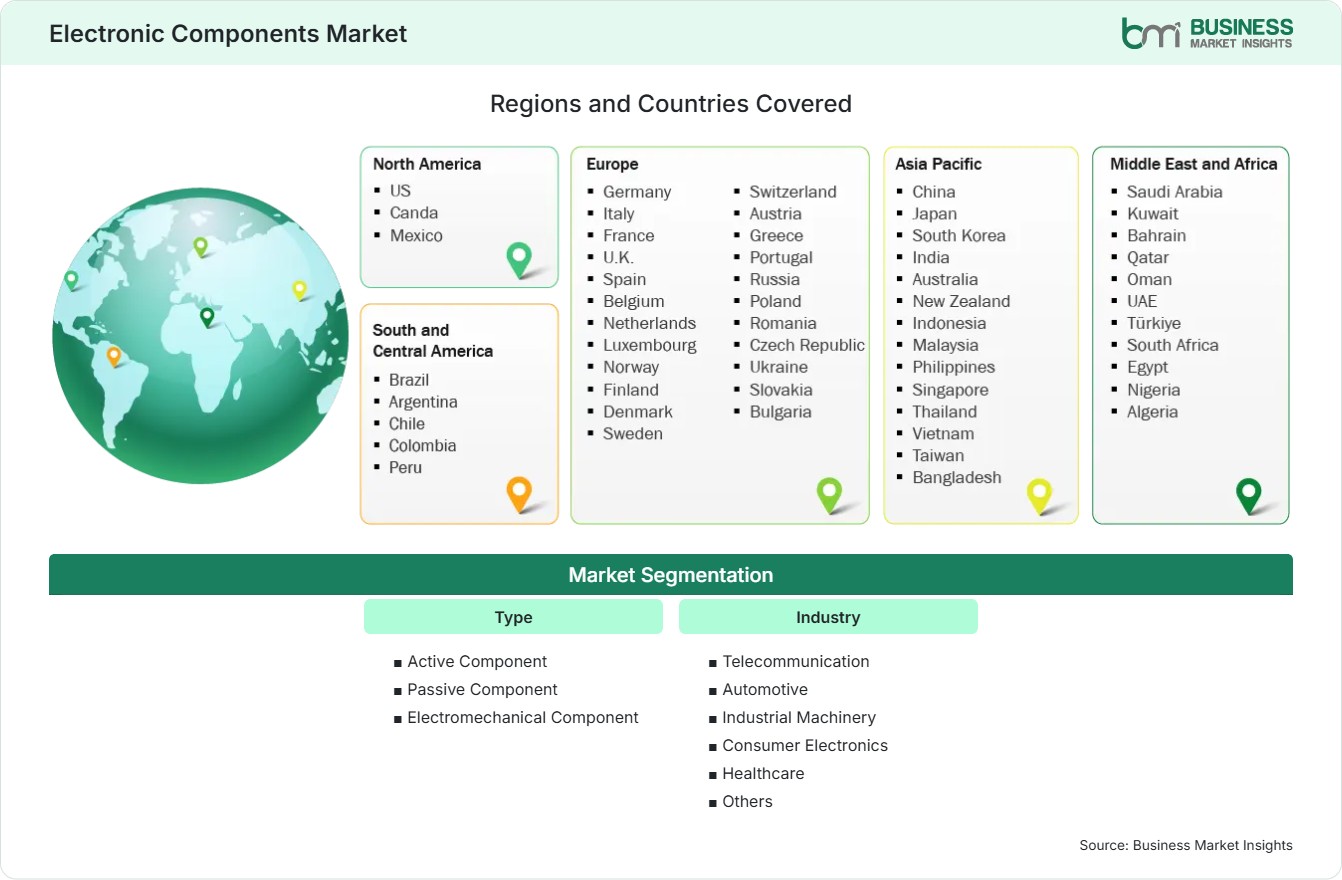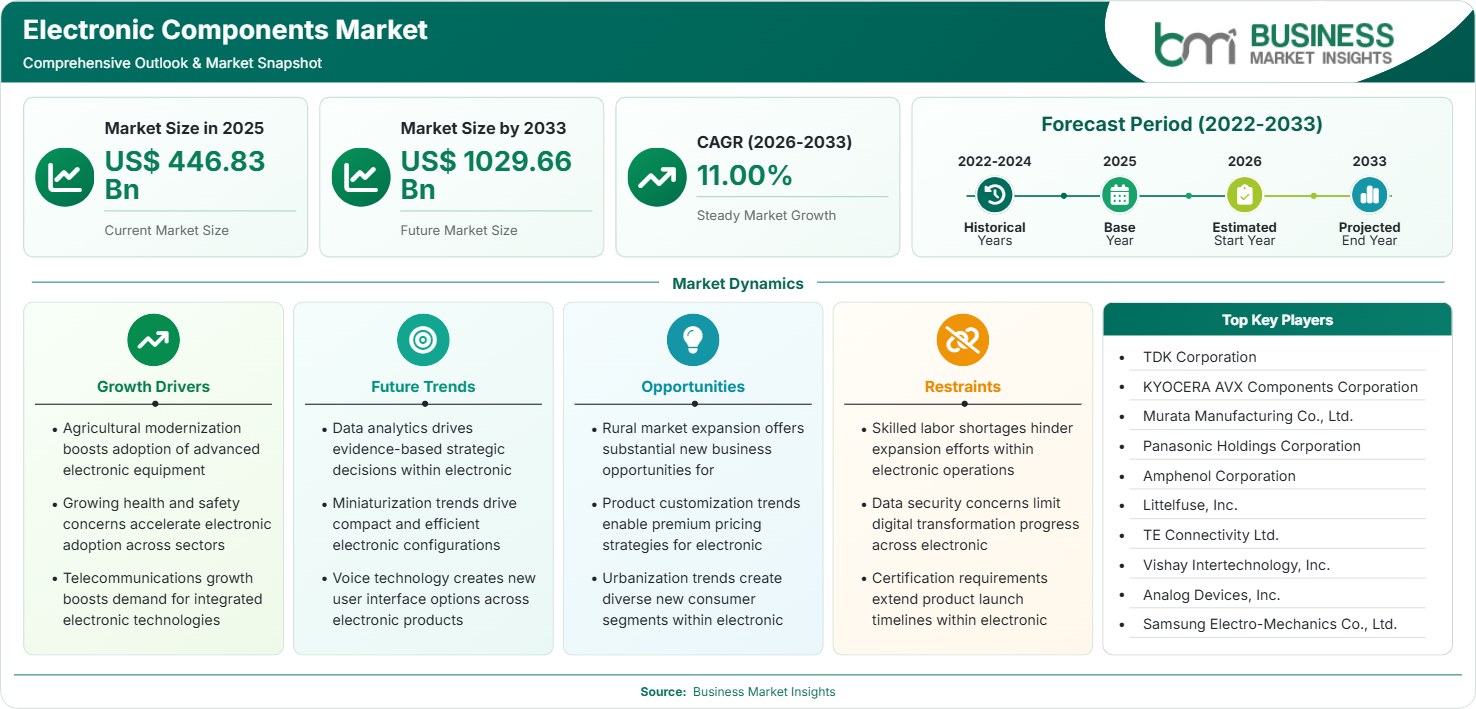
Electronic Components Market Regional Highlights
North America Electronic Components Market
North America accounts for 29%–32% Electronic Components Market share in 2025 and is projected to expand at a CAGR of 9.5%–10.5% through 2033. Regional demand is supported by semiconductor manufacturing investments, defense modernization programs, AI infrastructure deployment, and industrial automation initiatives. The United States remains the primary contributor, while Canada and Mexico benefit from supply chain diversification. Increasing domestic manufacturing incentives and strategic technology investments continue strengthening regional competitiveness across advanced electronics production and component sourcing activities.
- Semiconductor fabrication investments supported by public funding programs are increasing local sourcing opportunities and reducing dependence on overseas manufacturing networks.
- AI data center expansion is accelerating demand for power management devices, connectors, capacitors, and high-performance integrated circuits across cloud infrastructure projects.
- Automotive electrification initiatives are increasing component content per vehicle, supporting suppliers specializing in sensing, protection, and connectivity technologies.
- Aerospace and defense procurement programs require highly reliable components capable of operating under demanding environmental and performance conditions.
US Electronic Components Market
The United States represents approximately 78%–82% of regional Electronic Components Market demand and is anticipated to record a CAGR of 10.0%–11.0% during the forecast period. Strong technology leadership, semiconductor manufacturing expansion, defense electronics spending, and AI computing investments continue driving adoption. Research intensity across universities, technology firms, and industrial manufacturers supports innovation in advanced materials, sensors, and integrated circuit design. Continued reshoring efforts are improving domestic production capabilities while strengthening supply chain resilience.
- Federal semiconductor manufacturing initiatives are encouraging capacity expansion and advanced packaging investments across strategic technology clusters.
- Growth in AI accelerators and high-performance computing platforms is increasing requirements for sophisticated component architectures.
- Electric vehicle production expansion supports rising demand for power electronics, circuit protection devices, and advanced connectivity solutions.
- Industrial digitalization programs are driving adoption of sensing technologies and intelligent control systems across manufacturing environments.
Europe Electronic Components Market
Europe holds 21%–24% Electronic Components Market share in 2025 and is expected to achieve a CAGR of 9.8%–10.8% through 2033. Germany remains the leading regional market due to automotive and industrial manufacturing strength, while Poland and other Central European economies display higher expansion rates supported by electronics production investments. Sustainability regulations, energy efficiency objectives, and industrial automation initiatives support demand. Strong engineering expertise and advanced manufacturing capabilities continue reinforcing the region's position in specialized component applications.
- Germany leads regional consumption through automotive electronics, industrial automation systems, and advanced manufacturing infrastructure.
- Poland demonstrates strong growth supported by electronics assembly investments and expanding industrial production capacity.
- Energy transition projects increase demand for power management solutions and high-reliability component technologies.
- European industrial digitalization initiatives support widespread adoption of sensors, controllers, and communication modules.
- Research collaboration across academia and industry encourages innovation in advanced materials and miniaturized electronic systems.
Asia Pacific Electronic Components Market
Asia Pacific commands 42%–45% Electronic Components Market share in 2025 and records the fastest expansion at 12.5%–13.5% CAGR through 2033. China remains the largest market due to manufacturing scale, while India demonstrates among the strongest growth rates supported by production incentives and electronics localization. Japan, South Korea, and Taiwan maintain strategic importance through semiconductor and component expertise. Strong consumer electronics production, telecommunications investments, and vehicle electrification programs sustain robust regional demand across multiple applications.
- China remains the largest manufacturing hub, benefiting from integrated supply chains and extensive electronics production capabilities.
- India records rapid expansion through government incentives encouraging domestic electronics manufacturing and component localization.
- South Korea and Taiwan continue strengthening advanced semiconductor ecosystems supporting regional technology leadership.
- Smartphone, wearable, and consumer electronics production sustain significant demand for passive and active component categories.
- EV manufacturing growth increases adoption of connectors, capacitors, sensors, and power semiconductor solutions.
Rest of World Electronic Components Market
Rest of World accounts for 8%–10% Electronic Components Market share and is expected to grow at a CAGR of 10.5%–11.5% during the forecast period. South and Central America benefit from automotive manufacturing and industrial modernization activities. The Middle East and Africa increasingly invest in telecommunications infrastructure, renewable energy systems, and smart city projects requiring sophisticated electronic architectures. Brazil remains the leading market within Latin America, while the United Arab Emirates demonstrates strong growth through technology infrastructure investments and digital transformation initiatives.
- Brazil benefits from automotive manufacturing activity and expanding industrial automation deployment across key industries.
- Telecommunications infrastructure upgrades support increasing adoption of networking and connectivity components throughout emerging economies.
- Renewable energy installations require power management, protection, and monitoring technologies supporting system reliability.
- Gulf economies are investing in smart city infrastructure that relies on advanced sensing and communication solutions.
- Digital transformation initiatives across multiple sectors create opportunities for suppliers serving specialized electronics applications.