Market Summary
Executive Summary and Global Market Analysis
Power electronics testing comprises the validation, characterization, and reliability assessment of semiconductor devices and related subsystems used in power conversion applications. It covers electrical, thermal, switching, endurance, and dynamic-performance evaluation across power discrete devices, power modules, and power integrated circuits. These testing activities are essential where component behavior under real operating conditions determines system efficiency, safety, and lifetime. As power architectures become more demanding, testing is shifting from a final checkpoint to a central engineering function.
Market expansion is being shaped by the broader use of wide-bandgap materials, higher switching frequencies, and increasingly stringent reliability expectations across critical industries. Automotive electrification, industrial automation, ICT infrastructure, aerospace systems, and compact consumer electronics all require more rigorous validation to ensure stable performance under thermal and electrical stress. This raises the importance of test environments that can capture fast transient behavior, defect risks, and long-term degradation patterns. In parallel, faster product cycles are increasing the need for precise and efficient validation workflows.
Segment dynamics reflect different testing priorities by device class. Power discrete devices remain significant because they are widely used and require cost-efficient, repeatable evaluation across diode, transistor, and thyristor configurations. Power modules hold stronger strategic importance in high-current and thermally demanding applications, where dynamic switching analysis and package-level reliability are especially important. Power integrated circuits are also gaining attention as designers seek tighter functional integration and smaller system footprints.
Technology development in this market is moving toward double-pulse testing, isolated high-speed probing, automated characterization, and advanced fixtures tailored to wide-bandgap devices. Test systems are being refined to reduce parasitics, improve waveform accuracy, and support more realistic evaluation of fast-switching components. These advances are especially relevant for SiC- and GaN-linked applications where conventional validation approaches may not capture critical behavior with sufficient fidelity. This is making test capability a stronger competitive differentiator across the industry.
Competitive conditions are increasingly defined by measurement precision, test automation depth, and application-specific coverage across e-mobility, renewable energy, and data-intensive systems. Suppliers are differentiating through specialized fixtures, broader device support, and solutions that shorten characterization time without sacrificing accuracy. The market therefore reflects a shift toward more sophisticated validation ecosystems aligned with next-generation power semiconductor requirements.
Segment Analysis
Power Electronics Testing Market Segmentation
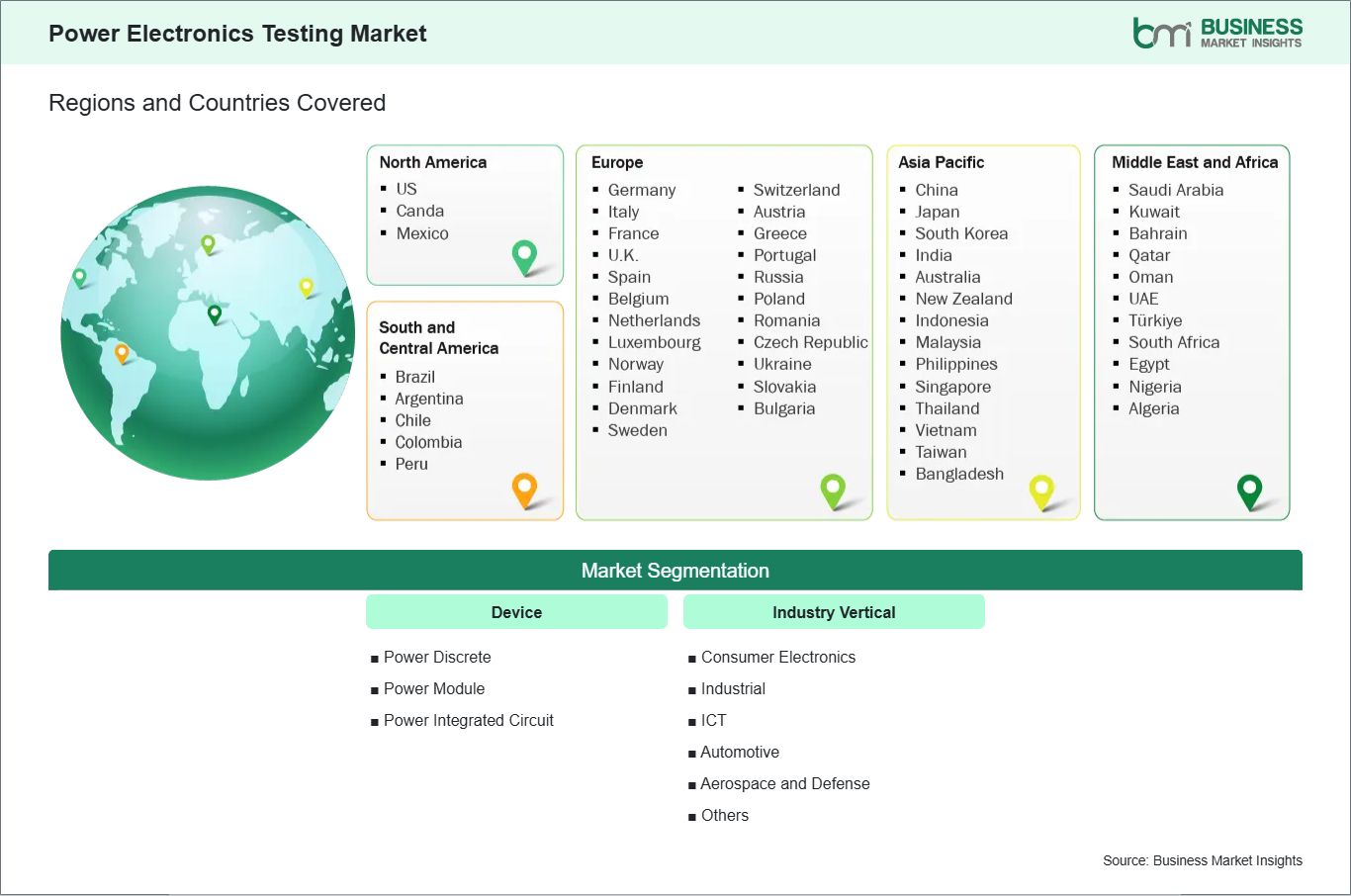
The Power Electronics Testing Market is segmented based on device, industry vertical, highlighting distinct operational priorities and evolving deployment strategies across various end uses.
By Device
- Power Discrete [Diode, Transistor, Thyristor] – Requires scalable validation across broad-volume switching components.
- Power Module – Demands deeper thermal and dynamic characterization under high-load conditions.
- Power Integrated Circuit – Supports compact systems needing function-rich power control verification.
By Industry Vertical
- Consumer Electronics – Focuses on compact, efficient, and thermally reliable components.
- Industrial – Prioritizes endurance, switching stability, and process continuity.
- ICT – Requires dependable validation for dense and performance-sensitive infrastructure.
- Automotive – Applies rigorous testing for electrified powertrain and onboard systems.
- Aerospace and Defense – Emphasizes reliability under strict operational requirements.
- Others – Covers additional sectors with advanced power validation needs.
Market Forces
Power Electronics Testing Market Drivers and Opportunities
Rising Need for High-Fidelity Validation in Advanced Power Devices
Power semiconductors are being used in more demanding electrical environments, where failure can affect safety, system uptime, and efficiency. Faster switching behavior, higher power density, and broader use of SiC and GaN devices create conditions that require more sophisticated validation than conventional electrical checks can provide. This creates a strong need for testing systems that can assess dynamic switching, thermal stress, parasitic effects, and reliability with greater precision. As design complexity rises, testing becomes more integral to development and qualification workflows.
The market impact is especially visible in automotive, industrial, and ICT applications where component performance directly affects mission-critical operations. Engineers and manufacturers are placing greater emphasis on early defect detection, realistic operating-condition simulation, and repeatable validation of device behavior. This strengthens demand for advanced testing platforms and specialized measurement methods across the product lifecycle. The market therefore benefits from both quality assurance priorities and the technical demands of next-generation power devices.
Automated Wide-Bandgap Characterization and Application-Specific Test Platforms
A major opportunity lies in solutions designed specifically for wide-bandgap semiconductor testing and high-speed characterization. SiC and GaN devices require test methods that capture fast transients and minimize fixture-induced distortion, creating room for advanced double-pulse testing, isolated probing, and automated measurement systems. These capabilities are increasingly valuable in e-mobility, renewable energy, industrial drives, and AI-linked power infrastructure where switching performance and efficiency are central design parameters. Vendors that address these needs with user-friendly and application-relevant platforms can strengthen market position.
Future scope expands as more manufacturers seek integrated test environments that reduce setup time, improve repeatability, and support broader device coverage. Test automation, advanced fixtures, and platform-based validation tools can capture stronger demand as power module complexity and material diversity increase. This creates commercial potential not only in laboratory characterization, but also in production-linked and pre-compliance validation workflows.
Size and Share Analysis
Power Electronics Testing Market Size and Share Analysis
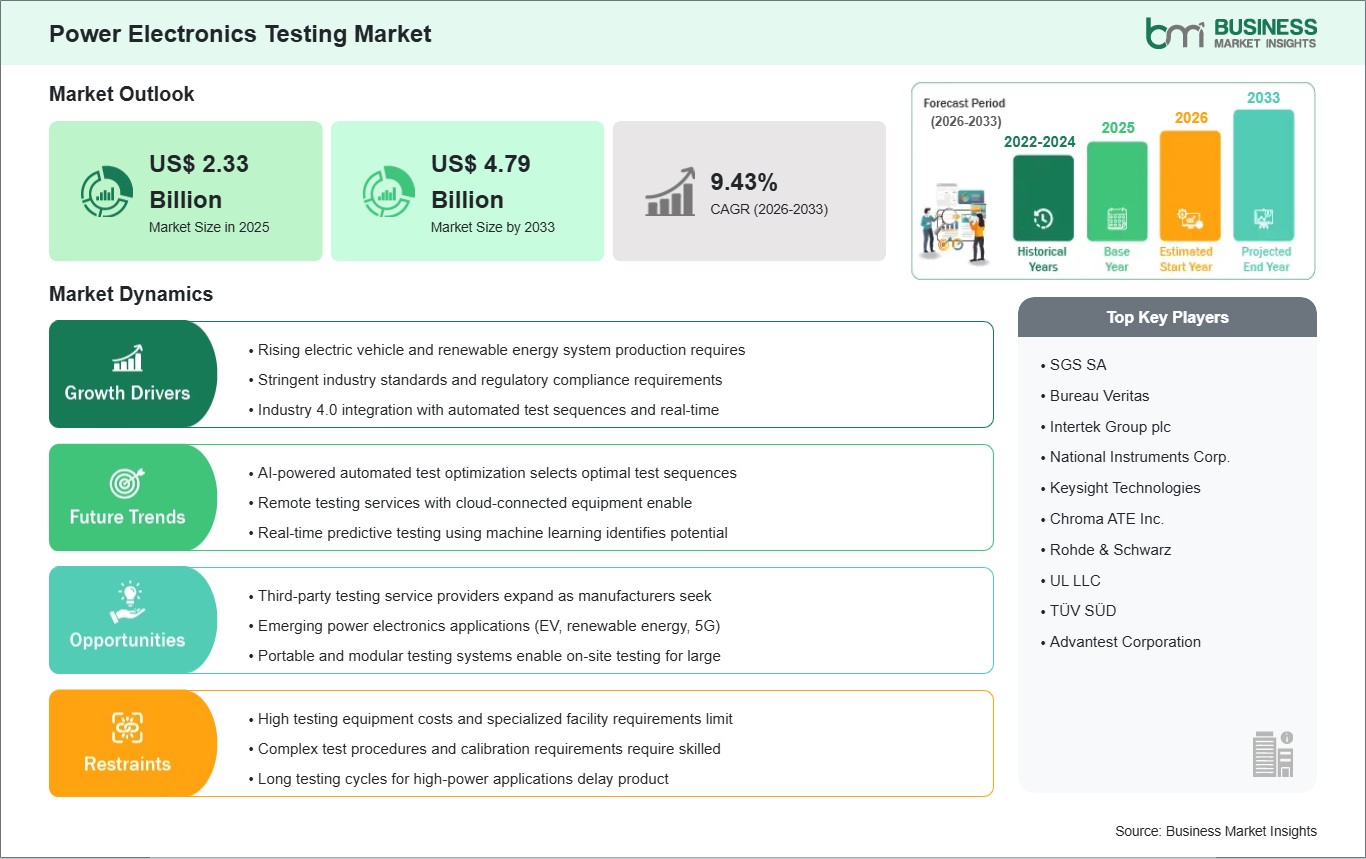
The Power Electronics Testing Market is projected to grow from US$ 2.33 billion in 2025 to US$ 4.79 billion by 2033. The market is estimated to record a CAGR of 9.43% from 2026 to 2033.
This trajectory indicates a market supported by tighter validation standards, broader use of advanced power semiconductors, and stronger integration of testing into product development. It also reflects the rising importance of reliable characterization in high-performance electrical systems.
By device, power discrete testing remains foundational due to broad component usage and high validation volume, while power module testing holds stronger strategic weight in performance-intensive systems. Power integrated circuit testing is also gaining relevance as integration depth increases across compact and intelligent power architectures. This device mix gives the market both scale and technical depth.
By industry vertical, automotive and industrial applications represent the most important demand centers because they combine power intensity with strict reliability expectations. ICT also carries notable relevance as data-centric infrastructure increasingly depends on efficient and validated power conversion components. Consumer electronics, aerospace, and defense contribute further demand through application-specific qualification needs.
Report Coverage
Power Electronics Testing Market Report Coverage and Deliverables
The "Power Electronics Testing Market Size and Forecast (2022–2033)" report provides a detailed analysis of the market covering below areas:
- Market size and forecast at global, regional, and country levels for all the key market segments covered under the scope
- Market trends, as well as market dynamics such as drivers, restraints, and key opportunities
- Market analysis covering key market trends, global and regional framework, major players, regulations, and recent market developments
- Industry landscape and competition analysis covering market concentration, heat map analysis, prominent players, and recent developments for the market
- Detailed company profiles, including SWOT analysis
Geographic Insights
Power Electronics Testing Market Geographic Insights
The Power Electronics Testing market shows diverse regional adoption patterns influenced by semiconductor development intensity, electrification programs, validation standards, and manufacturing sophistication. Across the global landscape, the market is advancing as industries place greater emphasis on accurate characterization of devices used in high-voltage and fast-switching environments. Regional differences are closely linked to automotive production, industrial power equipment demand, and the maturity of test and measurement ecosystems.
North America reflects a strong testing environment supported by advanced automotive, aerospace, ICT, and semiconductor development activities. The region places high emphasis on characterization precision, validation efficiency, and tools suited for next-generation power devices. This creates a favorable setting for advanced test platforms addressing wide-bandgap materials and complex module behavior.
Asia Pacific presents a broad opportunity because the region combines electronics manufacturing scale with expanding electric mobility, industrial output, and semiconductor supply-chain depth. Demand for testing solutions is reinforced by the need to validate components used in high-volume and performance-sensitive power applications. This supports a market structure that values both scalable test systems and more advanced characterization capability.
Europe maintains a strong position due to its concentration of automotive engineering, industrial automation, and power electronics R&D activity. Regional demand aligns with higher-fidelity validation tools, especially where efficiency, safety, and regulatory expectations shape product qualification. Beyond the major regions, emerging markets offer selective opportunity as electronics manufacturing capability and electrified infrastructure projects continue to develop.
Industry Activity
Recent Developments
The Power Electronics Testing Market is evaluated by gathering qualitative and quantitative data post primary and secondary research, which includes important corporate publications, association data, and databases. Recent developments and news in the market include:
- In May 2026, Rohde & Schwarz has introduced the new 3-phase power analysis option for the R&S®MXO 3 , 4, 5/5C series oscilloscopes. This option turns an MXO oscilloscope into a best-in-class waveform analysis tool for in-depth 3-phase AC power characterization. The solution simplifies total power results, multiphase AC power qualities, harmonic standard testing and distortion measurements, while keeping the original transient waveforms in view for instant root-cause tracing.
- In March 2025, Keysight Technologies, Inc. has enhanced its double-pulse test portfolio enabling customers to benefit from accurate and easy measurement of the dynamic characteristics of Wide-Bandgap (WBG) power semiconductor bare chips. The technologies implemented in the measurement fixture minimize parasitics and do not require soldering to the bare chip. The fixtures are compatible with both versions of Keysight’s double pulse testers.
Trust & Transparency
Research Methodology
The market analysis combines proprietary research with secondary data from government agencies, company disclosures, regulatory filings, industry databases and expert interviews. Market estimates are validated through data triangulation, cross-market benchmarking and analyst
review.
View Full Research Methodology
Key Sources Referred:
World Bank – Global Trade Indicators World Trade Organization (WTO) International Monetary Fund (IMF) International Energy Agency (IEA) International Trade Administration (ITA) Company Websites Company Annual Reports Company Investor Presentations