Market Summary
Executive Summary and Global Market Analysis
Power conditioning units are electrical systems designed to stabilize, regulate, filter, and optimize power supplied to sensitive loads and mission-critical equipment. They address disturbances such as voltage fluctuation, harmonics, transients, and waveform irregularities that can impair performance or shorten asset life. Their relevance has expanded as digital infrastructure, automated facilities, medical systems, and electrified transport networks become more dependent on reliable power quality. This positions the sector as an important layer between unstable supply conditions and performance-sensitive end-use systems.
Market momentum is being shaped by the rising operational cost of poor power quality across commercial, industrial, and institutional environments. Modern facilities increasingly rely on electronically controlled equipment that is more vulnerable to distortion, interruptions, and unstable voltage conditions. As energy systems become more decentralized and load profiles more complex, users are placing greater emphasis on conditioning solutions that can protect assets and maintain continuity. This is reinforcing procurement interest across both retrofit and new-installation environments.
Segment patterns reflect differences in performance requirement and installation scale. Active units hold a strong position where dynamic correction, harmonic filtering, and precise regulation are necessary, while passive units remain relevant in simpler or more cost-sensitive applications. By phase, three-phase systems are especially important in commercial buildings, industrial facilities, and transport-related infrastructure where larger loads and complex electrical environments are common. Single-phase units retain a meaningful role in residential and smaller commercial settings.
Technology development is moving toward smarter power management, broader monitoring capability, and tighter integration with efficient electrical infrastructure. Product innovation increasingly combines protection, digital visibility, and energy-conscious operation to support demanding loads in industrial and commercial environments. Advanced systems are also being designed to manage wider voltage ranges and lower harmonic distortion, reflecting the need for conditioned power in more variable operating conditions. This raises the strategic importance of product performance beyond traditional backup or protection functions.
Competitive conditions are shaped by the ability to address multiple power quality problems within increasingly sophisticated end-use environments. Suppliers are differentiating through digital control, application-specific reliability, and solutions aligned with commercial, industrial, and critical-facility requirements. The market therefore reflects a shift from basic electrical protection toward more intelligent and integrated power quality infrastructure.
Segment Analysis
Power Conditioning Unit Market Segmentation
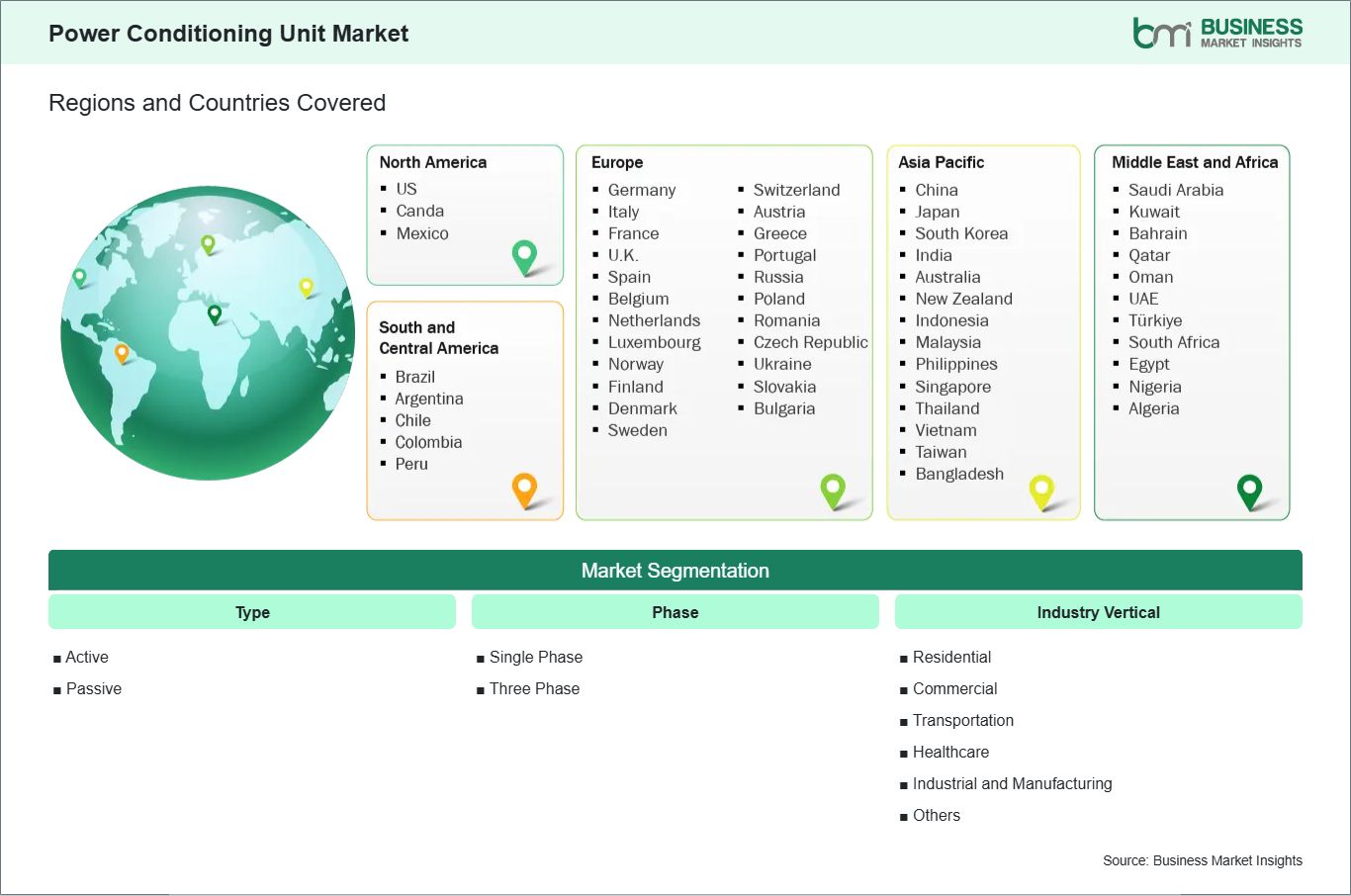
The Power Conditioning Unit Market is segmented based on Type, Phase, Industry Vertical, highlighting distinct operational priorities and evolving deployment strategies across various end uses.
By Type
- Active: Provides dynamic compensation for harmonics, voltage variation, and power quality events.
- Passive: Offers stable filtering for less complex electrical correction needs.
By Phase
- Single Phase: Fits smaller installations with moderate load sensitivity.
- Three Phase: Supports complex facilities requiring higher-capacity conditioned power.
By Industry Vertical
- Residential: Serves homes using sensitive electronics and connected energy systems.
- Commercial: Protects offices, retail sites, and digital infrastructure assets.
- Transportation: Supports electrified mobility systems and transport power reliability.
- Healthcare: Safeguards medical devices requiring stable and clean electricity.
- Industrial and Manufacturing: Secures automated equipment from costly power disturbances.
- Others: Covers additional sectors with power quality management requirements.
Market Forces
Power Conditioning Unit Market Drivers and Opportunities
Greater Exposure to Power Quality Disturbances in Digitized Facilities
Electrical environments are becoming more demanding as facilities deploy automation, digital controls, connected equipment, and electronically sensitive loads. These systems can be affected by harmonics, voltage sags, transients, and waveform instability that conventional supply arrangements do not always mitigate effectively. This creates a stronger need for power conditioning units that can regulate supply quality and reduce risk to operationally important equipment. The requirement is especially visible in settings where downtime, data loss, or equipment degradation carries significant financial or safety consequences.
The market effect extends across commercial complexes, healthcare facilities, industrial plants, and transportation-linked infrastructure. Operators in these environments are prioritizing conditioning solutions not only for protection, but also for continuity and predictable equipment behavior under variable load conditions. This makes power conditioning units more relevant as facilities modernize and integrate more advanced electrical assets. Their commercial value increasingly lies in protecting system performance rather than merely correcting occasional anomalies.
Intelligent Conditioning Solutions for High-Sensitivity and High-Growth Applications
A significant opportunity is emerging through the shift toward smarter and more application-focused power quality infrastructure. End users increasingly want conditioning systems that combine regulation, monitoring, energy efficiency, and broader compatibility with mission-critical operations. This creates room for solutions tailored to industrial automation, commercial reliability, healthcare systems, and data-intensive environments where electrical disturbances can cause disproportionate disruption. Intelligent conditioning platforms are therefore gaining strategic importance in facilities that need both power protection and operational visibility.
Future scope is strengthened by the expansion of electrified infrastructure, distributed energy environments, and higher-density digital loads. As users connect more sensitive systems to increasingly complex electrical networks, the need for adaptable active conditioning solutions becomes more pronounced. This supports wider deployment across three-phase installations and technically demanding sectors where conditioned power supports uptime, efficiency, and asset protection. The market’s opportunity therefore extends beyond correction into broader electrical optimization.
Size and Share Analysis
Power Conditioning Unit Market Size and Share Analysis
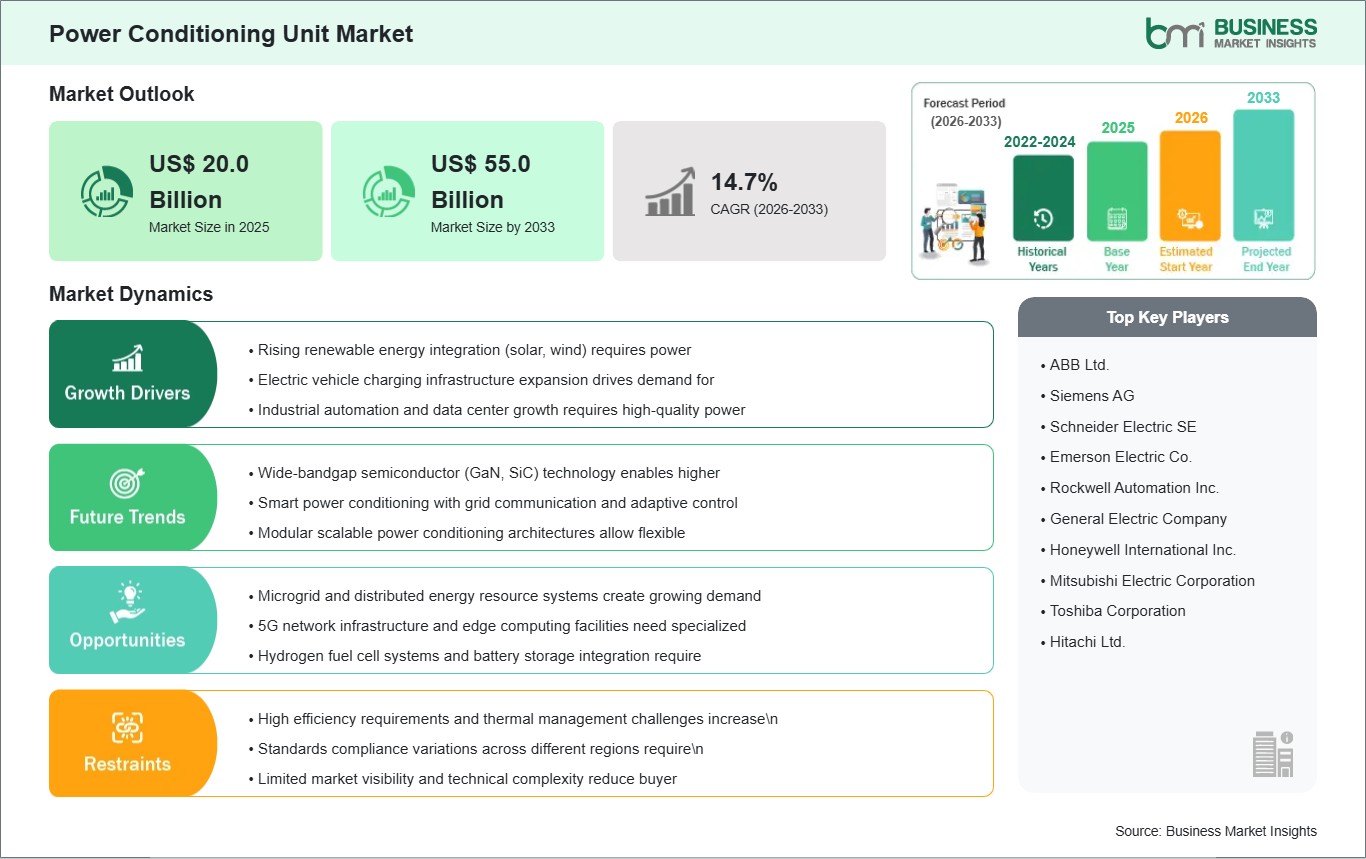
The Power Conditioning Unit Market size is expected to reach US$ 55.0 billion by 2033 from US$ 20.0 billion in 2025. The market is estimated to record a CAGR of 14.7% from 2026 to 2033.
This growth path indicates a market supported by the rising importance of power quality across digitally intensive and electrically complex end-use settings. It also reflects the increasing role of conditioning infrastructure in maintaining continuity and equipment integrity.
By type and phase, active systems hold a strong commercial position where dynamic correction and advanced filtering are required for sensitive loads. Three-phase units also maintain greater strategic importance in larger facilities due to their compatibility with commercial and industrial electrical configurations. Passive and single-phase products remain relevant in less complex or smaller-scale applications.
By industry vertical, industrial and manufacturing and commercial environments account for substantial demand because they rely heavily on automation, controlled processes, and uptime-sensitive electrical assets. Healthcare also represents a significant application area due to the need for stable power in clinically critical settings. Transportation and residential segments add further market depth as electrification and connected systems expand.
Report Coverage
Power Conditioning Unit Market Report Coverage and Deliverables
The "Power Conditioning Unit Market Size and Forecast (2022-2033)" report provides a detailed analysis of the market covering below areas:
- Market size and forecast at global, regional, and country levels for all the key market segments covered under the scope
- Market trends, as well as market dynamics such as drivers, restraints, and key opportunities
- Market analysis covering key market trends, global and regional framework, major players, regulations, and recent market developments
- Industry landscape and competition analysis covering market concentration, heat map analysis, prominent players, and recent developments for the market
- Detailed company profiles, including SWOT analysis
Geographic Insights
Power Conditioning Unit Market Geographic Insights
The Power Conditioning Unit market shows diverse regional adoption patterns influenced by grid quality conditions, electrical infrastructure modernization, digital load intensity, and industrial power reliability requirements. Across the global landscape, demand is rising where facilities need better protection against harmonic distortion, voltage instability, and operational disruption linked to poor power quality. Regional differences reflect the pace of electrification, industrial automation, and investment in mission-critical infrastructure.
North America reflects a mature but evolving market where commercial buildings, healthcare facilities, and industrial sites are investing in more intelligent power quality solutions. The region’s strong base of sensitive digital and operational equipment supports continued demand for active conditioning technologies and three-phase installations. Equipment selection increasingly favors solutions that combine monitoring, efficiency, and robust protection under variable load conditions.
Asia Pacific presents a strong expansion environment because the region combines industrial capacity growth, infrastructure development, and rising deployment of advanced electrical equipment. Demand is reinforced by the need to stabilize power in commercial, industrial, and transport-related settings where load complexity is increasing. This supports stronger relevance for both active and phase-specific conditioning systems across new and upgraded installations.
Europe shows a more efficiency- and compliance-oriented pattern shaped by advanced infrastructure, strict operational standards, and broader emphasis on energy-aware electrical systems. Conditioning technologies in the region are increasingly linked to resilient facility design and improved performance in complex power environments. Beyond the major regions, emerging markets offer additional opportunity where power instability, facility expansion, and industrial modernization create stronger need for conditioned electrical supply.
Industry Activity
Recent Developments
The Power Conditioning Unit Market is evaluated by gathering qualitative and quantitative data post primary and secondary research, which includes important corporate publications, association data, and databases. Recent developments and news in the market include:
- In March 2026, Vertiv (NYSE: VRT), a global leader in critical digital infrastructure, today announced the Vertiv™ PowerUPS 6000 Industrial uninterruptible power supply (UPS) system, designed to deliver reliable power protection for commercial and industrial (C&I) markets. The solution supports operations for industries including manufacturing, transportation, oil and gas, pharmaceuticals, food and beverage, packaging, and steel.
- In March 2025, Intelligent power management company Eaton is showcasing its latest innovations at Elecrama 2025, reinforcing its commitment to sustainable, efficient, and customer-centric power solutions. With a strong focus on Make in India, Eaton unveils cutting-edge products designed to enhance reliability and performance across critical applications, including data centers, renewable energy, and industrial power distribution.
Trust & Transparency
Research Methodology
The market analysis combines proprietary research with secondary data from government agencies, company disclosures, regulatory filings, industry databases and expert interviews. Market estimates are validated through data triangulation, cross-market benchmarking and analyst
review.
View Full Research Methodology
Key Sources Referred:
World Bank – Global Trade Indicators World Trade Organization (WTO) International Monetary Fund (IMF) International Energy Agency (IEA) International Trade Administration (ITA) Company Websites Company Annual Reports Company Investor Presentations