Market Summary
Executive Summary and Global Market Analysis
Power tools are motor-operated devices designed to perform mechanical tasks with greater speed, consistency, and force than manual alternatives. They include electric, pneumatic, and other powered formats used for drilling, fastening, sawing, demolition, and surface preparation across construction, manufacturing, repair, and home improvement settings. Their functional appeal lies in reducing labor intensity while improving precision, productivity, and repeatability. As workflow efficiency becomes more important across professional and consumer environments, these tools remain central to equipment purchasing decisions.
The market is advancing through a combination of construction activity, workshop modernization, industrial maintenance needs, and stronger household interest in project-based tool usage. Professional users require equipment that can withstand repetitive workloads and deliver consistent output across installation, fabrication, and repair tasks. At the same time, residential users increasingly favor compact and ergonomic products that simplify routine maintenance and improvement work. This dual-use profile gives the sector a broad demand base across both trade and non-trade channels.
Segment patterns show that electric tools hold the strongest position because they combine portability, ease of use, and broad application compatibility. Pneumatic tools remain relevant where high torque, durability, and continuous-duty operation are essential, particularly in industrial and automotive settings. By type, drilling and fastening tools carry the widest utility across end users, while sawing, demolition, and material removal categories address more specialized job requirements. End-user demand is distributed across industrial operations, commercial projects, and household applications with distinct purchasing priorities.
Technology evolution is centered on cordless performance, battery platform improvements, ergonomic refinement, and application-specific tool design. Better runtime, charging efficiency, and portability are reshaping buyer preferences, especially in electric formats used across mobile work environments. Manufacturers are also widening product ecosystems to improve interoperability and extend usage across jobsite and workshop tasks. These shifts are making platform strategy and user convenience more important within competitive positioning.
Competitive conditions reflect a market shaped by product breadth, battery ecosystems, distribution strength, and ongoing category expansion. Suppliers are refining cordless portfolios, targeting trade-specific requirements, and strengthening positions through new launches and portfolio restructuring. The industry therefore remains defined by product innovation, application coverage, and platform-led customer retention.
Segment Analysis
Power Tools Market Segmentation
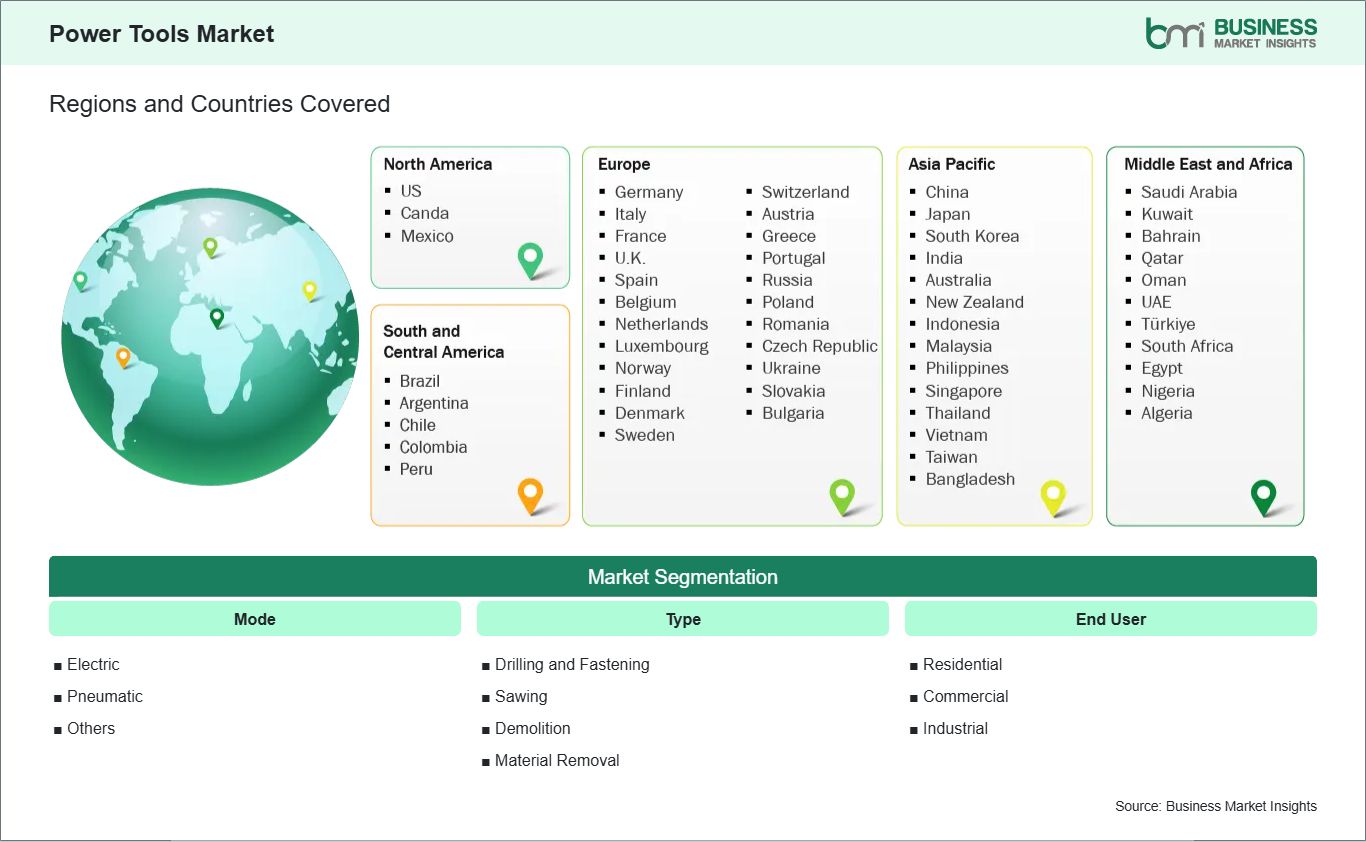
The Power Tools Market is segmented based on mode, type, end user, highlighting distinct operational priorities and evolving deployment strategies across various end uses.
By Mode
- Electric: Balances portability, usability, and broad task compatibility.
- Pneumatic: Serves heavy-duty applications requiring durable continuous operation.
- Others: Includes specialized formats for niche performance requirements.
By Type
- Drilling and Fastening: Supports the widest range of installation and assembly activities.
- Sawing: Addresses precision and productivity in cutting-oriented work.
- Demolition: Targets force-intensive material-breaking and removal applications.
- Material Removal: Enables smoothing, grinding, and finishing across multiple surfaces.
By End User
- Residential: Prefers compact, user-friendly tools for home improvement tasks.
- Commercial: Requires versatile equipment for installation and maintenance work.
- Industrial: Prioritizes durability, uptime, and performance consistency.
Market Forces
Power Tools Market Drivers and Opportunities
Construction, Maintenance, and Workshop Productivity Needs
A core growth driver comes from the need to complete mechanical tasks faster and with greater consistency across construction, repair, and fabrication environments. Contractors, technicians, and workshop operators rely on powered equipment to reduce manual effort while improving throughput and finish quality. This requirement supports steady purchasing across drilling, cutting, fastening, and surface-preparation applications. As jobsite efficiency becomes more tightly linked to labor productivity and schedule adherence, power tools retain strong commercial relevance.
The market impact extends across both professional and residential channels. Industrial and commercial users prioritize durability and performance under repetitive use, while homeowners increasingly seek accessible tools for maintenance and small-scale renovation work. This broad application base strengthens demand resilience and supports continued product differentiation by task, price point, and operating format. The sector therefore benefits from its utility across a wide range of end-use conditions.
Cordless Platform Expansion and User-Centric Product Design
A major opportunity lies in the continued shift toward cordless and ergonomically refined tool platforms. Improvements in battery runtime, charging performance, and weight distribution are making electric tools more practical across both professional and household applications. This trend expands use cases in mobile work environments where users value flexibility, reduced cable dependence, and simplified handling. It also supports the development of broader platform ecosystems that encourage repeat purchases across compatible tool families.
Future scope is likely to widen as manufacturers align tool launches with trade-specific applications and user comfort expectations. Product ecosystems that integrate batteries, chargers, accessories, and category extensions can deepen brand retention while lowering switching friction for buyers. This creates room for expansion across residential, commercial, and industrial segments without relying on a single end-user class.
Size and Share Analysis
Power Tools Market Size and Share Analysis
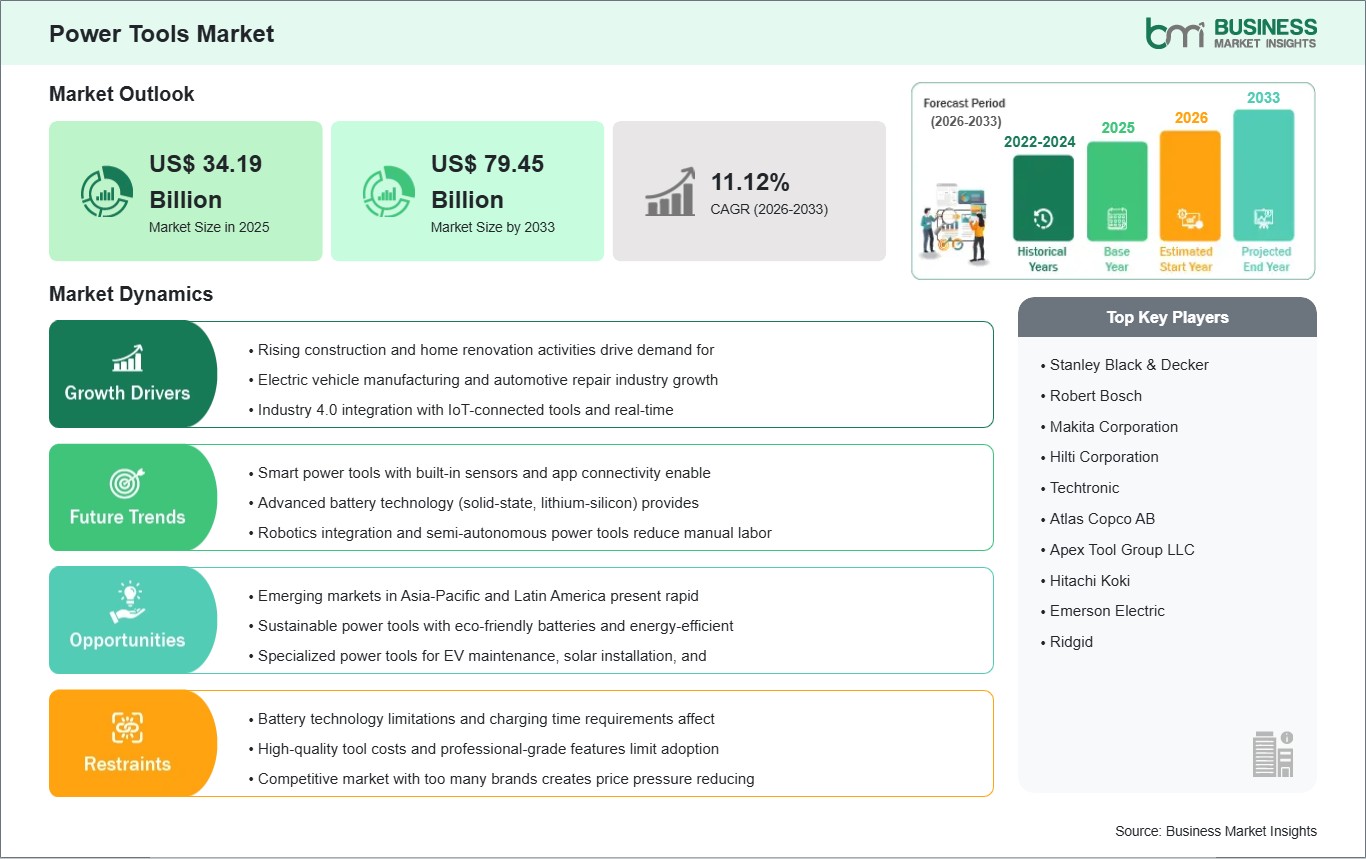
The Power Tools Market is projected to grow from US$ 34.19 billion in 2025 to US$ 79.45 billion by 2033. The market is estimated to record a CAGR of 11.12% from 2026 to 2033.
This growth pattern indicates a market supported by steady tool replacement, cordless platform expansion, and the continued relevance of powered equipment across worksite and household applications. It also reflects broader alignment with productivity-led purchasing decisions.
By mode and type, electric tools account for the strongest market position due to portability and broad usability, while pneumatic tools remain important in demanding professional settings. Drilling and fastening tools hold the leading share within product categories because they serve the widest set of routine tasks across end users. Sawing, demolition, and material removal segments provide additional depth through application-specific demand.
By end user, industrial and commercial segments represent the core demand base because they require frequent, performance-oriented tool usage. Residential demand also carries notable importance as DIY activity and home improvement preferences strengthen tool ownership among non-professional users. This end-user mix supports both premium and value-oriented product strategies.
Report Coverage
Power Tools Market Report Coverage and Deliverables
The "Power Tools Market Size and Forecast (2022–2033)" report provides a detailed analysis of the market covering below areas:
- Market size and forecast at global, regional, and country levels for all the key market segments covered under the scope
- Market trends, as well as market dynamics such as drivers, restraints, and key opportunities
- Market analysis covering key market trends, global and regional framework, major players, regulations, and recent market developments
- Industry landscape and competition analysis covering market concentration, heat map analysis, prominent players, and recent developments for the market
- Detailed company profiles, including SWOT analysis
Geographic Insights
Power Tools Market Geographic Insights
The Power Tools market shows diverse regional adoption patterns influenced by construction cycles, manufacturing intensity, consumer tool ownership, and product platform preferences. Across the global industry, market activity reflects the practical need for faster mechanical work, improved portability, and dependable task execution in both professional and household environments. Regional variation is shaped by differences in industrial structure, infrastructure development, and retail access to cordless systems.
North America remains a significant market because professional trades, renovation activity, and household improvement culture support broad tool usage. Demand in the region is also shaped by preference for cordless electric platforms, trade-grade product performance, and replacement purchases tied to active contractor channels. This creates a strong setting for premium offerings and ecosystem-led brand competition.
Asia Pacific presents the broadest expansion opportunity due to its combination of infrastructure activity, manufacturing growth, and rising tool penetration in developing consumer markets. Construction demand and industrial workshop usage support core sales, while expanding middle-class participation contributes additional residential purchasing momentum. These conditions make the region particularly important for both volume growth and portfolio diversification.
Europe maintains relevance through industrial maintenance, construction renovation, and strong emphasis on efficient and durable equipment selection. Emerging markets in Latin America, the Middle East, and Africa also offer selective opportunity where urban development, workshop formation, and contractor tool adoption continue to advance. Together, these regions broaden the market beyond its most mature demand centers.
Industry Activity
Recent Developments
The Power Tools Market is evaluated by gathering qualitative and quantitative data post primary and secondary research, which includes important corporate publications, association data, and databases. Recent developments and news in the market include:
- In May 2026, XTRA Power Tools has launched a new cordless range under the campaign ‘XTRA Freedom. XTRA Force,’ aimed at modern professionals in construction and industrial applications. This launch reflects the rapid transformation in India’s power tools market towards cordless technologies. The new range features brushless motors, offering users longer battery life, reduced heat, and lower maintenance.
- In March 2026, Makita Corporation and its group companies hereby announce that they have reached an agreement to acquire the power tool business operated by Electric Works Company of Panasonic Corporation and its group companies.
Trust & Transparency
Research Methodology
The market analysis combines proprietary research with secondary data from government agencies, company disclosures, regulatory filings, industry databases and expert interviews. Market estimates are validated through data triangulation, cross-market benchmarking and analyst
review.
View Full Research Methodology
Key Sources Referred:
World Bank – Global Trade IndicatorsWorld Trade Organization (WTO)International Monetary Fund (IMF)International Energy Agency (IEA)International Trade Administration (ITA)Company WebsitesCompany Annual ReportsCompany Investor Presentations