
Power Quality Meter Market Outlook: Size, Share, Trends, Growth Analysis, Competitive Landscape & Forecast, 2026-2033

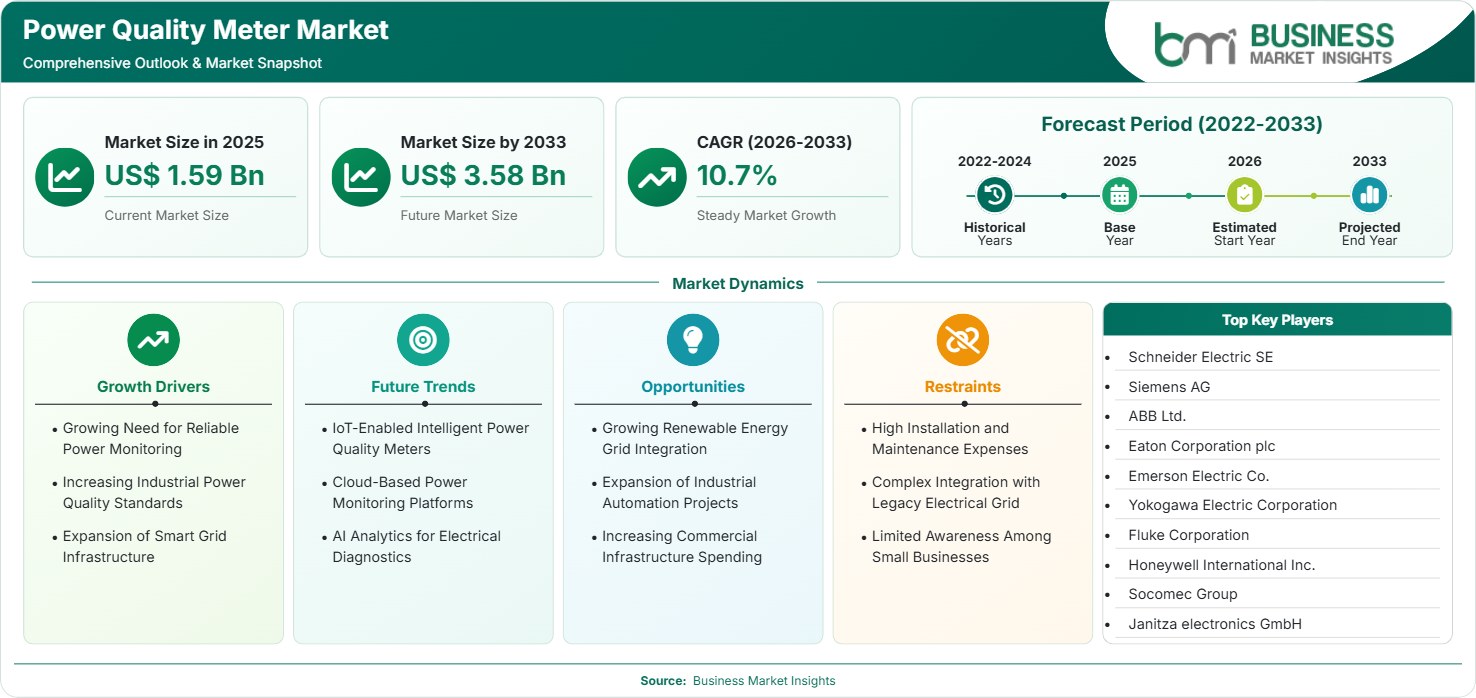
The Power Quality Meter Market size was valued at US$ 1.59 billion in 2025 and is projected to reach US$ 3.58 billion by 2033, growing at a CAGR of 10.7% from 2026 to 2033, driven by increasing demand for reliable electricity monitoring, stricter industrial power quality requirements, smart grid deployment, renewable energy integration, and expansion of automated electrical infrastructure.

Report Coverage
  • Phase: Single-phase, Three-phase
  • End-user: Industrial & Manufacturing, Commercial, Utilities, Transportation, Others
  • Application: Distribution Panels, Substation Monitoring, Equipment, Others
US$ 1.59 Bn Market size in 2025
US$ 3.58 Bn Market Size by 2033
10.7% CAGR, 2026 - 2033
2026-2033 Forecast Period

AI Overview

Power Quality Meter Market Summary

  • North America Region: North America held 31%–34% share in 2025 and is projected to grow at a CAGR of 10.2%–10.8% from 2026–2033. The region benefits from smart grid modernization, industrial automation adoption, renewable energy integration, and increasing focus on electrical reliability. The US market is expected to register a CAGR of 10.3%–10.9% during 2026–2033, supported by grid modernization programs and industrial monitoring requirements.
  • Fastest Growing Region: Asia Pacific accounted for 34%–38% share in 2025 and is anticipated to expand at a CAGR of 11.2%–11.8% from 2026–2033. Growth is supported by rapid industrialization, infrastructure expansion, smart grid investments, renewable power deployment, and increasing electricity quality monitoring requirements.
  • Leading Segment: Three-phase meters represented 62%–66% share in 2025 and are projected to grow at a CAGR of 10.5%–11.0% from 2026–2033, driven by industrial applications, manufacturing facilities, utility networks, and demand for accurate multi-load electrical monitoring.
  • High Growth Segment: Substation Monitoring accounted for 28%–32% share in 2025 and is expected to grow at a CAGR of 11.5%–12.1% from 2026–2033, supported by grid digitization, utility modernization, renewable integration, and advanced power management requirements.
  • Key Market Opportunity: Renewable energy integration, industrial automation expansion, smart grid development, and digital electricity monitoring solutions are creating opportunities for advanced power quality measurement technologies.
  • Major Market Players: Schneider Electric SE, Siemens AG, ABB Ltd., Eaton Corporation plc, Emerson Electric Co., Yokogawa Electric Corporation, Fluke Corporation, Honeywell International Inc., Socomec Group, and Janitza electronics GmbH.
Strategic Insights

Power Quality Meter Market: Strategic Insights

Power Quality Meter Market Strategic Framework
FREE PDF
Request your free sample
Request free sample
Stakeholder View

Key Takeaways

  • The market ecosystem includes electrical equipment manufacturers, smart grid technology providers, industrial automation companies, utilities, infrastructure developers, and energy management solution providers.
  • Industrial facilities, renewable energy installations, and utility networks represent major growth opportunities due to increasing requirements for stable and efficient power distribution.
  • Innovation is shifting toward IoT-enabled meters, cloud-based analytics, predictive maintenance capabilities, and real-time monitoring platforms for improved electrical management.
  • Asia Pacific offers strong investment potential due to industrial expansion, smart infrastructure development, renewable energy projects, and increasing electricity demand.
  • Companies are strengthening market positions through digital product launches, automation partnerships, regional expansion, and integrated energy management solutions.
  • Future competitiveness will depend on measurement accuracy, cybersecurity capabilities, interoperability with digital grids, installation efficiency, and advanced analytics integration.
Geographic Outlook

Power Quality Meter Market Regional Highlights

North America Power Quality Meter Market

North America accounted for 31%–34% share in 2025 and is projected to grow at a CAGR of 10.2%–10.8% throughout the Power Quality Meter Market Forecasts. The region benefits from smart grid investments, the adoption of industrial automation, the deployment of renewable energy, and the increasing demand for reliable electricity monitoring. The United States remains the largest contributor due to grid modernization initiatives, advanced industrial infrastructure, and strong adoption of digital energy management solutions.

  • The United States is increasing demand through smart grid upgrades and industrial power monitoring requirements.
  • Industrial facilities are adopting advanced meters to improve energy efficiency and reduce operational disruptions.
  • Utilities are investing in digital monitoring systems for improved grid reliability and performance management.
  • Renewable energy expansion is increasing requirements for accurate power quality measurement technologies.

US Power Quality Meter Market

The US represented 28%–31% share in 2025 and is expected to grow at a CAGR of 10.3%–10.9% from 2026–2033. Power Quality Meter Market growth is supported by increasing grid modernization investments, industrial automation adoption, renewable energy integration, and demand for advanced electrical monitoring systems. Commercial facilities and utilities are increasingly deploying digital meters to improve energy reliability and operational efficiency.

  • Industrial automation growth is increasing adoption of advanced electrical monitoring equipment.
  • Utilities are implementing intelligent grid technologies to improve electricity quality management.
  • Renewable energy projects require advanced monitoring for stable power integration.
  • Commercial infrastructure operators are adopting energy management solutions to optimize consumption.

Europe Power Quality Meter Market

Europe accounted for 22%–25% share of the Power Quality Meter Market in 2025 and is projected to grow at a CAGR of 10.0%–10.6% from 2026–2033. The region is advancing through renewable energy expansion, industrial automation, energy efficiency regulations, and the modernization of electrical infrastructure. Germany, the United Kingdom, France, and Italy remain important markets due to manufacturing strength, smart energy initiatives, and increasing demand for reliable power monitoring solutions across commercial and industrial facilities.

  • Germany is supporting adoption through industrial automation, renewable integration, and advanced electrical infrastructure development.
  • The United Kingdom is increasing demand through grid modernization projects and renewable energy management initiatives.
  • France is expanding power monitoring deployment across commercial facilities and energy infrastructure projects.
  • Italy is adopting advanced electrical measurement systems for industrial efficiency and energy optimization.
  • European manufacturers are prioritizing digital energy management and intelligent monitoring technologies.

Asia Pacific Power Quality Meter Market

Asia Pacific represented 34%–38% of the Power Quality Meter Market share in 2025 and is expected to register a CAGR of 11.2%–11.8% from 2026–2033, making it the fastest-growing regional market. Growth is driven by industrialization, manufacturing expansion, renewable energy development, smart grid investments, and infrastructure modernization. China, India, Japan, South Korea, and Southeast Asian countries are increasing adoption due to growing electricity demand and digital transformation of energy networks.

  • China is expanding power quality monitoring through industrial development and smart grid infrastructure investments.
  • India is increasing adoption through renewable energy expansion and electricity distribution modernization programs.
  • Japan supports demand through advanced manufacturing facilities and energy efficiency initiatives.
  • South Korea is adopting monitoring technologies for semiconductor and electronics manufacturing applications.
  • Southeast Asia is developing electrical infrastructure to support industrial and commercial growth.

Rest of World Power Quality Meter Market

Rest of World accounted for 9%–12% of the Power Quality Meter Market share in 2025 and is projected to grow at a CAGR of 10.4%–11.0% from 2026–2033. Latin America, the Middle East, and Africa are witnessing increasing investments in power infrastructure, renewable energy projects, and industrial development. Growing electrification initiatives and commercial infrastructure expansion are supporting demand for power quality measurement technologies.

Middle Eastern countries are investing in smart energy infrastructure, while Latin American markets are improving grid reliability through modernization programs. African economies are gradually adopting advanced electricity monitoring solutions as industrial and renewable energy projects expand.

  • Brazil is increasing adoption through industrial expansion and electrical infrastructure improvements.
  • Mexico is strengthening demand through manufacturing growth and energy management requirements.
  • Saudi Arabia is investing in smart infrastructure and renewable energy development.
  • South Africa is adopting monitoring systems for improved grid reliability and industrial operations.
  • Emerging markets are creating opportunities through electrification and infrastructure modernization initiatives.
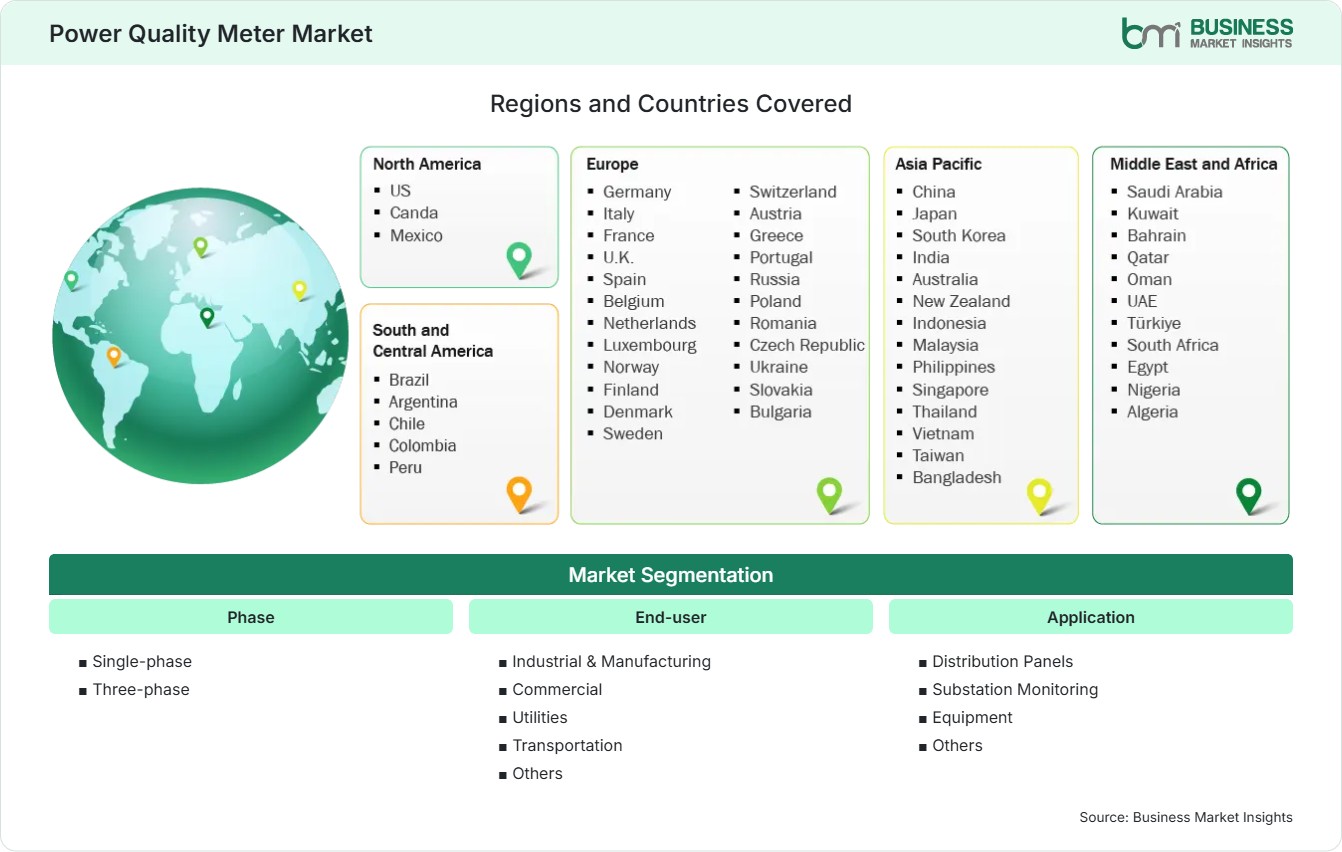
Global Market Geography
FREE PDF
Request your free sample
Request free sample
Segment Analysis

Power Quality Meter Market Segmentation

Phase

Phase segmentation includes single-phase and three-phase power quality meters designed for different electrical monitoring requirements. The segment accounted for 100% share in 2025 and is projected to grow at a CAGR of 10.7% from 2026–2033. Increasing industrial automation, commercial infrastructure development, renewable energy integration, and demand for reliable electricity management are supporting adoption across residential, commercial, industrial, and utility applications.

  • Single-phase: Single-phase meters support commercial and smaller electrical systems by providing monitoring capabilities for voltage variations, power disturbances, and energy quality management applications.
  • Three-phase: Three-phase meters dominate industrial and utility applications due to higher accuracy requirements, complex electrical loads, manufacturing processes, and large-scale power monitoring needs.

End-user

End-user segmentation reflects adoption across industrial facilities, commercial buildings, utilities, transportation systems, and other electrical infrastructure environments. The segment accounted for 100% share in 2025 and is projected to grow at a CAGR of 10.7% from 2026–2033. Rising electricity reliability requirements, digital energy management adoption, industrial automation expansion, and smart infrastructure development are increasing demand for power quality measurement solutions across multiple end-user categories.

  • Industrial & Manufacturing: Industrial and manufacturing facilities represent a major application area due to automated production systems, sensitive equipment requirements, energy optimization needs, and demand for uninterrupted electrical operations.
  • Commercial: Commercial users are adopting power quality meters to improve energy efficiency, monitor electrical performance, manage building systems, and support digital facility management initiatives.
  • Utilities: Utilities are deploying advanced monitoring solutions for grid reliability, voltage regulation, renewable integration, and improved electricity distribution management across transmission and distribution networks.
  • Transportation: Transportation infrastructure uses power quality monitoring systems to maintain electrical reliability in rail networks, charging infrastructure, and electrified transportation operations.
  • Others: Other end users include institutional facilities, data centers, healthcare facilities, and specialized infrastructure requiring accurate power quality analysis and electrical performance monitoring.

Application

Application segmentation covers distribution panels, substation monitoring, equipment monitoring, and other electrical management applications. The segment accounted for 100% share in 2025 and is projected to grow at a CAGR of 10.7% from 2026–2033. Increasing grid complexity, renewable energy deployment, industrial automation, and demand for predictive electrical maintenance are driving adoption of advanced monitoring technologies across power infrastructure.

  • Distribution Panels: Distribution panel applications are expanding due to the need for real-time electrical monitoring, fault detection, energy optimization, and improved facility-level power management.
  • Substation Monitoring: Substation monitoring adoption is increasing with smart grid expansion, utility modernization programs, renewable integration requirements, and demand for improved electricity network visibility.
  • Equipment: Equipment monitoring applications support industrial operations by identifying electrical disturbances, improving asset performance, and reducing downtime caused by power quality issues.
  • Others: Other applications include specialized electrical systems, infrastructure projects, and monitoring environments requiring detailed analysis of power performance parameters.
Market Forces

Power Quality Meter Market Dynamics

Key Market Drivers

Growing Need for Reliable Power Monitoring

The increasing need for reliable power monitoring is driving adoption of advanced measurement solutions across industrial, commercial, and utility applications. Electrical disturbances such as voltage fluctuations, harmonics, and interruptions can impact sensitive equipment performance and operational efficiency. Organizations are deploying power quality meters to identify issues, reduce downtime, and improve energy management practices. Growing dependence on automation, digital infrastructure, and electronic systems is increasing the requirement for continuous electrical monitoring. These factors are supporting Power Quality Meter Market growth as industries prioritize operational reliability, predictive maintenance, and improved electricity performance across increasingly complex power networks.

Increasing Industrial Power Quality Standards

Rising industrial power quality standards are encouraging businesses to adopt advanced monitoring technologies that ensure compliance and improve operational performance. Manufacturing facilities, semiconductor plants, data centers, and automated production environments require stable electricity supply to maintain productivity and protect sensitive equipment. Power quality meters enable organizations to measure electrical parameters, identify disturbances, and optimize energy systems. Increasing emphasis on energy efficiency and operational continuity is accelerating investment in monitoring solutions. The evolving Power Quality Meter Market trends reflect growing demand for intelligent measurement systems capable of supporting industrial automation, regulatory requirements, and advanced energy management strategies.

Expansion of Smart Grid Infrastructure

Expansion of smart grid infrastructure is increasing demand for advanced power quality monitoring technologies across utility networks. Utilities are integrating digital monitoring systems to improve grid visibility, manage distributed energy resources, and enhance electricity reliability. Smart grids require accurate measurement capabilities to handle renewable energy variability, decentralized generation, and changing consumption patterns. Power quality meters support real-time analysis and help operators identify network issues more efficiently. Government initiatives focused on grid modernization and energy transition are accelerating infrastructure investments. These developments are strengthening adoption of intelligent monitoring systems and supporting long-term market expansion.

Key Market Opportunities

Growing Renewable Energy Grid Integration

The integration of renewable energy sources into electricity grids is creating significant opportunities for power quality meter manufacturers. Solar and wind generation introduce variability that requires advanced monitoring to maintain grid stability and manage power fluctuations. Utilities and renewable energy operators are investing in measurement technologies to improve synchronization, detect disturbances, and optimize distributed energy resources. Increasing renewable capacity additions worldwide are expected to create sustained demand for intelligent monitoring systems. Companies offering solutions compatible with renewable infrastructure, digital grids, and energy management platforms can benefit from expanding opportunities in modern electricity networks.

Expansion of Industrial Automation Projects

The expansion of industrial automation projects is creating additional opportunities as factories increasingly depend on reliable electrical systems. Automated production lines, robotics, and connected manufacturing equipment require consistent power quality to avoid operational interruptions. Power quality meters enable manufacturers to monitor electrical performance, improve equipment reliability, and support predictive maintenance strategies. Growth in smart factories and Industry 4.0 adoption is increasing demand for advanced monitoring technologies. Suppliers developing integrated solutions with automation platforms, analytics capabilities, and remote monitoring features are positioned to capture opportunities across industrial sectors.

Increasing Commercial Infrastructure Spending

Increasing commercial infrastructure spending is creating opportunities for power quality monitoring solutions across office buildings, retail facilities, healthcare infrastructure, and large commercial complexes. Building operators are adopting intelligent energy management systems to improve efficiency, reduce operating costs, and maintain reliable electrical performance. Power quality meters support facility managers by providing visibility into energy consumption patterns and electrical conditions. Growing construction activity, smart building adoption, and sustainability initiatives are encouraging integration of advanced monitoring technologies. This trend is expanding demand beyond industrial applications and creating new growth avenues in commercial energy management environments.

Market Restraints and Challenges

High Installation and Maintenance Expenses

Factor: Power quality meter deployment requires specialized installation processes, technical expertise, calibration procedures, and ongoing maintenance investments, increasing total ownership costs for organizations.

Impact: High installation and maintenance expenses can limit adoption among small and medium-sized businesses with restricted budgets. Organizations may delay implementation despite long-term efficiency benefits, affecting market penetration in cost-sensitive applications.

Complex Integration with Legacy Electrical Grid

Factor: Existing electrical infrastructure often includes outdated systems that may require significant upgrades, compatibility adjustments, and technical modifications for advanced power quality meter integration.

Impact: Complex integration requirements can increase deployment timelines, raise implementation costs, and create challenges for utilities and industrial users transitioning toward digital monitoring systems.

Company Analysis

Competitive Landscape

The Power Quality Meter Market analysis highlights a competitive environment comprising electrical equipment manufacturers, energy management solution providers, automation technology companies, and industrial monitoring specialists. Companies are focusing on digital measurement capabilities, IoT integration, smart grid compatibility, and advanced analytics to strengthen their market presence. Competitive strategies emphasize improving monitoring accuracy, enabling predictive maintenance, supporting renewable energy integration, and developing solutions suitable for industrial, commercial, and utility applications.

Company Name

Overview

Products and Services relevant to this market

Schneider Electric SE

Global energy management and automation company providing electrical solutions.

Power quality meters, energy monitoring systems, digital power management, and grid solutions.

Siemens AG

Technology company delivering electrification, automation, and infrastructure solutions globally.

Power quality measurement devices, smart grid monitoring, industrial energy solutions, and digital systems.

ABB Ltd.

Electrical technology company specializing in power and automation solutions.

Power quality analyzers, monitoring equipment, electrical measurement systems, and grid technologies.

Eaton Corporation plc

Power management company supporting electrical infrastructure and energy efficiency.

Power quality meters, electrical monitoring solutions, power distribution technologies, and protection systems.

Emerson Electric Co.

Industrial technology company providing automation and monitoring solutions.

Electrical monitoring systems, power measurement technologies, automation solutions, and industrial analytics.

Yokogawa Electric Corporation

Measurement and control technology provider serving industrial markets.

Power quality analyzers, precision measurement instruments, monitoring systems, and testing solutions.

Fluke Corporation

Test and measurement company focused on electrical diagnostics.

Power quality analyzers, electrical testing equipment, monitoring instruments, and diagnostic solutions.

Honeywell International Inc.

Technology company offering automation and industrial management solutions.

Energy monitoring solutions, industrial control systems, power management technologies, and analytics.

Socomec Group

Electrical equipment company specializing in power management solutions.

Power quality monitoring devices, energy management systems, and electrical protection solutions.

Janitza electronics GmbH

Energy measurement specialist focused on power monitoring technologies.

Power quality meters, energy monitoring systems, grid analysis solutions, and communication platforms.

Industry Activity

Recent Developments

June 2026

Janitza introduced a new accessory that connects UMG devices communicating via Modbus to MQTT brokers. The JUG 25 is designed for DIN rail mounting and translates Modbus RTU and Modbus TCP communication into MQTT.

November 2024

Yokogawa Electric Corporation announced the release of the PBDH0400 Series differential probe with a maximum input voltage of 2000 V and a frequency bandwidth of 400 MHz.

October 2024

Chauvin Arnoux launched the CA 8345 Power Quality Analyzer, designed for comprehensive monitoring and analysis of electrical networks. The new analyzer offers Class A power quality measurements compliant with IEC 61000-4-30, enhanced data logging.

February 2024

Yokogawa Electric Corporation acquired Adept Fluidyne Pvt. Ltd. (“Adept”), one of the largest domestic manufacturers of magnetic flowmeters in India. This acquisition will provide Yokogawa with an Indian manufacturing base for its lineup of high-performance magnetic flowmeters.

Trust & Transparency

Research Methodology

The market analysis combines proprietary research with secondary data from government agencies, company disclosures, regulatory filings, industry databases and expert interviews. Market estimates are validated through data triangulation, cross-market benchmarking and analyst review.

View Full Research Methodology

Questions Answered

Frequently Asked Questions

What does the Power Quality Meter Market Report cover?

The Power Quality Meter Report covers market size, segmentation analysis, regional trends, competitive landscape, growth drivers, opportunities, challenges, recent developments, and industry forecasts through 2033.

How are companies improving power quality meter technologies?

Manufacturers are integrating IoT connectivity, cloud-based analytics, remote monitoring capabilities, predictive maintenance features, and advanced communication protocols to improve system performance and usability.

Why are smart grids increasing demand for power quality meters?

Smart grids require real-time monitoring capabilities to manage renewable energy variability, improve grid reliability, detect disturbances, and optimize electricity distribution performance across modern power networks.

Which phase segment dominates the market?

Three-phase power quality meters represent the leading segment due to extensive adoption across industrial facilities, utilities, manufacturing plants, and large-scale electrical infrastructure requiring accurate monitoring.

What factors are driving the Power Quality Meter Market growth?

The market is driven by increasing demand for reliable power monitoring, industrial automation expansion, smart grid infrastructure development, renewable energy integration, and rising requirements for electrical system efficiency and stability.

Access the Full Power Quality Meter Market Report

Get segment-level forecasts, regional estimates, competitive benchmarking, company profiles and downloadable Excel datasets.

Access the full Power Quality Meter Market Report
350 pages PDF & Excel | 2026-08-04