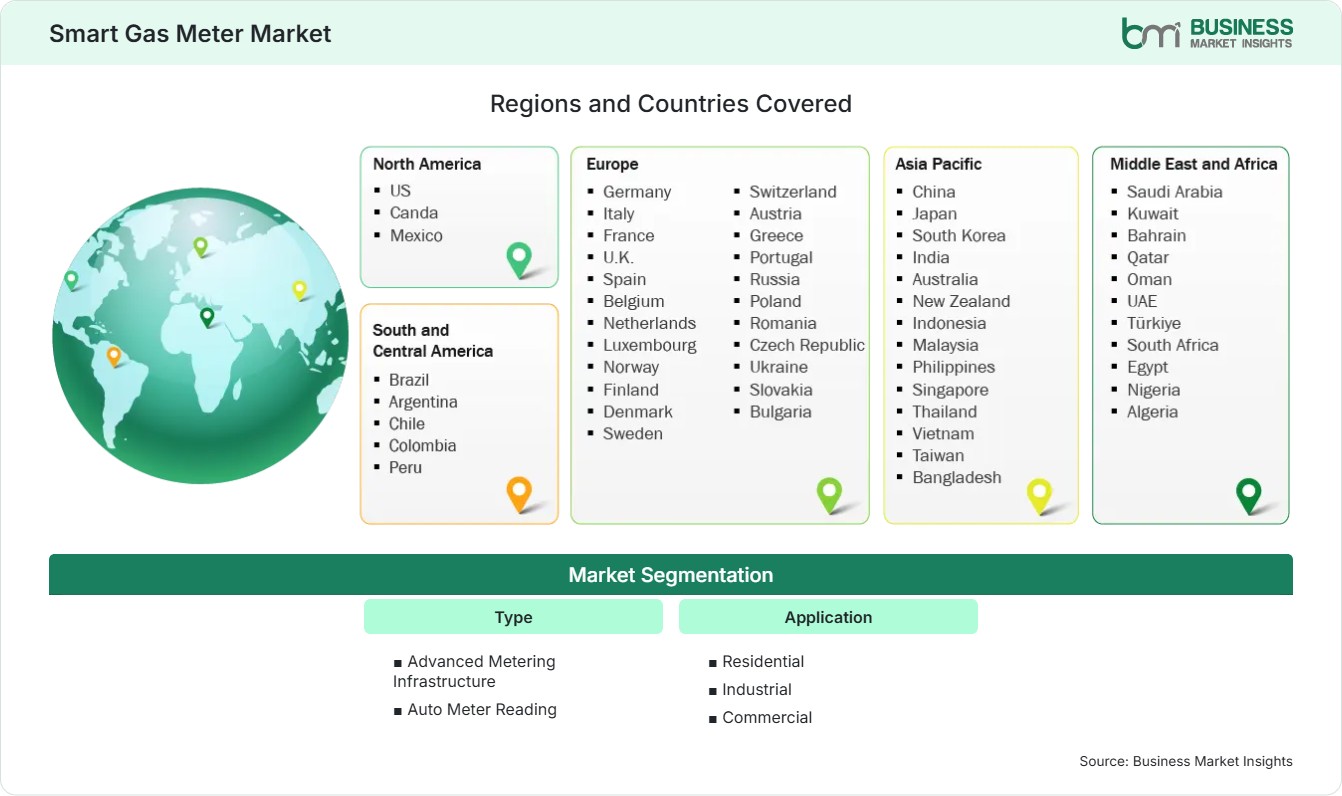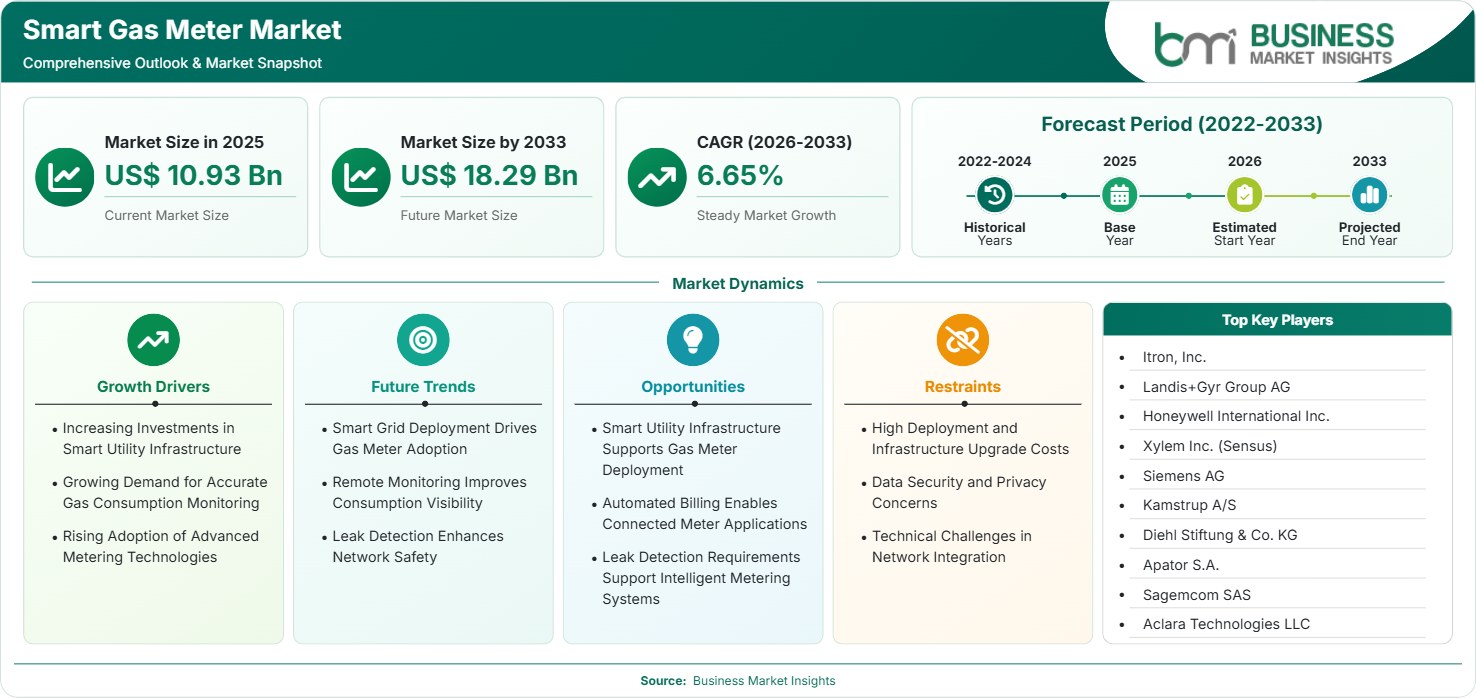
Smart Gas Meter Market Regional Highlights
North America Smart Gas Meter Market
North America accounted for 34%–37% of the Smart Gas Meter Market share in 2025 and is expected to expand at a CAGR of 5.8%–6.3% during 2026–2033. Strong utility modernization programs, regulatory support for advanced metering, and replacement of aging infrastructure maintain deployment momentum. Utilities increasingly leverage connected metering for operational efficiency, remote service delivery, and system reliability. Large-scale investments across the United States and Canada continue supporting intelligent gas network initiatives, making the region a mature but innovation-driven market.
- Utilities increasingly deploy AMI platforms integrating gas, electricity, and water meter management to improve operational visibility and customer engagement.
- Advanced cybersecurity requirements are influencing procurement decisions as connected infrastructure becomes critical to utility operations.
- Distribution network optimization initiatives encourage wider adoption of predictive maintenance and real-time consumption monitoring technologies.
- Federal and state infrastructure modernization funding supports continued replacement of legacy manual meter systems.
US Smart Gas Meter Market
The U.S. represented approximately 79%–83% of the North American market in 2025 and is forecast to advance at 5.9%–6.4% CAGR through 2033. Utility companies continue implementing digital transformation roadmaps focused on automated meter reading, outage response, and network management improvements. Regulatory emphasis on operational efficiency, customer service quality, and resource conservation supports sustained deployment demand. Investments in advanced communications infrastructure strengthen long-term adoption potential.
- Major utilities increasingly integrate smart gas data with enterprise analytics platforms to enhance asset utilization and customer insights.
- Adoption of cellular and NB-IoT communication technologies improves deployment flexibility in urban and suburban service territories.
- Infrastructure resilience initiatives support replacement of legacy metering fleets with connected alternatives.
- Growing emphasis on methane emission monitoring encourages enhanced network visibility and measurement accuracy.
Europe Smart Gas Meter Market
Europe accounted for 28%–31% of market revenue in 2025 and is projected to register a CAGR of 6.1%–6.7% of the Smart Gas Meter Market through 2033. Regulatory frameworks supporting smart metering rollout and energy efficiency programs continue driving adoption. Germany and Italy remain leading deployment markets, while Eastern European countries demonstrate comparatively faster implementation rates, often achieving growth between 6.8% and 7.5%. Utility digitization and climate-oriented energy management policies sustain long-term demand.
- European energy transition strategies support advanced metering infrastructure investment across regulated utility environments.
- Smart meter interoperability requirements encourage adoption of standardized communication protocols.
- Germany remains among the largest deployment markets due to advanced utility modernization initiatives.
- Poland and selected Central European countries demonstrate higher expansion rates driven by infrastructure upgrades.
- Data-driven consumption management solutions gain importance amid rising efficiency expectations.
Asia Pacific Smart Gas Meter Market
Asia Pacific held a 27%–30% share in 2025 and represents the fastest-expanding regional market with a CAGR of 7.8%–8.4% through 2033. China, Japan, and South Korea lead deployment volumes, while India exhibits particularly strong growth supported by urban gas network expansion. The region benefits from smart city investments, utility modernization efforts, and rising natural gas adoption. Strong manufacturing capabilities further improve deployment economics and scalability.
- China leads regional installations through extensive smart city and grid modernization programs.
- India records some of the fastest adoption rates due to city gas distribution network expansion.
- Telecommunications infrastructure improvements support large-scale NB-IoT metering deployments.
- Government-backed digital infrastructure initiatives encourage utility technology investments.
- Utility providers increasingly integrate analytics-enabled consumption management applications.
Rest of World Smart Gas Meter Market
The Rest of World region represented 8%–10% of revenue in 2025 and is projected to grow at a CAGR of 6.6%–7.2% of the Smart Gas Meter Market. South and Central America benefit from utility modernization initiatives, particularly in Brazil and Chile. Across the Middle East and Africa, infrastructure investment and expanding urban gas distribution networks support adoption. Gulf countries and South Africa remain important deployment markets, while emerging utility digitalization programs create additional opportunities.
- Brazil remains a leading regional adopter supported by utility modernization investments.
- Chile demonstrates relatively strong implementation momentum through digital utility projects.
- Gulf Cooperation Council countries prioritize intelligent infrastructure and energy management technologies.
- South Africa increasingly evaluates connected metering to improve utility efficiency and billing accuracy.
- Public-private infrastructure projects create opportunities for international technology vendors.