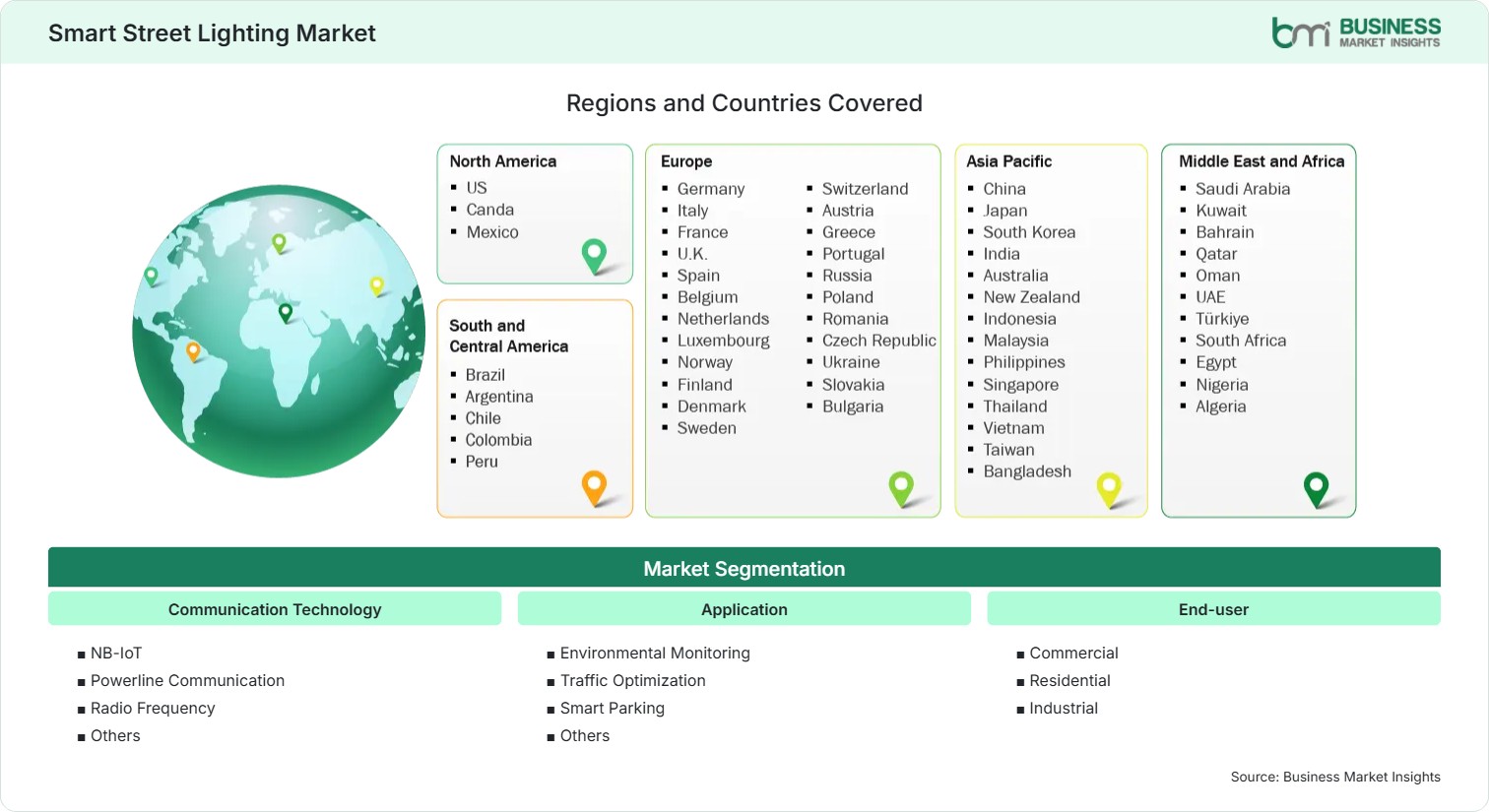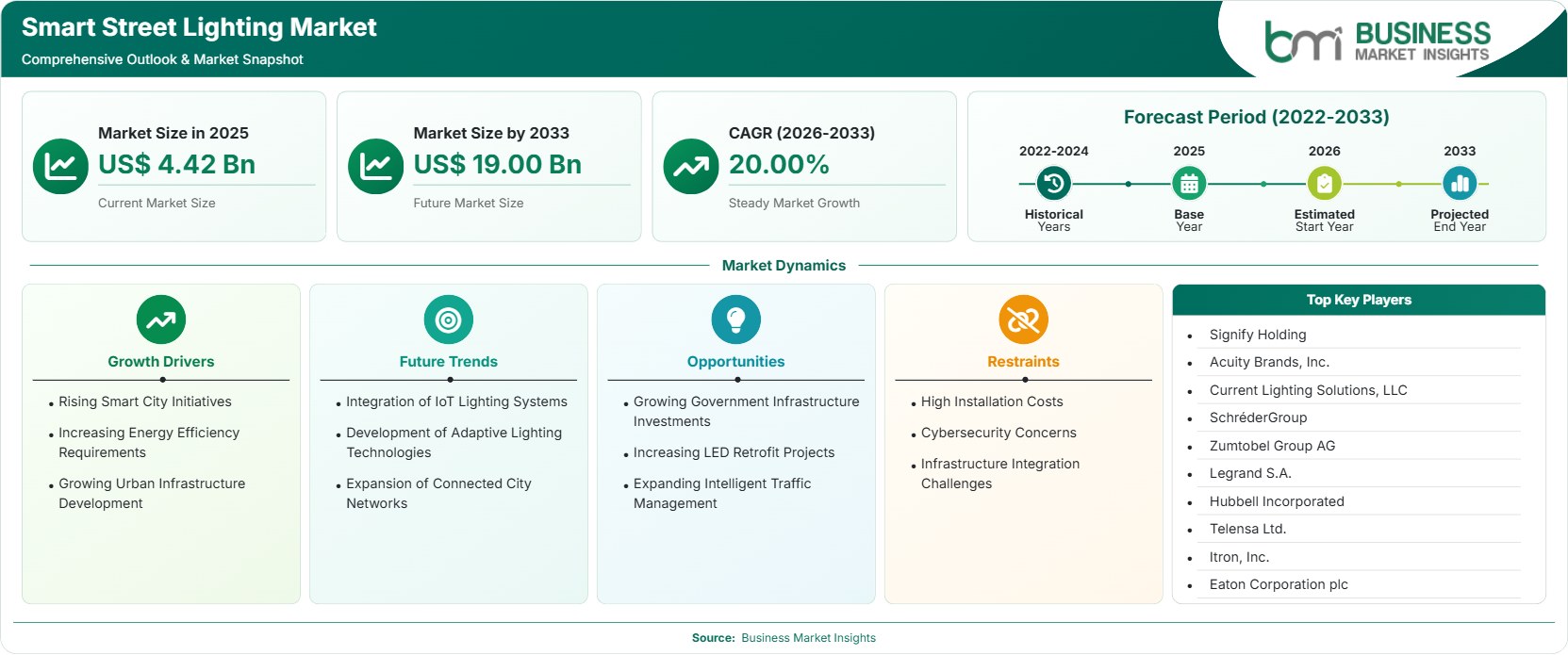
Smart Street Lighting Market Regional Highlights
North America Smart Street Lighting Market
North America represents a mature technology adoption region, holding a 32%–36% share in 2025 and expanding at a CAGR of 18.5%–20.5% during 2026–2033. The region benefits from municipal modernization programs, utility partnerships, and sustainability initiatives. Smart Street Lighting Market share remains strong due to advanced infrastructure readiness and demand for connected public services. The market growth is supported by increasing deployment of intelligent lighting controls across metropolitan areas, commercial zones, and transportation corridors.
- Municipal governments are replacing aging lighting infrastructure with connected LED systems to reduce energy expenses, improve maintenance efficiency, and enable centralized operational control across urban areas.
- Utility companies are supporting connected lighting adoption through energy management programs, infrastructure partnerships, and demand optimization initiatives that improve electricity usage efficiency.
- Integration with smart city platforms is increasing as cities combine lighting networks with environmental sensors, traffic monitoring systems, and public safety technologies.
- Technology providers are developing scalable communication architectures that support large deployments while improving interoperability between lighting hardware and digital management platforms.
US Smart Street Lighting Market
The US represents the largest contributor within North America, maintaining a 24%–28% share in 2025 and achieving a CAGR of 19%–21% from 2026–2033. The country benefits from smart infrastructure investments, sustainability objectives, and widespread LED conversion programs. Smart Street Lighting Market share in the US is strengthened by municipal contracts and technology partnerships. Cities are prioritizing connected lighting solutions to reduce operating costs, improve service reliability, and support broader digital infrastructure strategies.
- Federal and local sustainability programs are encouraging cities to adopt energy-efficient lighting systems with automated controls and remote management capabilities.
- Large metropolitan regions are integrating lighting networks with transportation systems to improve traffic monitoring, safety management, and urban mobility planning.
- Technology suppliers are focusing on cybersecurity-enabled platforms to address concerns associated with connected public infrastructure networks.
- Commercial districts are adopting intelligent lighting solutions to improve energy management and enhance operational visibility across large facilities.
Europe Smart Street Lighting Market
Europe holds a 24%–28% share in 2025 and is projected to expand at a CAGR of 19.5%–21.5% during 2026–2033. The region is influenced by climate objectives, energy efficiency regulations, and smart city investments. Countries including Germany, the United Kingdom, France, and the Netherlands are advancing connected infrastructure programs. The market share is supported by government-led sustainability initiatives, while Smart Street Lighting Market growth is driven by digital transformation across municipalities.
- European cities are implementing adaptive lighting systems to reduce electricity consumption and align with carbon neutrality targets.
- Germany is advancing industrial and municipal IoT adoption, creating demand for intelligent lighting management platforms.
- The United Kingdom is increasing investment in connected urban infrastructure through public modernization initiatives.
- France and the Netherlands are expanding smart city projects integrating lighting with mobility and environmental monitoring applications.
- European technology providers are emphasizing interoperable platforms that support long-term infrastructure scalability and sustainability objectives.
Asia Pacific Smart Street Lighting Market
Asia Pacific accounts for a 28%–32% share in 2025 and is expected to expand at a CAGR of 22%–24% during 2026–2033, making it the fastest-growing regional market. Rapid urbanization, smart city programs, infrastructure digitization, and government-backed sustainability initiatives are accelerating adoption. The market share is increasing due to large-scale deployments in China, India, Japan, and South Korea. Smart Street Lighting Market growth is supported by expanding urban infrastructure requirements and demand for connected energy management systems.
- China is investing heavily in smart city infrastructure, supporting large-scale deployment of connected lighting networks integrated with municipal digital platforms.
- India is increasing adoption through smart city missions, urban development programs, and government initiatives focused on efficient public infrastructure management.
- Japan and South Korea are advancing intelligent lighting deployments through advanced IoT ecosystems and technology-driven urban planning strategies.
- Southeast Asian countries are adopting connected lighting systems to improve energy efficiency, public safety, and infrastructure reliability in rapidly expanding cities.
- Regional manufacturers are developing cost-effective solutions designed for diverse municipal requirements and large-scale infrastructure modernization projects.
Rest of World Smart Street Lighting Market
Rest of World contributes a 10%–14% share in 2025 and is projected to grow at a CAGR of 17.5%–19.5% during 2026–2033. South and Central American countries are increasing investments in urban modernization, while Middle Eastern and African economies are focusing on smart infrastructure development. Brazil, Mexico, the UAE, and Saudi Arabia are emerging adoption centers due to government-backed digital transformation programs. Smart Street Lighting Market expansion is supported by energy conservation initiatives, public infrastructure upgrades, and increasing demand for automated city management systems.
- Brazil and Mexico are deploying intelligent lighting solutions to improve municipal efficiency, reduce electricity consumption, and modernize urban infrastructure networks.
- Middle Eastern countries are integrating connected lighting with large-scale smart city developments and sustainable urban planning initiatives.
- Saudi Arabia and the UAE are investing in digital infrastructure projects that combine lighting systems with broader city automation platforms.
- African urban centers are exploring smart lighting solutions to improve public services while managing infrastructure expansion challenges.
- Regional technology adoption is increasing through public-private partnerships focused on cost-efficient and scalable connected infrastructure deployments.