
Solar Street Lighting Market Outlook: Size, Share, Trends, Growth Analysis, Competitive Landscape & Forecast, 2026-2033

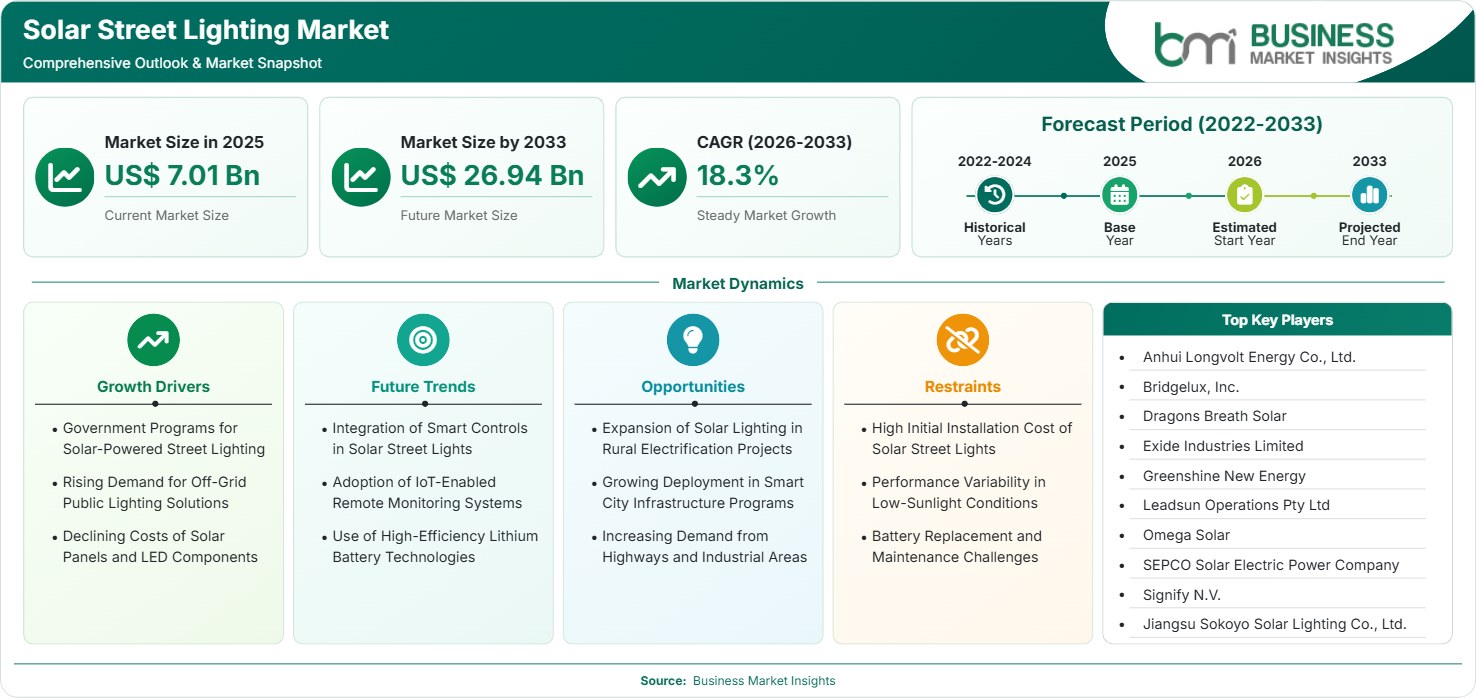
The Solar Street Lighting Market size was valued at US$ 7.01 Billion in 2025 and is projected to reach US$ 26.94 Billion by 2033, growing at a CAGR of 18.3% during 2026–2033. Growth is driven by increasing renewable energy adoption, government investments in sustainable infrastructure, rural electrification initiatives, decreasing LED costs, and rising demand for energy-efficient outdoor lighting systems.

Report Coverage
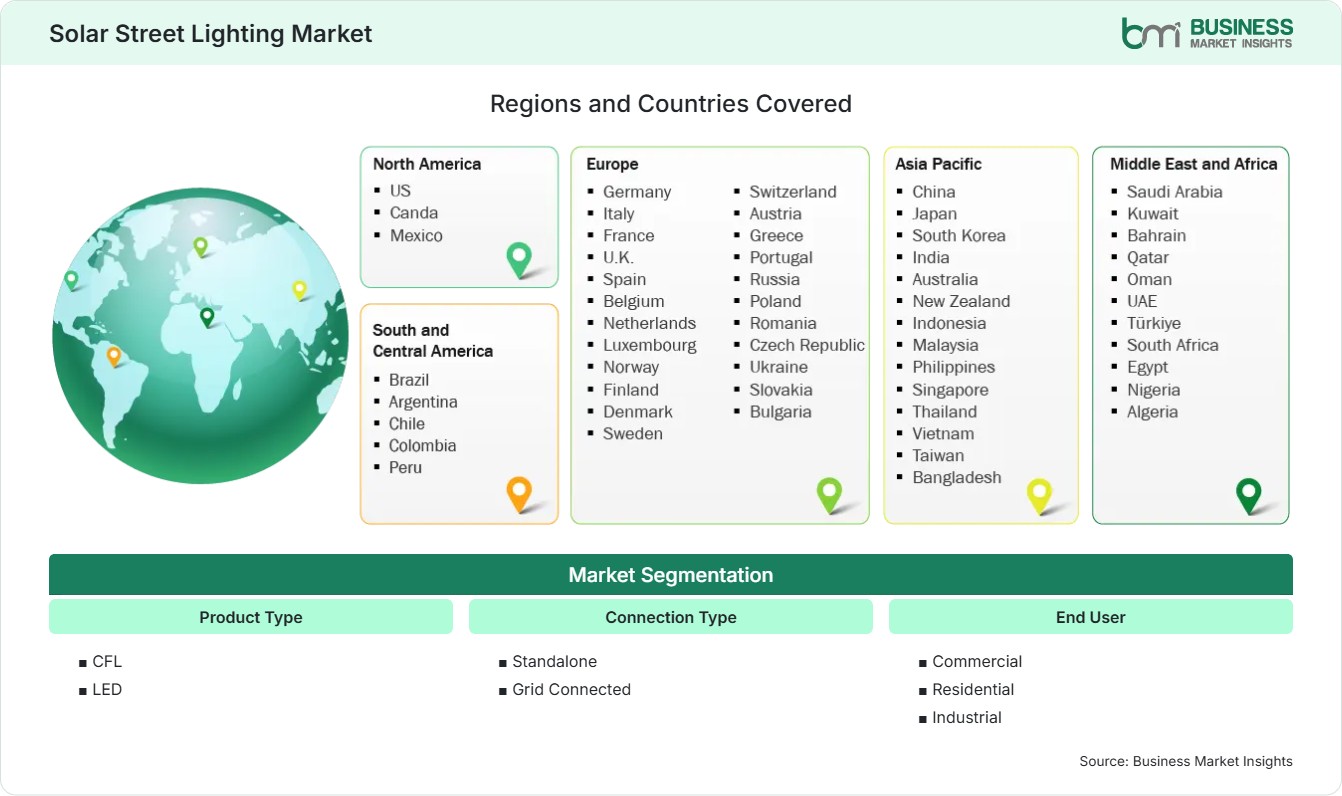
  • Product Type: CFL, LED
  • Connection Type: Standalone, Grid Connected
  • End User: Commercial, Residential, Industrial
US$ 7.01 Bn Market size in 2025
US$ 26.94 Bn Market Size by 2033
18.3% CAGR, 2026 - 2033
2026-2033 Forecast Period

01 AI Overview

Solar Street Lighting Market Summary

  • North America Region: North America holds a solar street lighting market share of 25%–28% in 2025, growing at a CAGR of 16.5%–17.5% during 2026–2033. Smart city deployments, energy efficiency mandates, and rising investments in renewable-powered public infrastructure support expansion. The U.S. remains the dominant regional market, registering a CAGR of 16.8%–17.8% due to increasing municipal solar lighting projects.
  • Fastest Growing Region: Asia Pacific accounts for 34%–37% of revenue in 2025 and is expected to grow at a CAGR of 19.5%–20.5% through 2033. Rapid urbanization, large-scale infrastructure development, and government-backed renewable energy programs continue accelerating adoption.
  • Leading Segment: LED holds a market share of 76%–80% in 2025 and is forecast to expand at a CAGR of 18.5%–19.5%. High energy efficiency, longer operational life, and declining component costs continue driving widespread deployment.
  • High Growth Segment: Standalone systems account for 58%–62% of revenue in 2025 and are projected to register a CAGR of 19.0%–20.0% during the forecast period. Demand is supported by rural lighting projects, off-grid applications, and lower infrastructure requirements.
  • Key Market Opportunity: Expanding smart city programs and integrated solar-powered public infrastructure projects are creating opportunities for intelligent lighting systems featuring IoT connectivity, remote monitoring, and predictive maintenance capabilities.
  • Major Market Players: Anhui Longvolt Energy Co., Ltd., Bridgelux, Inc., Dragons Breath Solar, Exide Industries Limited, Greenshine New Energy, Leadsun Operations Pty Ltd, Omega Solar, SEPCO Solar Electric Power Company, Signify N.V., and Jiangsu Sokoyo Solar Lighting Co., Ltd.
02 Strategic Insights

Solar Street Lighting Market: Strategic Insights

Solar Street Lighting Market Strategic Framework
FREE PDF
Request your free sample
Request free sample
03 Stakeholder View

Key Takeaways

  • The value chain is increasingly integrated, combining photovoltaic module suppliers, battery manufacturers, LED providers, lighting system integrators, and smart infrastructure developers.
  • Standalone solar lighting systems offer substantial growth opportunities in rural electrification projects and remote infrastructure developments where conventional grid expansion remains economically challenging.
  • Innovation is shifting toward AI-enabled monitoring, adaptive brightness controls, IoT connectivity, and advanced energy storage technologies that improve reliability and efficiency.
  • Asia Pacific remains the most attractive regional investment destination due to large-scale infrastructure expansion, government renewable energy targets, and significant public lighting modernization projects.
  • Strategic partnerships between lighting manufacturers, municipal authorities, and renewable energy developers are accelerating deployment across public infrastructure applications.
  • Growing adoption of smart city frameworks is one of the major solar street lighting market trends and is encouraging deployment of multifunctional lighting systems integrating surveillance, environmental monitoring, and wireless communication capabilities.
04 Geographic Outlook

Solar Street Lighting Market Regional Highlights

North America Solar Street Lighting Market

North America accounted for 25%–28% of global revenue in 2025 and is projected to expand at a CAGR of 16.5%–17.5% through 2033. The solar street lighting market forecast suggest the growing smart city investments, sustainability initiatives, and modernization of public infrastructure continue to support market expansion. Municipal governments are increasingly adopting solar-powered lighting systems to reduce electricity costs and enhance environmental performance. The market share in the region is further strengthened by advancements in LED technology and battery storage systems.

  • Smart city projects are increasingly incorporating intelligent solar lighting systems featuring adaptive controls, remote monitoring, and energy management capabilities.
  • Municipal authorities continue replacing conventional streetlights with renewable-powered alternatives to lower operating expenses and carbon emissions.
  • Federal and state-level sustainability programs are encouraging broader deployment of solar-powered public infrastructure across urban and suburban regions.
  • Technological advancements in lithium-ion batteries and LED modules are improving system reliability and long-term performance.
  • Transportation agencies are deploying solar lighting systems along highways, parking areas, and public spaces to enhance safety and visibility.

US Solar Street Lighting Market

The United States represented 20%–23% of global revenue in 2025 and is anticipated to register a CAGR of 16.8%–17.8% during the forecast period. Growing investments in resilient infrastructure, increasing renewable energy deployment, and strong support for sustainable urban development continue to drive adoption. Demand is expanding across municipalities, commercial properties, transportation infrastructure, and public utility projects, contributing to sustained Solar Street Lighting Market growth.

  • Municipal lighting modernization initiatives are creating substantial demand for energy-efficient solar-powered lighting systems.
  • Public infrastructure projects increasingly incorporate renewable energy technologies to meet sustainability and operational efficiency objectives.
  • Commercial facilities are adopting solar street lighting to reduce utility expenses and enhance environmental credentials.
  • Growing awareness of long-term maintenance savings is supporting wider deployment across multiple end-user categories.

Europe Solar Street Lighting Market

Europe held 23%–26% of global revenue in 2025 and is projected to expand at a CAGR of 17.0%–18.0% through 2033. The region benefits from ambitious carbon neutrality targets, extensive renewable energy adoption, and strong governmental support for sustainable infrastructure development. Germany leads the regional market with a CAGR of 17.2%–18.2%, while Poland emerges as the fastest-growing country at a CAGR of 18.5%–19.5%.

  • Governments across Europe continue investing in energy-efficient public infrastructure to advance climate and sustainability objectives.
  • Demand for integrated smart lighting systems is increasing as municipalities pursue digital transformation programs.
  • Germany maintains regional leadership through robust investments in renewable energy and infrastructure modernization.
  • Poland is witnessing accelerated growth due to urban development projects and increasing renewable energy integration.
  • Advanced lighting controls and intelligent monitoring technologies are enhancing operational efficiency and adoption rates.

Asia Pacific Solar Street Lighting Market

Asia Pacific accounted for 34%–37% of global revenue in 2025 and is expected to remain the fastest-growing region, registering a CAGR of 19.5%–20.5% through 2033. Rapid urbanization, increasing government spending on infrastructure, and expanding rural electrification initiatives are driving installation activity. China remains the leading solar street lighting market with a CAGR of 19.2%–20.2%, while India records the highest growth rate at 20.5%–21.5%.

  • Large-scale smart city developments continue generating substantial demand for solar-powered lighting infrastructure.
  • China benefits from strong domestic manufacturing capabilities and significant renewable energy investments.
  • India is accelerating deployment through rural electrification programs and sustainability-focused infrastructure initiatives.
  • Southeast Asian nations are increasingly investing in off-grid lighting systems for transportation and public utility projects.
  • Declining solar panel and battery costs continue supporting broader technology adoption throughout the region.

Rest of World Solar Street Lighting Market

The Rest of World region captured 11%–13% of global revenue in 2025 and is forecast to grow at a CAGR of 17.5%–18.5% through 2033. Increasing infrastructure investments, growing renewable energy adoption, and rising public safety requirements are driving solar street lighting market growth. Adoption is particularly strong where grid infrastructure remains limited or unreliable.

Brazil is the leading market in South & Central America and is projected to grow at a CAGR of 17.8%–18.8%. In the Middle East & Africa, the United Arab Emirates is the fastest-growing country, advancing at a CAGR of 18.2%–19.2% due to smart infrastructure investments and sustainability initiatives.

  • Brazil continues investing in renewable-powered public infrastructure and urban modernization projects.
  • The United Arab Emirates is expanding solar-powered lighting deployments through smart city and sustainability programs.
  • Off-grid lighting solutions are gaining popularity across remote and underserved regions with limited grid access.
  • Governments increasingly prioritize energy-efficient public lighting systems to reduce long-term operational expenditures.
  • Infrastructure expansion and transportation development projects continue creating opportunities for solar lighting installations.
Global Market Geography
FREE PDF
Request your free sample
Request free sample
05 Segment Analysis

Solar Street Lighting Market Segmentation

Product Type

Product type remains a critical determinant of efficiency, lifecycle cost, and adoption rates across solar-powered lighting installations. This segment accounted for approximately 76%–80% market share in 2025 and is expected to expand at a CAGR of 18.5%–19.5% through 2033. Improvements in lighting efficiency, durability, and operational performance continue supporting the dominant position of advanced lighting technologies across municipal, commercial, and industrial applications.

  • CFL: Compact fluorescent lamp-based systems remain deployed in budget-sensitive installations where lower upfront costs are prioritized despite relatively lower efficiency and shorter operating lifespans.
  • LED: LED-based solar street lighting dominates due to superior energy efficiency, extended service life, lower maintenance requirements, and compatibility with smart lighting controls.

Connection Type

Connection type significantly influences deployment feasibility and infrastructure requirements. The segment represented approximately 58%–62% of market revenue in 2025 and is projected to grow at a CAGR of 19.0%–20.0% through 2033. Rising investments in off-grid infrastructure and renewable-powered public utilities continue strengthening demand across diverse geographical environments.

  • Standalone: Standalone systems are widely adopted in rural areas, highways, and remote locations where electricity grid access is unavailable or economically impractical.
  • Grid Connected: Grid-connected solutions are gaining traction within urban infrastructure projects by combining renewable energy generation with backup power reliability.

End User

End-user demand is supported by increasing focus on sustainability, energy efficiency, and public infrastructure modernization. This segment accounted for approximately 42%–46% of market revenue in 2025 and is expected to register a CAGR of 18.0%–19.0% during the forecast period. Large-scale deployment initiatives continue expanding across multiple application environments.

  • Commercial: Commercial facilities utilize solar lighting systems to reduce energy expenses, improve sustainability performance, and strengthen environmental credentials.
  • Residential: Residential communities increasingly adopt solar-powered street lighting to improve public safety while lowering electricity consumption and maintenance costs.
  • Industrial: Industrial users deploy solar lighting across manufacturing sites, logistics facilities, mining operations, and utility infrastructure to enhance operational efficiency and security.
06 Market Forces

Solar Street Lighting Market Dynamics

Key Market Drivers

Government Programs for Solar-Powered Street Lighting

The governments of the world have begun making more investments into building the infrastructure that uses renewable energy and promotes sustainable urban development. Programs by the government that help in rural electrification, development of smart cities, and carbon reduction plans keep promoting the use of solar lights. Solar light installations are being prioritized by municipal authorities due to lower costs of electricity and better environment-friendly performance. Policies, incentives, and infrastructure modernization programs continue playing an important role in the promotion of solar street lights installations.

Rising Demand for Off-Grid Public Lighting Solutions

There is a rising need for reliable lighting systems in the remote and underprivileged areas, which is raising the demand for off-grid solar street light systems. Off-grid systems help in making the system independent from the existing electrical grid and give an efficient lighting option for roads and transport systems. Rural development projects and expansion of infrastructure projects have led to installation of these systems in areas that lack the connection with the grid.

Declining Costs of Solar Panels and LED Components

Continuous reductions in photovoltaic module prices, LED component costs, and battery system expenses are improving the economic viability of solar street lighting projects. Lower hardware costs enable municipalities, commercial operators, and industrial users to deploy larger-scale installations while maintaining attractive return-on-investment profiles. Advances in manufacturing efficiency and supply chain maturity have further enhanced affordability. These improvements are accelerating solar street lighting market penetration across developed and emerging economies while encouraging replacement of conventional street lighting systems with energy-efficient solar-powered alternatives.

Key Market Opportunities

Expansion of Solar Lighting in Rural Electrification Projects

Rural electrification initiatives present substantial solar street lighting market growth opportunities for solar street lighting providers. Many regions continue facing limitations in grid infrastructure, making solar-powered systems an effective and economical alternative. Governments, international development agencies, and public infrastructure authorities are increasingly investing in renewable lighting systems to improve safety, accessibility, and economic activity within rural communities. Companies offering durable, low-maintenance, and off-grid lighting solutions are well positioned to benefit from expanding infrastructure investments and growing demand for sustainable public lighting applications.

Growing Deployment in Smart City Infrastructure Programs

The expansion of smart city projects is creating new opportunities for advanced solar street lighting solutions integrated with intelligent technologies. Modern systems increasingly incorporate remote monitoring, adaptive brightness control, environmental sensors, and connected communication networks. Municipalities seeking to improve operational efficiency and digital infrastructure capabilities are adopting smart lighting platforms as part of broader urban modernization strategies. This trend is expected to generate strong demand for innovative solar lighting systems capable of supporting interconnected and data-driven public infrastructure ecosystems.

Increasing Demand from Highways and Industrial Areas

Highways, logistics corridors, industrial facilities, and large-scale commercial sites are emerging as important growth areas for solar street lighting deployments. These environments require reliable illumination while seeking to reduce long-term energy and maintenance expenses. Solar-powered solutions offer operational advantages in areas with extensive lighting requirements and limited access to grid infrastructure. Increasing transportation infrastructure development and industrial expansion across emerging economies are expected to create sustained opportunities for manufacturers and system integrators.

Market Restraints and Challenges

High Initial Installation Cost of Solar Street Lights

Factor: Solar street lighting installations require upfront investments in photovoltaic panels, batteries, controllers, mounting structures, and system integration.

Impact: Although lifecycle savings are attractive, higher initial capital requirements can discourage adoption among budget-constrained municipalities and smaller infrastructure operators. Financing limitations may delay project implementation, particularly in developing regions. The need for significant upfront expenditure remains one of the most important barriers affecting wider deployment despite favorable long-term economic benefits.

Performance Variability in Low-Sunlight Conditions

Factor: Solar lighting systems depend on solar irradiation levels, which can fluctuate due to weather conditions, seasonal variations, and geographic location.

Impact: Reduced solar energy generation may affect lighting performance, battery charging efficiency, and operational reliability in certain regions. Organizations deploying solar lighting systems must account for site-specific environmental conditions and invest in appropriate storage capacity. These factors can increase project complexity and influence purchasing decisions where uninterrupted lighting performance is critical.

07 Company Analysis

Competitive Landscape

The market is highly competitive, with manufacturers focusing on LED efficiency, battery technologies, intelligent controls, and integrated renewable energy solutions. Companies are expanding product portfolios and strengthening their presence in infrastructure modernization projects, making Solar Street Lighting Market analysis increasingly centered on technology differentiation and smart-city readiness.

Company Name

Overview

Products and Services Relevant to this Market

Anhui Longvolt Energy Co., Ltd.

Renewable energy company specializing in solar-powered lighting and energy systems.

Solar street lights, energy storage systems, photovoltaic lighting solutions.

Bridgelux, Inc.

LED technology company serving energy-efficient lighting applications globally.

LED components, high-efficiency lighting modules, outdoor lighting technologies.

Dragons Breath Solar

Solar solutions provider focusing on renewable-powered lighting applications.

Solar lighting systems, street lights, integrated renewable energy solutions.

Exide Industries Limited

Leading energy storage manufacturer supporting renewable infrastructure projects.

Batteries, energy storage systems, solar power support solutions.

Greenshine New Energy

Solar lighting specialist serving municipal and commercial markets.

Solar street lighting systems, parking lot lights, outdoor solar solutions.

Leadsun Operations Pty Ltd

Global provider of smart solar lighting and infrastructure technologies.

Smart solar street lights, IoT-enabled lighting platforms, off-grid lighting solutions.

Omega Solar

Renewable energy company focused on solar-powered lighting deployments.

Solar street lights, integrated photovoltaic lighting systems, outdoor solar solutions.

SEPCO Solar Electric Power Company

Solar infrastructure provider specializing in public lighting systems.

Solar street lighting projects, infrastructure lighting systems, turnkey solar solutions.

Signify N.V.

Global lighting leader focused on connected and energy-efficient technologies.

LED lighting systems, smart lighting platforms, connected outdoor lighting solutions.

Jiangsu Sokoyo Solar Lighting Co., Ltd.

Manufacturer of solar-powered street lighting and smart lighting systems.

Solar street lights, intelligent lighting solutions, photovoltaic infrastructure products.

08 Industry Activity

Recent Developments

June 2026

SolSetu reported that India accelerated the deployment of solar street lighting systems through rural electrification and smart city projects, with growing adoption of smart solar lights featuring LED technology, advanced battery storage, motion sensors, and remote monitoring capabilities.

March 2026

Signify N.V. expanded deployments of connected outdoor lighting systems supporting smart city infrastructure projects and energy-efficient municipal lighting initiatives.

January 2026

Leadsun Operations Pty Ltd enhanced its smart solar lighting portfolio with integrated monitoring and intelligent control capabilities targeting public infrastructure developments.

May 2024

Vedanta Aluminium announced the installation of 100 solar-powered streetlights across remote villages in Odisha’s Sundargarh district, improving rural connectivity, safety, and access to sustainable lighting while supporting community development and clean energy goals.

10 Trust & Transparency

Research Methodology

The market analysis combines proprietary research with secondary data from government agencies, company disclosures, regulatory filings, industry databases and expert interviews. Market estimates are validated through data triangulation, cross-market benchmarking and analyst review.

View Full Research Methodology

11 Questions Answered

Frequently Asked Questions

What are the major challenges facing the market?

High installation costs and performance variability in regions with limited sunlight remain the primary challenges affecting adoption.

Which region leads market growth?

Asia Pacific is the fastest-growing region due to extensive infrastructure development, renewable energy investments, and large-scale urbanization projects.

Why are standalone systems growing rapidly?

Standalone solutions require no grid connectivity, making them ideal for remote locations, rural infrastructure projects, highways, and off-grid applications.

Which product type dominates the market?

LED-based solar street lighting systems lead the market due to superior efficiency, longer lifespan, and lower maintenance requirements.

What is driving growth in the Solar Street Lighting Market report?

Government renewable energy programs, rural electrification initiatives, smart city investments, and declining solar component costs are the primary growth drivers.

Access the Full Solar Street Lighting Market Report

Get segment-level forecasts, regional estimates, competitive benchmarking, company profiles and downloadable Excel datasets.

Access the full Solar Street Lighting Market Report
350 pages PDF & Excel | 2026-07-30