Market Summary
Executive Summary and Global Market Analysis
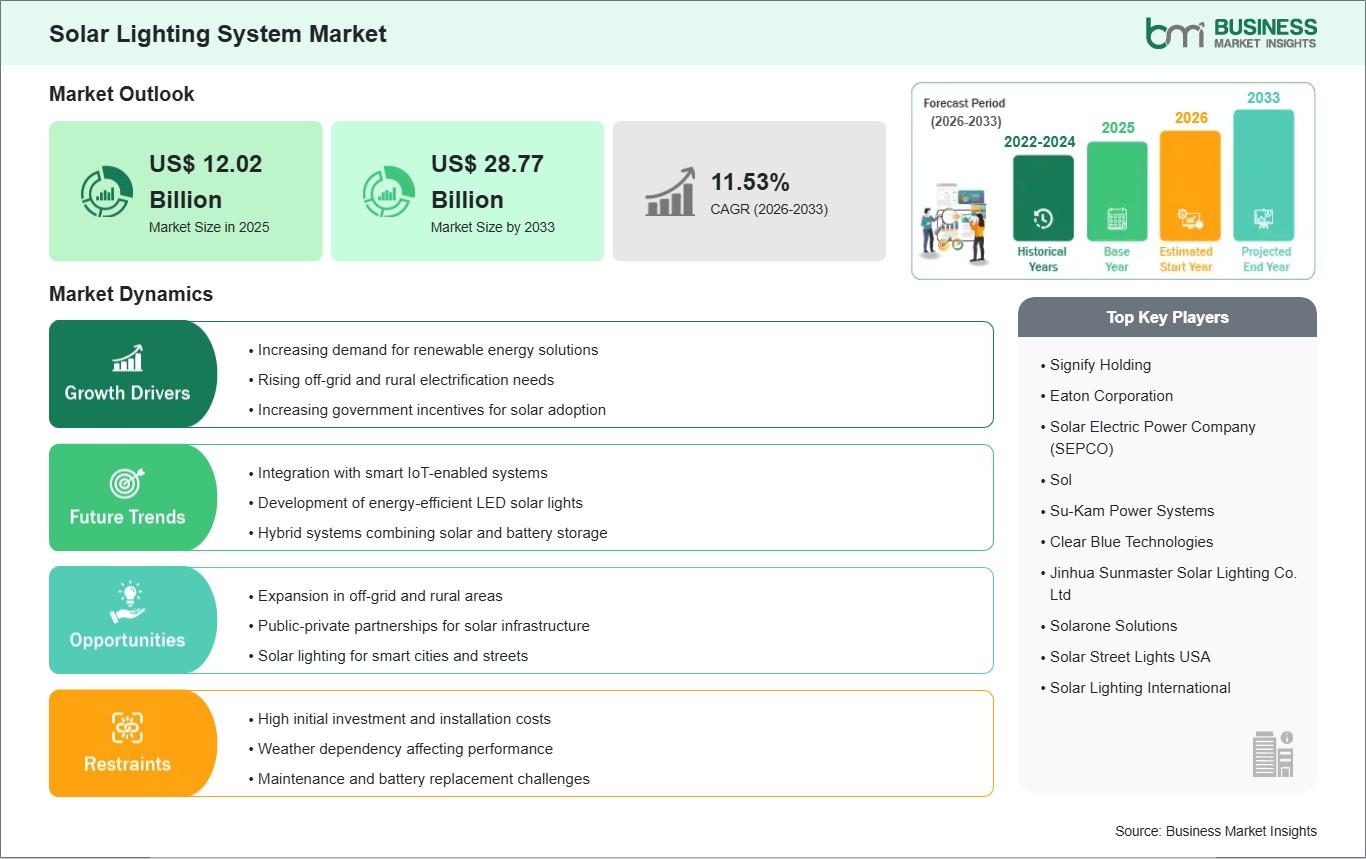
The solar lighting system market is growing as people seek sustainable, energy-efficient solutions. Solar lighting systems turn sunlight into electricity to power LED and other lights, offering eco-friendly options compared to traditional grid-based lighting. They are commonly used in homes, businesses, public spaces, and industrial areas, including streets, parks, highways, and emergency lighting systems. Rising electricity costs, government incentives for renewable energy, and the push for carbon reduction drive market growth. Technological improvements play a crucial role in this market's development. High-efficiency photovoltaic panels, energy storage solutions, and LED lighting now provide longer operational life and less maintenance. They also offer better illumination. Smart features like motion sensors, adaptive dimming, and IoT-based monitoring help optimize energy use and allow for predictive maintenance. These features enable real-time management of systems, improving cost-effectiveness and reliability. Global sustainability efforts and smart city projects also influence this market.
Solar lighting cuts greenhouse gas emissions, supports off-grid electrification, and fits with green infrastructure goals. Industrial, commercial, and municipal sectors are adopting these systems more to ensure consistent lighting, reduce energy costs, and boost operational efficiency. Partnerships between solar technology providers, construction companies, and government agencies are speeding up deployment. Overall, solar lighting systems are becoming essential parts of modern, energy-aware infrastructure.
Segment Analysis
Solar Lighting System Market Segmentation
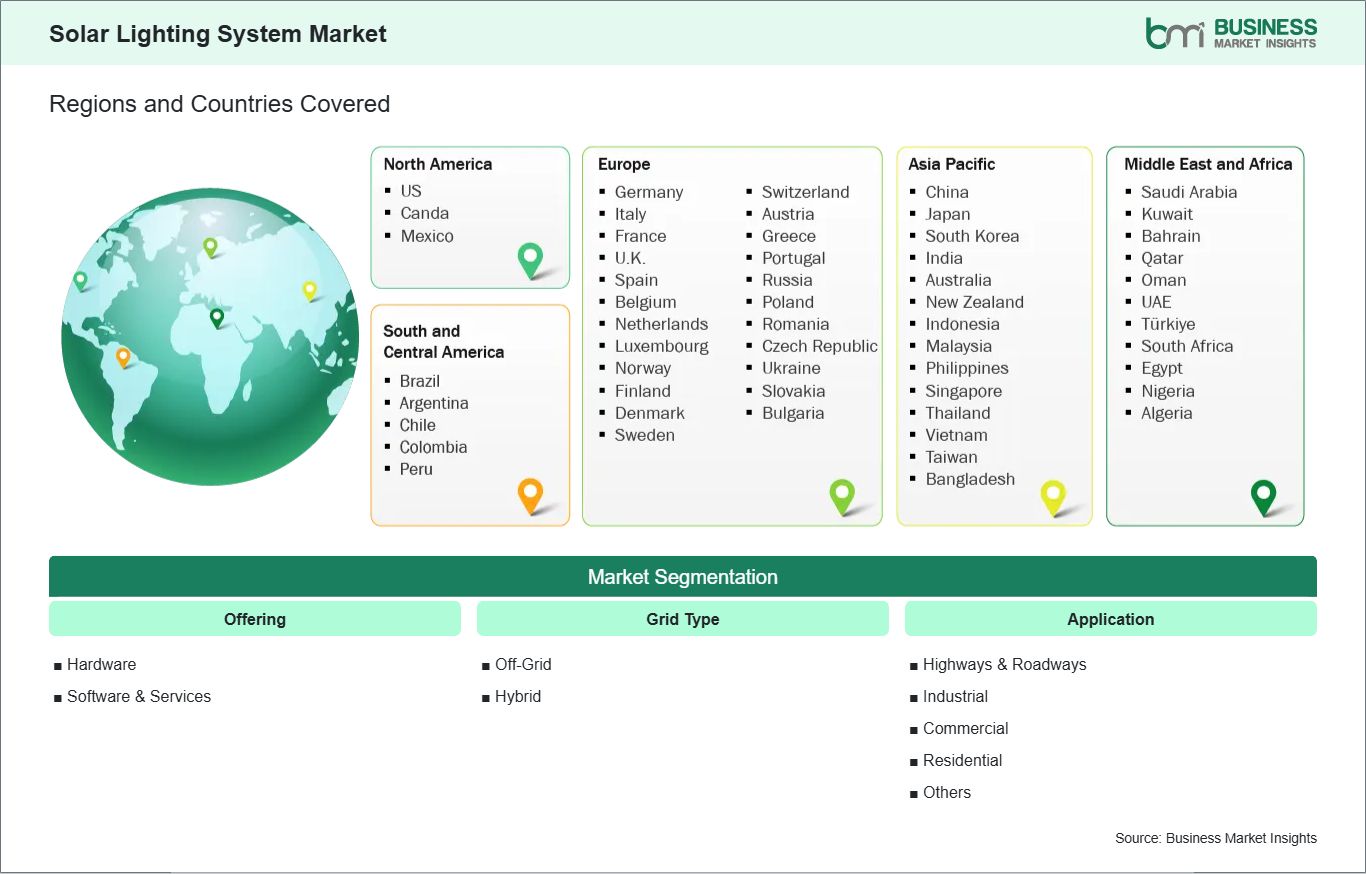
Key segments that contributed to the derivation of the solar lighting system market analysis are offering, grid type, application.
- Offering, the solar lighting system market is segmented into hardware and software & services. The hardware segment dominated the market in 2025.
- Based on Grid Type, the solar lighting system market is classified into off‑grid and hybrid. The off‑grid segment dominated the market in 2025.
- In terms of Application, the solar lighting system market is classified into highways & roadways, industrial, commercial, residential, and others. The highways & roadways segment dominated the market in 2025.
Market Forces
Solar Lighting System Market Drivers and Opportunities
Increasing demand for renewable energy solutions
The solar lighting system market is expanding rapidly as the focus on sustainable and renewable energy grows. Consumers, businesses, and municipalities are increasingly adopting solar-powered streetlights, outdoor lights, and commercial lighting solutions to reduce energy costs and carbon emissions. Government incentives, renewable energy subsidies, and supportive policies encourage the deployment of solar lighting infrastructure. Technological advancements in LED efficiency, energy storage, and smart controls improve reliability and performance, while partnerships between manufacturers and energy service providers accelerate innovation. As environmental awareness rises and the demand for clean energy intensifies, solar lighting is becoming a cornerstone of sustainable urban and rural development worldwide.
Expansion in off-grid and rural areas
Solar lighting systems are playing a critical role in extending reliable illumination to off-grid and rural communities. Standalone solutions, including streetlights, village lighting, and community centers, provide safe, low-maintenance, and energy-independent alternatives where conventional electricity is limited or costly. Integration with battery storage and IoT-enabled controls ensures consistent performance even in areas with irregular sunlight. Public and private initiatives, including rural electrification programs and sustainable development projects, further support adoption. As populations in remote and underserved regions grow, solar lighting offers a practical, cost-effective solution, improving safety, productivity, and quality of life while contributing to global clean energy objectives.
Size and Share Analysis
Solar Lighting System Market Size and Share Analysis
The Solar Lighting System Market demonstrates steady growth, with size and share analysis highlighting evolving trends and competitive dynamics among key players. The report examines subsegments categorized within offering, light source, grid type, and application, offering insights into their contribution to overall market performance.
Offering, the hardware sub segment dominated the market in 2025, driven by increasing adoption of durable and efficient solar lighting fixtures.
Based on light source, the LED sub segment dominated the market in 2025, driven by superior energy efficiency, longer lifespan, and reduced maintenance requirements.
Based on grid type, the off‑grid sub segment dominated the market in 2025, driven by the growing deployment of standalone solar lighting systems in remote and rural areas.
In terms of application, the highways & roadways sub segment dominated the market in 2025, driven by government initiatives to enhance road safety and promote sustainable energy solutions.
Report Coverage
Solar Lighting System Market Report Coverage and Deliverables
The "Solar Lighting System Market Size and Forecast (2022 - 2033)" report provides a detailed analysis of the market covering below areas:
- Solar Lighting System Market size and forecast at global, regional, and country levels for all the key market segments covered under the scope
- Solar Lighting System Market trends, as well as drivers, restraints, and opportunities
- Solar Lighting System Market analysis covering key trends, global and regional framework, major players, regulations, and recent developments
- Industry landscape and competition analysis covering market concentration, heat map analysis, prominent players, and recent developments for the Solar Lighting System Market
- Detailed company profiles, including SWOT analysis
Geographic Insights
Solar Lighting System Market Geographic Insights
The geographical scope of the Solar Lighting System Market report is divided into North America, Asia Pacific, Europe, Middle East & Africa, and South & Central America. North America held the largest share in 2025.
The global solar lighting system market demonstrates diverse regional dynamics influenced by renewable energy policies, infrastructure development, and electrification priorities. North America dominates the market due to strong investments in sustainable infrastructure and the widespread adoption of advanced lighting technologies. Municipalities, universities, and commercial facilities across the United States and Canada are integrating solar-powered street and outdoor lighting systems to reduce electricity consumption and enhance energy resilience. The presence of established technology providers and increasing smart city initiatives further supports regional leadership.
Asia Pacific represents a rapidly expanding market driven by urbanization, rural electrification programs, and government support for renewable energy solutions. Countries such as India, China, and Southeast Asian nations are actively deploying solar street lighting and standalone solar lighting systems in remote communities and public infrastructure projects. Regional manufacturing capabilities also contribute to improved accessibility and cost competitiveness.
Europe is witnessing consistent adoption of solar lighting systems as part of sustainability-focused urban planning. Municipal authorities are installing solar-powered lighting across parks, pedestrian zones, and cycling routes to reduce carbon emissions and support environmental targets. The Middle East & Africa region is adopting solar lighting to address limited grid infrastructure, particularly in rural and desert areas.
Meanwhile, South & Central America is gradually expanding solar lighting deployment in rural roads, tourism locations, and community development projects to support sustainable infrastructure growth.
Industry Activity
Recent Developments
The Solar Lighting System Market is evaluated by gathering qualitative and quantitative data post primary and secondary research, which includes important corporate publications, association data, and databases. A few of the key developments in the solar lighting system market are:
- In May 2023, Signify announced the launch of its first “Philips Solar Light Hub” in India to showcase and promote a wide range of solar lighting solutions for residential, commercial, and street lighting applications, supporting wider adoption of solar-powered lighting products.
- In May 2024, Signify announced a partnership with Shanghai Lianchuang Optoelectronic Technology to jointly develop an IoT-enabled solar street lighting platform, integrating sensors, analytics, and smart-city management features for global markets.
Trust & Transparency
Research Methodology
The market analysis combines proprietary research with secondary data from government agencies, company disclosures, regulatory filings, industry databases and expert interviews. Market estimates are validated through data triangulation, cross-market benchmarking and analyst
review.
View Full Research Methodology
Key Sources Referred:
World Health Organization (WHO) Organisation for Economic Cooperation and Development (OECD) The World Bank Group Worldometer The Lancet International Bar Association International Trade Administration