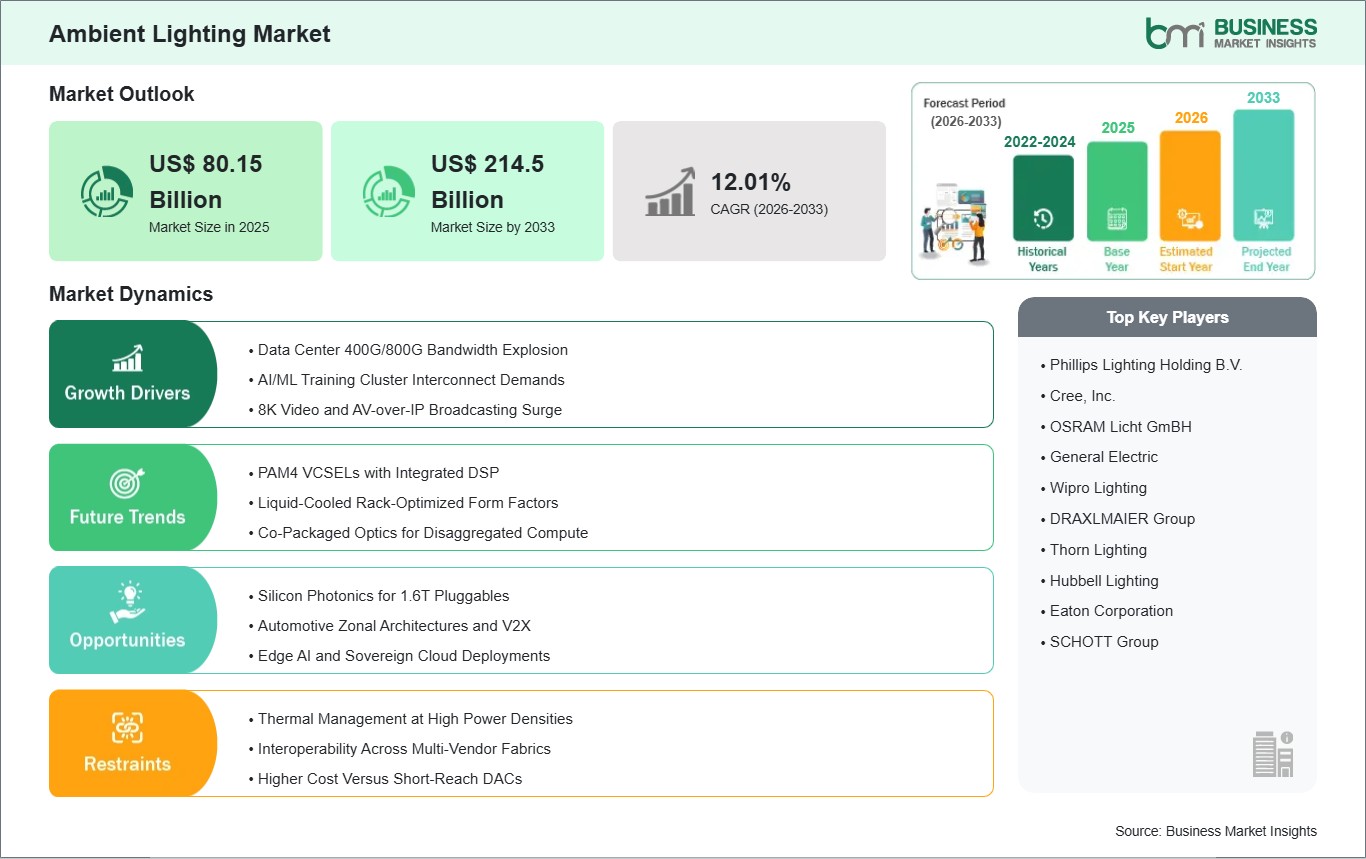
The ambient lighting market size is expected to reach US$ 214.5 billion by 2033 from US$ 80.15 billion in 2025. The market is estimated to record a CAGR of 12.01% from 2026 to 2033.
The global ambient lighting market is leveraging LED modules, smart sensors, and tunable white CCTs to offer an evenly lit illumination in the space of wellness and focused areas. These arrangements combine dimmable drivers, circadian algorithms, and wireless protocols resulting in energy savings of up to 95% when compared with fluorescents. Hence, smart homes, office biophilic designs, and warehouse automation can function perfectly at the glare, free levels. Besides the most significant benefits, 50% lower power draw versus halogens, 40% weight reduction from polymer housings, and a zoning based on an app are making ambient lighting an essential feature of human, centric buildings, edge AI vision systems, and sustainable retail ecosystems. 5G, enabled IoT lighting, wellness mandates, and AR/VR workspaces will be accompanied by a strong surge because of the unstructured sensor data explosion. The market is being propelled by green building certifications like LEED and EDGE and the reduction in GaN LED costs. On the other hand, supply chain disruptions for rare earth phosphors and Zigbee/Matter protocols interoperability become the pain points of the industry. Moreover, micro, LED arrays, 200 lm/W phosphor tech, and automotive cabin lighting networks are areas of great potentials.

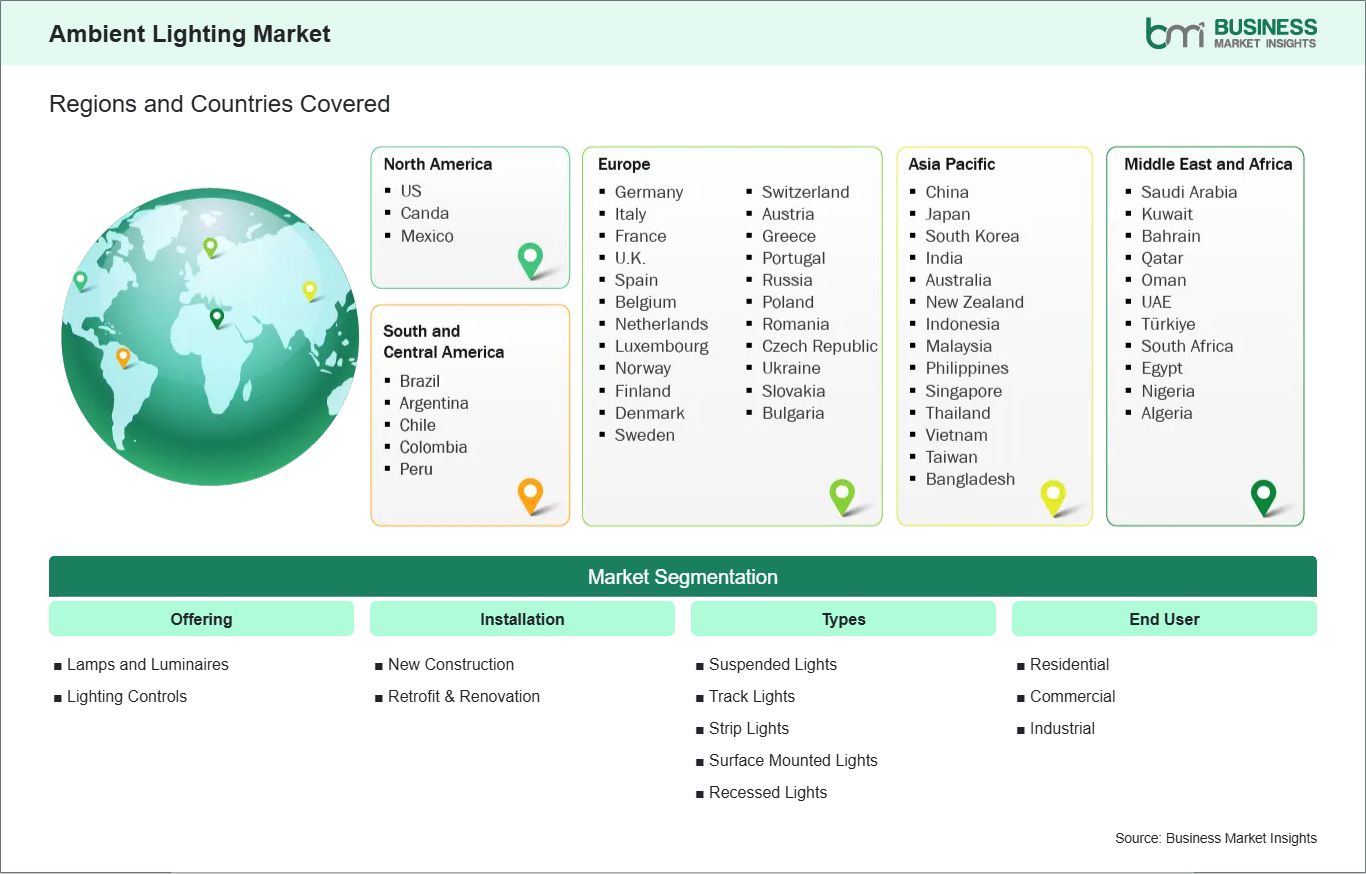
Key segments shaping the global ambient lighting market include offering, installation, types, and end user.
The ambient lighting segment was dominated by hyperscale retrofits of aged infrastructures and AI, optimized occupancy sensing, as operators focused on low, watt, tunable 2700, 6500K interconnects. Signify and Osram recessed luminaries pair with Lutron controls for circadian office pods, the resulting 30% productivity gains being achieved through sub, 1% flicker across 100m zones, which is vital for remote hybrid workforces. In the context of EU Taxonomy rules, a 20% annual luminaire upgrade rate is accumulating a backlog of more than 50M units by 2030. Thanks to IRA incentives, US fabs are quantum, dot LED ramping, phosphor chain stressed warehouses FTL picking are blending strip lights with controls. COB LEDs shine in 85C industrial bays, DAC, to, LED swaps on the other hand, are unlocking quick ROI; hence, ambient systems will be the stepping stone for zero, touch mesh networks capable of holding petabyte, scale BIM models, liquid, cooled panels, and PUE targets below 1.1.
The energy shocks from Ukraine have focused the attention on the grid resilience, thus, hybrid sensor arrays integrating lux, motion, and CO2 monitors were developed to prevent over, illumination in adversary, threatened factories. GaN drivers excel in the EMI, heavy EV production plants, thereby the SNR is improved by more than 25% comparing to the silicon competitors.
Suspended/track lights are likely to benefit from the wellness residential booms as well as from factory 4.0 cockpits, thus giving room to stadium cove glows and zonal robotics. Matter standards help fuse surface-mounted strips with Thread for remote monitoring, thus reducing venue wiring by 55% compared to the use of legacy fluorescents for CES/Expo streams. Consumer mandates such as the EU Ecolabel drive the controls below $15/unit. At the same time, Industry 5.0 autonomy calls for 50 lm/W recessed links for machine vision at a price of less than US$ 80/unit. Micro, LEDs scale down to 0.3mm, thus cutting down the BOMs for edge gateways by half. Industrial verticals use suspended pendants in 48V DC grids according to UL 8750. These changes set the stage for suppliers to grab US$ 22 billion deals through 2034, with ambient lighting as the pluggable cores for disaggregated IoT and immersive environments.

By offering, the global ambient lighting market segments into Lamps and Luminaires, Lighting Controls. The Lamps and Luminaires segment dominated in 2024. Drives 75% installations: tunable CCT scalability boosts hyperscaler wellness adoption in 3000K fabrics.
By installation, segments are New Construction, Retrofit & Renovation. The Retrofit & Renovation segment led in 2024. Captures 65% volume; rebate programs demand rapid server-to-retrofit scaling.
By types, divisions include Suspended Lights, Track Lights, Strip Lights, Surface Mounted Lights, and Recessed Lights. The Recessed Lights segment held the largest share in 2024. Versatile 10-50W support enables seamless zone migrations globally.
By end user, categories are Residential, Commercial, and Industrial. The Commercial segment topped in 2024. Aligns with intra-building spans in mega-scale deployments.
| Report Attribute | Details |
|---|---|
| Market size in 2025 | US$ 80.15 Billion |
| Market Size by 2033 | US$ 214.5 Billion |
| Global CAGR (2026 - 2033) | 12.01% |
| Historical Data | 2022-2024 |
| Forecast period | 2026-2033 |
| Segments Covered | By Offering
|
|
Regions and Countries Covered
| |
| North America | US, Canada, Mexico |
| Europe | Belgium, Austria, Finland, Denmark, Greece, Poland, Romania, Russia, Ukraine, Czech Republic, Slovakia, Bulgaria, Italy, Luxembourg, Germany, Switzerland, France, Netherlands, Norway, Portugal, Spain, Sweden, United Kingdom |
| Asia-Pacific | Australia, China, India, Japan, South Korea, Indonesia, Malaysia, Philippines, Singapore, Thailand, Vietnam, Bangladesh, New Zealand, Taiwan |
| South and Central America | Brazil, Argentina, Peru, Chile, Colombia |
| Middle East and Africa | Bahrain, Kuwait, Oman, Qatar, Saudi Arabia, United Arab Emirates, Turkiye, South Africa, Egypt, Algeria, Nigeria |
| Market leaders and key company profiles |
|
The "Ambient Lighting Market Size and Forecast (2022-2033)" report provides a detailed analysis of the market covering below areas:
The geographical scope of the ambient lighting market report is divided into five regions: North America, Asia Pacific, Europe, the Middle East & Africa, and South & Central America. The ambient lighting market in North America registered the highest market share in 2024.
North America still leads the way with three mega, cloud campuses, and wellness labs across the US, Canada, and Mexico. There is a massive increase in the US deployment, where 4000K recessed strips are used to power xAI's Austin hubs and AWS edge nodes for tactical circadian AI. In Canada, operators like Digital Realty install 3000K controls for their ML pipelines. The maquiladoras light their strip lights to Tier 1 factory level in Mexico. Europe is continuing to advance by implementing the EU Green Deal and net, zero mandates, Germany's Helvar and Tridonic are making recesses for edge factories, the UK's cove is getting adopted for BBC studios, and France's OVHcloud is stressing low, power pendants for sovereign clouds.
The Middle East is making data havens, such as Saudi NEOM's stc suspended grids and UAE du's track lights for 5G sites. Asia Pacific is thriving with China's 14th Plan trials and chip objectives, Alibaba taking micro, LED controls. Dependence on advanced COBs is India's Reliance that is putting up 200 lm/W retrofits but is falling behind due to phosphor gaps. South and Central America will develop over the forecast period.

The ambient lighting market is evaluated by gathering qualitative and quantitative data post primary and secondary research, which includes important corporate publications, association data, and databases. A few of the key developments in the ambient lighting market are:
The Ambient Lighting Market is valued at US$ 80.15 Billion in 2025, it is projected to reach US$ 214.5 Billion by 2033.
As per our report Ambient Lighting Market, the market size is valued at US$ 80.15 Billion in 2025, projecting it to reach US$ 214.5 Billion by 2033. This translates to a CAGR of approximately 12.01% during the forecast period.
The Ambient Lighting Market report typically cover these key segments-
The historic period, base year, and forecast period can vary slightly depending on the specific market research report. However, for the Ambient Lighting Market report:
The Ambient Lighting Market is populated by several key players, each contributing to its growth and innovation. Some of the major players include:
The Ambient Lighting Market report is valuable for diverse stakeholders, including:
Essentially, anyone involved in or considering involvement in the Ambient Lighting Market value chain can benefit from the information contained in a comprehensive market report.
Please tell us your area of interest
(Market Segments/ Regions and Countries/ Companies)