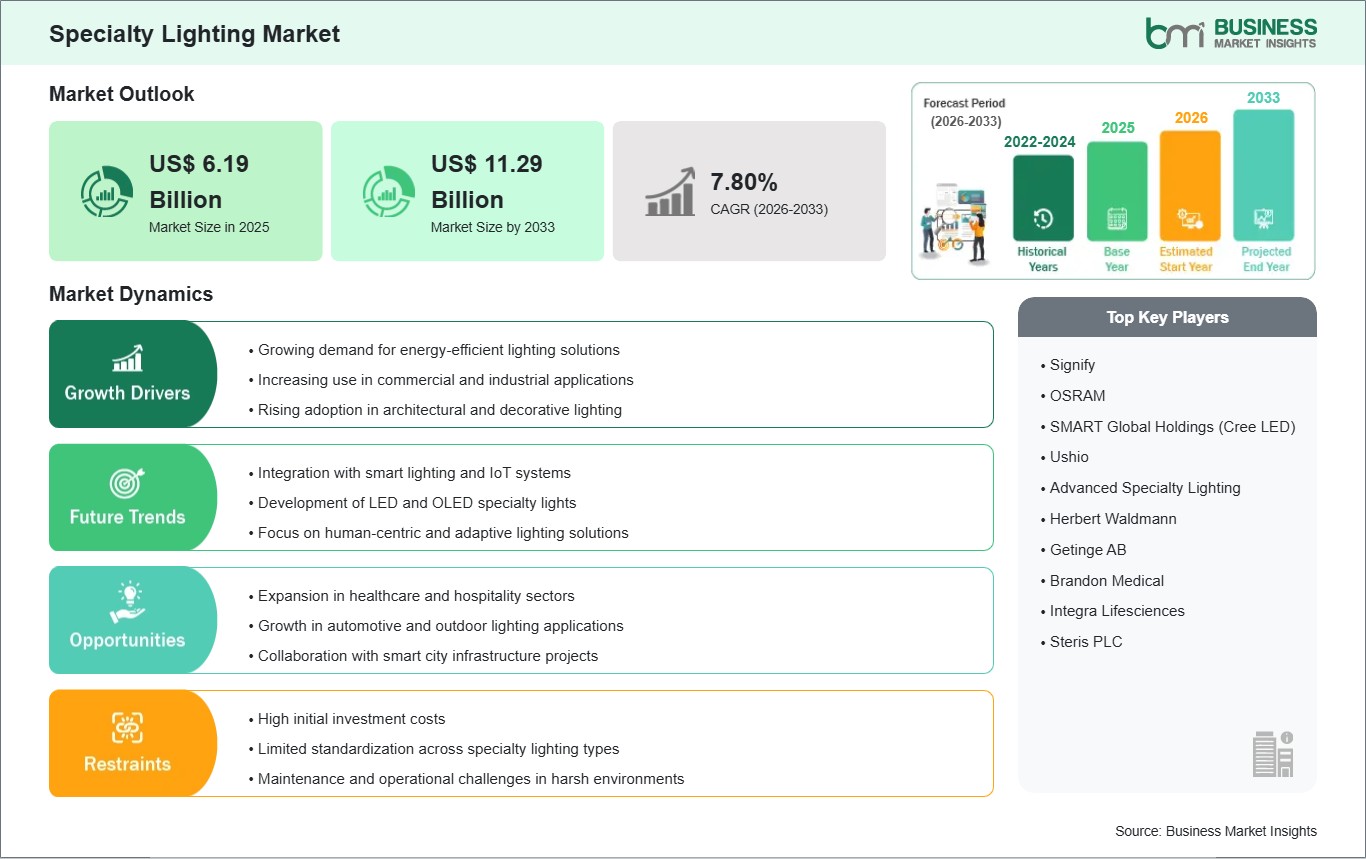
The Specialty Lighting Market size is expected to reach US$ 11.29 billion by 2033 from US$ 6.19 billion in 2025. The market is estimated to record a CAGR of 7.80% from 2026 to 2033.
The specialty lighting market is growing as industries adopt customized lighting solutions for specific applications and environments. Specialty lighting includes systems designed for areas like healthcare, automotive, horticulture, entertainment, aviation, and industrial work, where conventional lighting may not meet functional or regulatory needs. These lighting products provide precise illumination, including controlled intensity, color spectrum, durability, and reliable performance under tough conditions. Recent advancements, especially in LED technology, are changing the specialty lighting landscape. Modern lighting systems are more energy efficient, last longer, and offer greater design flexibility. Manufacturers are developing specific lighting solutions, such as surgical lights for medical use, UV lights for sterilization, and horticultural lighting for plant growth cycles.
The growing use of smart lighting controls and sensor-based technologies is enabling automation, saving energy, and improving user control in specialized environments. Market growth is fueled by increased investments in updating infrastructure, healthcare facilities, entertainment centers, and controlled environment agriculture. Industries are recognizing that tailored lighting systems can enhance operational efficiency, productivity, and safety. As innovation continues in optics, materials, and digital control technologies, specialty lighting systems are becoming crucial in modern industrial and commercial settings.

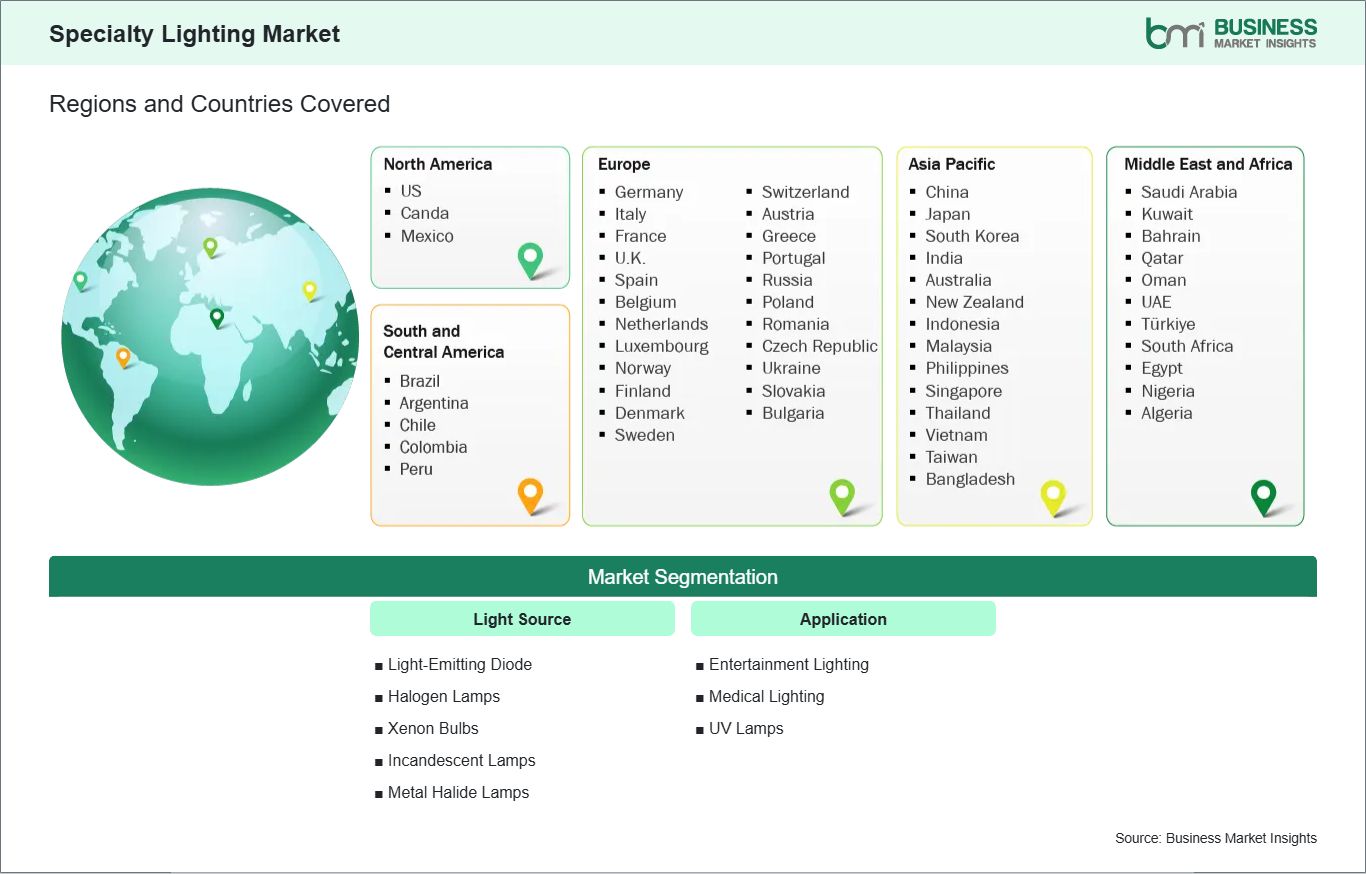
Key segments that contributed to the derivation of the specialty lighting market analysis are light source and application.
The specialty lighting market is expanding as industries increasingly focus on energy-efficient illumination technologies. Businesses and institutions are replacing traditional lighting systems with advanced specialty lighting solutions that consume less power while delivering higher performance and reliability. This shift is largely influenced by the need to reduce operational costs and support sustainability initiatives in commercial and industrial environments. In established lighting markets, organizations are prioritizing upgrades to modern lighting systems that offer longer operational life and minimal maintenance requirements. Facilities such as healthcare centers, laboratories, and manufacturing plants rely on specialty lighting to maintain consistent illumination while improving overall energy efficiency.
The transition toward smart lighting controls and automated systems further strengthens the demand for energy-efficient specialty lighting solutions. In emerging infrastructure environments, rapid development of commercial spaces and public facilities is encouraging the adoption of efficient lighting technologies. Builders and project developers are integrating specialty lighting into new projects to ensure durability, flexibility, and reduced energy consumption, supporting the broader shift toward sustainable building practices.
The use of specialty lighting in architectural and landscape design is becoming increasingly important as property developers and designers seek to enhance visual appeal and functionality. Specialty lighting allows precise control over brightness, color, and direction, enabling creative lighting effects that highlight building structures, outdoor spaces, and public environments. In mature urban design markets, architectural lighting plays a key role in improving the aesthetic value of commercial buildings, cultural venues, and hospitality facilities.
Designers are incorporating advanced lighting technologies into building facades, interiors, and surrounding landscapes to create visually engaging environments while maintaining energy efficiency and operational flexibility. In developing construction markets, the growing focus on modern infrastructure and urban aesthetics is driving greater use of landscape lighting. Developers are integrating specialty lighting into parks, walkways, and public areas to enhance nighttime visibility and overall ambience. As cities continue to prioritize attractive and well-lit environments, specialty lighting solutions are becoming an essential component of contemporary architectural planning.
The Specialty Lighting Market demonstrates steady growth, with size and share analysis highlighting evolving trends and competitive dynamics among key players. The report examines subsegments categorized within light source and application, offering insights into their contribution to overall market performance.
Light Source, the light-emitting diode (led) subsegment dominated the market in 2025, driven by energy efficiency, longer lifespan, and increasing adoption across entertainment and medical applications.
In terms of Application, the entertainment lighting subsegment dominated the market in 2025, driven by growing demand for advanced lighting systems in concerts, theaters, and live events.
| Report Attribute | Details |
|---|---|
| Market size in 2025 | US$ 6.19 Billion |
| Market Size by 2033 | US$ 11.29 Billion |
| Global CAGR (2026 - 2033) | 7.80% |
| Historical Data | 2022-2024 |
| Forecast period | 2026-2033 |
| Segments Covered | By Light Source
|
|
Regions and Countries Covered
| |
| North America | US, Canada, Mexico |
| Europe | Belgium, Austria, Finland, Denmark, Greece, Poland, Romania, Russia, Ukraine, Czech Republic, Slovakia, Bulgaria, Italy, Luxembourg, Germany, Switzerland, France, Netherlands, Norway, Portugal, Spain, Sweden, United Kingdom |
| Asia-Pacific | Australia, China, India, Japan, South Korea, Indonesia, Malaysia, Philippines, Singapore, Thailand, Vietnam, Bangladesh, New Zealand, Taiwan |
| South and Central America | Brazil, Argentina, Peru, Chile, Colombia |
| Middle East and Africa | Bahrain, Kuwait, Oman, Qatar, Saudi Arabia, United Arab Emirates, Turkiye, South Africa, Egypt, Algeria, Nigeria |
| Market leaders and key company profiles |
|
The "Specialty Lighting Market Size and Forecast (2022 - 2033)" report provides a detailed analysis of the market covering below areas:
The geographical scope of the Specialty Lighting Market report is divided into North America, Asia Pacific, Europe, Middle East & Africa, and South & Central America. North America held the largest share in 2025.
Regional demand for specialty lighting varies depending on industrial development, healthcare infrastructure, and technological adoption. North America dominates the market due to strong demand across healthcare, entertainment, and automotive industries. The United States and Canada are major adopters of advanced specialty lighting solutions, particularly in surgical lighting, studio and stage lighting, and high-performance automotive lighting systems. Continuous investments in healthcare modernization and film production infrastructure further support regional growth.
Asia Pacific is emerging as a rapidly expanding region driven by large-scale manufacturing, urban development, and growing adoption of controlled environment agriculture. Countries such as China, Japan, South Korea, and India are increasingly implementing horticulture lighting, industrial inspection lighting, and advanced automotive lighting systems. Expanding electronics manufacturing also supports the demand for precision lighting in production facilities.
Europe emphasizes high-quality specialty lighting solutions in automotive engineering, architectural applications, and medical technologies. Germany, France, and Italy are investing in energy-efficient and precision lighting systems designed for specialized industrial environments and high-end commercial applications.
Middle East & Africa is witnessing growing adoption in hospitality, aviation infrastructure, and large entertainment venues, particularly in the UAE, Saudi Arabia, and South Africa.
South & Central America is gradually expanding specialty lighting adoption in agriculture, sports facilities, and healthcare institutions, with Brazil, Mexico, and Chile investing in modern lighting infrastructure to support evolving industry requirements.

The Specialty Lighting Market is evaluated by gathering qualitative and quantitative data post primary and secondary research, which includes important corporate publications, association data, and databases. A few of the key developments in the spatial light Modulator market are:
The Specialty Lighting Market is valued at US$ 6.19 Billion in 2025, it is projected to reach US$ 11.29 Billion by 2033.
As per our report Specialty Lighting Market, the market size is valued at US$ 6.19 Billion in 2025, projecting it to reach US$ 11.29 Billion by 2033. This translates to a CAGR of approximately 7.80% during the forecast period.
The Specialty Lighting Market report typically cover these key segments-
The historic period, base year, and forecast period can vary slightly depending on the specific market research report. However, for the Specialty Lighting Market report:
The Specialty Lighting Market is populated by several key players, each contributing to its growth and innovation. Some of the major players include:
The Specialty Lighting Market report is valuable for diverse stakeholders, including:
Essentially, anyone involved in or considering involvement in the Specialty Lighting Market value chain can benefit from the information contained in a comprehensive market report.
Please tell us your area of interest
(Market Segments/ Regions and Countries/ Companies)